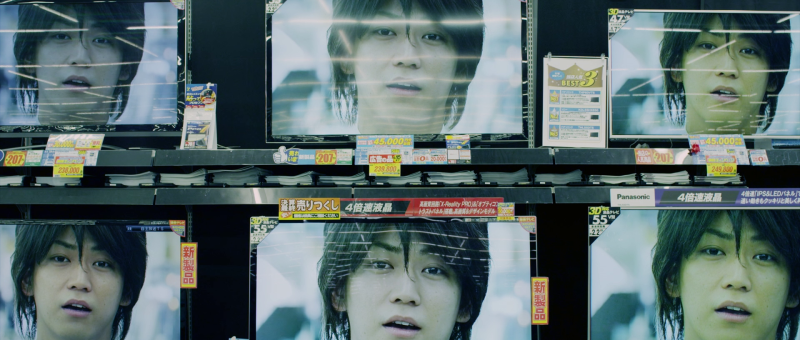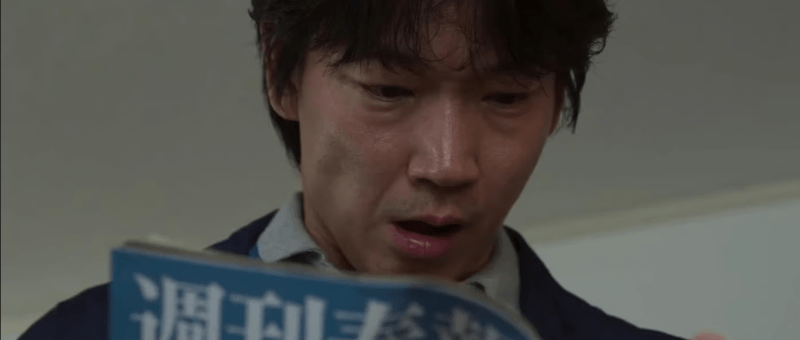
Sham (でっちあげ ~殺人教師と呼ばれた男, Takashi Miike, 2025) [Fantasia 2025]

After a couple of hundred years of corporatising culture, sham apologies have become an unfortunate phenomenon all over the world. Corporations in particular will often offer a fairly meaningless apology that acknowledges a minimal level of responsibility but does not bind them to recompense those they’ve wronged nor put right anything that their conduct has made wrong. The problem is that an apology has become a kind of sticking plaster that allows us all to move on but doesn’t really solve anything and may even prevent us from doing so because it turns us all into accidental liars who are primed to say “sorry” to make the situation go away even it wasn’t actually our fault.

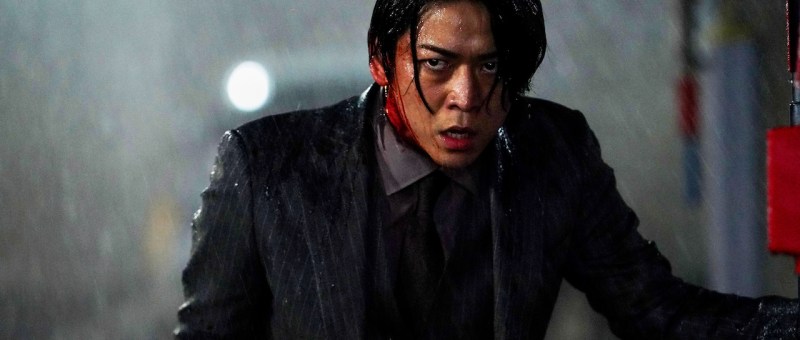
That’s essentially what happens to Seiichi (Go Ayano), previously an unremarkable primary school teacher with a teenage son of his own and an apparently happy home. Inspired by a real life case, Takashi Miike’s courtroom drama Sham (でっちあげ ~殺人教師と呼ばれた男, Detchiage: Satsujin Kyoshi to Yobareta Otoko) flirts with ambiguities but in keeping with its themes eventually descends into a defence of the well-meaning man as its hero becomes so embroiled in the injustice being done to him that he doesn’t see that he is not entirely blameless. Though we’re first introduced to him as the “homicidal teacher” the papers describe him as, the film’s title leaves us in no doubt that his account is the truer. But it remains a fact that during his conversation with Ritsuko (Ko Shibasaki), the mother of the boy Seiichi is accused of racially bullying, he did remark that Takuto’s American grandfather may explain his unique characteristics which is perhaps within the realms of thoughtless things well-meaning people say in awkward conversations but hints at a level of latent societal prejudice. In any case, that the fact his conversation with Ritsuko ended up drifting towards subjects like bloodlines and the Pacific War is not ideal, while Seiichi should probably have been more mindful of his politically neutral position as an educator. 

Likewise, he doesn’t dispute that he tapped Takuto lightly on the cheek to “educate” him that it hurt when he slapped another boy, Junya, who, according to Seiichi, he was bullying. He probably shouldn’t have done this either, even if some may see it merely as common sense in teaching the children that violence is wrong, as ironic as that may be. In any case, the film is on Seiichi’s side and insistent that he did not treat Takuto any differently on account of his non-Japanese ancestor nor spout off any of the racist nonsense that Ritsuko attributes to him. But the major problem is that Seiichi is mild-mannered and also a product of this society. He tries to protest his innocence, but is pressured by his headmaster to apologise anyway which is, of course, a form of lying, something they discourage the children from doing. In the end he goes along with it, because it’s easier to just say “sorry” and hope it goes away rather than address the real issues. 

It’s this sham society that the film seems to be critiquing, even if its message gets lost among its intertwining plot threads as Seiichi effectively finds himself bullied by an empowered tabloid media formenting mob justice against what it brands a far-right fascist teacher as a means of selling papers through generating outrage. While he is scrutinised and scorned, no one bothers to look into Ritsuko’s story which is already full of holes such as why, if she’s so protective as a mother, she waited for her son to be a victim of “corporal punishment” 18 times before complaining to the school. Little motivation is given for Ritusko’s actions, though Miike films her and her husband with an an almost vampiric sense of unease as they appear eerily in black on their way to the school. Unhinged herself, the answers may lie in Ritsuko’s own childhood and her yearning for a protective mother figure, not to mention the sophistication of being a child returning from abroad with good education and prospects for the future.

Seiichi refocuses his closing statement on Takuto, insisting that he doesn’t blame him for “lying”, but it’s perhaps also try that he is a kind of victim too whose own actions can only be explained by a closer look at his relationship with his mother and familial environment. But it turns out that it really is easier to just say “sorry” and move on. Even the psychiatrists seem more interested in treating Ritsuko like a customer whose wishes must be obeyed than earnestly trying to help Takuto even if his issues don’t seem to be as serious as his mother might have it. But according to Seiichi, telling a child off is the purest expression of love. If everyone carries on with sham apologies, nothing really changes and kids like Takuto get forgotten about as everyone falls over themselves to make the situation go away. No one really cares about the truth, and so it becomes an inconvenience to social cohesion in which those who insist on speaking it are hounded down until they agree with the majority and meekly say “sorry” while those in the wrong nod their heads and continue with their lives free of blame or consequence.


 Sham screened as part of this year’s Fantasia International Film Festival.

Trailer (English subtitles)
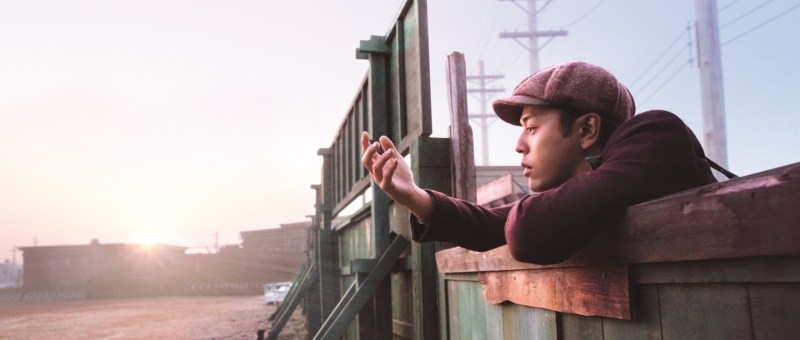
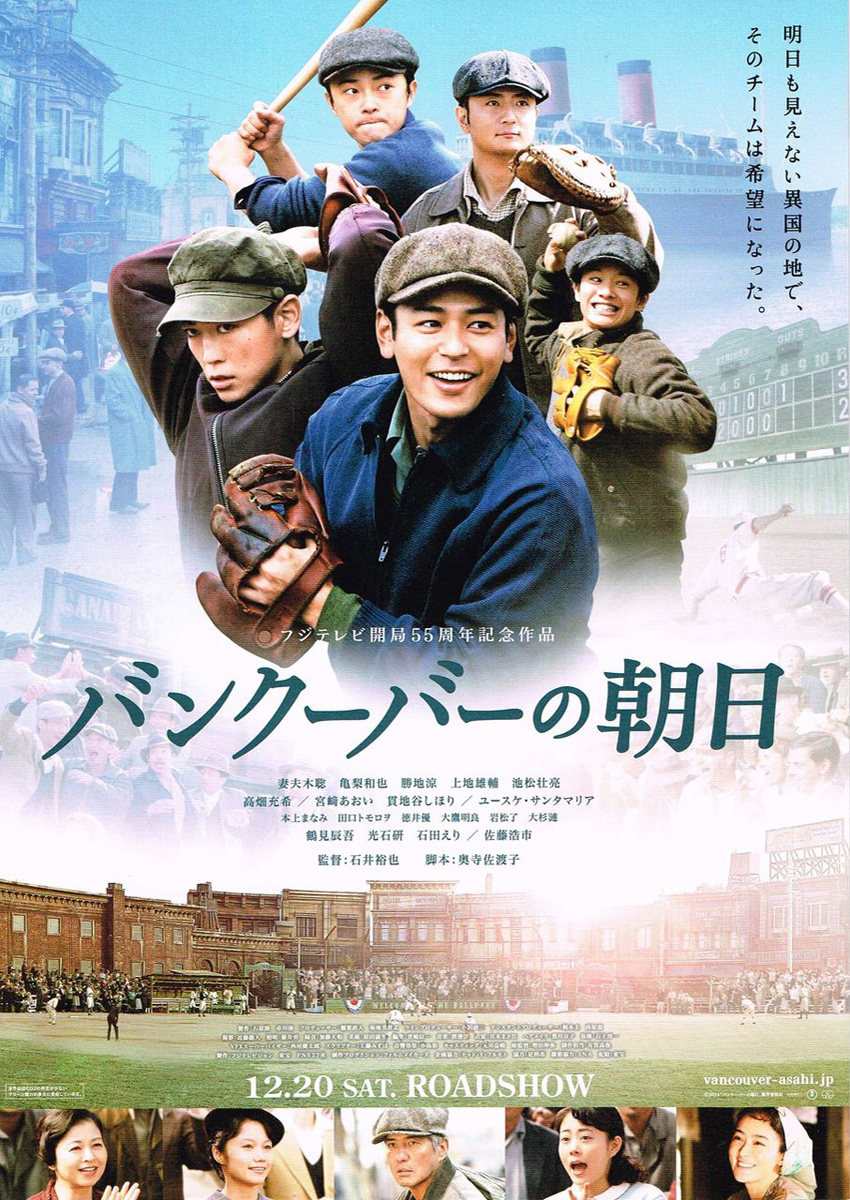
The Vancouver Asahi (バンクーバーの朝日, Yuya Ishii, 2014)

Second generation Japanese-Canadians stake their hopes on baseball in Yuya Ishii’s historical drama The Vancouver Asahi (バンクーバーの朝日, Vancouver no Asahi), inspired by the story of the Vancouver Asahi baseball team which was belatedly granted a place in the Canadian Baseball Hall of Fame in 2003. In many ways a conventional sporting movie in which the underdogs eventually triumph, Ishii does not shy away from the dark shadows of the 1930s even while framing the Asahi’s path to glory as a symbolic punch back against discrimination and oppression. 

As the hero, Reggie (Satoshi Tsumabuki), relates, many like his parents came to Canada at the beginning of the 20th century planning to work for three years and then return to a more comfortable life in Japan only to find themselves trapped in low-paid and exploitative work. Reggie’s main concern is that his drunken and dejected father Seiji (Koichi Sato) still sends the majority of his pay back relatives in Japan meaning their family live like paupers while as he never meant to stay he hasn’t bothered to learn the language or attempt to integrate into the local community. In fact, Reggie is their major breadwinner with his job at the sawmill but the only thing that makes his life worth living is playing baseball with the Vancouver Asahi baseball team even though they are regarded as something of a joke, always at the bottom of the league tables and never actually winning a game. 

The plight of Asahi is closely aligned with that of the immigrant community, divided as it is in its approach to integration with some feeling they should abandon their Japaneseness in order to better get along with Canadians and others fiercely determined to hang on to their traditions. When Reggie admits that they can’t win against the power of the Canadians it feels as if he’s talking about more than just baseball though his solutions are perhaps apt for both in realising that to beat strength you need to be smart. What he comes up with is essentially a bunt and run strategy that plays to their advantages of speed and lightness but also at times feels to him like a trick or a gimmick, an admission that they can’t compete in the normal way. “Why are you always apologising?” Reggie is repeatedly asked, his shyness and mumbling speech always seeking to keep the peace while his desire to offer justification is less as one Japanese old lady puts it “a bad habit of their culture” but a defence mechanism in an environment of potentially violent oppression. 

As Japanese migrants the family faces constant xenophobic micro aggressions, a woman at the hotel refusing to let Reggie’s bellboy friend Frank (Sosuke Ikematsu) carry her bags while they are also suspected as thieves or harassed by the local Canadians. Reggie’s hothead friend Kei (Ryo Katsuji) finds it increasingly difficult to keep his cool, not least as it turns out because his father was killed fighting for the Canadians in the last war and yet he is still treated as a dangerous outsider. Meanwhile, they are paid only half the wages of the Canadian workers, expected to work unreasonable hours, and can be fired without warning. Now an ageing man, Seiji is still a casual labourer fighting for a place on a truck to work at a quarry or construction site often in other towns away from his family in order to get more money. The team is constantly losing players because men lose their jobs and focus on finding new ones or moving away. As one old man laments, there’s no job security and even if you go to a Canadian university it won’t make any difference to your job prospects. Reggie’s sister Emi (Mitsuki Takahata) was on track for a scholarship only to have it pulled at the last minute when parents of the other kids complained it wasn’t right it was going to a Japanese girl. 

After the hotel fires all of its Japanese staff, Frank decides to go “back” to Japan where relatives will help him find work but pointing out to Reggie that he’ll still be seen as an outsider even there and there’s no guarantee anything will be any better in Japan. Poignantly the guys later catch sight of him in a newsreel as a soldier having been sent to the Machurian front. Once war breaks out they are discriminated against again, forced out of their homes and interned leaving all their property behind and destroying their small community, the Asahi included. The team’s unexpected success had forged a bridge between the Japanese and Canadian communities but it was not strong enough to survive the war. Stepping away from the sports movie, Ishii concentrates more on the ways they were betrayed, the team’s success later buried and forgotten while they find the advances they’d made washed away on the shore as if to suggest their strike back against an oppressive society could never be more than superficial while their position remains so precarious. 


Trailer (no subtitles)

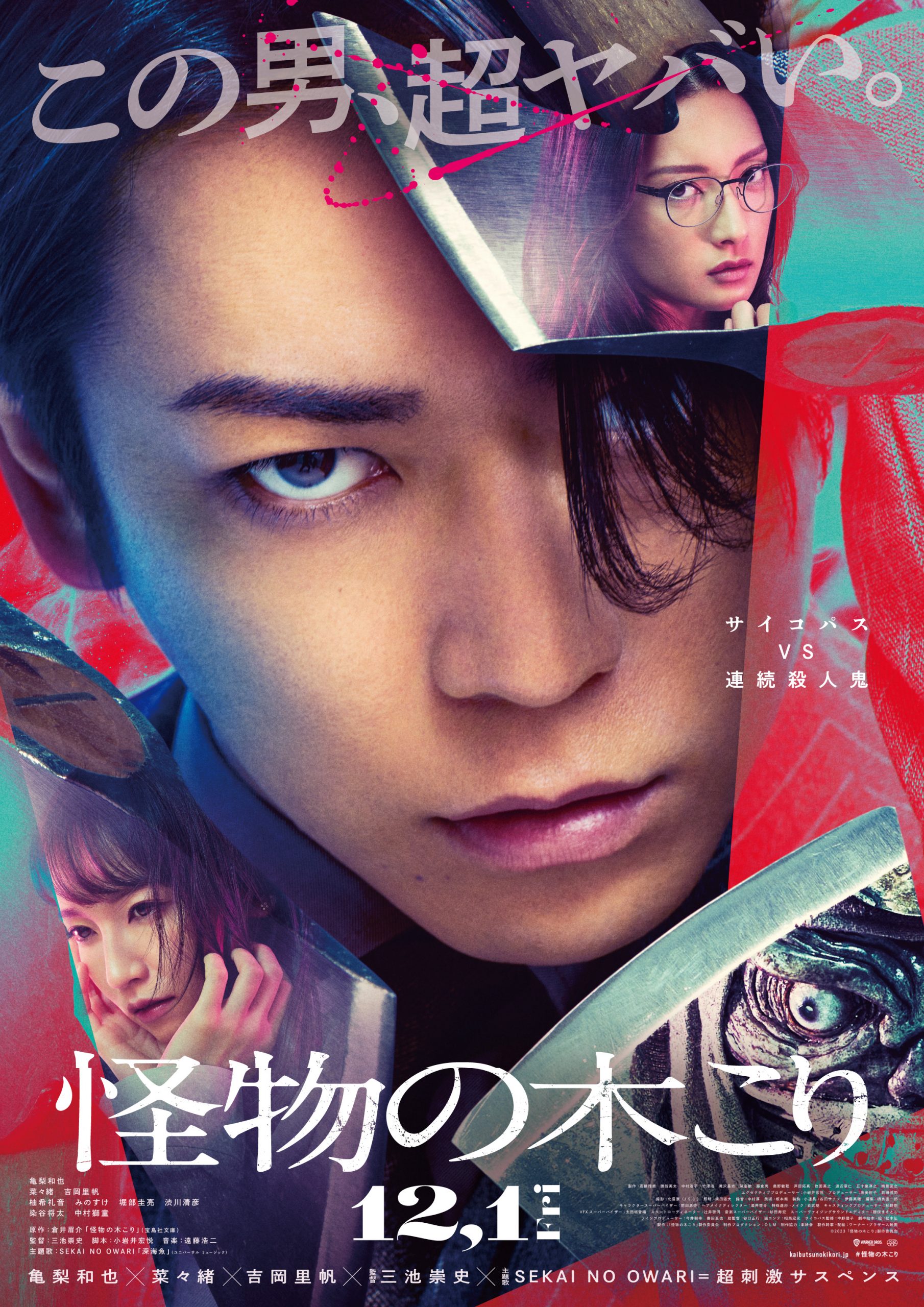
Lumberjack the Monster (怪物の木こり, Takashi Miike, 2023)

Could being a psychopath actually be better? It might be an attractive thought for some, the absolute freedom of living without emotional or moral constraint. Emotion is after all a difficult thing to bear, though life without it might also be lonely and unfulfilling leaving a void often filled by other desires such as a lust for wealth, status, power, or proof of superiority. Based on a novel by Mayusuke Kurai, Takashi Miike’s Lumberjack the Monster (怪物の木こり, Kaibutsu no Mikori) finds its hero at a point of existential crisis no longer certain of his true nature or identity.

The film takes its title from a fairytale featured in a picture book being read by a small boy who has been abducted and illegally experimented on. A monster begins living as a lumberjack in a small town where he begins killing and eating the residents, only no one notices. Eventually it realises that he spends more time being the lumberjack than the monster and is confused about his identity. With no friends left to talk to (because it ate them all), the monster decides to move to another town to make more friends but ends up sneaking into the house of a lumberjack, stealing a baby, and fashioning after itself to create another monstrous lumberjack.

This is in a sense what’s happened to Akira (Kazuya Kamenashi), now a lawyer who discovers he has a “neuro-chip” in his brain that suppresses his emotions after he’s attacked by a masked figure and it breaks re-introducing him to an unwelcome humanity. This is quite inconvenient for him in that he’s done quite a lot to feel guilty about, firstly participating in a scheme with his “friend” Sugitani (Shota Sometani), a natural-born psychopaths, to facilitate his experimentation on live humans, and secondly that he murdered his boss who is also his fiancée’s father to take over his law firm. Though the fiancée, Emi (Riho Yoshioka), seems to be afraid of him, it’s also true that simple proximity to her warmth and kindness may have begun to reopen his heart.

Of course, it could be true that the mad scientists who abducted the children accidentally picked up a few who were already psychopaths but in this case it seems like the chip did its job on each of the victims of the axe-wielding assassin. Meanwhile, we also see “psychopathic” traits in lead investigator Toshiro (Nanao) who admits that she will do whatever it takes to get to the truth even if it includes throwing out the police rulebook. Akira asks her if her desire to solve the case isn’t also a roundabout means of vengeance for the death of her brother, leaving her not so different from the assassin who is also extracting vicarious revenge on man-made psychopaths, but she replies that that’s exactly how a psychopath might see it while also deflecting a similar question from embittered cop Inui (Kiyohiko Shibukawa) who remarks that if the killer’s only taking out psychopaths then why bother stop them?

In some ways, Akira is like the lumberjack. He was simply being what he was and knew no different, but gradually beginning to rediscover his humanity is burdened with guilt and remorse now acutely aware not just of the feelings of others rather than their consequences but of his own feelings too. The couple who abducted the children claimed they were doing it to save their son, trying to reverse engineer psychopathy so they could cure him though their actions were themselves psychopathic and like the lumberjack they created only more monstrous children like themselves. Akira has it seems rediscovered the person he may have been if he had been raised in the loving family from which he was abducted and is determined to search for the meaning of life, but he is also responsible for the decisions he made as a man who knew no guilt or remorse and may in fact have to pay for the moral transgressions he was not fully aware he was making. Miike conjures a sense of the gothic in the creepy, candlelit mansion where the children were kept and otherwise sticks to standard procedural for the “real” world, but finally lands back in the realms of fairytale as his hero finds himself part of neither one world nor another while faced with a choice that may earn him redemption but also loneliness and futility.


Trailer (English subtitles)

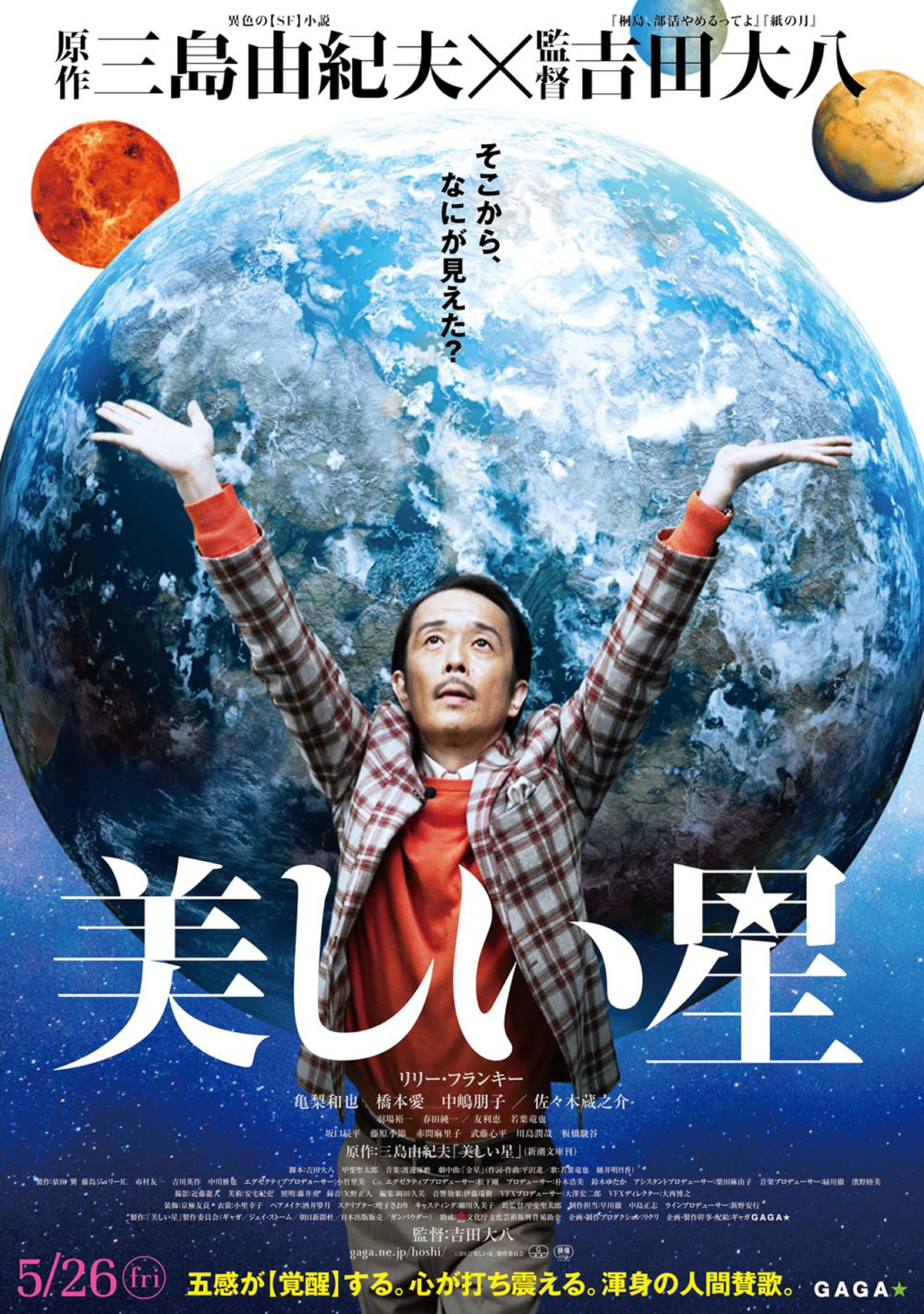
A Beautiful Star (美しい星, Daihachi Yoshida, 2017)

A Beautiful Star poster 1Given life’s anxieties, it can sometimes be hard to remember that the world is a beautiful place. If only we humans could learn to stop and smell the flowers every so often, we wouldn’t be so eager to destroy the place that gave us life. Loosely adapting a novel by Yukio Mishima, Daihachi Yoshida’s A Beautiful Star (美しい星, Utsukushii Hoshi) swaps Cold War nuclear paranoia for climate change anxiety as a collection of extra-terrestrials consider differing strategies to save the Earth, the most radical of them being the eradication of the human race.

Yoshida opens with the Osugi family, minus son Kazuo (Kazuya Kamenashi), “enjoying” a birthday dinner at an Italian restaurant. The tension between them is obvious as patriarch Juichiro (Lily Franky) bad mouths his absent son, daughter Akiko (Ai Hashimoto) sits sullenly not touching her food, and mum Iyoko (Tomoko Nakajima) tries to keep the peace. Juichiro, as we later realise, is a minor celebrity – a much loved TV weatherman whose predictions are not terribly good but he does have a very personable manner. Unfortunately, he’s not so nice offscreen and has been cheating on his wife with a much younger woman who is after his job. After a tryst at a love hotel, the pair get into some kind of bizarre car accident and Juichiro wakes up on his own in a field feeling not quite right. After a colleague suggests he might have been abducted by aliens, he develops an interest in UFOs and, after being moved to tears on air, comes to the conclusion that he is a Martian emissary from the League of Solar Planets come to enlighten the Earth to the dangers of global warming before it’s too late.

In fact, Juichiro is not the only member of the Osugis to believe he is not of this Earth. Except for mum Iyoko, everyone eventually realises they are actually from another planet but their feelings of “alienation” are perfectly Earthbound and born of extremely normal anxieties the like of which can cause discord in any family. Complaining about his son’s lateness to the birthday dinner, Juichiro runs down Kazuo’s lack of full-time employment and writes him off as “just an errand boy”. Kazuo, resentful of his father, feels an intense insecurity about his failure to forge a successful life for himself – something that is thrown into stark relief when he meets an old college buddy now a salaryman who seems to take pleasure in the fact that the captain of the basketball team has made a mess of things where he is now on the road to career success. So when Kazuo meets shady fixer Kuroki (Kuranosuke Sasaki), currently running the campaign for conservative politician and climate change denier Takamori (Jyunichi Haruta), and finds out he is actually from Mercury, it restores his sense of purpose even if it pushes him towards becoming a slightly dangerous right-wing manipulator.

His sister, meanwhile, is a lonely, depressed university student with a complex about her appearance. Approached by a creepy guy running some kind of campus beauty pageant, she can’t get away fast enough but is captivated by the song of a street busker who eventually tells her she likes his music because it’s inspired by their shared roots as Venusians and that the reason she “despises” her own beauty is that Venusians used to set the beauty standards on Earth but now they’ve been usurped. Feeling not quite so alone and more confident in her skin, Akiko decides to enter the pageant to “correct” the perception of beauty in human society.

“Beauty” seems to be the key. Iyoko finds herself sucked into a pyramid scheme selling “beautiful” water mostly out of a sense of lonely purposelessness. Apparently from power spot deep within the Earth, the water is supposed to be its rejuvenating life blood but like so much else, humanity has misused and commodified it. Juichiro’s Martians have a conventional solution to the present problem in that they want humanity to wake up and slow down. The Mercurians, however, have more radical ideas. Seeing as humanity is toxic to this planet that we all love, the obvious answer is simply to eliminate it, engineer a reset in which the Earth could heal itself after which point a new, more responsible humanity could be permitted to return. The problem, they say, is that humans do not think of themselves as a part of nature or realise that extinction is a perfectly natural part of the ecological life cycle. If they did, they might not be in this mess, but now they need to accept their responsibility and agree to a mass cull to save the planet.

Each of the Osugis has their insecurities wielded against them, and in the end each of them is in some way deceived. Kazuo’s resentful ambition is exposed by Kuroki, but he eventually realises he’s not much more than a patsy, while Akiko has to face up to the possibility that she’s been spun a yarn by an unscrupulous man who was only after the usual thing from a naive and vulnerable young woman. Iyoko’s deception is of the more usual kind as she figures out that “beautiful water” is an obvious scam she only bought into because of the false sense of belonging and achievement it afforded her, and Juichiro has to wonder if his Martian “delusion” has a medical explanation, but through their various deceptions the family is eventually forced back together again springing into action as a unit. The Mercurians dismissed humanity as unable to see the world’s beauty, remaining wilfully ignorant of the gift they had been given. The Osugis have at least been awakened to a kind of beauty in the world and in themselves as they face their alien qualities and integrate them with those of others. Yoshida may not have a clear answer for the problems of climate change (who does?), but he is at least clear on one thing – you lose that which you take for granted. Smell the flowers while the flowers last.


International trailer (English subtitles)

It’s Me, It’s Me (俺俺, Satoshi Miki, 2013)

It's Me It's Me posterSome say it’s good to be your own best friend, but then again perhaps too much of your own company isn’t so good for you after all. The hero of Satoshi Miki’s adaptation of the Tomoyuki Hoshino novel, It’s Me, It’s Me (俺俺, Ore Ore), is about to put this hypothesis to the test as his identity literally splinters, overwriting the source code of strangers and replacing it with its own. How can you save your identity when you aren’t sure who you are? Perhaps getting to know yourself isn’t as straightforward a process as most would believe.

Hitoshi (Kazuya Kamenashi), an aimless 20-something, had dreams of becoming a photographer but they’ve fallen by the wayside while he supports himself with a dead end job on the camera counter in a local electronics superstore. Virtually invisible to all around him and so anonymous the woman in the fast food restaurant almost wouldn’t give him the fries he’d ordered, Hitoshi is irritated when two salaryman-types gossiping about how one of them plans to quit the company to pursue his dreams rudely invade his space. Perhaps for this reason, he finds himself taking off with the irritating stranger’s phone after he carelessly allows it to fall onto Hitoshi’s tray.

Emboldened, Hitoshi decides to use the phone to commit an “Ore Ore” scam – a well known telephone fraud in which a stranger rings an elderly person and shouts “it’s me, it’s me!” in a panic so they won’t twig it’s not really their grandson who is ringing them and claiming to be in some kind of terrible trouble which can only be relieved with cold hard cash. Not the sharpest knife in the drawer, Hitoshi gets the money wired to his account and then tries to dispose of the phone but it’s already too late. When he gets home, a strange woman (Keiko Takahashi) is in his apartment and she keeps calling him “Daiki”. What’s more, when he tries to go and see his mum (Midoriko Kimura), another guy is there who looks just like him and his mum won’t let him in.

Hitoshi eventually becomes friends with “Daiki” who introduces him to another “Me”, Nao – a cheerful student slacker. Each in their own way slightly disconnected, the trio build up an easy friendship – they do after all have quite a lot in common, and begin jokingly referring to their shared apartment as “Me Island”. Hitoshi, remarking that he’s never felt so carefree among others, begins to see the upsides of his strange new situation which obviously include the ability to be in two places at once, but too much of himself eventually begins to grate when Nao begins tracking down and bringing home all the other Mes he can find with the intention of launching a Me Empire.

A member of a lost generation, Hitoshi is a perfect example of modern urban malaise. Though he once had dreams, they’ve been steadily killed off by an oppressive society leaving him alone and adrift, unable to connect with others as the light slowly dies in his eyes. Perhaps, however, there is the odd flicker of resistance in his intense resentment towards those who have defiantly not given up – the chatty salaryman talking about his individualist dreams and later his work colleague who has been secretly taking accountancy classes in an effort to escape casual employment hell for a steady, if dull, regular job.

Hitoshi has always regarded relationships as “troublesome” but begins to feel differently through bonding with himself. As Daiki puts it, accepting others means that you’ll be accepted – something Hitoshi unconsciously longs for but is too insecure to believe is possible. His actualisation receives another stimulus when he meets the beautiful and mysterious Sayaka (Yuki Uchida) who again encourages him to accept the one who accepts you and is the only other person who seems to be able to see the “real” him as distinct from all the other Mes. Yet Hitoshi struggles – he can accept parts of but not all of himself, eventually leading to a disastrous turn of events in which the parts of himself he does not like begin being “deleted” as one Me decides to make war on all the others.

Only by ridding his psyche of imperfections can Hitoshi reformat his personality and once again resume full autonomy as the one and only Me. Yet can we be so sure final Hitoshi is the “true” Hitoshi? Who can say – only Hitoshi himself can know the answer to that (or not), the rest of us will just have to accept him as he is in the hope that he will also be able to accept us so that we can in turn accept ourselves.


Original trailer (no subtitles)

Policeman And Me (PとJK, Ryuichi Hiroki, 2017)

policeman 2The world of shojo manga is a particular one. Aimed squarely at younger teenage girls, the genre focuses heavily on idealised, aspirational romance as the usually female protagonist finds innocent love with a charming if sometimes shy or diffident suitor. Then again, sometimes that all feels a little dull meaning there is always space to send the drama into strange or uncomfortable areas. Policeman and Me (PとJK, P to JK), adapted from the shojo manga by Maki Miyoshi is just one of these slightly problematic romances in which a high school girl ends up married to a 26 year old policeman who somehow thinks having an official certificate will make all of this seem less ill-advised than it perhaps is.

Kako (Tao Tsuchiya) is only 16 and, truth be told, a little innocent, even naive when it comes to love though she desperately wants to get herself a proper boyfriend. Dragged by a friend to singles mixer where she’s abruptly told that’s she’s 22 for the next few hours, Kako is bashful and dutifully refrains from underage drinking or inappropriate behaviour. Against the odds she hits it off with handsome policeman, Kota (Kazuya Kamenashi), who still thinks she’s 22 and that her reticence is a sign both of shyness and of maturity. Inadvertently blurting out her real age, Kako blows things with Kota who, as policeman, has no interest in dating a 16 year old. However, leaving Kako to walk home alone after the last train has left through a dodgy area of town is not a good idea and she’s soon beset by a gang of moody boys! Luckily, Kota’s policeman instincts have kicked in and he turns up to save the day with some delinquent moves of his own.

Despite the age difference, Kota and Kako have a genuine connection but Kota is anxious not to do anything dishonourable or untoward. Thus, facing the prospect of breaking up with his teenage sweetheart, he abruptly proposes marriage! After all, when the government rubber stamps something it must be OK and no-one can be accused of doing anything morally wrong, right? The surprising thing is, Kota puts on a fancy suit and goes to break the news to Kako’s parents only to have them give up almost without a fight. Her father may be angry to begin with but he’s soon won over and left with nothing other to say than please look after my girl (and try not to get her pregnant until she’s finished her education).

Kako is then placed in the incongruous position of being both a regular high school girl and a married housewife. Kota is stationed at the local police box with two other officers – one an older guy and the other a young woman who both support him in his new life as a married man. The couple live in an improbably large house inherited from Kota’s late parents but their relationship remains chaste and innocent. Perhaps realising that this unusual union will not be welcomed by all Kako has not told anyone at school about her marriage whilst she goes about trying to rescue the sensitive delinquent, Okami (Mahiro Takasugi), who accidentally put her in the hospital before she was valiantly rescued by Kota.

Okami and Kota lock horns over several things from Kako to the rule of law but they have more in common than it might first seem. Kota, once a violent teen himself, is nursing a huge debt to his policeman father killed in the line of duty. Taking on his father’s mission, Kota has dedicated himself to serving and protecting even if he once rebelled against that very thing as the kind of teenage punk Okami currently aspires to be. Okami has his own share of troubles at home which explain most of his behaviour as well as his aversion to law enforcement but Kako sees straight through his tough facade for the damaged boy inside. Kota too comes to find him more of a kindred spirit in need of rescue than a danger to society who needs locking up and also views him as an ally in being another of Kako’s admirers.

Ryuichi Hiroki thrives on this sort of uncomfortable drama, bringing a touch of moral queasiness to an otherwise cute story of innocent romance. Kota and Kako never particularly deal with the elephant in the room aside from Kako’s worries that Kota sees her a little girl who needs protecting rather than a wife who wants to stand alongside him as an equal. Then again Kako is quite happy in a subservient role, playing directly into her romantic fantasies. Hiroki directs all of this in true shojo style, keeping it all very chaste and innocent, overcoming all obstacles related to the inappropriateness in the central relationship and reaffirming the fact that true love is real, occurs in unexpected places, and is waiting for every romantic young girl who dreams of a tall guy in a dashing uniform. Unrealistic? Perhaps, but that’s shojo.


Policeman and Me was screened at the 19th Udine Far East Film Festival.

30s trailer (no subtitles)