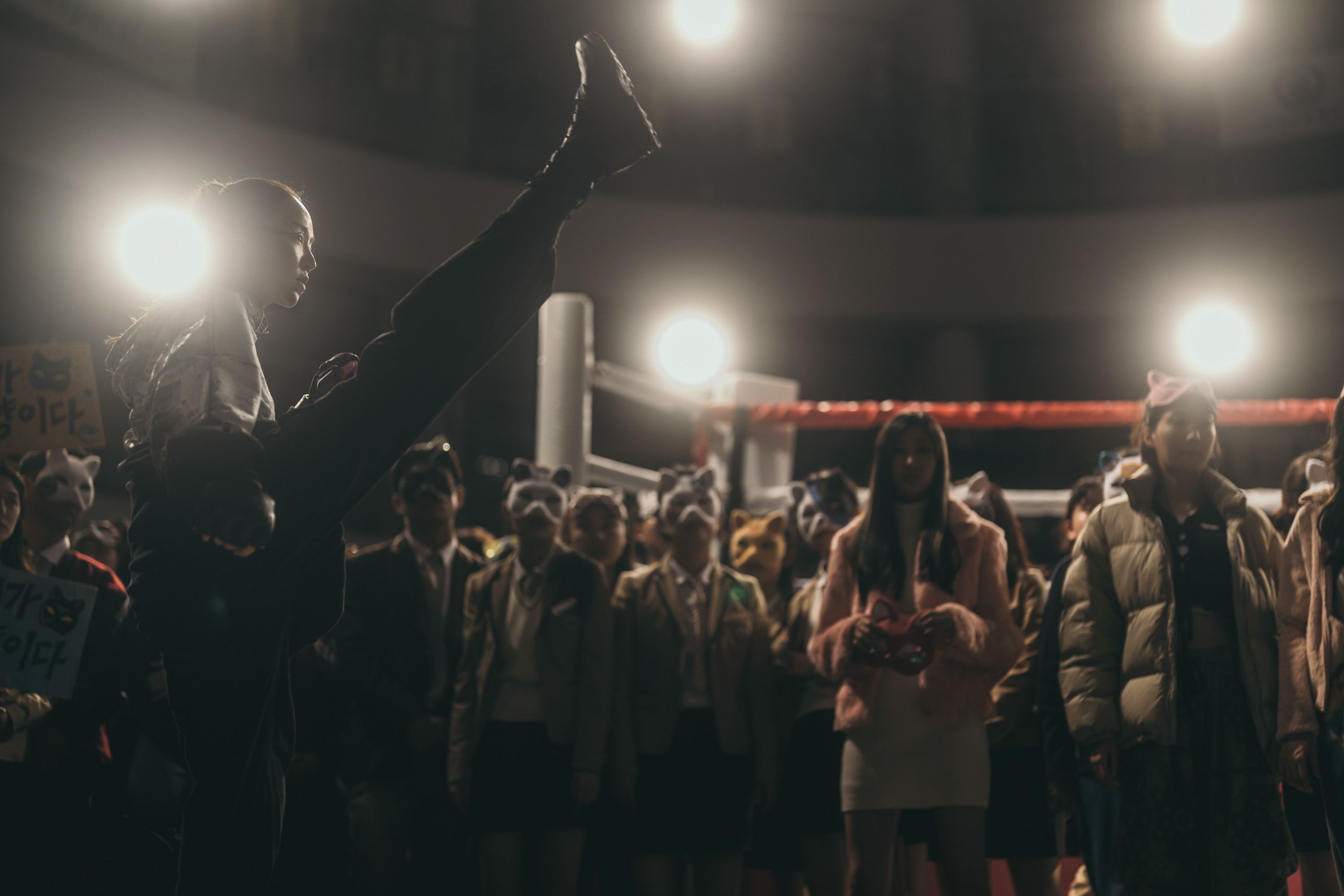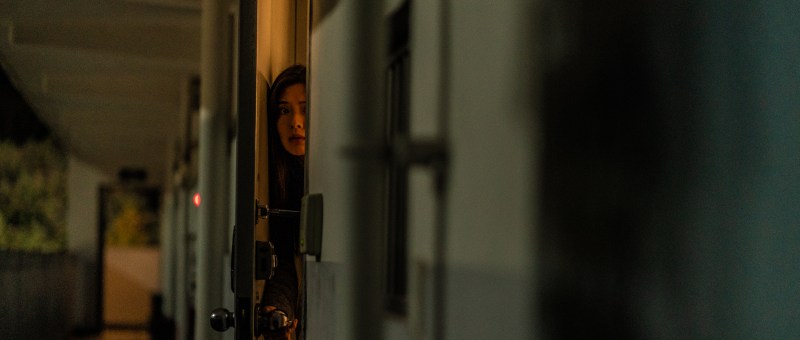
Noise (노이즈, Kim Soo-jin, 2024) [Fantasia 2025]

There are things you have to put up with if you live in an apartment block, and if you live in a city an apartment is often your only option. The question is, how much is it reasonable to expect someone to accept and what are the limits that can reasonably be placed on your own behaviour. What does it really mean to be a “good neighbour”? It’s clear the “noise” at the centre of Kim Soo-jin’s apartment block horror is not simply the sound of other people living, but a swarming cacophony of societal anxiety and persistent judgement.

There’s a large banner hanging off the side of this particular building that says residents don’t want to die inside their collapsing apartment block. Their fear hints the indifference of a society driven by capitalistic desires in which things like building regulations that ensure people’s safety and quality of life have become a thing of the past. The chairwoman of the residents’ association (Baek Joo-hee) is fiercely petitioning for the block to be knocked down and rebuilt properly, but that won’t happen if they don’t think they’ll be able to sell units in the new build because of untoward rumours about the old one. For those reasons, she doesn’t want people causing trouble or dragging up unpleasantness, which is why she’s not minded to help when Ju-young’s (Lee Sun-bin) sister Ju-hee (Han Su-a) goes missing after declaring that she was going to find the source of the “noise” within the apartment block that’s driving her and others out of their minds.

The interesting thing is that Ju-young is originally not particularly bothered by noise as she has a hearing impairment from a childhood accident and can simply remove her hearing aid to avoid it. Ju-hee asks her if she really can’t hear anything, or if it’s more like she chooses not to hear and goes about her life deliberately avoiding the “noise” of the contemporary society. There may be something in her criticism in that Ju-young, who works in a noisy factory, eventually moves out into the workers’ dorms to escape her sister’s increasingly erratic behaviour rather than stay to help her through her anxiety or actively look for somewhere less “noisy” they could live together in peace.

Hearing noise from above, Ju-hee bangs on the ceiling but inadvertently spreads the noise below as if a great flow of frustration and resentment were trickling down from top to bottom so that those nearest to the ground can barely hear themselves think. But there’s also a great stink rising from below given that the basement is home to a decade’s worth of illegally dumped rubbish. Rather than dispose of it, the security guard has simply chained up the doors but complains that for unclear reasons people are still dumping things through the broken window at the back, which no one is making an effort to fix. There’s so much “noise” that no one is really paying attention to the bigger things like missing women and fugitive killers, in part because they’re inconveniences that would prevent them upgrading their block or being able to sell up and move on. Yet paradoxically, the owner-residents blame everything of the renters insisting that they are inconsiderate because they don’t have a stake in the building’s future. 

The block itself becomes a kind of metaphor for a lingering authoritarianism with constant reminders that everyone can hear what everyone else is saying and is making less than silent judgements about the way their fellow residents live their lives. A woman drives herself crazy believing that she’s being a good neighbour by letting her child play outside so the noise won’t disturb anyone, only for them to be hit by a car and killed. The building has a haunted quality, as if everyone here were already dead and living in a kind of limbo. They complain about the noise, but ignore it when their neighbours are desperately asking for help. As Ju-young later advises, the way to continue living is not to listen and live your own life in your own way rather than give in to the petty demands of those around you who try to control your life because they know they can’t control their own. Driven out of their minds by the constant thrumming of social pressure, acts of violence are inevitable but as Ju-young traverses the dingy corridors and ill-lit stairways in search of her missing sister all while venturing deeper inside her own buried trauma, it becomes increasingly difficult to tell where exactly the threat may lie.


Noise screened as part of this year’s Fantasia International Film Festival.

Trailer (English subtitles)
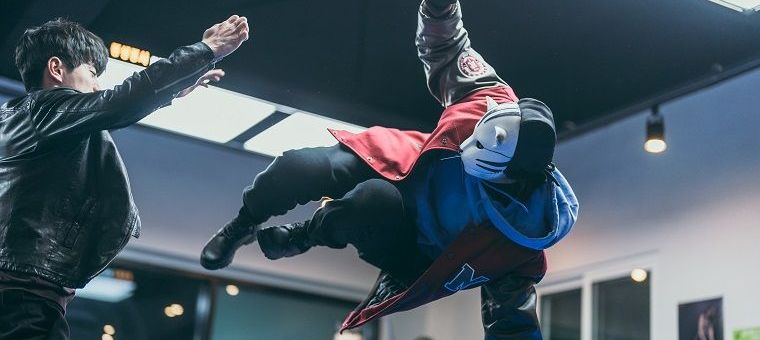
Brave Citizen (용감한 시민, Park Jin-pyo, 2023) [Fantasia 2024]

There’s an intentional irony in the mantra teacher Si-min (Shin Hae-Sun) is fond of repeating that “If you do nothing, nothing will happen,” in that on the one hand it means that until people decide to act a dissatisfying status quo will continue, but on the other it may also seem threatening implying that if only you keep quiet nothing will happen to you. The main thrust of Park Jin-pyo’s webtoon adaptation Brave Citizen (용감한 시민) does seem to be that abuses of power take place because so few people are willing to challenge them or indeed to stand up for those who cannot stand up for themselves.

That’s something Si-min discovers when a student comes to her and says he’s being harassed by notorious bully Su-kang (Lee Jun-Young). A former boxer/martial artist, Si-min is on a temp contract and evidently waited quite some time to be offered a position so takes it to heart when her boss, Mrs Lee (Cha Chung-Hwa), warns her not make waves and jeopardise her hopes of being hired full-time. Somewhat cynical she tries to talk herself out of standing up for him, talking herself into turning a blind eye to injustice as nothing to do with her but at the end of the day she isn’t someone who can just sit by and take it nor watch as others are harmed while Su-kang goes unchallenged. 

He’s unchallenged largely due to the socio-economic conditions of contemporary Korea in which the wealthy and well-connected are able to live above the law. When one of Su-kang’s victims tries to report him to the police, they are the ones who end up accused of making a false report while Su-kang gets off scot free because he counts judges and prosecutors among his relatives while his mother is a prominent lawyer. His family apparently also donate large amounts of money to the school, which has won a series of “anti-bullying awards,” which is why he can’t be expelled. Si-min’s predecessor took her own life because of Su-kang’s bullying while pretty much everyone is scared stiff of him.

It’s for these reasons that Si-min turns to violence in the hope of giving Su-kan a little “off-site education” and perhaps you can’t blame her when faced with such intransigence from compromised authority. Yet standing up for the students is also a way of learning to stand up for herself, not to succumb to turning a blind eye to injustice simply because it’s more convenient. It’s this wilful suppression of one’s rage towards the persistent injustices of society that ends up spreading them, a continuous chain of abuse in which people take out their frustrations on those unable to defend themselves like the drunk man who yells at Si-min in the street and comes to realise he’s picked on the wrong person. 

Then again, when questioned why he behaves this way Su-kang only answers that “it’s fun”. It’s difficult to believe he would be insecure in his status, yet he persistently mocks those he sees as socially inferior, “nobodies” and ”hobos”, as opposed to elites like himself. The suggestion is that he and his friends have become this way because of a lack of boundaries and a sense of invincibility, which is partly what annoys him so much about an intervention from an authoritarian figure such as Si-min over whom he has no authority because she has decided not to grant it to him. 

This might be what makes her a “brave citizen,” the name of an award granted to ordinary people working in favour of justice that her father had once won after otherwise ruining his life through unwisely guaranteeing a loan and being left on the hook for paying it back. Embracing the absurdity of the webtoon, Park goes big and bold painting the inequalities of the contemporary society in stark relief while injecting a sense of catharsis into Si-min’s attempts to smack some sense into the bullies while rediscovering her own desire to challenge injustice rather than remain complicit with it even if it is personally inconvenient. Her rebellion encourages others to do the same while robbing the bullies of their privileged position and exposing them to the consequences of their actions. Of course, fighting violence with violence may not be the best solution but does at least allow Si-min to make the most of what she has and to recover the self that had been beaten down and defeated but is now capable of fighting back both for herself and others.


Brave Citizen screened as part of this year’s Fantasia International Film Festival.

International trailer (English subtitles)

The President’s Barber (효자동 이발사, Lim Chan-sang, 2004)

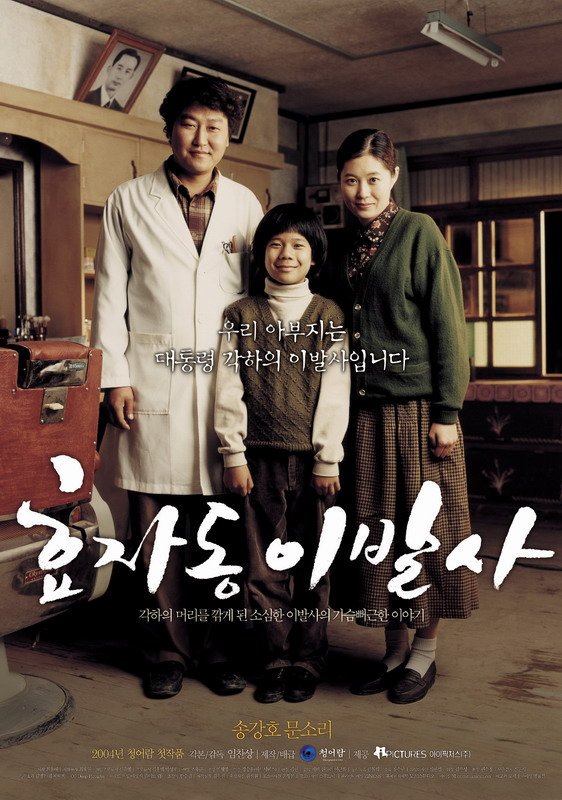
president's barber posterWe each of us live in the midst of history being made, some of us closer to the action than others. Most of us don’t quite realise how close we are or fully understand our role in events until it’s too late, but in any case we’re all just too busy getting on with the business of living to give much thought such grand concepts as history or legacy. Song Kang-ho has made a name for himself playing genial everymen forever at the mercy of historical machinations, but before he was an apathetic Taxi Driver, he was an apathetic barber giving haircuts to a dictator he half imagined was a friend. The President’s Barber (효자동 이발사, Hyojadong Ibalsa) is part journey into the intersection between rosy childhood nostalgia and national trauma, and part subtle political satire on the moral corruptions of authoritarianism but its own soft heartedness is often at odds with the grimness of its purpose.

Sung Han-mo (like the counter for tofu) is a nice but dim sort who has his own barber’s studio right across from the Blue House. As his son (Lee Jae-eung) tells us in his cutsey voice over, Han-mo (Song Kang-ho) is easily led and content to do whatever the village leader tells him to do, including participating in the ongoing corruption surrounding the re-election of despotic president Rhee Syngman. Our narrator, the oddly named Nak-an, was born as a result of a brief indiscretion between his father and an assistant (Moon So-ri) who had, apparently, hoped to marry someone else from her home village if Han-mo hadn’t trapped her with maternity. She wanted wanted an abortion but didn’t find out until after the much publicised five month cut off, meaning Han-mo talked her into staying and little Nak-an acquired the unfortunate nickname of “five months Na-kan”.

The family live happily enough until the mid-1960s when Park Chung-hee stages a coup and declares himself “President for Life”. When Han-mo somehow manages to catch a “North Korean Spy”, he gets himself a commendation and the attention of the authorities (for good or ill). A KCIA agent dutifully turns up and hauls Han-mo off to the Blue House because the president needs a trim…

Park’s reputation underwent something of a rehabilitation for a time. He did, in the minds of those seeking to justify his tyrannical reign, preside over Korea’s economic recovery. Han-mo is one of many to prosper, in his case directly in working indirectly for the regime. Han-mo is a simple man, he doesn’t think about politics but often feels belittled and downtrodden, made a figure of fun by those close to him even whilst remaining a cheerful optimist. He doesn’t take much convincing to hitch his mule to Park’s waggon, enjoying the personal boost in his social standing and finally feeling like a someone in being introduced to the world of the elites even when he is forced to accept that he does not and cannot exist fully within it.

Han-mo cuts hair, chatting away the way a barber does without really realising either that he is a vox pop spy or that he might, at any time, say the wrong thing and land himself in serious trouble. Serious trouble arrives during a heated and extremely bizarre period of political hysteria surrounding the “Marxus” virus – a lamentable episode in which an epidemic of dysentery was blamed on North Korean spies and all those who suffered from the condition taken in for “questioning”. Only when his own family is threatened does Han-mo start to reconsider his role in the affair – his status as a peripheral member of the Blue House team is no help in protecting those close to him and he can no longer pretend he does not know what happens in those basements, and that it happens to ordinary people not just “suspicious” ones.

The low level satire derives from Han-mo’s background presence becoming foreground as a very personal spat between a couple of high ranking Blue House staffers gathers in intensity before exploding into events which will have profound, though short-lived, consequences for Korean political history. Han-mo sadly takes down his portrait of Park hanging in pride of place in his shop and replaces it with one of Chun Doo-hwan (who was bald). Still a simple man he has, at least, learned his lesson and prepares to turn down the “honour” of shaving a dictator’s chin. Korea, the film seems to unsubtly hint, is finding its feet again though there will be another long reckoning before it, like Han-mo and his family, is finally able to free itself of the militarist yoke.