
Smugglers (밀수, Ryoo Seung-wan, 2023)

A collection of free divers decide it’s time to take control of the boat in Ryoo Seung-wan’s 1970s-set action drama, Smugglers (밀수, Milsu). The smoke rising from factory chimneys in the opening sequence as the fisherwomen pull into port ought to tip us off that this is partly a story of capitalistic corruption taking place during the economic miracle late into the rule of dictator Park Chung-hee. These factories may have made some rich and provided jobs for local men who can no longer make a living from the land, but it’s also destroyed the livelihood of these traditional divers. They return with a full haul, but are dismayed to discover that all of the shell fish is rotten because of the chemicals illegally spilled into the water by the local plants while the authorities have either been bribed or turn a blind eye.

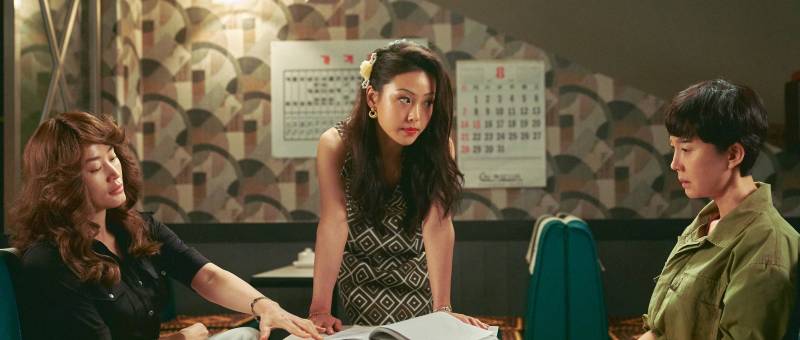
This is, in a lot of ways, the prevailing culture, as customs officers can also be bought off or choose to turn a blind eye when it suits them. One man is seen arriving by boat wearing several pairs of jeans to sell on the black market, while others carry bags full of foreign cigarettes and other contraband items the customs officials would be within their rights to “confiscate”. A local man starts putting pressure on the captain of the boat that drives the divers to start picking up other things have been dropped into the ocean, as it seems that everyone’s doing it anyway and there aren’t any other ways to make money in the local economy. He isn’t very happy about it, but his daughter Jin-sook (Yum Jung-ah) and her friend Choon-ja (Kim Hye-soo) along with most of the other women are blinded by the vast amounts of money they begin receiving that allow them to start living the high life in a growing local culture of excess as symbolised by the presence of a nightclub. Even gangster Kwon, when he arrives a few years later, is surprised to discover that this rural backwater has its own cinema and entertainment scene.

Kwon (Zo In-sung) is also someone who has been corrupted by his time serving in the Vietnam War, having lost his humanity and become ruthless to the extent of sadistic violence. Nevertheless, he’s also someone whom Choon-ja later thinks that she can manipulate on returning to the harbour town two years after escaping from the scene of the arrest when the other women were captured by police. That she ran off and has not been seen again leads some to the inevitable conclusion that she sold them out and made a new life in Seoul on the proceeds. There is then a degree of mistrust between herself and Jin-sook who suffered personal tragedy and spent time in prison while Choon-ja bided her time, waiting to put her plan in action. 

For much of the running time, the audience is a long way ahead of the cast in figuring out what actually happened during the first failed smuggling mission which makes the final revelations fall rather flat, yet it comes to something that the women largely find themselves powerless and divided in the face of male authority. Jin-sook has not inherited her father’s boat as it has been taken over by Hammer (Park Jeong-min) who was only a lowly assistant when she was arrested. She continues to be at his mercy despite being the de facto leader of the divers without whom the smuggling operation would fall apart. The return of Choon-ja then gives them an opportunity to leverage female solidarity and turn the tables on the men who exploit their labour and offer little in return.

Jin-sook’s initial reluctance to work with Choon-ja results in one of the divers going out into shark-infested waters and losing a leg in desperation to feed her family. Ironically, her husband had already lost an arm in a maritime accident, preventing him from working. The mistrust she faces also bears out Choon-ja’s claim that when you’re poor, the blame will always fall on you even if you haven’t done anything wrong. In the end, these women have only themselves to rely on if they want to turn the boat around. The film really kicks into gear in the third act as it enters conspiracy heist mode and Ryoo engages in his characteristically well-designed action sequences including a mass knife fight in a hotel and an impressive underwater sequence in which the divers have to fend off both assassins and sharks while trying to retrieve the bounty. Where it really excels, however, is in period detail and the sense of camaraderie that arises between the women as they finally become determined to seize the wheel.


Trailer (English subtitles)

Noise (노이즈, Kim Soo-jin, 2024) [Fantasia 2025]

There are things you have to put up with if you live in an apartment block, and if you live in a city an apartment is often your only option. The question is, how much is it reasonable to expect someone to accept and what are the limits that can reasonably be placed on your own behaviour. What does it really mean to be a “good neighbour”? It’s clear the “noise” at the centre of Kim Soo-jin’s apartment block horror is not simply the sound of other people living, but a swarming cacophony of societal anxiety and persistent judgement.

There’s a large banner hanging off the side of this particular building that says residents don’t want to die inside their collapsing apartment block. Their fear hints the indifference of a society driven by capitalistic desires in which things like building regulations that ensure people’s safety and quality of life have become a thing of the past. The chairwoman of the residents’ association (Baek Joo-hee) is fiercely petitioning for the block to be knocked down and rebuilt properly, but that won’t happen if they don’t think they’ll be able to sell units in the new build because of untoward rumours about the old one. For those reasons, she doesn’t want people causing trouble or dragging up unpleasantness, which is why she’s not minded to help when Ju-young’s (Lee Sun-bin) sister Ju-hee (Han Su-a) goes missing after declaring that she was going to find the source of the “noise” within the apartment block that’s driving her and others out of their minds.

The interesting thing is that Ju-young is originally not particularly bothered by noise as she has a hearing impairment from a childhood accident and can simply remove her hearing aid to avoid it. Ju-hee asks her if she really can’t hear anything, or if it’s more like she chooses not to hear and goes about her life deliberately avoiding the “noise” of the contemporary society. There may be something in her criticism in that Ju-young, who works in a noisy factory, eventually moves out into the workers’ dorms to escape her sister’s increasingly erratic behaviour rather than stay to help her through her anxiety or actively look for somewhere less “noisy” they could live together in peace.

Hearing noise from above, Ju-hee bangs on the ceiling but inadvertently spreads the noise below as if a great flow of frustration and resentment were trickling down from top to bottom so that those nearest to the ground can barely hear themselves think. But there’s also a great stink rising from below given that the basement is home to a decade’s worth of illegally dumped rubbish. Rather than dispose of it, the security guard has simply chained up the doors but complains that for unclear reasons people are still dumping things through the broken window at the back, which no one is making an effort to fix. There’s so much “noise” that no one is really paying attention to the bigger things like missing women and fugitive killers, in part because they’re inconveniences that would prevent them upgrading their block or being able to sell up and move on. Yet paradoxically, the owner-residents blame everything of the renters insisting that they are inconsiderate because they don’t have a stake in the building’s future. 

The block itself becomes a kind of metaphor for a lingering authoritarianism with constant reminders that everyone can hear what everyone else is saying and is making less than silent judgements about the way their fellow residents live their lives. A woman drives herself crazy believing that she’s being a good neighbour by letting her child play outside so the noise won’t disturb anyone, only for them to be hit by a car and killed. The building has a haunted quality, as if everyone here were already dead and living in a kind of limbo. They complain about the noise, but ignore it when their neighbours are desperately asking for help. As Ju-young later advises, the way to continue living is not to listen and live your own life in your own way rather than give in to the petty demands of those around you who try to control your life because they know they can’t control their own. Driven out of their minds by the constant thrumming of social pressure, acts of violence are inevitable but as Ju-young traverses the dingy corridors and ill-lit stairways in search of her missing sister all while venturing deeper inside her own buried trauma, it becomes increasingly difficult to tell where exactly the threat may lie.


Noise screened as part of this year’s Fantasia International Film Festival.

Trailer (English subtitles)

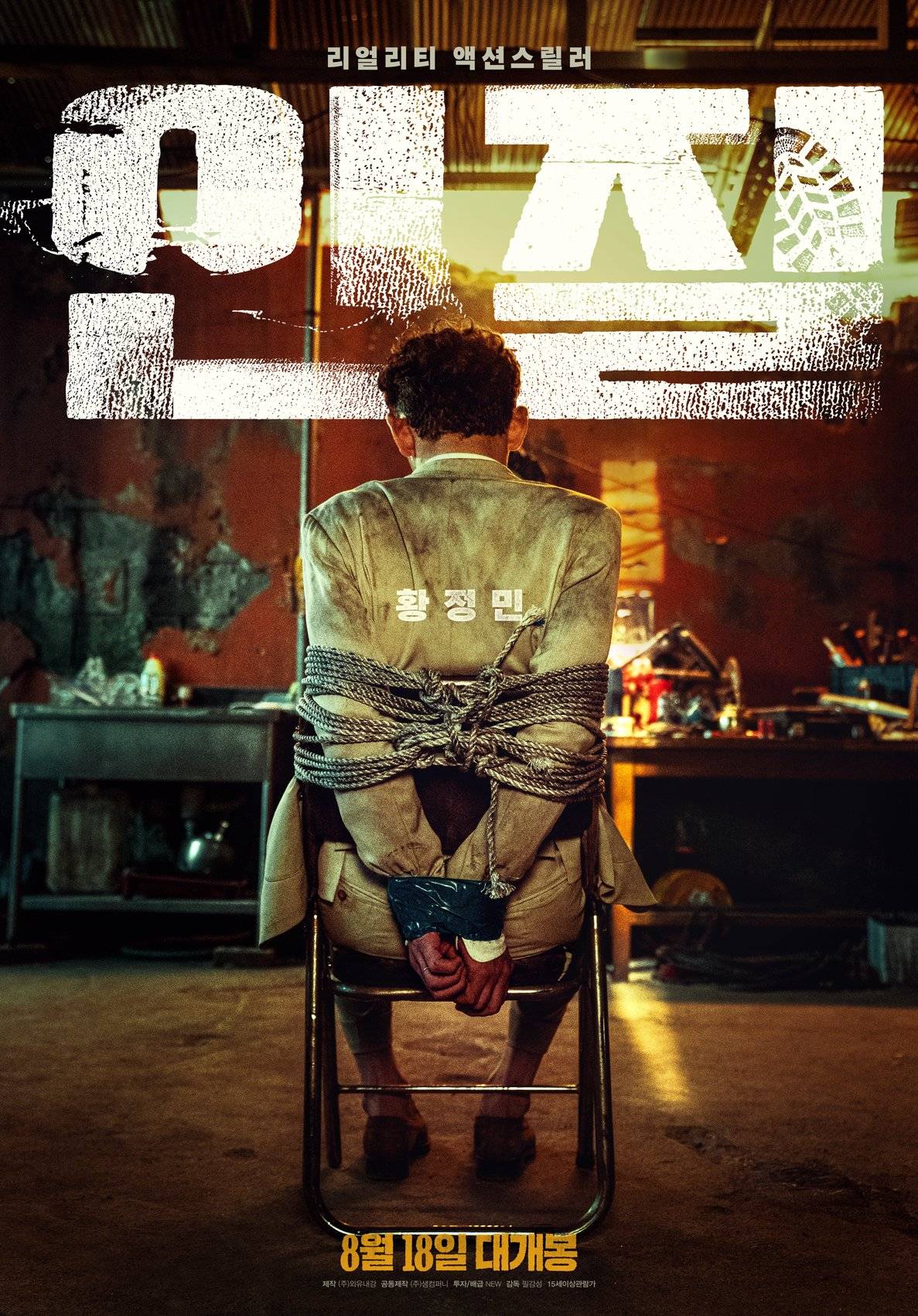
Hostage: Missing Celebrity (인질, Pil Gam-seong, 2021)

“This is real, birdbrain”. If you’re a famous actor, it might take a while to dawn on you that you’re in real trouble rather than the subject of an admittedly dark candid camera skit or variety show stunt. Real life and the movies begin to blur for top Korean actor Hwang Jung-min playing a fictionalised version of himself when he’s kidnapped by a gang of ruthless petty criminals in Pil Gam-seong’s meta take on Chinese thriller Saving Mr Wu, Hostage: Missing Celebrity (인질, Injil). 

Indeed the film opens with a montage of Hwang’s career to date including a degree of self-deprecation in which he describes himself as “just a petty actor” reminding the journalist interviewing him that film is a collaborative medium of which he is only a part. This version of himself that we see is modest and wholesome, going home early after an afterparty while his wife and son are away planning to relax alone. He seems to live a very lowkey life living in a fairly ordinary suburban house without domestic help or other signs of obvious wealth aside perhaps from an expensive car. Hwang is also on fairly friendly terms with the clerk at the local convenience store which he evidently visits frequently just like any other ordinary person rather than sending an underling to fetch him things or walking around with a massive entourage to remind people that he’s a movie star. Even while trying to escape his kidnappers he takes his shoes off before entering an old man’s home to use his landline telephone. 

Yet one can’t escape the fact that he is fantastically rich and perhaps out of touch with “real” life, his kidnappers targeting him mainly on a whim born of chance coincidence but also in resentment for everything he represents. The leader of the gang, Choi Ki-wan (Kim Jae-beom), is a crazed psychopath whose primary motivations are most likely sadistic rather than purely financial even if his targets are those with fancy cars but those of his underlings are perhaps more prosaic. When one of the gang members is captured, it emerges that he had massive debts to a casino loanshark while the most sympathetic of the kidnappers appears to have learning difficulties and later explains that he’s only doing this to pay for medical treatment to remove a prominent facial birthmark and scarring so he could live a more normal life. Because of his naivety he remains strangely loyal to Ki-wan believing that he’s looking after him while refusing any responsibility for his crimes. The gang’s only female member (Lee Ho-jung), by contrast, seems to be a North Korean refugee in a romantic relationship with Ki-wan’s less psychotic but no less cruel partner Dong-hoon (Ryu Kyung-soo) who just wants the money. 

Having literally played through scenarios just like these in his films, Hwang Jung-min the actor has perhaps gained a degree of experience that allows him to process his situation with a surprising degree of rationality quickly realising that as the kidnappers have made no attempt to hide their identities they most likely plan to kill him, and a young woman, So-yeon (Lee Yoo-mi), abducted alongside a wealthy cafe owner they killed when he couldn’t come up with the cash fast enough, after they’ve got the ransom payments. It isn’t that Hwang’s stingy, it’s that he knows there’s no point giving them the money but his only chance for survival lies in making them think he might. Even so, he gets to literally play the hero engaging in a battle of wits with the kidnappers before attempting to make a dashing escape while the on the outside the a dogged policewoman and her partner do their best to track them down despite the unhelpful interventions of their more conservative boss. 

Ki-wan might well have a point in admitting he’s overreached by going for such a high profile target. The police probably wouldn’t be investigating so heavily if the victim weren’t a famous movie star whose face is splashed across the papers. After all, they hadn’t done much for So-yeon whose sister had had to go to social media to raise awareness about her kidnapping fearing the police weren’t doing enough to help. Bearing out the underlying economic anxiety, So-yeon had only got the cafe job a few days previously after 37 failed interviews. Hwang’s response that he failed a hundred auditions before getting a break, people laughing at his acting dreams because he was a guy with curly hair and red skin who spoke with a strong southern accent, is intended to be reassuring in implying that even if it takes time you get there in the end but is also a little insensitive in the circumstances in downplaying So-yeon’s struggles in the contemporary economy having gone from elation in finally finding employment to being locked in a shed by a gang of psychos because of her boss’ personal greed which seems like quite the metaphor for the inequalities of the modern society. In any case, Pil crafts an intense kidnap thriller given an additional layer of absurdity in its meta dimensions but ends on a note of poignancy which suggests that Hwang himself is also and perhaps always will be hostage to his own image. 


Hostage: Missing Celebrity screened as part of this year’s Udine Far East Film Festival.

International trailer (English subtitles)