The Romantic President (피아노 치는 대통령, Jeon Man-bae, 2002)

A pure-hearted politician finds himself falling for an uncompromising teacher in Jeon Man-bae’s nonsense comedy Romantic President (피아노 치는 대통령, Piano chineun daetongnyeong). This president is indeed “romantic” in the sense that he is an idealised vision of a political leader. The film doesn’t go into his politics at all and it’s ambiguous where he belongs on the political divide. Instead, he is depicted as a man of integrity who is good and kind. In short, the kind of political leader that might not really exist in real life.

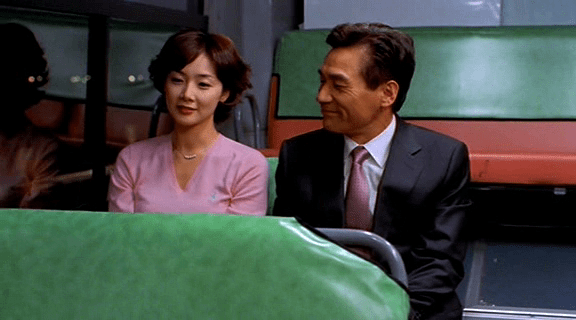
Min-wook (Ahn Sung-ki) first appears in disguise having gone undercover to talk to a group of homeless people living at the station. While talking to them, he himself is harassed by a policeman overstepping the bounds of his authority. The policeman calls the men “trash” and says that they disgust ordinary people. Little knowing who he is, the policeman bullies Min-wook who then identifies himself by striking the same pose as on as his campaign photo.

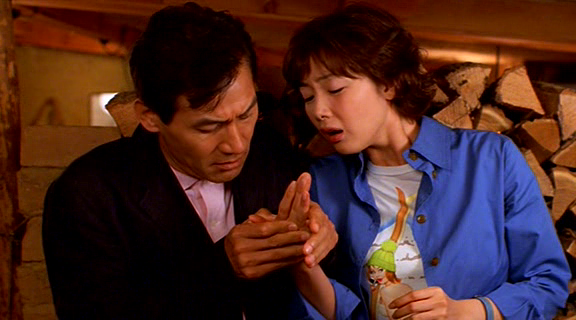
Something similar happens later when Min-wook decides to take a day driving a taxi in order to get closer to the people he is supposed to be serving. All of which marks him out as someone who is genuinely interested in the lives of the electorate and how to make them better. Though references are made to other political scandals, Min-wook seems to be held to a different standard and is a figure of integrity and incorruptibility. This is, however, why his romance is so dangerous in that It complicates his image and the secrecy involved because of his position makes it seem like he’s done something wrong or that there is an illicit quality to his relationship with schoolteacher Eun-soo (Choi Ji-woo). However, at the film’s conclusion, Min-wook admits that the “piano-playing president” was a persona he constructed for the purpose of winning the election, which is to say inauthentic. He has been lying all along, but his romance with Eun-soo has made it impossible for him to continue with the subterfuge. Only by being his true self can he gain romantic fulfilment even if it comes at the cost of his political career.

For her part, Eun-soo may also be harbouring a secret that paints her as something of a political rebel and possible extremist. She has failed to keep a job for more than six months because of her eccentric behaviour and intense interest in teaching in which, like Min-wook, she is invested in her pupils lives and wants to do what she can to make them better. On arrival at her new school she poses as a pupil to find out the class gossip and then becomes determined to save Young-hee (Im Soo-jung) who has become a delinquent little knowing she is the president’s daughter. No one else is willing to go against the Blue House with the consequence that Young-hee has become drunk on power, rebelling in the hope that someone will push back. Eun-soo is that person and soon earns Young-hee’s trust precisely because of the genuine interest she takes in her that is undaunted by her father’s position.

Young-hee too responds to authenticity and gradually becomes more authentic herself through her interactions with Eun-soo. Nevertheless, at the same time, the film suggests that society remains judgemental and is not always prepared to recognise an individual’s authentic identity. Eun-soo’s roommate is a transwoman who is repeatedly deadnamed and then eventually outed by the invasive press when Eun-soo’s relationship with Min-wook is exposed. Nevertheless, Eun-soo strives to protect her friend while accepting that she may have to deny her feelings to protect Min-wook’s position.

Despite all the silliness and zany antics, the film has a degree of earnestness at its heart in which it believes that it shouldn’t be wrong to express one’s true feelings. Authority figures can fall in love too, and it’s better for everyone if they do, otherwise you end up with the toxic combination of power and unhappiness that causes the policeman to abuse his authority to bully the homeless. Even so, the irony is that on becoming Min-wook’s official partner, Eun-soo must again play another role, radically altering her appearance to conform to the image of the president’s wife. Nevertheless, once authentically embraced, their love is accepted by the wider society which is then itself improved as a result.


Trailer (English subtitles)

The President’s Barber (효자동 이발사, Lim Chan-sang, 2004)

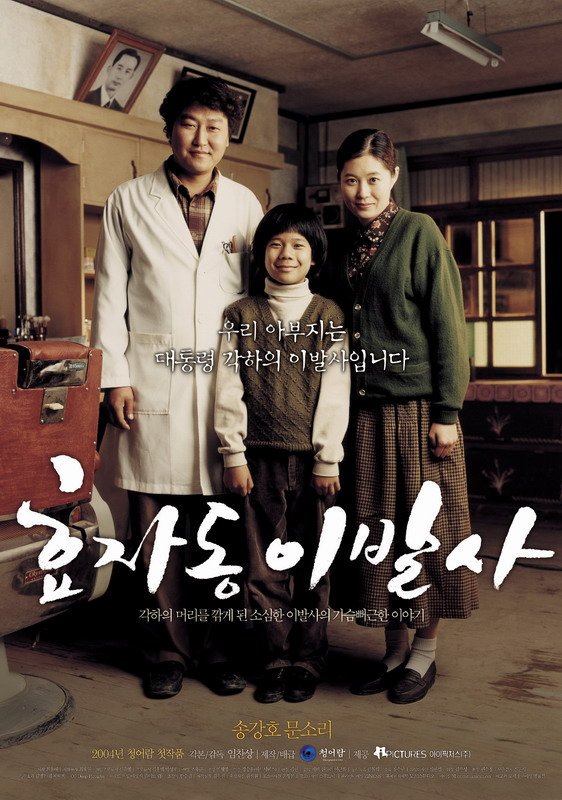
president's barber posterWe each of us live in the midst of history being made, some of us closer to the action than others. Most of us don’t quite realise how close we are or fully understand our role in events until it’s too late, but in any case we’re all just too busy getting on with the business of living to give much thought such grand concepts as history or legacy. Song Kang-ho has made a name for himself playing genial everymen forever at the mercy of historical machinations, but before he was an apathetic Taxi Driver, he was an apathetic barber giving haircuts to a dictator he half imagined was a friend. The President’s Barber (효자동 이발사, Hyojadong Ibalsa) is part journey into the intersection between rosy childhood nostalgia and national trauma, and part subtle political satire on the moral corruptions of authoritarianism but its own soft heartedness is often at odds with the grimness of its purpose.

Sung Han-mo (like the counter for tofu) is a nice but dim sort who has his own barber’s studio right across from the Blue House. As his son (Lee Jae-eung) tells us in his cutsey voice over, Han-mo (Song Kang-ho) is easily led and content to do whatever the village leader tells him to do, including participating in the ongoing corruption surrounding the re-election of despotic president Rhee Syngman. Our narrator, the oddly named Nak-an, was born as a result of a brief indiscretion between his father and an assistant (Moon So-ri) who had, apparently, hoped to marry someone else from her home village if Han-mo hadn’t trapped her with maternity. She wanted wanted an abortion but didn’t find out until after the much publicised five month cut off, meaning Han-mo talked her into staying and little Nak-an acquired the unfortunate nickname of “five months Na-kan”.

The family live happily enough until the mid-1960s when Park Chung-hee stages a coup and declares himself “President for Life”. When Han-mo somehow manages to catch a “North Korean Spy”, he gets himself a commendation and the attention of the authorities (for good or ill). A KCIA agent dutifully turns up and hauls Han-mo off to the Blue House because the president needs a trim…

Park’s reputation underwent something of a rehabilitation for a time. He did, in the minds of those seeking to justify his tyrannical reign, preside over Korea’s economic recovery. Han-mo is one of many to prosper, in his case directly in working indirectly for the regime. Han-mo is a simple man, he doesn’t think about politics but often feels belittled and downtrodden, made a figure of fun by those close to him even whilst remaining a cheerful optimist. He doesn’t take much convincing to hitch his mule to Park’s waggon, enjoying the personal boost in his social standing and finally feeling like a someone in being introduced to the world of the elites even when he is forced to accept that he does not and cannot exist fully within it.

Han-mo cuts hair, chatting away the way a barber does without really realising either that he is a vox pop spy or that he might, at any time, say the wrong thing and land himself in serious trouble. Serious trouble arrives during a heated and extremely bizarre period of political hysteria surrounding the “Marxus” virus – a lamentable episode in which an epidemic of dysentery was blamed on North Korean spies and all those who suffered from the condition taken in for “questioning”. Only when his own family is threatened does Han-mo start to reconsider his role in the affair – his status as a peripheral member of the Blue House team is no help in protecting those close to him and he can no longer pretend he does not know what happens in those basements, and that it happens to ordinary people not just “suspicious” ones.

The low level satire derives from Han-mo’s background presence becoming foreground as a very personal spat between a couple of high ranking Blue House staffers gathers in intensity before exploding into events which will have profound, though short-lived, consequences for Korean political history. Han-mo sadly takes down his portrait of Park hanging in pride of place in his shop and replaces it with one of Chun Doo-hwan (who was bald). Still a simple man he has, at least, learned his lesson and prepares to turn down the “honour” of shaving a dictator’s chin. Korea, the film seems to unsubtly hint, is finding its feet again though there will be another long reckoning before it, like Han-mo and his family, is finally able to free itself of the militarist yoke.