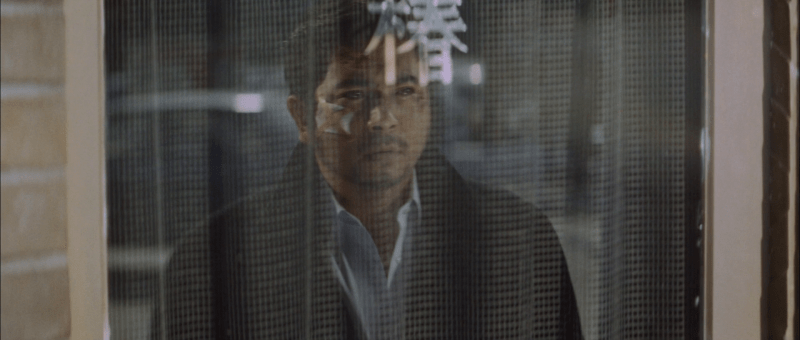
The Man Without a Map (燃えつきた地図, Hiroshi Teshigahara, 1968)

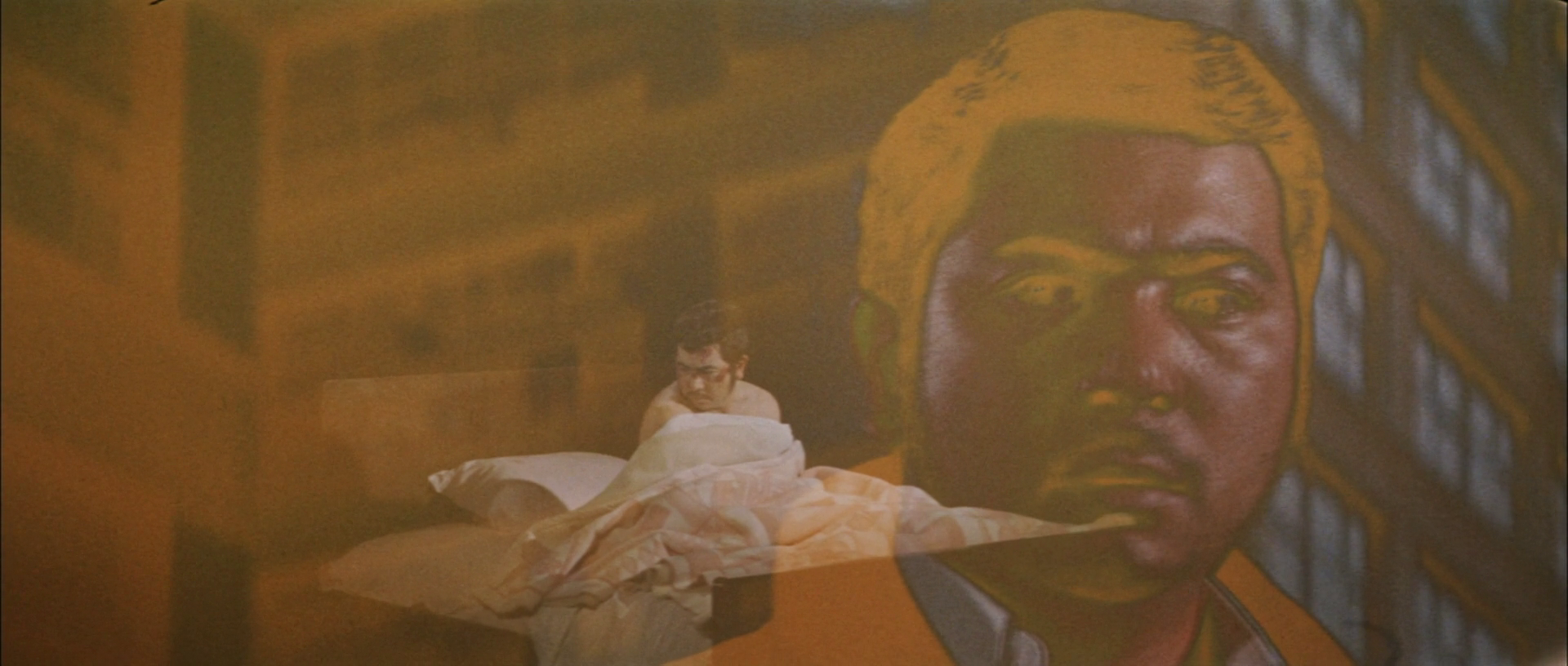
Hired to find a missing person no one really wants found, a detective begins to chase his own tail amid the impersonal vistas of the contemporary city in Hiroshi Teshigahara’s The Man Without a Map (燃えつきた地図, Moetsukita chizu). The fourth and final in his series of Kobo Abe adaptations and the only one in colour, the film’s Japanese title “burned-up map” may also, in its way, refer to the city of Tokyo which appears blurred out and indistinct in the sepia-tinted opening and is thereafter frequently shot from above as a depersonalised space where anonymous cars shuttle along highways like so many ants moving in rhythm with the momentum of the metropolis.

We follow a nameless detective (Shintaro Katsu) as he’s charged with investigating the disappearance of a 43-year-old salaryman, Hiroshi Nemuro, who turns out to have myriad other personalities and hasn’t been seen for six months. The man’s wife, Mrs Nemuro (Etsuko Ichihara), is not terribly helpful and the detective comes to wonder if the investigation itself is intended to further disguise the man’s whereabouts and prove that he really is a “missing person”. Yet this Tokyo is full of “missing people” including the detective who, we later learn, is a kind of fugitive himself. He apparently walked out on his wife (Tamao Nakamura), the owner of a successful boutique, because he couldn’t find his place there any more. He was once a salaryman too, and became a detective because it was the furthest thing he could think of from a regular job. 

It confuses him that no one really seems to be interested in where Nemuro is or if he’s alright, only in the reason behind his disappearance. The more he chases him, the more he begins to take on Nemuro’s characteristics as if he were intended to slide into the space Nemuro has vacated. Toru Takemitsu’s eerie harpsichord score only seems to add to the hauntingly gothic quality of this quest. The question is whether such a thing as identity even exists any more. The detective puts on Nemuro’’s jacket, though it’s too small, and is mistaken for him, while a colleague of Nemuro’s insists that he’s seen him in the street and is sure it was Nemuro simply because of the unusual colour of his suit without ever seeing his face. Tashiro (Kiyoshi Atsumi) tells the detective that Nemuro had a secret hobby taking nude photos at a specialist club that caters to such things. The two of them are confident they’ve identified the woman in the picture based on her haircut, but the girl they speaks laughs and takes off her wig explaining that she was merely asked to wear it, so the woman in the photo could be anyone, including Nemuro’s own wife.

Nemuro apparently had a series of hobbies for which he’d obtained certificates because he said that having them helped him to feel anchored in his life, though he’s apparently unmoored now. Like the detective, he may have been trying on different personalities from car mechanic to school teacher looking for the right fit and a place he felt he belonged in rebellion against the depersonalisation of the salaryman society in which one man in a suit is as good as another. The detective finds an opposite number in the missing man’s brother-in-law (Osamu Okawa), a very modern, apparently gay gangster connected with a network of male sex workers sold on to influential elites, and a commune of similarly displaced people working as casual labourers that is overcome with corporate thugs and eventually trashed.

The trashing of the commune may have something to do with a man named Maeda who is a councillor in a town no one’s heard of, but was possibly involved in some shady business over which Nemuro may have been intending to blackmail him or blow a whistle with the assistance of his brother-in-law who helped him land a big contract at work. The more the detective investigates, the more confused he becomes. It’s impossible to follow the case as we might expect in a conventional noir thriller, but we’re not supposed to be looking at Nemuro’s disappearance so much as the detective’s gradually fracturing sense of self as he becomes lost in the anonymous city. He sees himself bury Mrs Nemuro in leaves only for her body somehow reduce itself to its component parts and sink into the street. Later her face is superimposed on the buildings as if she were looking down on him while he is lost and alone. Nemuro’s face also appears on buildings, though more as a metaphor as if the salaryman and the office building were one and the same and the reason the detective can’t find him is because he doesn’t really exist as a concrete identity. The detective spots a dead cat in the road and laments that he never thought to ask its name, but will try to think up a good one later. He might as well be talking about himself, now displaced, unmoored, and pursued among the city streets, a man without a map lost amid the simulacrum of an imaginary city.
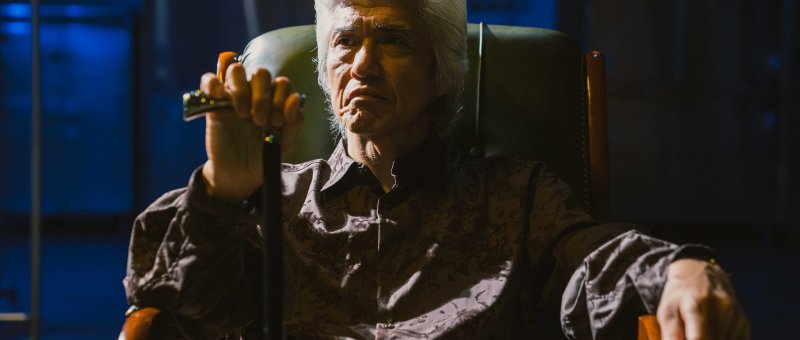
The Box Man (箱男, Gakuryu Ishii, 2024)

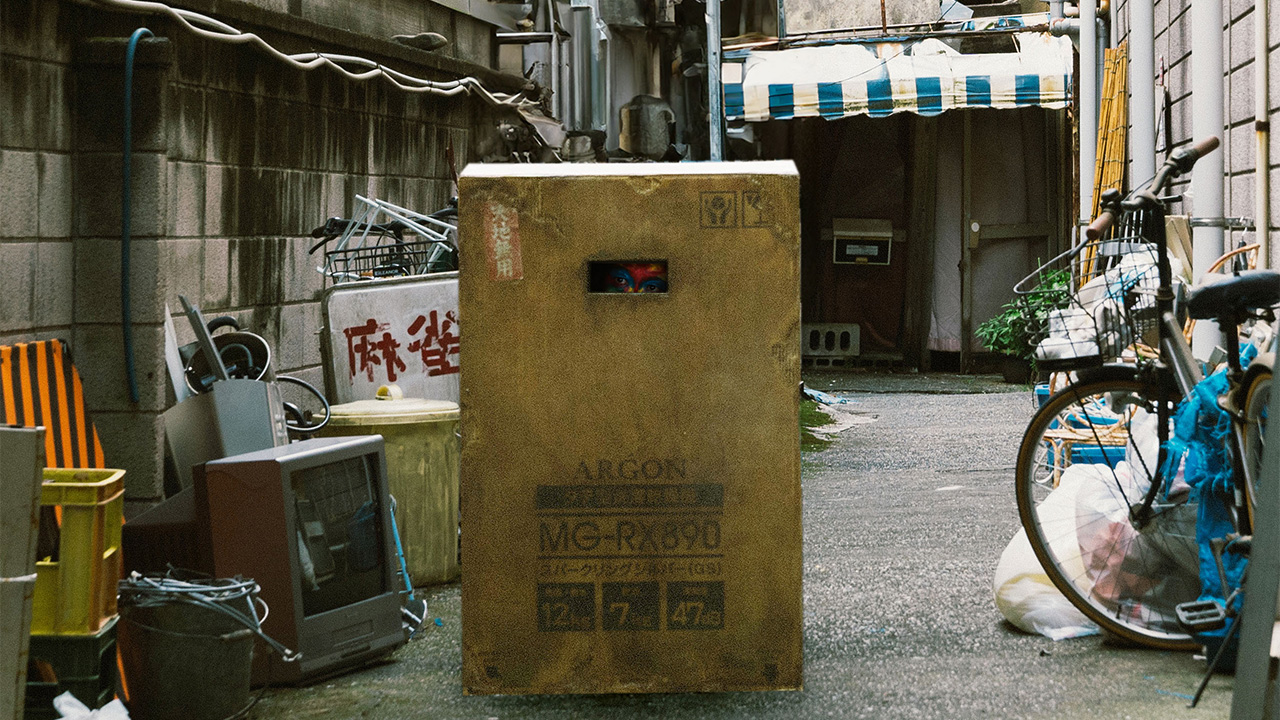
Those who obsess over the Box Man, become the Box Man, in Gakuryu Ishii’s adaptation of the Kobo Abe novel. Yet the unnamed hero’s problem is that he feels himself unable to become “the real thing” and is thereafter trapped inside a labyrinth while forever seeking an exit. It’s never clear to him, or to us, if the cardboard box he wears is really just that or something imbued with a supernatural power that actively masks his identity even from himself.

Tellingly, the only named character is a woman, Yoko (Ayana Shiramoto), who seems to exist outside of the box. She appears to be free, confident, aware of all she is and apparently certain of her identity. The Box Man, or perhaps “a” Box Man, meanwhile, is known only as “myself,” a former photographer (Masatoshi Nagase) who almost pities those who target him in memory of the Box Man who once infected and cursed him to the same fate. Watching the city through the tiny letterbox slit, he remains a step away from our world and later refers to the box as the entrance to some other place suggesting that it’s really we who are trapped on the other side of the cardboard.

He advances something similar when he in effect turns the box inside out, walling himself inside a single room by covering the windows and doors to box out the world but not really finding escape. Still, others seem to covet the title of Box Man, those also without concrete identities but going by names such as Fake Doctor (Tadanobu Asano) and the General (Koichi Sato), both of whom are apparently interested in the Box Man and tracking his every move. It seems they believe there can only be one real, authentic Box Man allowed, but become increasingly uncertain which of them is “real”. The notes the Box Man is keeping become key to his identity, but like a metaphor for the unseen hand of fate, one points out that perhaps someone else has written them out for them, Myself lamenting that the author has written a better version of himself than he ever could. 

There is something undeniably absurd about the way the Box Men scuttle around, occasionally sticking their ams out of the box’ flaps while arguing over the true identify of the Box Man despite having described the mystery as boring. The Fake Doctor seems to want to destroy the box, as if he wanted to obliterate it perhaps in an attempt to destroy the image of a mask to avoid the suggestion that he has one himself, while it remains unclear if this would free the other Box Man or trap him further while Fake Doctor would take his place. When Myself killed the Box Man before him, a mask may have been what he wanted. A photographer sick of seeing the world and longing to be free of it, to shed himself of an identity he no longer wanted only to search for it once again even as others try to crush it from without. 

The Box Man comes to the conclusion that it’s the world that should be boxed away, but of course it’s all the same. When he remarks that Yoko, after leaving their sanctuary, did not really escape but has simply gone to a deeper level, it’s reflective if his own desire to find meaning in a meaningless world. He claims that he dreams of a world yet to begin but is finally confronted perhaps by anonymity in witnessing a row full of Box Men apparently all also devoid of personality which might in an ironic sense tell him who is if only in reflection. 

Strange and surreal, Ishii lends an edge of absurdity to the strange existence of the Box Man while perhaps aligning the letterbox frame of his open window to that of the cinema screen and the artificial reality that surrounds us. In any case, it seems the other world the Box Man longed to enter was that of the self, his interior life expanding inside the box as a small galaxy he has somehow become lost inside, no longer able to see beyond himself but trapped inside an “exitless black hole” looking for a path to authenticity away from this “fantasy” in which everything is “fake” save the potential salvation of a distant guiding light.


The Box Man screens in New York July 13 as part of this year’s JAPAN CUTS.

Original trailer (English subtitles)

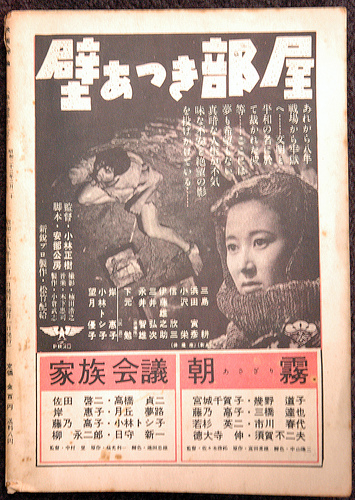
The Thick-Walled Room (壁あつき部屋, Masaki Kobayashi, 1956)

4473285465_b5cf3a248fThere’s a persistent myth that Japanese cinema avoids talking about the war directly and only addresses the war part of post-war malaise obliquely but if you look at the cinema of the early ‘50s immediately after the end of the occupation this is not the case at all. Though the strict censorship measures in place during the occupation often made referring to the war itself, the rise of militarism in the ‘30s or the American presence after the war’s end impossible, once these measures were relaxed a number of film directors who had direct experience with the conflict began to address what they felt about modern Japan. One of these directors was Masaki Kobayashi whose trilogy, The Human Condition, would come to be the best example of these films. This early effort, The Thick-Walled Room (壁あつき部屋, Kabe Atsuki Heya), scripted by Kobo Abe is one of the first attempts to tell the story of the men who’d returned from overseas bringing a troubled legacy with them.

The Thick-Walled Room is set inside an American detention centre for soldiers who have been declared B or C class war criminals. In essence, these are the rank and file men who were “just following orders” or committed random acts of desperation because they believed it was necessary to survive. The men are kept fairly well in the prison, they aren’t treated cruelly though they are sent for forced labour in a stone quarry. The main protagonist of the story, Yamashita, insists on maintaining a beard as a form of mini rebellion (quipping that he’s trying to grow a rope to hang himself). He feels betrayed by a superior officer,  who ordered him to commit an atrocity and then cut some kind of deal to deny it afterwards and get off scot free – he returned to Yamashita’s home town, has married and is lording it over Yamashita’s own family as some kind of devious landlord.

The others in the cell include a young romantic dreaming of a girl he met in the war who, it turns out, has long forgotten him and is now living in the pleasure quarters. The film also doesn’t shy away from the other implications of the war with a Korean soldier also among the detained who laments what’s happening both to the country of his birth which is now once again at war and his adopted country tearing itself apart in guilt and defeat. When asked whether he’s from North or South Korea the soldier hesitates, perhaps offended by the question, and simply replies “I am Korean” before walking off. Others dream of home and wives and families and this whole thing being over. However, they’re all at the mercy of two governments – the Americans and the Japanese and though they believe they may finally be released when the treaty is signed, it’s never that simple.

Masaki Kobayashi begins the themes he would return to over and over again – the depths of human cruelty, repression, indifference, vengeance. These are man who risked their lives for a god only to find he was a man and nothing more. They’ve come back alive, but different. Not only must they deal with the shame of defeat and now being prisoners of their enemies but also with entire war guilt of a nation. These are just the little guys, they did as they were told even if they didn’t want to or they killed and stole to survive. They have done terrible things to those who had no role in the conflict, this is not in dispute, and they pay a heavy spiritual toll for those actions. The people who ordered and orchestrated these deliberate reigns of terror, however, have largely escaped or lied and cheated their way out of the hangman’s noose.

Kobayashi uses a lot of expressionist techniques more reminiscent of silent cinema than of the more recent films of the era. Whilst the men are inside the cell there is nothing outside it, the war still exists in here and in their minds. We start off leaning on the walls of the cell only to find ourselves thrown back into the heat of the jungle and finally thrown out again after encountering our dramatic event. The faces of the dead pass in montages across the screen crying “murderer” and “war criminal” in a constant vision of recrimination. Even if they are eventually released, these men will be in prison for the rest of their lives.

In fact, the film was so controversial that the release was held back until 1956 even though the American occupation was technically over before it was completed. Though it isn’t the most accomplished of Kobayashi’s films, The Thick-Walled Room includes many of the ideas and motifs that he would return to throughout his career. Kobayashi wants us to see things as they are and were from all angles. He sympathises with these men but doesn’t excuse what they or the nation as a whole has done, as he would continue to do he seeks a way forward that acknowledges the past but will bring us to a more compassionate future.


The Thick-Walled Room is the first of four early films from Masaki Kobayashi available in Criterion’s Eclipse Series 38: Masaki Kobayashi Against the System DVD boxset.