
5 Centimeters per Second (秒速5センチメートル, Yoshiyuki Okuyama, 2025)

Sometimes people come into your life for a short time and then move on. Perhaps you won’t see them again, though the effect they have on you remains profound. Takaki is still hung up on a girl he met during his childhood and subsequently lost touch with to the extent that he has become isolated and emotionally distant. In remaking Makoto Shinkai’s anime 5 Centimeters per Second ( 秒速5センチメートル), Yoshiyuki Okuyama homes in on a sense of urban alienation and a longing for something greater that transcends ordinary life before arriving at an acceptance that sometimes there is no greater meaning beyond a pleasant memory.

Takaki (Yuzu Aoki) feels as if he’s looking for the feeling he’s lost while living in a soulless urban environment and doing a job that, as someone later says, isn’t all that much fun but not particularly taxing either. It’s clear that he wants something more out of life, but at the same time has become afraid to connect with people. As a child, he moved around a lot and so developed a habit of avoiding getting into relationships in order to avoid the pain of separation. As an adult, he never stays in one place for too long and is always moving on, quitting one job after another and moving to new parts of the city. He has a kind of girlfriend, but keeps her at arms’ length emotionally and is not seriously invested in the relationship.

The irony is that he and Akari (Mitsuki Takahata) bonded over the experience of being transfer students, but where Takaki has become a kind of nomad, Akari has begun to settle down with a regular job in a book shop. Though the film is told mostly from Takaki’s perspective, it seems that she has decided their youthful connection is something that belongs in the past as a comforting memory rather than a promise that will one day be fulfilled. She may think of Takaki from time to time, but also hopes that he has moved on and is living in the present rather than being hung up on the romantic ideal of their childhood connection.

TV news broadcasts discussing space probes that are destined to continue travelling in different directions echo the course of their relationship. Takaki assumes it’s an orbit and that their paths are destined to cross again eventually, when really their childhood friendship was a kind of launch point after which the distance between them would only grow. Their paths do indeed cross at times with several near misses at reconnection, but they remain liminal presences in each other’s lives.

The implication is that Takaki has retreated into a fantasy of idealised romance to avoid dealing the emotional difficulties of adult life, while for Akari the memory of her childhood friendship with Takaki has allowed her to move on into a more settled adulthood in which she is willing to accept the possibility of painful separations while putting down roots and forging relationships with those around her. Living through the illusionary “end of the world” affords Takaki a kind of rebirth in which he can learn to let go of the past and begin to move on by opening himself up to those around him. 

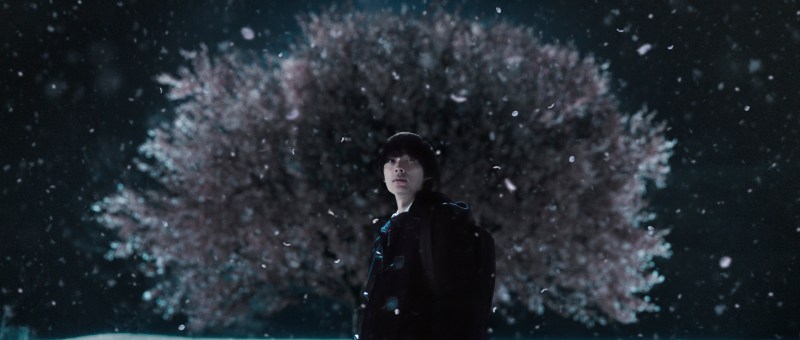
Okuyama captures Takaki’s sense of alienation while finding beauty in the world that surrounds him, from the spaces of urban loneliness to the crisp white snow and cherry blossom tree that Takaki believes is his salvation. The environment both reflects his anxieties and feelings of isolation, and is at times a barrier to his reconnection with Akari, but is also a source of hope for the future that the impending end of the world will not in fact come to be. Takaki’s 30th birthday is rather a kind of coming full circle and the launch point for adulthood in which he can finally move on from idealised first love and begin to open himself up to all the joy and pain that life has to offer.


5 Centimeters per Second screened as part of this year’s Nippon Connection

Trailer (English subtitles)
The Box Man (箱男, Gakuryu Ishii, 2024)

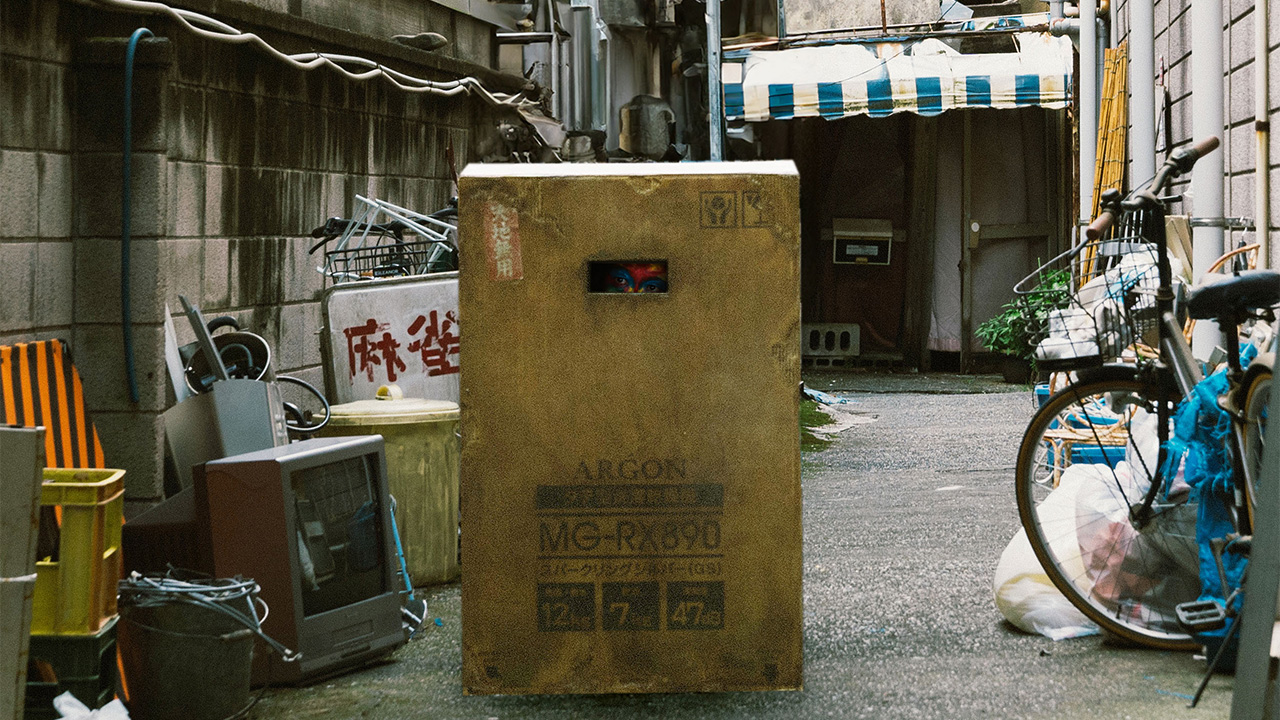
Those who obsess over the Box Man, become the Box Man, in Gakuryu Ishii’s adaptation of the Kobo Abe novel. Yet the unnamed hero’s problem is that he feels himself unable to become “the real thing” and is thereafter trapped inside a labyrinth while forever seeking an exit. It’s never clear to him, or to us, if the cardboard box he wears is really just that or something imbued with a supernatural power that actively masks his identity even from himself.

Tellingly, the only named character is a woman, Yoko (Ayana Shiramoto), who seems to exist outside of the box. She appears to be free, confident, aware of all she is and apparently certain of her identity. The Box Man, or perhaps “a” Box Man, meanwhile, is known only as “myself,” a former photographer (Masatoshi Nagase) who almost pities those who target him in memory of the Box Man who once infected and cursed him to the same fate. Watching the city through the tiny letterbox slit, he remains a step away from our world and later refers to the box as the entrance to some other place suggesting that it’s really we who are trapped on the other side of the cardboard.

He advances something similar when he in effect turns the box inside out, walling himself inside a single room by covering the windows and doors to box out the world but not really finding escape. Still, others seem to covet the title of Box Man, those also without concrete identities but going by names such as Fake Doctor (Tadanobu Asano) and the General (Koichi Sato), both of whom are apparently interested in the Box Man and tracking his every move. It seems they believe there can only be one real, authentic Box Man allowed, but become increasingly uncertain which of them is “real”. The notes the Box Man is keeping become key to his identity, but like a metaphor for the unseen hand of fate, one points out that perhaps someone else has written them out for them, Myself lamenting that the author has written a better version of himself than he ever could. 

There is something undeniably absurd about the way the Box Men scuttle around, occasionally sticking their ams out of the box’ flaps while arguing over the true identify of the Box Man despite having described the mystery as boring. The Fake Doctor seems to want to destroy the box, as if he wanted to obliterate it perhaps in an attempt to destroy the image of a mask to avoid the suggestion that he has one himself, while it remains unclear if this would free the other Box Man or trap him further while Fake Doctor would take his place. When Myself killed the Box Man before him, a mask may have been what he wanted. A photographer sick of seeing the world and longing to be free of it, to shed himself of an identity he no longer wanted only to search for it once again even as others try to crush it from without. 

The Box Man comes to the conclusion that it’s the world that should be boxed away, but of course it’s all the same. When he remarks that Yoko, after leaving their sanctuary, did not really escape but has simply gone to a deeper level, it’s reflective if his own desire to find meaning in a meaningless world. He claims that he dreams of a world yet to begin but is finally confronted perhaps by anonymity in witnessing a row full of Box Men apparently all also devoid of personality which might in an ironic sense tell him who is if only in reflection. 

Strange and surreal, Ishii lends an edge of absurdity to the strange existence of the Box Man while perhaps aligning the letterbox frame of his open window to that of the cinema screen and the artificial reality that surrounds us. In any case, it seems the other world the Box Man longed to enter was that of the self, his interior life expanding inside the box as a small galaxy he has somehow become lost inside, no longer able to see beyond himself but trapped inside an “exitless black hole” looking for a path to authenticity away from this “fantasy” in which everything is “fake” save the potential salvation of a distant guiding light.


The Box Man screens in New York July 13 as part of this year’s JAPAN CUTS.

Original trailer (English subtitles)