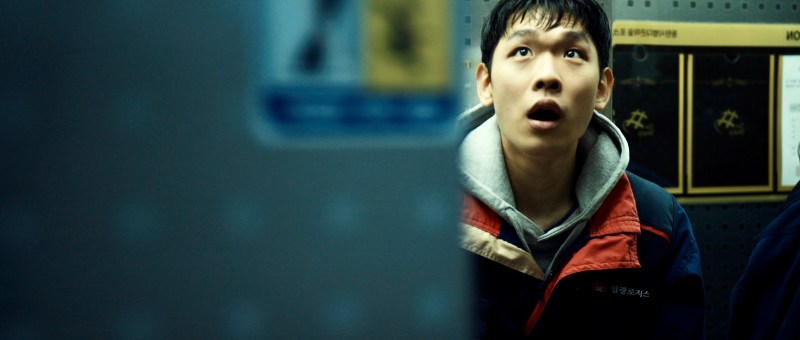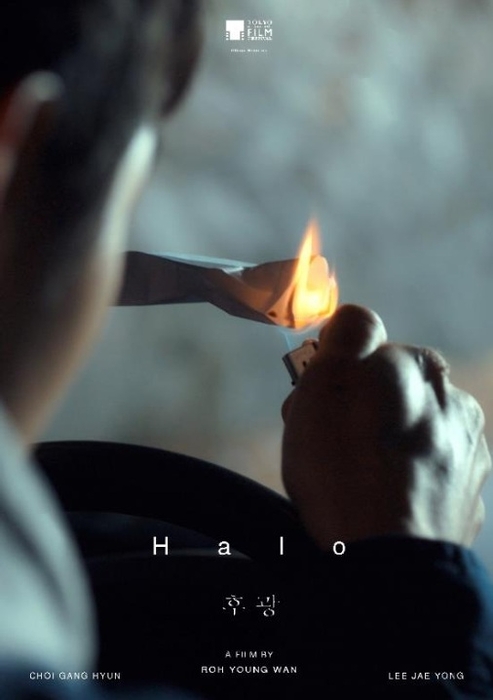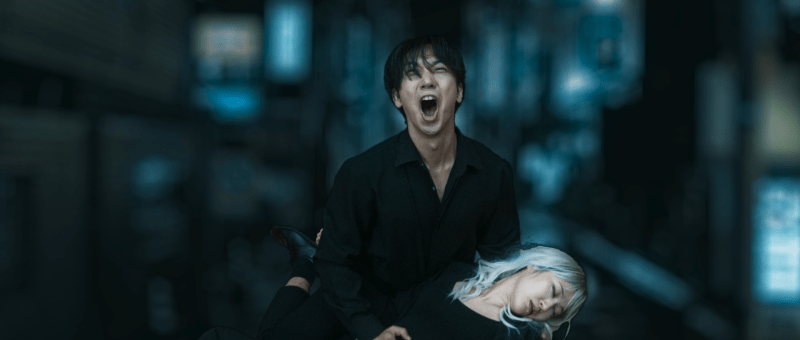
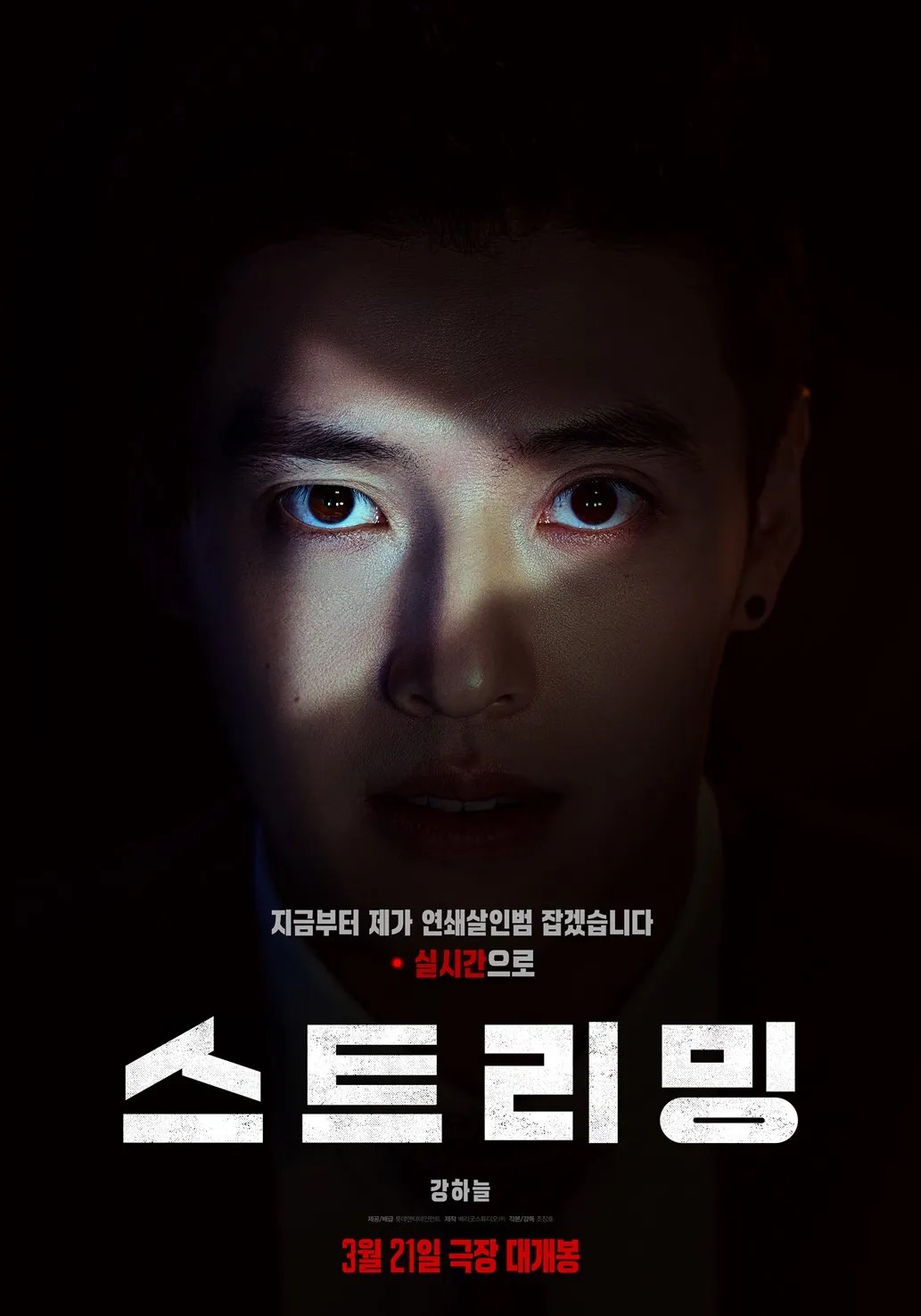
The Great Flood (대홍수, Kim Byung-woo, 2025)

Humanity survived a great flood once before, or so we’ve been led to believe. The mysterious forces at the centre of Kim Byung-woo’s The Great Flood (대홍수, Daehongsu) believe we can survive it again, albeit in an altered form. Or then again, maybe not. What begins as a disaster movie soon shifts into speculative fiction exploring the nature of “human emotion” and whether such a complex thing can ever really be replicated synthetically.

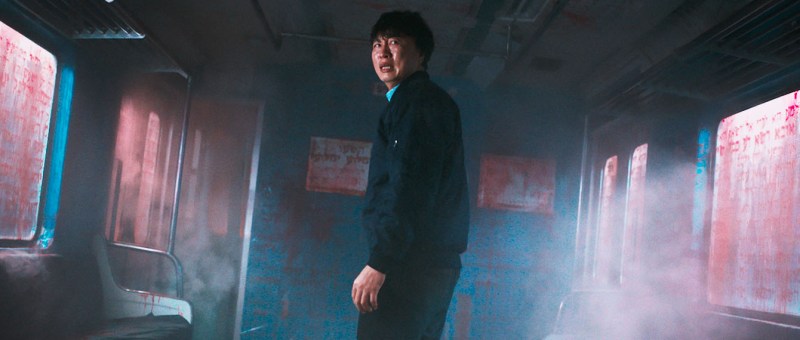
After their apartment is surrounded by floodwaters slowly climbing past their third floor flat, An-na (Kim Da-mi) tries to make her way to higher floors with her often uncooperative six-year-old son Ja-in (Kwon Eun-seong). As in recent similarly themed films, the apartment block becomes a microcosm of the contemporary society with An-na encountering stairs that have been blocked and neighbours who aren’t happy about those from lower floors encroaching on their space. Religious maniacs block access and insist this is God’s will. The only way out is a human sacrifice. Meanwhile, thuggish looters rob abandoned flats despite the fact that all of these previously valuable items are probably worthless now that no one knows when the waters will stop rising let alone when they will recede. 

It turns out, however, that An-na is an important person because she works for the Emotion Engine Development Team at the Darwin Center which has apparently known about this all along and has planning ways for humanity to survive for quite some time. It’s soon revealed that Ja-in is not An-na’s biological son but an experimental AI child she’s been developing to create the Emotion Engine. After the initial flood, An-na and Ja-in become separated and she is plunged until a looping series of simulations structured like a video game in which she must reunite with her son to give the Engine maternal instinct and save humanity.

Whether intentional or not, this is all incredibly sexist. Though apparently a top researcher, An-na’s worth is now entirely defined by her ability to become a mother. A flashback reveals An-na asked her boss if she could give Ja-in back because motherhood isn’t for her, while in flashbacks to her time with him she’s shown repeatedly hurting his feelings by neglecting him for her work. He asks to use her work iPad to do his drawings because she doesn’t look at them otherwise, while she’s irritated by his badgering when she’s obviously busy. The conceit is that she can’t find Ja-in because she doesn’t understand why he left her. She worries that he might not want to go with her anyway because she “abandoned” him to go with the men from the Darwin Centre to be saved from the flood and continue her research to save humanity.

The man sent to save her, the unemotional Hee-jo (Park Hae-soo), was also abandoned by his mother and is cynically looking forward to seeing what decision An-na will make. He’ll feel reassured in some way if she chooses to leave Ja-in behind because it will mean that it wasn’t just him, this is the way “human emotion” works. An-na obviously has an opportunity to recast “human emotion” than just recreate it, if that weren’t perhaps against the spirit of what she’s doing. In any case, the earlier part of the film is full of these dilemmas as Hee-jo encourages her to leave struggling people behind so they can make it to the roof for the helicopter. Even so, she comes across people who haven’t abandoned their humanity such as an old man continuing to feed his wife who seems to have dementia with the waves approaching and a man who stays with his pregnant wife who has gone into labour. In the end, An-na can only complete this quest by embracing her humanity by saving the little girl who is trapped in the lift and helping the pregnant lady rather than by abandoning them to survive alone.

This is also true of overcoming her maternal anxiety to believe she can be a mother to Ja-in which is also positioned as becoming a mother to all mankind as a kind of eve in a new digitised world. The apartment blocks are shaped like datacentres and the water reinterpreted as fire as if this is where people live now. Even so, we can’t be sure whether any of this, even the first flood, was ever really “real” or part of the AI-training scenario in which the Engine must be trained by “real” experiences, or if the An-na who accepts her motherhood and asks to be the test subject sent with Ja-in is the “real” woman or the model from the simulations. In any case, is humanity really surviving by being recreated as AI or bringing about its own demise? In our world at least, the waters may already be rising.


Trailer (English subtitles)

Revelations (계시록, Yeon Sang-ho, 2025)

A put upon pastor’s life begins to spiral out of control when he comes to suspect a recently released sex offender has kidnapped his child in Yeon Sang-ho’s grim spiritual drama, Revelations (계시록, Gyesirok). Less about the crime at its centre, the film is more an exploration of our intense desire to justify our actions and remake the world in a way that makes sense to us while refusing to see or accept the reality of others.

Min-chan (Ryu Jun-yeol) runs a small evangelical church that is part of a larger religious organisation and like any other ambitious employee is hoping for advancement. With the area undergoing redevelopment, a larger church is to be built and Min-chan’s wife Si-yeong (Moon Joo-yeon) comes to the conclusion that his mentor Pastor Jung gave him this smaller church to build a congregation in preparation for heading up this larger one. But Jung rather insensitively asks him if he can think of anyone to run it while suggesting that ideally he’d prefer to give it to his son, Hwan-su, though Hwan-su doesn’t feel ready and thinks Min-chan would be a better fit. Min-chan consoles himself by repeating the pastor’s words that God will show them the right person for the job and is secretly heartened when Hwan-su is out of the running due to the exposure of an extra-marital affair with a parishioner. But on the other hand, he’s recently discovered his wife has been having an affair with her personal trainer, which means he wouldn’t get the job either if anyone found out.

As such, he’s under an intense amount of pressure and increasingly dependent on revelations he believes are from God. When Yang-rae (Shin Min-jae) walks into his church, Min-chan is intent on recruiting him but is unnerved by his ankle bracelet. When his own child goes temporarily missing, he becomes convinced that Yang-rae has taken them, especially when he sees Yang-rae loading up his van with shovels. Though this is an example of Min-chan’s latent prejudice and a contradiction in his religiosity given that he has no idea what Yang-rae might have done and is uninterested in helping him only in increasing the numbers of his congregation, it turns out that Yang-rae has taken another child from among his parishioners. Having had an altercation with Yang-rae and attempting to cover up his crime, Min-chan pretty much forgets about A-yeong (Kim Bo-min) and believes he has received a revelation that she’s dead and it’s his mission to purge the evil of kidnappers by killing Yang-rae, coming over all fire and brimstone and ignoring Yang-rae when he points out they’ll never find A-yeong if he dies.

For Min-chan, Yang-rae has become a faceless figure of evil in a similar way he has for traumatised policewoman Yeon-hee (Shin Hyun-been) who is haunted by the ghost of her sister who took her own life after being kidnapped and tortured by Yang-rae. A psychiatrist she meets explains to her that the ghost isn’t real but only a manifestation of the guilt she feels for not being able to save her sister. Her desire to save A-yeong is also a means of making peace with the traumatic past, but even she is caught between the desire for revenge and that of finding her in being at least tempted to pull the trigger and kill Yong-rae herself. She had also been further harmed psychologically by the fact that Yong-rae got a reduced sentence on the grounds of the horrific childhood abuse he’d suffered at the hands of his step-father. But it’s only by acknowledging that he wasn’t a faceless evil but a real person with his own feelings and trauma that she can come to understand him and put the clues together to find A-yeong. 

As the psychiatrist says, Min-chan’s God, Yeon-hee’s ghost, and Yang-rae’s one-eyed monster are all the same thing. They’re trying to overcome the reality that most tragedies in life are caused by things we can’t control. Placed into a police cell, Min-chan has a large square window that floods the room with light, but also a large smudge in the wall that looks sort of like Jesus. He begins scrubbing at it, trying to clarify the image, but it just becomes muddier and could just as easily be a demon rather than God, leaving him finally uncertain as to from whom he was receiving his “revelations”, be they from God, the devil, or just his own confused mind, while dealing with the stress of having his masculinity and career progress undermined in being cheated on by his wife and passed over by his mentor. While Yeon-hui has laid her ghosts to rest, all Min-chan is left with is uncertainty.


Trailer (English subtitles)

Mission: Cross (크로스, Lee Myung-hoon, 2024)

“Justifying each other’s existence, is that what marriage is about?” Asks top cop Mi-seon (Yum Jung-ah) while contemplating her vaguely dissatisfying marriage to househusband Kang-mu (Hwang Jung-min). In the opening sequences of Lee Myung-hoon’s action rom-com Mission: Cross (크로스), Mi-seon describes Kang-mu as a lottery ticket that’s never going win and suggests she only puts up with him because he’s not the worst man in the world and maybe marriage means putting up with each other. Only on discovering his long-buried secret does she begin re-evaluate him along with what marriage means to her.

Part of what puts her off, however, is Kang-mu’s seeming unmanliness. As a househusband, a rarity in South Korea’s patriarchal society, Kang-mu takes good care of care of her but Mi-seon finds it vaguely annoying and is irritated by his tendency to raid her wallet. It’s also Kang-mu that hosts when her colleagues come over for celebrations after solving a case and he’s got labelled Tupperware in his fridge with homemade kimchi for them. Nevertheless, they all jokingly refer to Kang-mu as Mi-seon’s “missus” which is also in part born of their characterisation of Mi-seon as a man because of her no-nonsense nature and the authority she holds over them. When Kang-mu asks Mi-seon’s colleague Sang-un (Jung Man-sik) to give her a wrist brace he bought her but thinks she’s too proud to accept from him, she jokingly asks if he fancies her but he replies that he only likes women. Nevertheless, Sang-un too is positioned as unmanly because his wife cheated on him which led to their divorce. The other two officers, meanwhile, are obsessed with romantic drama and act out their own version of events after spotting Kang-mu with another woman and becoming convinced that he’s having an affair.

Kang-mu, however, has a secret past as an intelligence officer from which he got fired for conducting an unauthorised mission to stop a Russian arms shipment reaching North Korea. While they were on the boat, they discovered that it was actually going to South Korea while one of his men was killed by the Russian Mafia. Six years later, one of his old colleagues has gone missing while trying to expose a procurement fraud scam run by the mysterious General Park through a fake contract to buy a new aerospace weapon from the Russians. Meanwhile, Mi-seon is investigating the attempted murder of a young woman who was shot after delivering a USB stick containing accounting files to a dead drop. 

Obviously, the cases are connected and Mi-seon is about to make a discovery about her husband but not before she experiences the unexpected jealousy of suspecting that he might actually be having an affair. The film actively turns an established trope on its head in that there are countless dramas in which a secret agent thinks he’s married to a regular housewife only to find out she used to be a top assassin, but in its way still ends up conforming to traditional gender roles while essentially subverting them. Mi-seon’s attraction to her husband is reignited when he becomes more stereotypically masculine by charging in with guns and rescuing her. In any case, finding out truth seems to complete the puzzle so that she can reconsider the point of marriage to reflect “Even if the whole world is against you, I’m on your side. That’s what marriage is.” 

Even so, the end result is that they fight crime together rather than Mi-seon having to take a back seat while she also commits to making it work rather than being vaguely irritated with Kang-mu but not making any attempt to improve their marriage. Lee cleverly plays with the tropes of the genre to create a genuinely surprising twist complete with a Bond-style maniacal villain playing off the region’s complicated geopolitics by working with the Russians who are thought to be colluding with North Korea against the South when really just in it for themselves. While the final mid-credits sequence, a reference to Hwang’s Netflix series Narco Saints, is a little uncomfortable in its implications, it’s clear that there’s a lot more milage in this potential franchise built around the unusual dynamics of the central pair’s marriage as well as those of Mi-seon’s equally unusual team of lovelorn romantics.


Trailer (English subtitles)

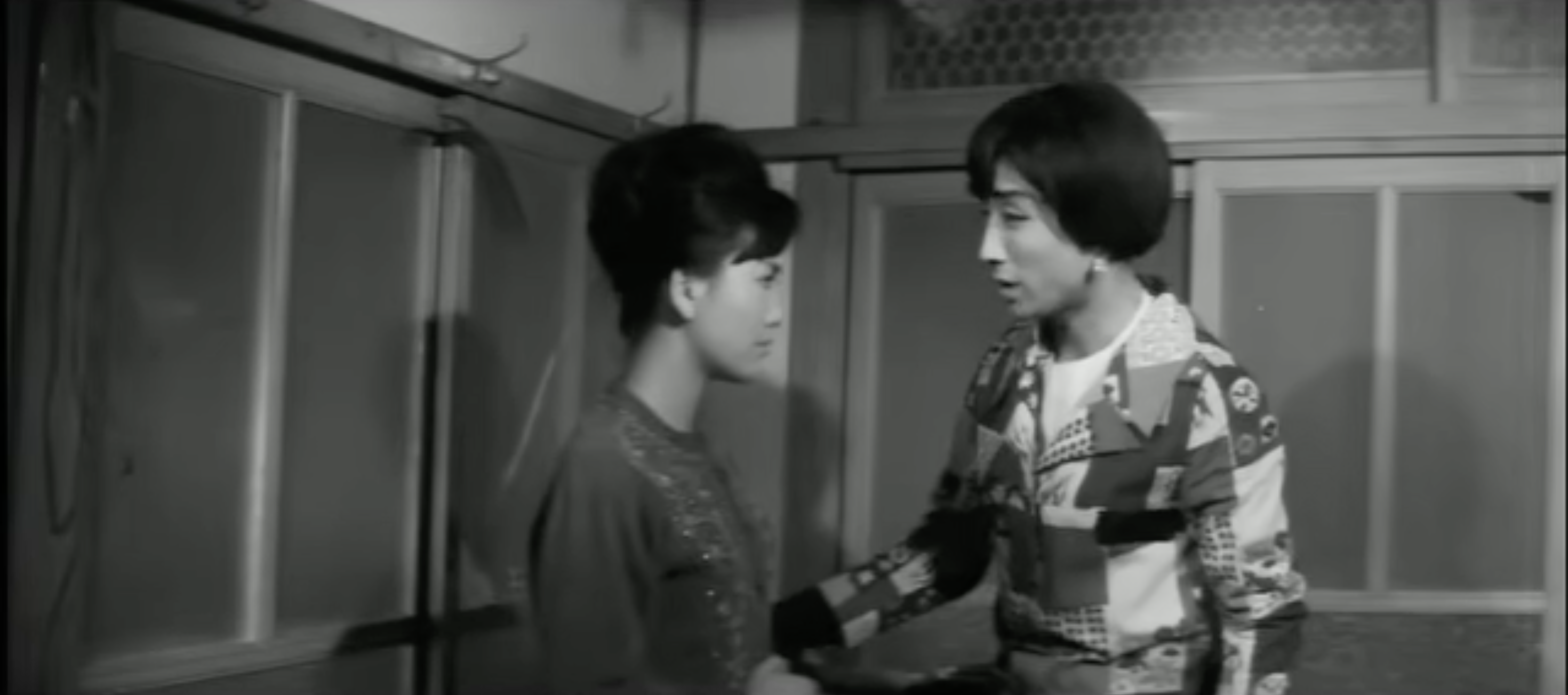
Murderer Report (살인자 리포트, Cho Young-jun, 2025)

“Call it a psychodrama,” the psychiatrist/serial killer at the centre of Cho Young-jun’s psychological thriller Murderer Report (살인자 리포트, Salinja Report) suggests in a meta moment, and the film is, in some ways, a battle of wits between down on her luck journalist Sun-ju (Cho Yeo-Jeong) and a man who claims to have killed 11 people. There is, of course, more going on than it first seems, but also a push and pull between interviewer and interviewee in which the tables are always turning.

One might debate the wisdom of entering a hotel room with a man who says he’s a serial killer (Jung Sung-Il), but Sun-ju insists she’s agreeing to meet him not because she could really use an exclusive, but because he told her she could save his next victim by agreeing to interview him properly. She has no way of knowing whether he’s telling the truth, but leans towards assuming he’s a crank seeing as the victims he named didn’t have any obvious connections and were all killed in different ways, but still it’s a risky business. Despite assuring him that she hadn’t told anyone about their meeting, Sun-ju is being watched over by her policeman boyfriend Sang-woo (Kim Tae-Han) who is in the room below waiting to strike.

As for why the psychiatrist might want to be interviewed, he describes it as if it’s a kind of therapy session in which he can interrogate himself to ensure his practice is still justified. He believes it is because he only kills bad people that have harmed his patients and sees it as just another part of his treatment plan in alleviating his patients’ suffering as if he were excising a painful tumour from their lives. To that extent, it’s as if he’s providing extrajudicial justice in the face of a justice system in which he believes many have lost faith when criminals get off with light sentences while victims and their families will suffer forever. According to the psychiatrist, revenge is the best way to alleviate their pain. 

Or perhaps, as Sun-ju says, he just likes killing people and is trying to rationalise his actions. After all, even if he doesn’t, the patients probably feel guilty, though the psychiatrist claims to treat that too as part of his holistic service. Little by little he chips away at Sun-ju’s civility, pushing her towards an admission of her hypocrisy that if it were her in this situation and someone caused harm to her child, then she’d probably want them dead too. The psychiatrist obviously knows more about her than she does about him, including her career setbacks and difficult relationship with her teenage daughter whom she fears might rather live with her father instead.

That Sun-ju’s workplace troubles are concerned with a failed attempt to expose the wrongdoings of a major corporation who leaked toxic substances into the water supply leading to an increase in childhood cancers, further deepens the sense of rottenness in contemporary society. The corporation managed to cover it up by bribing prosecutors and politicians, implying that only a man like the psychiatrist is capable of providing true justice despite his claims that he isn’t trying to cure the slickness in his society only alleviate the pain of his patients. The doctor challenges Sun-ju’s ethics too, insisting that she as a duty to social justice and the safety of citizens, so rather than being here interviewing him she should have alerted law enforcement. Of course, Sun-ju has actually done that in having Sung-woo watch her, breaking her promise to keep it confidential, but perhaps trying to have her cake and eat it too. 
Still, the jury’s out on who is really interviewing who as the doctor and Sun-ju each attempt to dominate the narrative. This is indeed a psychodrama, or an extreme form of therapy in which the doctor is trying to force Sun-ju into a self-examination in order to alert her to things going on in her life that she is ironically unaware of. She, meanwhile, begins to get under his skin to the extent that he is mildly shaken from his mission, until hearing that there is another patient waiting to see him so his services may once again be needed. Tense, if eventually outlandish, the film reaches a rather troubling conclusion but is truly at its best in the verbal sparring between the doctor and Sun-ju each of whom has hidden agendas and a singular goal in mind.


Trailer (English subtitles)

List (리스트, Hong Sang-soo, 2011)

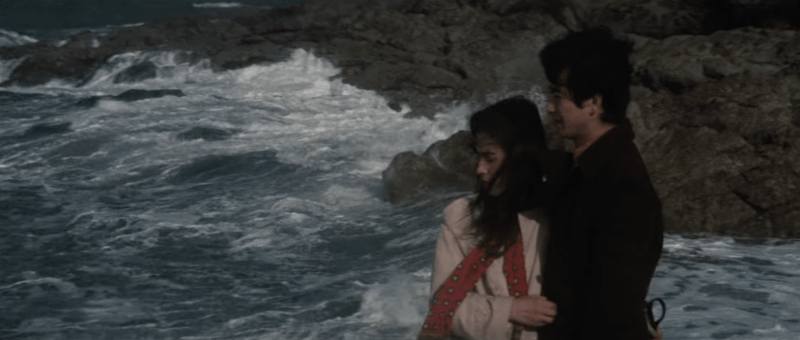
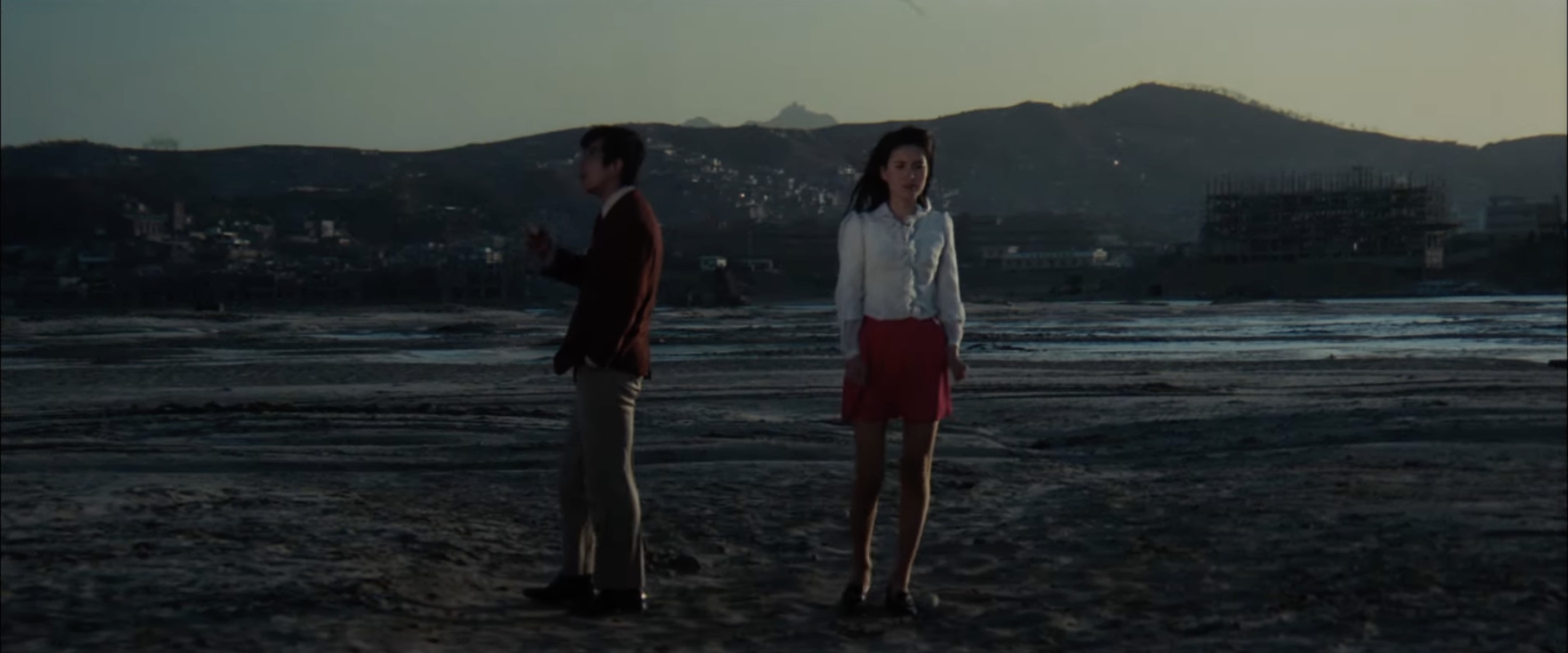
Hong Sang-soo finds himself in a positive, if characteristically melancholy, mood for his hard to see 2011 short, List (리스트). Short as a companion piece to In Another Country, the film opens with the exact same scene as a mother and daughter bicker about the sorry circumstances which have forced them to retreat to the seaside where they’ll be living in peaceful seclusion. This time however, young(ish) Mihye (Jung Yu-mi) sits down to write not a screenplay but a list, a kind of itinerary in order to make the most of this deliberately boring “vacation” taken all alone with her nice but “concerned” mother (Youn Yuh-jung).

Mihye’s List runs right through the day and includes normal holiday activities like having a meal in a famous restaurant, checking out the mudflats, and buying souvenirs, as well as reminders to giver her mum a massage and let her know she’s loved, and a few idiosyncratic suggestions too. Perhaps what she’s really the most excited about is trying out her new tooth brushing technique! At night she plans to dream of “prince charming” which is also something her mother later brings up in pushing a little on why the near 30-year-old Mihye has no boyfriend and is not yet married. Mihye’s mother worries that she has no desires before dialling back and suggesting that Mihye has desires but not the courage to act on them. 

This will, perhaps, prove to be true when Mihye and her mother meet a nice man just sitting on the beach as if waiting for them. Unsurprisingly, the man turns out to be a film director but he’s a far cry from Hong’s general leads. Sanjun (Yu Jun-sang) is a nice, wounded young man who might be slightly awkward but in an affable way. Though Mihye’s mother is taken with him, Mihye isn’t so sure. He seems kind of like a prince charming, but then again he’s just a random man they met on a beach who turns out to be famous and successful. Claiming that her daughter is “shy”, Mihye’s mother agrees to Sanjun’s invitation to a date on Mihye’s behalf (which was bizarrely directed to her anyway) and then offers to come along despite Mihye’s double protests. 

Tellingly, Hong departs from his usual aesthetic with key scenes shot on obvious sets and a strange absence of energy even in those taking place on location. Mihye muses and her fantasies appear to come to life. She completes her list for the day almost by accident while in the company of the prince charming she requested. Still, she isn’t sure. She asks him why he likes her but his answers are vague and perhaps worrying. He likes her “purity” and thinks she’s cute. She’s “special” in a way no one can see. All things Mihye’s wants to hear but doesn’t quite believe. Later she tells Sanjun she’s frightened of what her life will become, that she’s trapped by her mother and feels, in some way, damaged by her though she fails to elaborate further. In true fairytale style the romance escalates improbably, culminating in lifelong declarations of love and a promise of mutual salvation. 

Mihye wonders why people can’t see the good right in front of them. Sanjun replies it’s because they’re too focused on indulging themselves in the now. Yet what Mihye learns is perhaps that occasional fantasies are OK, that vague lists are useful because they leave you open to possibilities while lessening the fear of disappointment, and that even if your mother thinks your plans are “too ambitious”, it doesn’t really matter, you can just see where they go. Mihye might not have cured any of those anxieties. Perhaps she still feels trapped, resentful, even hopeless, but the sun rises anew and there’s another day to explore. It’s as cheerful an ending as Hong can muster, hope mixed with melancholy resignation and a stoic determination to put a brave face on existential despair.


Omniscient Reader: The Prophecy (전지적 독자 시점, Kim Byung-woo, 2025)

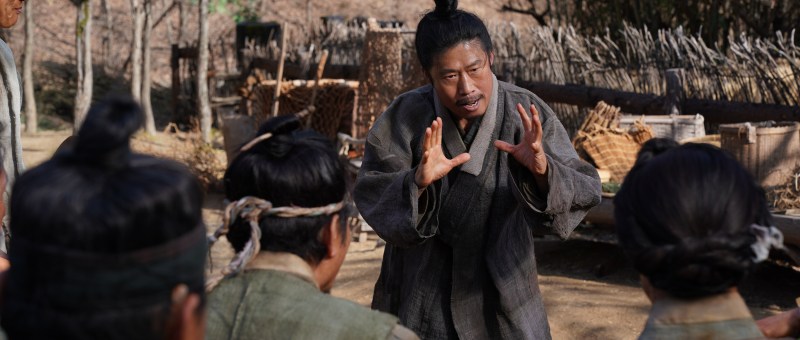
Fed up with the ending of a web novel he’s been reading since his teens, Dokja (Ahn Hyo-seop) sends the author a message. By this stage, he’s the only reader left, a kind of “lone survivor”, if you will. But he tells the author that the ending has disappointed him and that he can’t accept that the main theme was that it’s alright to sacrifice the lives of others so that you alone can live. Adapted from the popular webtoon, Kim Byung-woo’s Omniscient Reader: The Prophecy (전지적 독자 시점, Jeonjijeok Dokja Sijeom) is in part about the conflict between nihilistic pragmatism and selfishness, and a pure-hearted altruism that insists it’s possible for us all to survive and that surviving alone would be pointless anyway.

It only obliquely, however, touches on these themes in how they relate to the contemporary society in hinting at the destructive effects of capitalism. Dokja is the hero of this story, but he’s also a face in the crowd as a member of a constant stream of office workers on their way to work, not really so different from little ants squeezed between the fingers of powerful elites. Dokja at least feels himself to have lost out in this lottery, a contract worker let go by a conglomerate, while his sleazy boss Mr Han (Choi Young-joon) slobbers all over his female colleague, Sangha (Chae Soo-bin), who unlike him is no longer wedded to the corporate philosophy and is considering striking out on her own to do something that interests her personally. Perhaps the novel ending on the same day as his contract felt a little bit to much like the end of a world, which is what pushed him to write a message that in other ways seems uncharacteristically mean. 

But then the author tells him that if he doesn’t like this ending he can write his own, perhaps obliquely reminding him that he is free to change his future if he wants. Nevertheless, Dokja is soon thrown into the world of the novel where he is faced with a series of scenarios where he must choose whether to sacrifice the lives of others in order to save his own for the entertainment of celestial beings who watch the whole thing via live streams and occasionally sponsor interesting players. Dokja has an advantage in that he already knows what’s going to happen, but is also aware that things don’t always go the way they should and his own actions change the course of the narrative. He’s convinced that he has to save the “hero”, Jung-hyeok (Lee Min-ho), or the fantasy world will end, killing everyone inside it, but never really considers that he too can be the protagonist of his own story. 

He remains committed, however, that the only way to survive is through mutual solidarity even if he scoffs at the quasi-communist mentality at the Geumho subway station correctly guessing that it’s all a scam being run by a corrupt politician which muddies the water somewhat when it comes to the film’s politics. In any case, Dokja seems to believe that he must save Jung-hyeok not just physically but spiritually in proving to him that his nihilistic viewpoint is mistaken and the only way for them to survive is to support each other by pooling their skills and resources. In dealing with his own trauma and guilt over having once sacrificed someone else to ensure his own survival, Dokja is able to write a new ending for himself surrounded by his companions rather than as a lone survivor roaming a ruined land with nothing to look forward to except death.

On the other hand, perhaps it’s true that he thinks he needs a hero to save him rather than realising that he is also the hero of this story, while the fantasy world too is driven by capitalistic mentality in which Dokja must amass coins to be able to level up or literally buy his survival. Occasionally he wavers, wondering if the others have a point when they tell him he’s being foolish and should learn to just save himself no matter what happens to anyone else, but otherwise remains committed to rejecting the premise of the original novel’s nihilistic ending in insisting that there’s a way for us all to survive if only we can learn to be less selfish, trust each other, and work for the good of all.


Omniscient Reader: The Prophecy is available in the UK on digital download from 15th December.

UK Trailer (English subtitles)

The Unrighteous (원정빌라, Kim Seon-kuk, 2024)

After discovering that all of his neighbours have become members of a religious cult, one young man tries to hold fast to his independence but finds himself confronted by the forces of conformity and mass hysteria in Kim Seon-kuk’s paranoid horror thriller, The Unrighteous (원정빌라, Wonjeong Villa). The film’s English title maybe somewhat misleading, though if anyone is unrighteous, it is the cult themselves rather than non-believer Ju-hyun (Lee Hyun-woo), while it’s also true that he lives in an unrighteous society obsessed with property values and social status.

It begins, however, with apartment complex horror as Ju-hyun gets into a vendetta with his upstairs neighbour Shin-hye (Moon Jeong-Hee) who first tries to bully him out of parking in “her” parking space which she is trying to hold for her husband who “always” parks there. Hearing strange sounds from above, Ju-hyun tries to complain about the noise, but Shin-hye ignores him and ironically insists that “neighbours should be more understanding” as if suggesting that Ju-hyun is being selfish and unreasonable and should rather make allowances for her son who is suffering from a serious illness. Ju-hyun had asked for quiet because his mother is recovering from recent surgery. 

The real problems start shortly after when it becomes apparent that Shin-hye has got religion after joining a Christian-leaning organisation that Ju-hyun has been warned is a cult that targets people with bogus surveys in order to recruit them. Though she had looked tired and took little interest in her appearance, Shin-hye is now nicely turned out with stereotypically middle-class housewife outfits, styled hair, and makeup. Grinning eerily, she seems to be intent on converting her neighbours. Ju-yhyun immediately earns her ire once again when he complains about her inviting the pastor to their residents committee meeting without prior notice. He’s not the only one who objects to being subjected to a religious lecture without his consent, though Shin-hye homes in on the neighbours’ various anxieties from job precarity to loneliness to win them over to her cause.

There seems to be a direct correlation between the literal cult Shin-hye is propagating and that of property ownership in that she often repeats that they are now all “homeowners” as opposed to tenants and “true owners of this land”. Ju-hyun is a property owner too, having paid off his mortgage at a comparatively young age, and himself hopes that the redevelopment project takes place so that he can move to a nicer apartment and have a better quality of life. Everyone is obsessed with how much more profit they might be able to make if the house prices rise in the area which is something the cult is also promising them happen. Ju-hyun isn’t disinterested in that, but also wants to see the town come back to life again and is heartened that so many people are moving to the area to take advantage of the currently lower than average prices.

Studying to become an estate agent, he seems to have an interest in finding people happy homes which might on some level be because of his own disordered familial background. Vague allusions are made to Ju-hyun’s long lost father being in some way abusive to the extent that Ju-hyun can’t forget the look in his eyes and is reluctant to let him back into their lives after he contact his mother to say he wants to apologise and make amends. It’s no surprise that he too has joined the cult, though the way that Ju-hyun reacts makes him something of a complicated hero and unrighteous in his actions. He justifies himself that he’s trying to keep his family safe and ensure the home he’s worked so hard to provide for them won’d be taken away, but his mother also has a point in resenting his bossiness and condescension as he repeatedly instructs her not to  have anything to do with the cult or open the door to strangers. When he has an opportunity to save his neighbours, he wonders whether he should bother given how mean to him they’ve all been through this whole ordeal.

In a sinister manner, the cult begins to encircle him as his employer and the leader of the redevelopment project turn out to be cult members. He’s fired from his job for refusing to join the cult, while the police seem to be in on it too and react to his attempts to explain with exasperation as if he were just a delusional conspiracy theorist. Only the local pharmacist with a side line in investigating cults is willing to help to help him. Nevertheless, the escalating darkness from trance-like religious mania to human sacrifice is quite steep even intended as satire that people would willingly sacrifice the lives of others in the name of house prices, even if they’re tricked into handing over the deeds to their properties to the cult become “the true owners of land”. Ju-hyun, however, resolutely refuses to drink the cool aid, in some ways quite literally, looking on with disdain as his neighbours dance in the street on receiving the news that the long awaited redevelopment project will indeed be happening as if it were a miracle fallen to them from some higher powers.


Trailer (English subtitles)

Big Deal (소주전쟁, Choi Yun-jin, 2025)

When Korea’s biggest Soju conglomerate, Gukbo, is on the verge of bankruptcy in the wake of the Asian financial crisis and the CEO’s mismanagement, it provokes a national outcry but also the attention of a hundred foreign firms all swarming over Korea like vultures eager to get a piece of the pie. Loosely based on a real life incident, Choi Yun-jin’s Big Deal (소주전쟁, Soju Jeonjaeng) is more evenhanded than one might expect at once decrying the amoral business practices of American corporate imperialism while pointing out that maybe things aren’t perfect in Korea either with its dynastic approach to company management and workaholic lifestyle that comes at the cost of familial bonds.

In fact it sort of implies that In-beom’s (Lee Je-hoon) desire to send Gukbo into bankruptcy so they can take it over and flip it is a kind of revenge against his own workaholic father who passed away 10 years previously, his death presumably hastened by stress and overwork though what In-beom resents more than anything else is that he was never really much of a father to him. That might be why Gukbo’s earnest financial officer Pyo (Yoo Hae-jin) comes to fill that role. In-beom complains that Pyo is stupid and naive, knowing nothing of how the world works, but also that his stupidity makes him feel like an arsehole because it forces him to realise that he’s doing something wrong. 

Caught between In-beom whose firm, Solquin, are pretending to consult on the administration process but in reality feeding into to their subsidiary to buy up shares, and the CEO, Pyo is the only one thinking about what’s going to happen to all their employees when the place goes bust. Like In-beom’s father, Pyo is also a workaholic whose wife and daughter left him because he was never there. He remains dedicated to Gukbo, but not to the extent of breaking the rules, even if he eventually goes along with it when the CEO suggests a dodgy plan to undercut Solquin and maintain control of the company his father founded. What becomes apparent is that Seok (Son Hyun-joo) is out of his depth and that the only qualification he has is being the boss’ son. It’s his fault the company got into trouble because of his reckless expansion plans while he tries to cover up his failings through cronyism, playing golf with the great and the good while leaving Pyo to clean up the mess he’s made.

Nevertheless, for good or ill, Gukbo comes to represent a Korea preyed upon by venal foreign influence. When the plan is exposed, Pyo is sure that the creditors won’t agree to bankruptcy because they won’t be able to stand such a typically Korean business being placed into foreign hands. In-beom thinks that’s ridiculous and no one has that kind of patriotic attachment to a company, but it turns out he’s right and Solquin have an uphill battle in front of them. Yet even In-beom begins to tire of his colleagues’ underhandedness. Though there are a handful of women working at the American investment firm, the culture is extremely macho and misogynistic with liberal and frankly unprofessional use of the F-word as In-beom’s male colleagues make obnoxious jokes about who is getting their dick sucked by whom. Pyo and his team may drink too much, but at least they’re collegiate rather than adversarial.

The question is really whether as In-beom says making money is just that and can’t be either sleazy or noble, while Pyo definitely thinks there are right ways and wrong ways to earn. Solquin is definitely wrong, while Gukbo isn’t entirely right either. In-beom may have a point when he challenges his old-fashioned salaryman mentality of putting the company first every time, but the conclusion Pyo seems to come to is to let all go and just be yourself. That doesn’t mean you have to stoop to their dishonest ways of doing business, but equally it doesn’t mean you have to let them walk all over you either. Capitalism is an inherently corrupt system, but there’s not a lot either of them can do about that even if eventually meeting somewhere in the middle as Pyo loses his faith in chaebol culture and In-beom realises he’s just as disposable when his American bosses chew up him and spit him out as soon as he’s served his usefulness. A closing title reminds us we’re still dealing with a lot of these problems 20 years later with companies that are too big to fail and inadequate regulation though Pyo at least seems to have found a happy medium doing what he loves on his own terms.


Trailer (English subtitles)

Choi Yun-jin directed this film, but her name was later removed from the credits after being fired by the production company who accused her of misappropriating the script.

The Rose: Come Back to Me (Eugene Yi, 2025)

Korean indie group The Rose have been making waves for close to a decade, starting out in Seoul and now having signed with a US label and playing the Coachella festival. They cite their musical message as healing, in part because music has healed them at various points in their lives, both individually and as a group, though they have faced a series of hardships, from the rigours of the K-pop industry to an exploitative label and a potentially explosive scandal.

Eugene Yi’s documentary is however more of a puff piece interested in how the band heroically overcame their struggles rather than the nature of the struggles themselves, despite a few talking heads outlining the oppressive and exploitative nature of the Korean music industry. According to them, what makes The Rose interesting is they all started out in K-pop training schools, but each found it wasn’t for them. As one of them points out, only 0.01% of applicants get to debut, and only 0.01% of the ones that do are successful. Sammy, a Korean-American musician who took part in a Korean TV talent competition, says that he developed body image problems because of the way the agency tried to control his appearance and eventually dropped out because he lost the joy of music in having to literally dance to their tune. 

Others of the band members had similar experiences before coming together as a street band and eventually forming The Rose as four young guys with a dream. They got an apartment together and eked out a living while spending all their time practising and writing songs. But as so often in these stories, they were picked up by a label who only wanted Sammy. He convinced them to take the others too, but they also tried to control the direction of their music and rejected their choice of an intensely personal, self-written debut song, insisting they needed something poppier and more upbeat. The joke was on them, though, because the song took off on its own on YouTube and became a hit across Europe. The label sent them touring, but otherwise did little else and misled them about the financial situation to the point that they decided to sue.

Suing your label is pretty unheard of in Korea where going against your team is socially difficult, as is challenging flaws in the system rather than just trusting in it and going with the flow. Had they lost, it would have been the end of the band and they’d all be financially ruined for the rest of their lives. This was also the time that Covid hit, with two of the band members going into the military. Along with the psychological pressure of the label playing divide and conquer to set them at each other’s throats, the anxiety of the court case strained Jeff’s mental health to the point of hospitalisation. He wondered if he should give up music if this was what it was doing to him, but then rediscovered its healing qualities. 

Having won their court case, the band reunited and signed with a label in the US only to be hit by another scandal once they started to make a name for themselves and Sammy’s former conviction for drug use after being caught with a small amount of marijuana was exposed in the papers. Any kind of involvement with drugs is a no-go in the Korean entertainment industry and can end careers or worse. Nevertheless, the band seem to have bounced back from it if even Sammy laments the guilt he feels for letting down his bandmates’ parents though he’d always been upfront with the guys that it might come out some day. Jeff too had remarked on the additional guilt he felt towards his parents for becoming ill, demonstrating that they’re all nice guys who care about their families and are serious about their healing message. Jeff is touched when members of the audience tell him their music helped them get through a loss or overcome their suicidal thoughts. 

Nevertheless, the film does rather seem set up to emphasise those messages and make the guys look as good as possible in addition to painting them as an authentic artistic rebellion against the soullessness of K-pop with its manufactured stars who are kept on a tight leash and trained to within an inch of their lives so that almost nothing of their individual expression remains. A little more shade might have helped to offset the hagiographic tone, though it’s true enough the band has talent and they’ve worked incredibly to get to where they are overcoming a series and crises and hardships along the way.


The Rose: Come Back to Me screened as part of this year’s San Diego Asian Film Festival.

Trailer (English subtitles)

Red Nails (홍이, Hwang Seul-gi, 2024)

A not quite middle-aged woman watches as her mother takes an aerobics class with other similarly aged people at a nursing home. The attendant turns to her and remarks that it can’t have been an easy decision, leading us to think that she has reluctantly decided her mother may be better off living where she can be properly looked after. But Hong (Jang Sun) has actually arrived to take her mother home. Not because she’s had a change of heart, and not exactly because she’s having a hard time and can’t afford to pay for the home any more, but because she’s realised her estranged mother’s a cash cow and the only one she has left to tap.

Hwang Seul-gi’s complex drama Red Nails (홍이, Hong-i) never shies away from its heroine’s flaws even if it tries its best to empathise with her. Hong is clearly irresponsible with money. The piled up boxes in her living room hint that she may have fallen victim to a multi-level marketing scam, but whatever the root causes are, she’s pretty much bankrupt with the bailiffs about to be sent in to seize her goods due to her phenomenally large debts. Even so, we later see her going on shopping sprees as if she were trying to fill some sort of void through guilty consumerism that is really just punishing herself by making her situation even worse. 

Hong’s borrowed money from an ex-boyfriend who has since married someone else but continues to sleep with her while badgering Hong for his money back, claiming his wife’ll throw a fit if he doesn’t get it. Meanwhile, she’s engaged in a fantasy romance with a man from an app, Jin-woo, whom she misleads about her financial circumstances and later uses when she needs a free ride. Hong has a habit of taking advantage of people, including her mother’s old friend Hae-joo who agrees to watch her in the day. Hong often messes her around, staying out late without calling and just expecting Hae-joo is figure something out. Hae-joo eventually confronts her about her unreasonable behaviour while taking advantage of her free labour, but Hong tries to give her money as if that was the problem. Hae-joo is insulted, and bringing money into the equation only threatens to change the nature of the relationship. It makes Hae-joo feel cheap and used when she had been doing this as a friend because she cared about Seo-hee. 

Seo-hee, meanwhile, seems ambivalent about her new living standards and, at times, berates Hong complaining that she wishes she’d never been born. It’s not clear what happened in Hong’s childhood, but they evidently did not get on and still don’t now. Seo-hee wants to go home, complaining that there’s a thief in the house though whether or not she knows that Hong has been dipping into her savings to pay off her debts, she’s still aware that she brought home because she needed money rather than companionship. 

But then Hong is also lonely, and her romance with Jin-woo is an attempt to escape her disappointing circumstances. Her ex suggests she once dreamed of becoming a teacher, but is currently teaching a literacy class for a group of older woman at a local institute where she also cleans the toilets. She also has a second job directing traffic at a construction site where the foreman hates her, docking her pay for neglecting her duties by using her phone while on the job. She cannot her escape her debts through any legitimate means, though that hardly justifies stealing from her mother. 

Even so, it appears that on some level Hong wanted comfort and companionship along with her mother’s approval. As they live together, they begin to draw closer but at the same time it’s clear that they remember things differently, though whether Hong is right to blame Seo-hee’s dementia or has misremembered herself is destined to be an eternal mystery. Hong tries to fulfil her mother’s dream of lighting sparklers, but the pair are yelled by some kind of environmental officer and forced to put them out. Hong looks on forlornly as the glow fades away as if symbolising the flame going out of the relationship between the two women. Despite their growing closeness, there are some things that it seems can never really be made up and all Hong really has is a frustrated memory of a longed-for closeness that can never really be.

Red Nails screened as part of this year’s London Korean Film Festival.

Trailer (no subtitles)