Hong Kong 1941 (等待黎明, Leong Po-Chih, 1984)

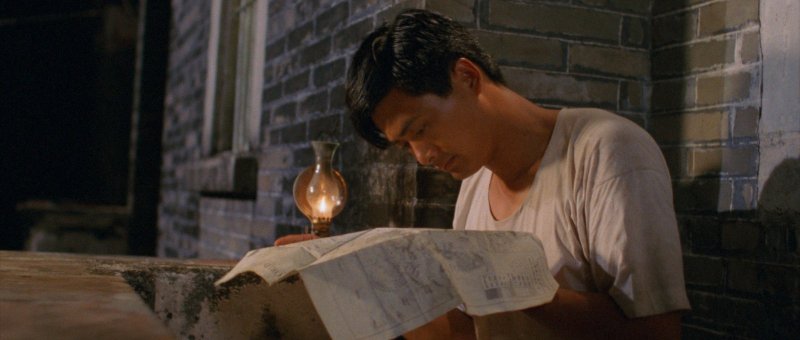
“Britain has reassured the people that it will not give up Hong Kong,” according to a radio broadcast at the beginning of Leong Po-Chih’s Hong Kong 1941 (等待黎明). The words have a kind of irony to them and not only because Britain did abandon the people following the Japanese invasion, but because the film was released on the eve of the Sino-British Joint Declaration in which it said something quite similar. 

But then again, the opening scenes are themselves quite critical of British rule as they, on the one hand, insist they aren’t going anywhere and, on the other, start evacuating women and children to “safer” areas of the commonwealth such as Australia. Out of work actor Fei (Chow Yun-fat) fled the Japanese incursion on the Mainland and came to Hong Kong, but now tries to stowaway abroad a boat going to Australia. He’s caught by a little British girl who speaks fluent Cantonese yet refers to him as her “slave” and insists that he “kowtow to me, now.” But then the girl suddenly adopts the persona of the Empress Dowager Cixi and demands the same. Fei makes the first of his many jumps into the water around Hong Kong, as if only in this liminal space can he be free. Anticipating the wave of migration occurring before and after the Handover, and also that of the present day, he and his friends Keung (Alexander Man Chi-leung) and Nam (Cecilia Yip Tung) set their sights on leaving to find Gold Mountain in Australia or America.

But they’re one day too late because the date of their departure is that the Japanese arrive in Hong Kong. Their haste to leave was in part caused by the fact that Nam’s father, Ha Chung-sun (Shih Kien), was trying to force her to go through with an arranged marriage her prospective groom didn’t want either. Nam is never really free as, as she points out, even after her father relents and allows Keung to marry her after she is raped by a police officer emboldened by the chaos and therefore worthless to him as currency, Keung never actually asked her and she’s in effect forced into a marriage with him instead. In fact, she returns to the shrine Keung lives in two find the two men constructing her marital bed for her with the double helix symbol of happiness already placed above it in an ironic expression of patriarchal oppression.

Indeed, her position is more precarious than either of the men and we see other families roughly cutting their daughters’ long hair to make them look like boys in fear of a rapacious Japanese army. But it largely turns out that it wasn’t so much the Japanese they needed to be worried about as the local population, experiencing a temporary limbo in which the social order has been suspended. Police officer Fa Wing (Paul Chun) who had acted as a lackey for Ha Chung-sun while constantly eying up Nam leads a gang of looters to Ha’s house to take their own revenge against his capitalistic oppression of them. Ha had largely made his money through rice profiteering and exploiting the local workforce. Recent layoffs at the warehouse had led to a labour riot, while Keung and his friends had been running a sideline skimming sacks of rice to sell on the black market. 

Ha and his henchmen anxiously await the arrival of the Japanese hoping that they will protect them from retribution, but the Japanese do not arrive fast enough. When they do, Ha collaborates and attempts to ingratiate himself with the Japanese officer in charge of the colony who once again takes a liking to Nam. General Kanezawa (Stuart Ong) also uses their poverty to starve them into submission, promising rice to anyone who will come and sing with him. The song he chooses is “Shina no Yoru” by Li Hsiang-lan, whom he describes as “their very own”, yet was actually a Japanese woman, Yoshiko Yamaguchi, groomed for stardom in Manchuria and marketed a Chinese star in propaganda films. Another song of hers, Ieraishan, can be heard earlier on the soundtrack as if heralding Japanese arrival. 

Though Nam tries to resist, Fei raises the trio’s arms in a cry of “banzai” in a moment of ostensible collaboration designed to buy them temporary safety. His philosophy and that of many others is to take the rice and deal with the rest later, which Fei does by becoming an enforcement officer with the Japanese to get papers that will allow all of them leave. He uses his position to help a gang of Mainlanders who are resisting the Japanese, and are, in fact, the last ones to stay behind and defend the colony, as well as well as save Keung when his attempt to rescue two friends who have been sold out for forced labour on another Japanese-controlled island by a local gangster backfires and he’s captured himself. 

Ironically enough, Fei had been the first one to try to leave and described himself as “selfish” after jumping back into the water to return to Nam and Keung who didn’t make the boat on time because they were trying to save a local eccentric everyone calls “emperor” played by the director himself. Fei is quite obviously in love with Nam, and she gradually falls for him in return though symbolically wedded to Keung, if not in the legal sense. Again, she has no say over her romantic future which is sorted out between the two men with Fei abiding to a code of honour in continuing to protect the relationship between Keung and Nam. Perhaps this echoes the way in which the Hong Kong people of 1941 or 1984 have little say in their future either as their fate is decided by two distant powers. Nevertheless, it leaves Keung feeling awkward and inadequate, realising that Nam likely prefers the smart and dynamic Fei over his constant failures and inability to protect her, though he is never jealous or resentful towards him only knowing that he is continually indebted. Yet it’s Nam who eventually strikes back for Hong Kong and for her own freedom while Fei looks on as children in the street play at beheadings as if they were Japanese soldiers. She embodies the spirit of Hong and carries it with her, and as the Chinese title of the film suggests, waits for a new dawn while accepting that just like old memories it will be replaced by what is to come. She speaks from a perspective that is both historical and uncertain, mourning the past while fearful of the future, but all the while continuing to live as one new dawn replaces another.


Hong Kong 1941 screened as part of this year’s Focus Hong Kong.

Trailer
The Black Tavern (黑店, Teddy Yip Wing-Cho, 1972)

One of the reasons that martial arts films are so popular is that it’s often easy to tell who is good and who is bad. In general, the just hero vanquishes the source of evil and corruption, thereby restoring a sense of moral order to a world that may in other ways be chaotic. But chaotic is probably the best way to describe the world of The Black Tavern (黑店) in which the titular inn becomes a nexus of greed and villainy where it is impossible to tell who, if anyone, is good, while almost everyone is actually bad and the heroine only really intervenes in the closing scenes.

One way you can tell that something is very rotten at the Gao Family Inn is that the cook suddenly emerges from a pit underground carrying someone’s leg, which he then chops up and uses to make buns. No one ever mentions this again. It’s a just symbol of how corrupt and hellish this world has become. The inn is apparently the only staging post on this route, which is presumably how they continue to get custom despite bumping off their guests, taking all their stuff, and then chopping them up to put in buns to serve to the next unfortunate person who arrives in search of a bed for the night. 

But the reason so many venal bandits are drawn here is that a beggar monk (Dean Shek) tells them he saw vast riches fall out of a chest belonging to Hai Gangfeng, a former official returning to his home province with all his ill-gotten gains from accepting bribes. Assuming Gangfeng will be stopping at the inn, everyone who heard the monk is on their way there. Only, as it turns out, the man we thought was Hai Gangfeng is actually a bandit, “Whipmaster” Zheng Shoushan (Ku Feng), who cunningly pretended to be him to take over the inn and wait for the real Gangfeng’s arrival. He does not, however, seem to have anticipated so many other bandit gangs each more outlandish than the last having the same idea.

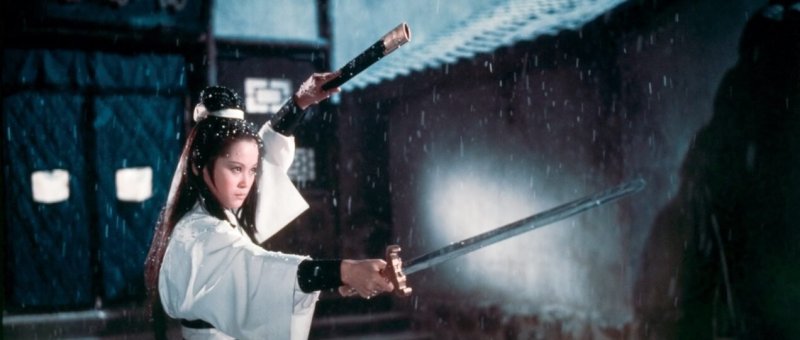
One turns up with a band of hopping vampires who turn out to be crooks in disguise, while another is wearing a horned helmet that gets stuck in things when he’s trying to fight. Of course, they’re all trying to kill each other so they can be the ones in control when Gangfeng finally arrives. What they don’t realise is that the whole thing’s a honeytrap designed to lure them all to the inn for just this purpose, so that they’ll all kill each other and spare the forces of justice some trouble. Those would be Zhang Caibing (Shih Szu), a disciple of the Lady Hermit making this a kind of extended universe film of the Cheng Pei-Pei classic. Continuing her mentor’s mission, she’s out to skim off the “scum of the martial arts world,” explaining to Shoushan that if he doesn’t like it, he should have thought of that before committing so many “evil deeds”. 

On the other hand, Caibing does seem to be enjoying this quite a lot so perhaps she’s not quite so entitled to the moral high ground as she’d like to think. While taking a leaf out of King Hu’s book, Yip adds an edge of slapstick absurdity in setting up elaborate action sequences with well-deserved pay offs and indulging in goreless yet extreme kills such as a series of surprise decapitations. Shoushan’s bladed whip becomes a versatile weapon but also an extension of his character in his cowardliness and lack of morality. It’s only really any good at long range, which means that he keeps his opponents at arms’ length rather than confront them directly as in the typical tests of skill that define a martial arts battle. He coils it around their necks, snake-like, then either pops their heads off or strangles them to death. Just like the innkeeper he killed off at the start, he seems to have genuine affection for his female companions but eventually meets a similar fate as his trademark whip is ironically turned against him. 

There’s also a genuine, if underplayed, sense of ambiguity in the attraction between the mysterious swordsman (Tung Li ) and Shoushan’s daughter that prevents him from killing her while suggesting that he too was on some level attracted to banditry. Even if he rides off in the end with Caibing, it does not appear that their relationship is romantic. Nor is he allowed to claim victory by swooping in when all seemed lost for Caibing during the final fight, immediately encountering difficulty with Shoushan who puts up a good fight that again seems contrary to his moral character in the amount of skill and effort needed to beat him. Indeed, it often seems as if he will win after all. This world will fall to men like him and turn into one giant Black Tavern. In the end, it’s a team effort that takes him down, including the strange intrusion of the beggar monk who was after all the person who started all this by repeating the rumour in the last rest stop and may or may not actually be working with Caibing. In any case, the incredibly fast-paced action sequences and the dark humour that accompanies them lend the film an epic quality despite its tight duration along with an ironic kind of cynicism that insists this world is simply too silly to be evil but that the scum of the martial arts world will pay all the same.


The Black Tavern screened as part of this year’s Focus Hong Kong.

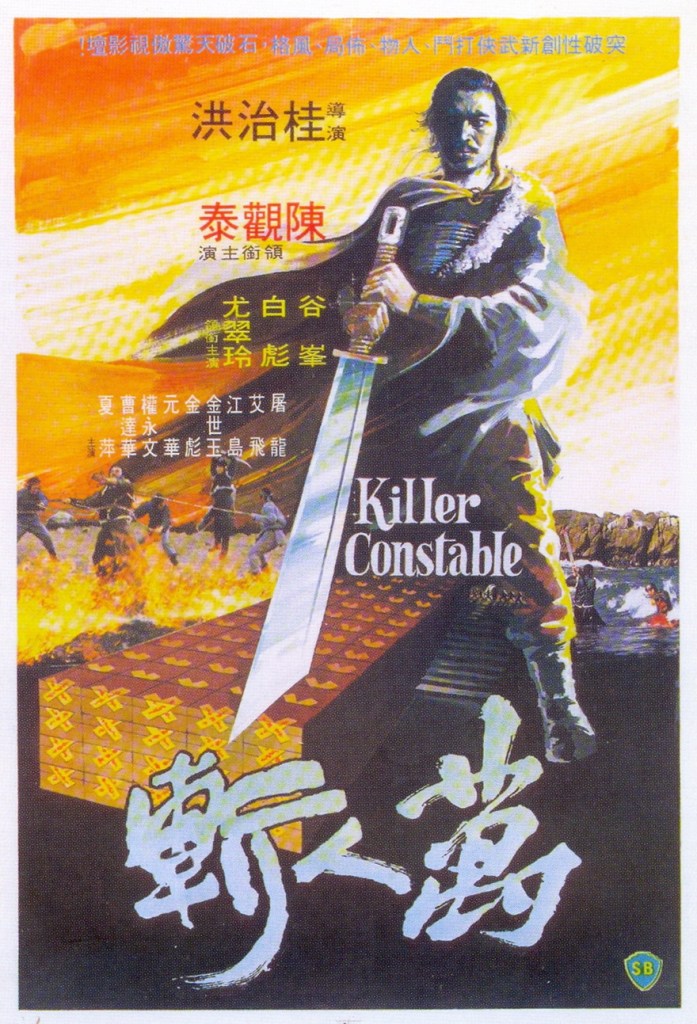
Killer Constable (萬人斬, Kuei Chih-Hung, 1980)

KillerConstable+1980-19-bEvery sovereign needs that one ultra reliable and supremely talented servant who can be called upon in desperate times. For the Dowager Empress of the Qing Empire, that man is Leng Tien-Ying – otherwise known as the Killer Constable. When a sizeable amount of gold goes missing from the Imperial Vaults, it’s Leng they call to try and get it back. However, what Leng doesn’t know is that there’s far more going on here than he could possibly have imagined and he’s about to wade into a trap so deep that you never even see the bottom.

At several points, the giant broadsword style weapon that Leng carries catches the light and appears to shine out with some kind of ethereal righteousness, yet if Leng wields the shining sword of justice he does so with a heart of ice. Early on one of his most trusted subordinates argues with him and says he intends to leave because he thinks Leng is more killer than policeman. He doesn’t take prisoners, where there’s reasonable proof of guilt he cuts the perpetrator down on the spot. At one point he tortures a suspect for information by mock drowning him in a lake while his wife and terrified children look on. When the wife complains, he hits her causing the husband to make the mistake of going for Leng which earns him the prize of getting his head cut off right in front of his family who are now left without any means of supporting themselves.

Leng cares only about the letter of the law. As the squad of policemen ride through the barren landscape, they pass through ruined towns filled with the starving and the desperate. One of the more compassionate men asks what’s happened here and if they, as policemen, shouldn’t be trying to help, but is reminded that these poor people are Hans and the policemen are Manchurians, so it’s just none of their business whether they live or die.

However, here is where Kuei’s film deviates from the accepted path. Leng’s generally bleak attitude to life is the one the film most closely identifies with. Any attempt at compassion is met with by betrayal, each act of kindness only earns retribution and being softhearted is almost another word for dying young. That is not to say the film is completely behind Leng as a hero or even as an anti-hero, he too will pay for the way he lives his life starting with realising that he alone is responsible for the deaths of the men that blindly followed him on a fruitless quest.

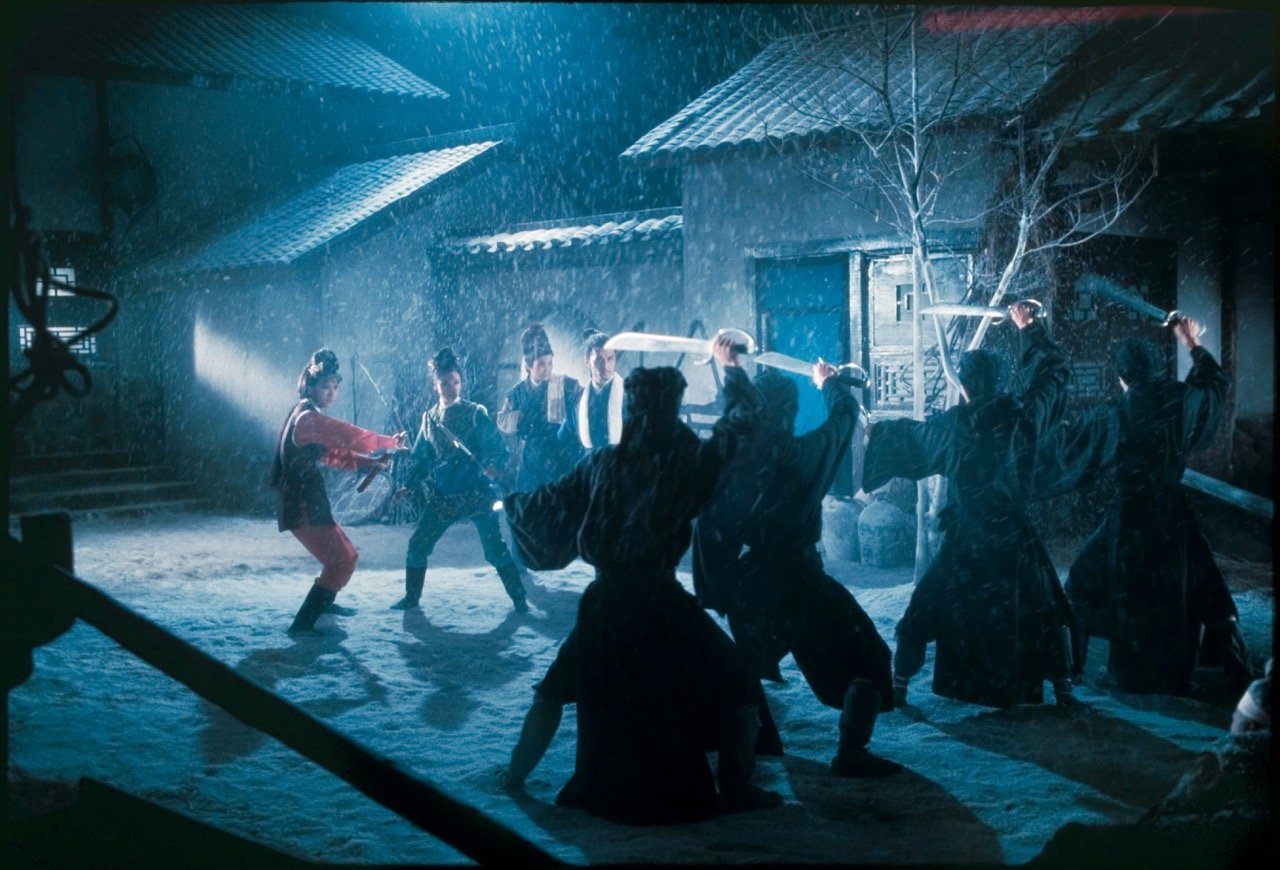
Killer Constable is more of a swordplay film than a kung-fu one and is filled with plenty of energetic and expertly choreographed fight sequences. The men fight in blazing heat (at one time literally), pouring rain and mud filled swamps against a suspiciously well trained gang of opponents who always seem to be lying in wait for them. The Killer Constable also seems to have something of a fetish for chopping off people’s legs which carries on right into the bloody finale with limbs flying off with oddly gleeful abandon.

As it turns out, the Killer Constable is not completely heartless, he’s just lived in this harsh world long enough to come to the opinion that the “bad” cannot be redeemed and need to be cut down like weeds so that the flowers can once again bloom. However, he, in his quest, has crossed the line and become that which he most hates. To nearly everyone else in the picture, Leng is a bad guy – the uncompromising face of the law and the knock at the door you most fear coming. In the film’s surprisingly downbeat ending he too will get what’s coming to him.

Bleak beyond measure, the only good and true thing in the cruel wold of Killer Constable is the blind daughter of one of the criminals. Kind and cheerful, she tries to help Leng as he lies wounded and is entrusted to him should her father die, yet she pays the heaviest price of all, left standing all alone in the rain waiting for the return of those who will never come home again. Far from heroic, Killer Constable is a critique of blind justice dealt out by self righteous egoists who will always discover the error of their ways far too late.


Seen as part of HOME’s CRIME: Hong Kong Style touring season.