Georama Boy, Panorama Girl (ジオラマボーイ・パノラマガール, Natsuki Seta, 2020) [Fantasia 2021]

“As long as you have a girl you can cope with anything. Who cares what’s happening in the world?” the lovestruck hero of Natsuki Seta’s Georama Boy, Panorama Girl (ジオラマボーイ・パノラマガール) blusters floating around on a cloud of adolescent intensity. “Man, you’re crazy” his more mature workmate replies with unconcealed exasperation. Adapted from a manga by Kyoko Okazaki, Seta’s post-modern drama like her previous film Parks recalls the lighthearted teen movies of the Bubble era even as it gleefully subverts rom-com norms as the mismatched youngsters repeatedly glide past each other experiencing parallel though connected episodes of romantic disillusionment in a rapidly deconstructing city. 

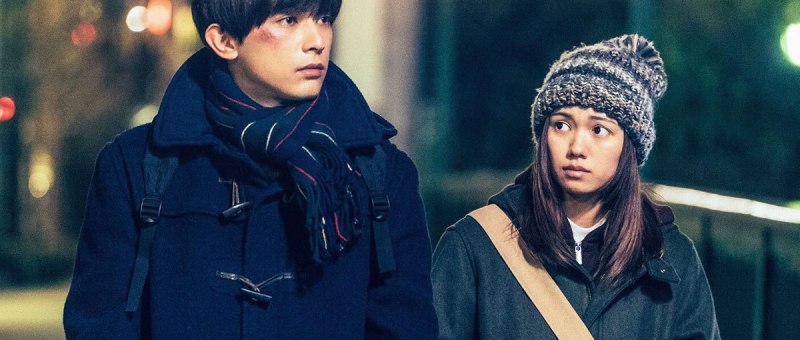
The heroine, Haruko Shibuya (Anna Yamada), is a dreamy, romantic sort of girl who’s read too many shojo manga and wishes the summer could go on indefinitely because she wants “to dream longer”. Kenichi Kanagawa (Jin Suzuki), by contrast, is a slightly nerdy young man who upends expectation by suddenly standing up mid-class after being forced to take a test on the first day back after the summer holidays to announce he’s quitting school because he’s realised it’s just not necessary for him. As if trying to get his mid-life crisis over as early as possible, Kenichi picks up a skateboard and starts hanging round in Shibuya unsuccessfully trying to pick up girls until he catches the attention of a free spirited older woman, Mayumi (Misato Morita), only to be unceremoniously beaten up by her maybe boyfriend after being spotted together in a cafe. Bloodied, bruised, and collapsed in the street is how he eventually meets Haruko who stops to see he’s OK and then randomly gifts him her combini purchases, keeping hold of his school ID card which is how she figures out who he is. 

Being a teenage girl, Haruko, like her friends Kaede (Erika Takizawa) and Maru (Kogarashi Wakasugi), longs to fall in love and thinks meeting Kenichi is her romantic destiny even over investing in its potency in believing their love is probably necessary in order to save the Earth from calamity like the star-crossed lovers from a shojo manga. As their names suggest, Haruko is the city centre whereas Kenichi is the provincial suburbs, but they spend their time dancing around each other living out parallel love stories as Kenichi continues to obsess over Mayumi whose free-spirited frankness is tinged with sadness while her toying with a lovestruck teen has an almost self-destructive quality. Each of them experience a moment of romantic disillusionment realising that their adolescent visions of pure love are essentially unrealistic and that chance meetings are sometimes just that intended to go no further because life thinks nothing of the rules of narrative causality. 

The failure of Haruko’s romantic dreams prompts her into a further moment of introspection as she continues to wonder if everything around her is merely an illusion. Meanwhile, the TV news is a catalogue of contemporary anxieties from an early report on a young woman who took her own life rather than return to school because of rampant bullying not to mention exam stress, to a protest over nuclear weapons and conscription, and even one about a potential response to meteors and aliens. The Tokyo the teens inhabit is one of constant uncertainty, a city half-built and in a state of limbo remaking itself for the upcoming Olympics (which ironically we now know will only half arrive). Yet as Kenichi had suggested, the teens barely notice what’s going on in the world around them so caught up are they in their adolescent dramas finding themselves less star-crossed than at cross purposes in their mutual romantic dilemmas. 

Just like the teen movies of old, Seta draws inspiration from the French New Wave as the youngsters frequently monologue across each other sometimes in sync and others not their dialogue in a sense pretentious but also filled with the naive intensity of youth as they each attempt to navigate their way towards a more mature adulthood. With a charmingly timeless retro quality, Georama Boy, Panorama Girl embraces the absurdity of teenage love but finally opens the door to something more “real” brokered in a way by twin heartbreak followed by a mutual resetting as the pair walk out into a new dawn now more ready to meet whatever it has waiting for them. 


Georama Boy, Panorama Girl streams in Canada until Aug. 25 as part of this year’s Fantasia International Film Festival.

International trailer (English subtitles)

Chiwawa (チワワちゃん, Ken Ninomiya, 2019) [Fantasia 2019]

Chiwawa posterFollowing indie drama The Limit of Sleeping Beauty, Ken Ninomiya takes a further step towards the mainstream with Chiwawa (チワワちゃん, Chiwawa-chan), inspired by Kyoko Okazaki’s 1996 manga. Updated for the Instagram generation, Ninomiya’s adaptation leans heavily on his trademark clubland style and sheds the sense of nihilism which defined mid-90s pop culture in favour of a world weary exploration of identity in the internet age in which connections are wilfully fleeting and personas easily interchangeable. The party is, however, about to come to an end for the latest generation of bright young things seeking hedonistic release but finding only emptiness in the superficial pleasures of meaningless excess.

The titular “Chiwawa” (Shiori Yoshida) is found dead, floating in pieces in Tokyo Bay. The notice of her demise is, in fact, the first time many of her friends discover her real name, Yoshiko Chiwaki, apparently 20 years old and according to the news a nursing student. She was for a time a big star on Instagram and a popular internet model whose face could be seen all over the city on mile high billboards, but before that she was just a girl looking for fun and friends in the Tokyo club scene which is how she met our heroine, Miki (Mugi Kadowaki). Like Miki herself, Chiwawa was added to the small group of clubland friends as the current squeeze of playboy student Yoshida (Ryo Narita), introducing herself with her enigmatic nickname supposedly a reference to her petite stature. Branding herself as an ultra cute airhead, she quickly worked her way into the disparate group of Bohemians but eventually outgrew them and moved on to more dubious pleasures including an ill-fated love affair with a famous photographer (Tadanobu Asano).

The only one of her friends seemingly preoccupied about what happened to Chiwawa, Miki begins an investigation but her research is less geared towards finding out who killed her – something the police don’t seem to be very invested in, but discovering who she “really” was. Mimicking the structure of Okazaki’s episodic manga, Miki begins interviewing her friends to build up a kaleidoscopic composite of the woman she thought she knew while perhaps discovering something about herself as she reconsiders her own life trajectory and the coming end of her youthful days in the clubland scene while pondering where it is she’s supposed to go next.

Like much of Okazaki’s work, the manga’s mid-90’s setting is soaked post-bubble malaise as her dejected youngsters escape from the sense of crushing disappointment in the wake of the abrupt end of the heady ‘80s heyday of Japan as leading global economy, but for Miki and her friends twenty years later perhaps things aren’t all that different as they fight the onset of adulthood and the relative lack of freedom and possibility they will encounter when their student lives end and the workaday world finally arrives. Aspiring filmmaker Nagai (Nijiro Murakami) captures everything with his video camera while working as a photographer’s assistant by day, allowing Miki and her friends to use the studio at night for their Instagram side gigs which is how Chiwawa winds up in the fashion biz.

Some starving artists, others merely nervous hedonists, the gang have no money but when Chiwawa runs off with the gigantic bribe a group of slimy businessmen were boasting about carrying, the gang manage to blow it in just three days of upscale partying. Miki alone, and perhaps more in hindsight, feels the emptiness of all this senseless excess but it’s Chiwawa herself who seems to fear the party’s end most of all. When you start to think it’ll go on like this forever, that’s when you know it’s about to end she laments, apparently missing her old gang like crazy but knowing you can’t put something back together after it falls apart.

Miki fails to solve the mystery of Chiwawa, perhaps sorry that she didn’t try harder to know her while she was alive but also knowing that’s partly because “Chiwawa” might not have wanted to be known for all that she was chasing love and acceptance in all the wrong places. In the end, she retreats into a past that no one quite remembers, another melancholy ghost of Tokyo’s neon-tinged nightlife. Youth moves on, clubs close down, the world keeps turning. That may be the saddest thing of all, Chiwawa remains unknown, unloved, and finally unremembered. A melancholy exploration of fractured identities, the ethereality of youth, and the impossibility of true connection, Chiwawa is another zeitgeisty piece from Ninomiya which takes the manga’s post-bubble anxiety and reboots for an age of alienation in which the end of the party is always lingering painfully on the horizon.


Chiwawa was screened as part of the 2019 Fantasia International Film Festival

Original trailer (English subtitles)

Images: (C)2019 CHIWAWA Chang PRODUCTION COMMIIEE(TOEI VIDEO, VAP, KADOKAWA, GEEK PIKTURES, TOEI ADVERTISING)

River’s Edge (リバーズ・エッジ, Isao Yukisada, 2018)

River's Edge poster 2The ‘90s were a strange time to be a teenager, but then what age isn’t? Isao Yukisada, surprisingly making his first manga adaptation, brings Kyoko Okazaki’s cult hit River’s Edge (リバーズ・エッジ) to the big screen, recreating those days of nihilistic despair in which ordinary teens spiralled out of control in the wake the bubble bursting, watching all their possibilities disappear in a cloud of smoke. Set in 1994, River’s Edge is a post-bubble story but it also takes place in the period immediately before everything started to go wrong. In 1995 there was a devastating earthquake followed by terror in Tokyo and somehow it all seemed so dark – something the kids at the centre of River’s Edge already seem to see as they watch time flow, knowing all that awaits them is yet more emptiness.

Haruna (Fumi Nikaido), a spirited tomboy and latchkey kid living with her busy single-mother, is in a lazy relationship with violent popular boy Kannonzaki (Shuhei Uesugi) though in truth she doesn’t seem to like him very much. One of her major problems with Kannonzaki is that he keeps picking on one particular guy, Yamada (Ryo Yoshizawa), who is rumoured to be gay. Warned by one of Kannonzaki’s minions, Haruna races off to an abandoned storeroom where she finds Yamada trussed up and naked hidden inside a locker. The pair become friends and he offers to show her his “special treasure” which turns out to be a dead body hidden among the reeds near the edge of the river. Yamada, with another friend, Kozue (Sumire) – a model with an eating disorder, likes to come to the river to gaze at the body in an effort to feel alive.

The ‘90s were full of tales of cruel, emotionless youth torturing itself without mercy and there is something of the era’s insensitivity in the detachment of the central trio. Unable to feel alive, the teens of River’s Edge chase sensation and oblivion through indiscriminate sex, drugs, violence, and self harm but rarely find the kind of fulfilment they so desperately crave. Kannonzaki, the rowdy delinquent, blames his broken home for his lack of connection, making a fierce resentment of a perceived rejection his excuse for his dangerously violent proclivities which run not only to venting his rage on the figure of the gay outsider Yamada but also to drug fuelled rough sex with one of Haruna’s classmates, Rumi (Shiori Doi), who is also chasing agency through sexuality but eventually finds herself cornered in the most terrible of ways.

Yamada is indeed gay, but can hardly say so in the environment in which he lives and so has turned in on himself with a near sociopathic detachment. Having given up on the idea of romantic fulfilment he has resigned himself to loving the object of his affection from afar, happy enough that he exists in the world even if he can never declare himself let alone dare to hope his feelings may be returned. Yamada works as a rent boy in the evenings, going to hotels with middle-aged men for money, but has a fake girlfriend at school, Kanna (Aoi Morikawa), whom he uses as a beard. Kanna, seemingly sweet and oblivious, soon becomes jealous of her boyfriend’s friendship with Haruna and is driven into her own kind of despair by Yamada’s continued coldness.

There’s an especial irony in Yamada’s use of Kanna which is almost certainly not lost on him. These kids, like many before them, abhor the fakery of the adult world but are also unable to embrace their own painful truths. Yamada covers up his sexuality through misleading Kanna, while Kannonzaki is resentful towards his parents who put on a front of marital harmony even after his father ran off with his mistress only to come back a week later with his tail between his legs, and Kozue laments the superficiality of her industry in which everyone falls over themselves to declare something ugly beautiful in order to make themselves feel better. There are no responsible adults here, having ruined the future for their kids they no longer have any kind of moral authority that can offer guidance or support to a jaded generation.

Shooting in the classic 4:3 of a ‘90s TV, Yukisada recreates the narrowness of an era in which the kids struggle to see past themselves, blinkered by their own solipsistic perspective and trapped by the shallowness of their perceptions. Permanently dark, gloomy, and lonely their world is one nihilistic despair in which they feel themselves already dead, living in the half-dug grave of a moribund city giving off its last few puffs of toxic industrial smoke before the whole thing collapses in on itself. In one sense nothing changes, there are no answers or cures for adolescent malaise, but something does eventually seem to shift in the genuine connection formed between two detached outsiders standing on the brink, watching the decay of their era flow past them with melancholy resignation.


Screened at Nippon Connection 2018.

Original trailer (no subtitles)