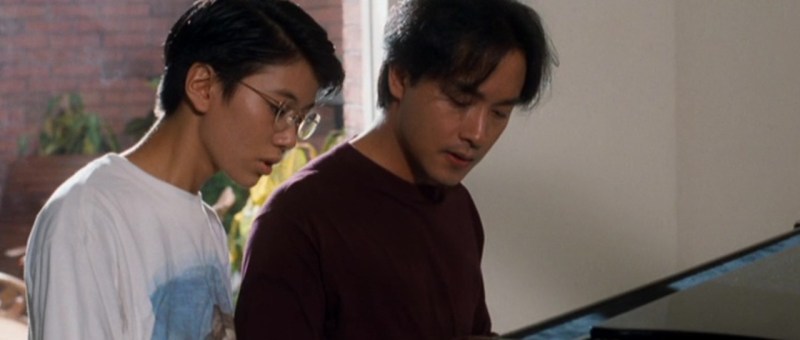
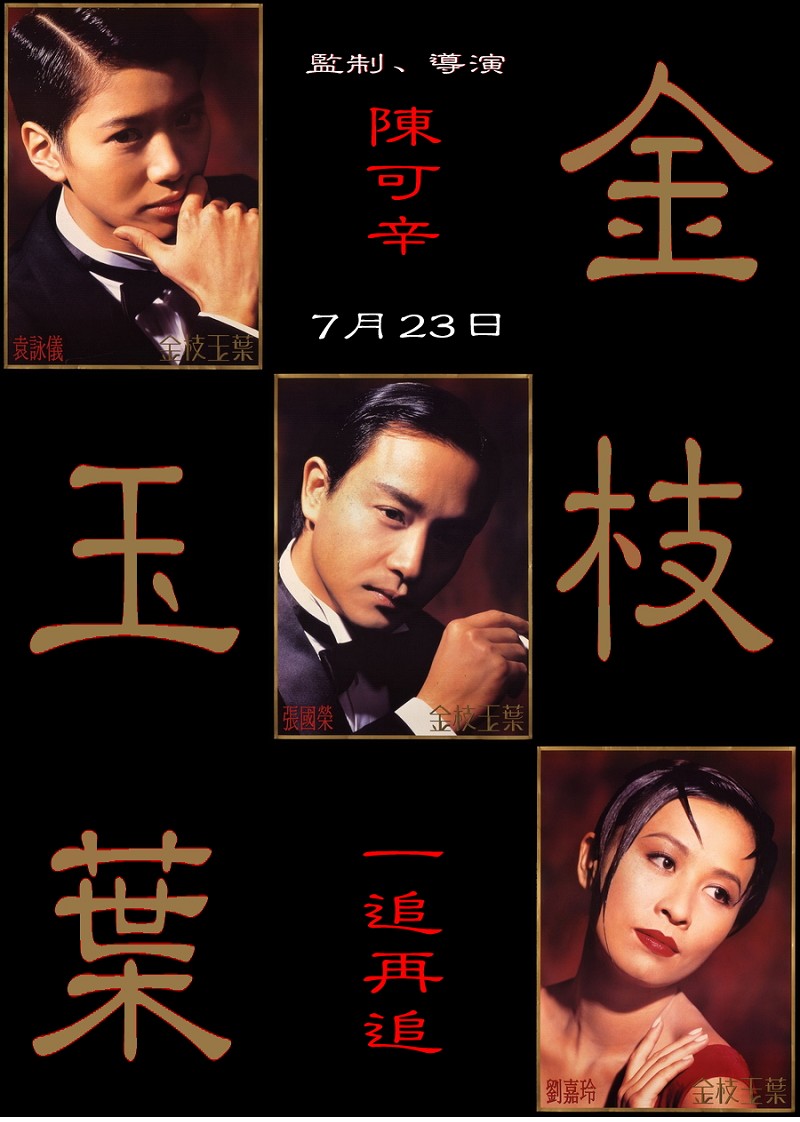
He’s a Woman, She’s a Man (金枝玉葉, Peter Chan, 1994)

A frustrated composer in a moribund relationship with his former muse experiences a moment of existential confusion on feeling an unexpected attraction to his latest prospect whom he assumes to be male in Peter Chan’s hilarious meta comedy, He’s a Woman She’s a Man (金枝玉葉). Broadly progressive in its views of gender and sexuality, the film also takes aim at a growing obsession with celebrity in an increasingly consumerist culture. 

The heroine, Wing (Anita Yuen), is a case in point. She’s completely obsessed with the singer May Rose (Carina Lau) to the point that she almost lives her life vicariously through her. Rose’s successes are her successes, while she earns a few extra pennies peddling celebrity tat like Aaron Kwok’s used tissues. Rose meanwhile is riding high professionally by winning yet another reward, but her relationship with songwriter/manager Sam (Leslie Cheung) has clearly run its course. He’s become bored with the “celebrity” lifestyle and hasn’t written anything new in some time while unwilling to admit that he’s fallen out of love with Rose, refusing to take on new proteges because of his habit of falling in love with them.

That’s one reason he finally agrees to take on a male star, assuming there will be no danger of romantic conflict and intending to kick back against celebrity culture if ironically by creating an “everyman” sensation. But unbeknownst to him, Wing has had a male makeover and decided to enter the auditions in the hope of meeting her idols. Unexpectedly picked up for a recording contract during a spat between Rose and Sam, Wing finds herself having to keep up the act but is conflicted on fearing her presence is only deepening the rift between the “perfect couple” whose wedding it is her life goal to witness. 

Even before her makeover, Wing makes repeated references to her atypical gender presentation in lamenting her flat chest, especially in contrast with a rival celebrity hunter she nicknames “big boobs”. She takes lessons in performative masculinity from her roommate and best friend since primary school Yuri (Jordan Chan), who appears to have no romantic interest in her, and stuffs glow sticks down her trousers to make herself feel more “complete”. Yet despite all that, she is always forced to deny her seeming femininity with several people directly asking her if she is “gay” which is a more complicated question than it seems given that she’s a straight woman but currently living as a man. To find out for sure, Rose tries to seduce her in an attempt which is admittedly predatory and ends in a chase around the bed with Wing desperately trying to avoid being accidentally “outed” in an amorous moment. 

Nevertheless, there is a degree of romantic attraction in Wing’s obsession with Rose which is also a reflection of her internalised sense of shame in her atypical femininity as seen in her wide-eyed observation of Rose’s shadow dance as she slips into something more comfortable along with her admission that she always wanted to know what it felt like to touch a breast (because she feels she has none of her own). Even so, she begins to fall for Sam who is slowly being driven out of his mind with romantic confusion in being unable to reconcile his attraction to Wing with his heterosexuality. One of Wing’s closest associates whom he refers to as “Auntie” (Eric Tsang) is an openly gay man who asks him the all important question of whether of what’s really bothering him isn’t Wing’s ambiguous sexuality but his own. The question takes on a meta dimension in the knowledge that Cheung was himself bisexual but at that point not openly. Much as Sam explains, he might personally not have a problem with it but some people in the industry are very “sensitive about this kind of thing”.

Sam doesn’t know that Wing is “really” a woman, which might neatly explain his inexplicable attraction to her, but cannot begin to reconcile himself until he accepts that it “doesn’t matter what you are” because the fact remains that he loves her. Wing might make her final dash in more stereotypically female attire, but she does so in a voluminous white dress which, aside from its matrimonial connotations, further emphasises her lack of conventional femininity in her literal inability to manage it as she attempts to run while trying not to trip over herself. “Too much reality can really get up your nose,” Rose had complained in trying to keep her fantasy of a fairytale romance alive while internally accepting she can no longer be the “ordinary” girl Sam is looking for in a world of celebrity miasma and consumerist aspiration, finally reaching her own moment of self-acceptance just as Wing decides to shoot her shot right into Sam’s tender heart.

Trailer
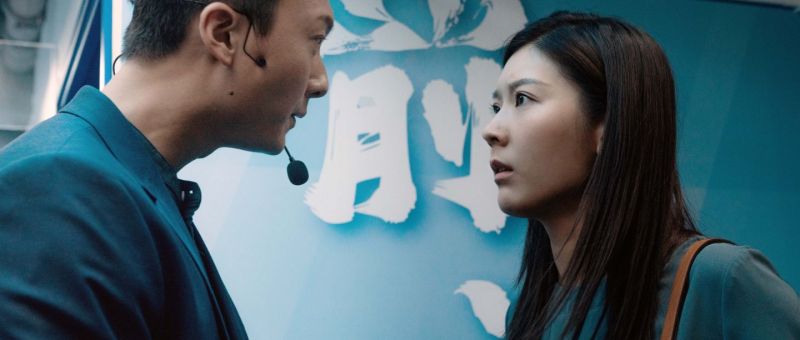
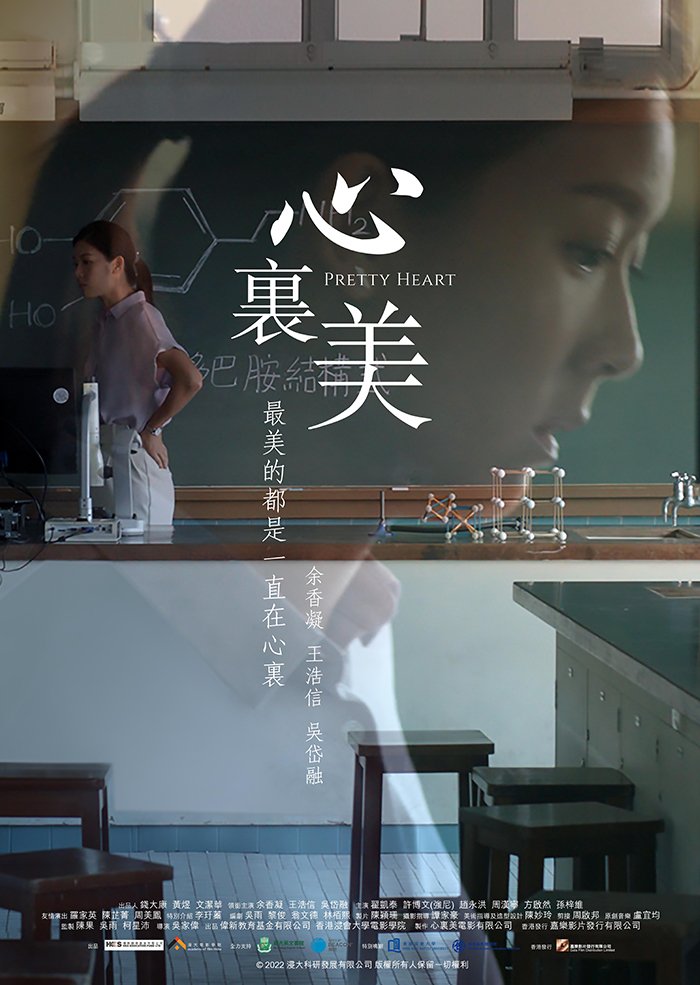
Pretty Heart (心裏美, Terry Ng Ka-wai, 2022)

An idealistic teacher finds herself questioning her views on education while confronting her traumatic past in Terry Ng Ka-wai’s gentle drama, Pretty Heart (心裏美). Partly a contemplation of the nature of education, the film has some serious questions to ask about the contemporary school system and in its inbuilt inequalities along with the complicated relationships between parents and children while ultimately opting for a kind of balance in which there is room for many kinds of learning. 

For Chloe (Jennifer Yu Heung Ying) education shouldn’t just be about passing tests but learning about how to live life, gaining the ability to think critically and enriching one’s existence. But at her school, which is funded by both public and private means, she’s regarded as something of a troublemaker by Mrs. Tsang, the wealthy head of the board who seems to have the headmaster well under her thumb. Mrs. Tsang is so hands on because her son Chi Kit is a pupil though a somewhat indifferent one sure that his money and connections will engineer his success. A small fight breaks out when a young girl, Shu Ting, who comes from an impoverished single parent family, tries to hand out tickets for video lectures by top cram school teacher K.K. Ho with Chi Kit insisting that only the elite who have the means to pay deserve a place in the room. 

The incident at once lays bare the fallacy that education is a levelling force enabling social mobility under in meritocracy when kids like Chi Kit will always be able to game the system in ways that those like Shu Ting cannot even if, as Mr. Ho tells another pupil, at the end of the day it’s the effort you put in that counts. What annoys Chloe about the elite cram school with its good-looking teachers and flashy showmanship is its devaluing of education in giving kids tips on how pass exams while telling them that they can safely ignore half of the syllabus to focus on the bits that are most likely appear to on the test paper without actually needing to understand much of what they’re memorising. Defending himself, Ho eventually argues that he merely provides a complementary service intended to run in concert with the kind of education Chole offers which is less geared towards test scores than comprehensive learning. 

Yet he also takes Chloe to task for her lack of connection with the kids and image of herself as a teacher pointing out that she has never really bothered to learn much about their lives outside of the classroom. Much of her animosity towards the cram school stems from the fact is it is run by her estranged father whom she assumes to be cynical and unfeeling yet has generated a fatherly relationship with Shu Ting and is doing his best to support her while she contends with difficult family circumstances trying to balance her need to support herself and her mother financially with her education. 

Witnessing Ho’s innate kindness to those around him forces Chloe to rethink her preconceptions while accepting that her reserve has sometimes interfered with her intentions as an educator. Re-encountering her father also causes her to revisit longstanding childhood trauma which may in part have been born of a childish misunderstanding she may be better placed to process as an adult woman. As her father says, the most important thing to learn may be the art of forgiveness and it seems that she has been poisoning herself with hate and resentment as manifested in her literal heart problems. 

The conclusion that the film comes to is that it’s not all so black and white and perhaps the good comes with the bad. Having begun to deal with her emotional trauma, Chloe seems to have become a better and more engaging teacher committed to helping her students in all aspects of her lives. It may not solve the problems of social inequality in the school system or fix the commodification of education symbolised in the existence of the cram school but does at least seem to generate a shift in the general environment which sees even a relieved Mrs Tsang step back from her elitism. Admittedly a little contrived in its melodramatic narrative, the film nevertheless has its heart in the right place as the melancholy heroine learns a few lessons of her own in dealing with the traumatic past.


Pretty Heart screens in Chicago on Nov.6 as part of the 15th season of Asian Pop-Up Cinema where actress Jennifer Yu Heung Ying will be in attendance to collect her Bright Star Award.

Original trailer (English subtitles)

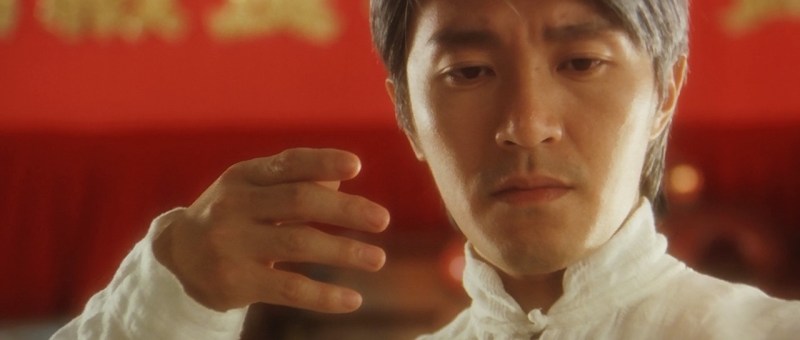
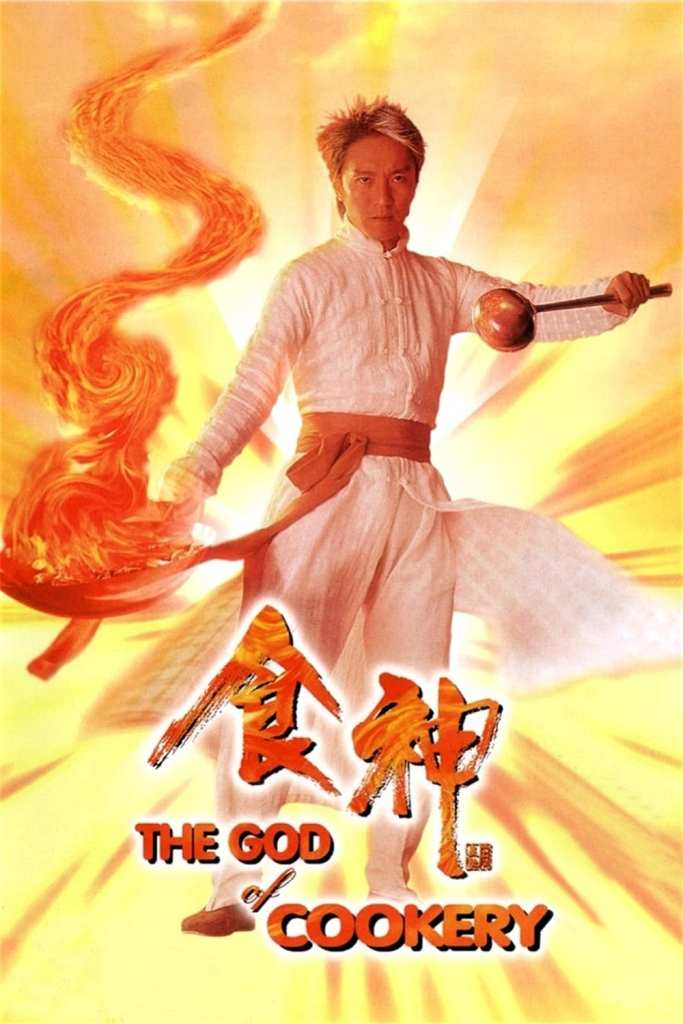
The God of Cookery (食神, Stephen Chow, 1996)

Thing about cooking is, you gotta have heart. At least, that’s the main takeaway from Stephen Chow’s 1996 culinary comedy God of Cookery (食神) in which he once again stars as a man who’s become rich and successful exploiting the talents of others but gets a major humbling when his duplicity is exposed by an even more duplicitous, though apparently talented, rival. Only by living among the people and rediscovering the simple joy of ordinary food cooked with love can he regain his true identity as the “God of Cooking”. 

Stephen Chow (Stephen Chow playing a character of the same name but written with different characters) has built up a successful food empire built around himself as a celebrity chef known as the “God of Cooking”. As a popular TV judge on a cooking competition, he makes a point of giving each of the contestants zero points, starting off with words of praise but eventually finding fault with “basic” techniques and even at one point complaining that it doesn’t matter how tasty the dish is because the chef is so ugly it’s made him lose his appetite. Chow treats his employees with total disdain, going so far as making a prospective hire defecate in public in front of a lift in return for a job, while schmoozing with Triads to expand his empire. The Triads, however, are getting fed up with him and have installed a mole in his organisation. Bull Tong (Vincent Kok Tak-chiu) is a talented chef who claims to have trained at the Chinese Culinary School on the mainland. He makes a point of causing public embarrassment to Chow by tearing apart one of his signature dishes at the press launch for the 50th branch of his branded restaurant chain. Chow is exposed as a talentless fraud and thanks to his haughty attitude, his friends abandon him. 

Penniless and destitute, he rocks up at a noodle stall run by Sister “Twin Daggers” Turkey (Karen Mok), critiquing her noodles in the same way Bull had torn apart his. Turkey takes pity on him after he’s beaten up by thugs and accepts him into her mini street gang. It’s Chow who finds an innovate solution to to her turf war with a rival stall holder in inventing the not entirely appetising “Pissing Beef Balls” which prove an instant hit with all who try them, even helping to cure those suffering with anorexia (apparently a widespread problem of the time, at least according to onscreen newspapers). Chow has not, however, lost his cynical streak and wants to get back to the top by opening a nationwide chain of Pissing Beef Ball restaurants, while Bull and the Triads begin to panic about his seemingly unstoppable success. 

Parodying both Tsui Hark’s Chinese Feast from the previous year, and Wong Jing hit God of Gamblers, Chow brings even more of his now familiar slapstick style, turning cookery into a kind of martial art, and even including a brief sequence in which he gets trapped inside the Shaolin Temple and ends up learning some of their patented culinary techniques. As the cynical top chef, Chow stands in for the evils of the age, puffed up on empty capitalism, openly telling his staff to pull dirty restaurant tricks like making the seats small and uncomfortable to increase turnover and filling the drinks with giant ice cubes to keep costs down and encourage guests to order more. Bull Tong, however, goes even further, beating the staff and suggesting they serve greasy, salt-laden dishes like French fries so kids order more soda, ignoring complaints from the chefs that it’s unethical to serve such obviously unhealthy food to children. 

Sister Turkey’s cuisine, by contrast, might not exactly be top table stuff but it makes no pretence of being anything other than it is. Her rival prides himself on using high quality ingredients, even making sure his oil is changed daily, making it plain that your average market hawker (whether he’s telling the truth or not) at least appears to have more concern for his customers than giant restaurant chains do. Turkey’s ordinary barbecue pork and rice dish with a side of egg is the best Chow’s ever tasted because it was made with kindness. He may have been fond of saying that you have to have heart to cook, but it was just one of his soulless catchphrases until he realised it was true. Good food, companionship, love, and a Christmas miracle slowly work their magic until the “God of Cookery” is finally restored thanks to a little celestial intervention, showing the Bull Tongs of the world exactly what they’re missing.


The God of Cookery screens in New York on Feb. 15 as part of this year’s New York Asian Film Festival Winter Showcase.

A Home with a View (家和萬事驚, Herman Yau, 2019)

Home with a view poster 2Everyone needs an oasis. It might be a mirage, but still you need to believe in it anyway or with the world the way it is you might just go crazy. For the Lo family, that oasis was their tiny harbour view for which they paid handsomely even though their home could be described as modest at best. Relying on the calming vision of the sea to preserve their peace of mind, the family are constantly preoccupied by the rapid increase in high rise apartment buildings which threaten it, but did not bank on a cynical businessman setting up home on the rooftop opposite and putting up a giant advertising billboard to make a few extra pennies.

Adapting the stage play by Cheung Tat-ming, Herman Yau uses the woes of the Lo family to satirise the effects of Hong Kong’s ongoing housing crisis as they find themselves living in a cramped apartment block where everyone seems to have problems but no inclination to mind their own business. Mrs. Lo, Suk-yin (Anita Yuen Wing-yi), is fed up with the butcher (Lam Suet) who lives directly above them and his habit of loudly mincing pork while she’s trying to eat her dinner in peace, while the kids – son Bun-hong (Ng Siu-hin) and daughter Yu-sze (Jocelyn Choi), resent the intrusion of cigarette smoke wafting up from the flat below belonging to an elderly resident whose oasis is presumably tobacco. Meanwhile, Grandpa (Cheung Tat-ming) is in poor health and in the process of losing his marbles all of which makes for a very exciting home environment where chaos rules and there is always something new to bicker about.

Family patriarch, Wai-man (Francis Ng Chun-yu), sunk considerable expense into buying this apartment because of its sea view. In fact he’s still paying off a hefty mortgage which is why the family is engaged in a money saving competition where they challenge each other to come up with the best schemes and bargains, but he is at heart a kindhearted man which is perhaps why he finds himself handing over a huge wad of cash to pay off the overdue rent of the lady next-door who was threatening to commit suicide rather than risk eviction with her husband seemingly having disappeared off somewhere leaving her alone with her young son. He is not, however, above jamming with the system and is himself an estate agent peddling “low cost” subdivided flats with no widows or kitchens and only access to communal bathrooms in disused but not quite redeveloped former industrial buildings.

Desperate to reclaim their access to serenity, the family set about trying to get the cynical businessman opposite, Wong (Louis Koo Tin-lok), to take the billboard down but he proves smug and indifferent to their plight. In fact, his resentment towards those who can afford swanky sea view apartments is one of the reasons he put the billboard up in the first place so he’s not about to take it down just because he’s realised its presence is inconsiderate. Trying to get the authorities, including an old friend with a longstanding crush on Suk-yin, involved proves largely fruitless with the family locked into a bureaucratic nightmare which saps all their energy and only drives them all crazier even as they begin to unite in pooling their efforts to outsmart Wong who insists the billboard is “art” which he made himself and enriches the city.

The intersection between art and advertising, as well as mild motion towards both things as acts of protest, is only one of the film’s meta touches, but its main theme is indeed family and the various ways the modern society both frustrates and cements it. The Los who were always at each other’s throats, became calm sitting together gazing out at the peaceful harbour but later returned to their individual spheres before reuniting in conflict. Meanwhile, we discover that Wong has a sad story of his own which paints him as a lonely man without a family who likes the attention the billboard has brought him because it’s finally forced people to acknowledge his existence. Rather than managing to make friends with him, the Los descend further into their psychotic fury as they try to defeat Wong, ironically rediscovering their family solidarity in the process. “In this terrible world only family can protect us”, Grandpa says, and in this crazy cutthroat society he may be right. Perhaps the best course of action is to all go mad together rather than try to resist the craziness.


A Home with a View was screened as part of the 2019 Udine Far East Film Festival. It is also currently available to stream via Netflix in the UK (and possibly other territories).

Original trailer (English subtitles)