
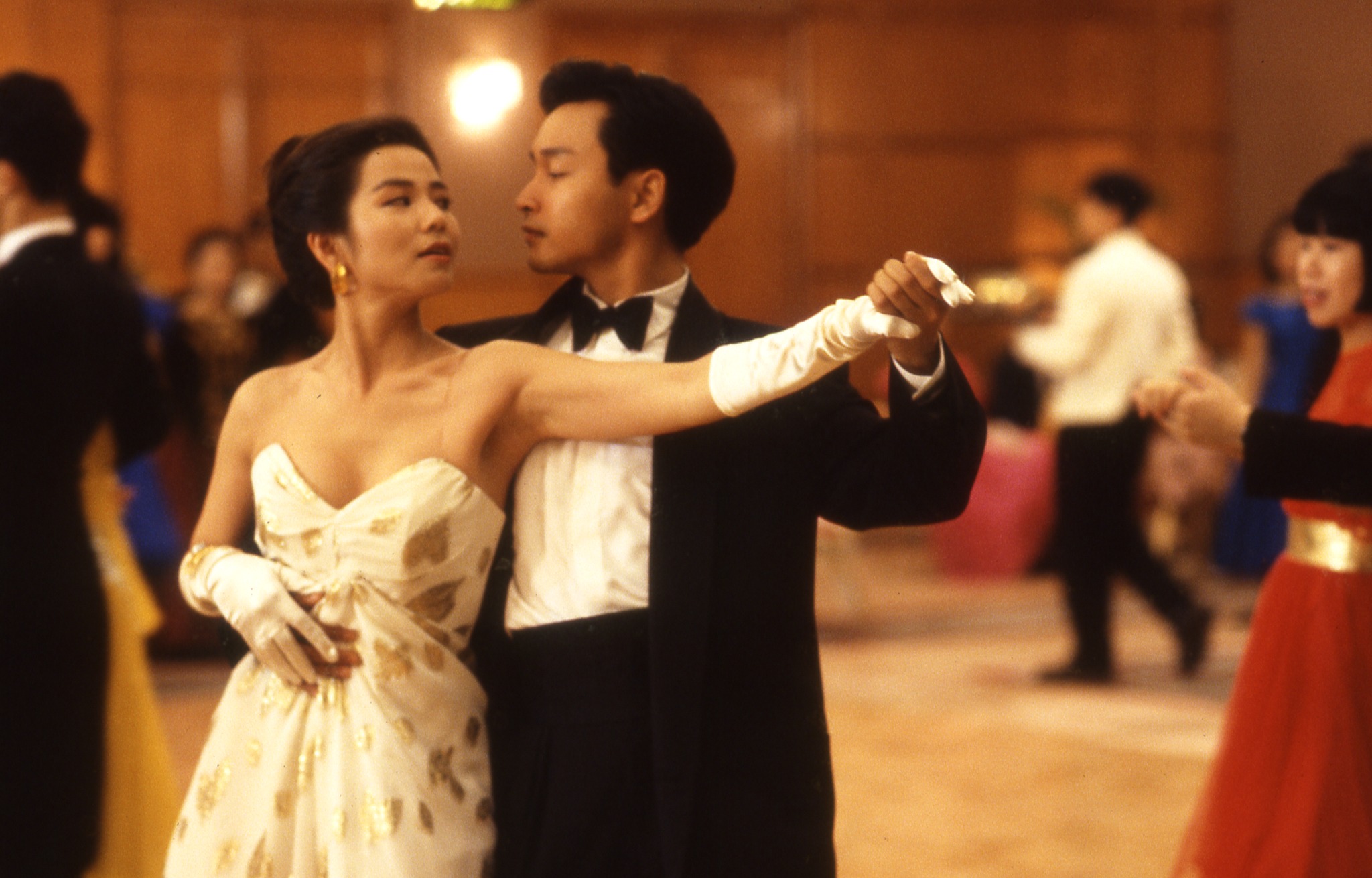
Once a Thief (縱橫四海, John Woo, 1991)

A trio of orphans raised to be international art thieves rebel against their mentor when a job goes wrong in John Woo’s throwback to his early comedies, Once a Thief (縱橫四海). A breezy, Lupin III-esque adventure, the film on one level seems to be satirising the vacuity of extreme wealth as the rich spend huge amounts of money to buy stolen paintings they can’t show to anyone while painting our heroes as anti-capitalist rebels for whom the money is but a secondary concern.

They are, after all, having quite a lot of fun with their complicated heists. Though the robberies are finely tuned affairs, we also see that the team are not infallible and often riding on bravado such as Rice Pudding (Chow Yun-fat) failing to land smoothly in the getaway car and being left trailing behind alone. The trio take it in good humour and have a real sense of camaraderie in which they’re forever playing tricks on each other. Not even the intrusion of romantic rivalry can disrupt their friendship as it becomes clear that both Jim (Leslie Cheung) and Rice Pudding are in love with Red Bean (Cherie Chung), with Rice Pudding originally having the upper hand.

There is something quite funny about the fact that the other two are called “Rice Pudding” and “Red Bean” but “Jim” is just “Jim”. Despite the romantic rivalry, there’s also a sense of homoerotic tension that exists between the two men, with Jim cheekily flirting with a portrait artist while boasting of the gang’s success. The European setting adds a sense of sophistication and international glamour that recalls classic Hollywood cinema, while hinting a new globalised society. The gang are wanted by “Interpol”, and the Zenigata-like figure of a Hong Kong policeman (Paul Chu) who acts as a kind of alternate father figure watching over the trio since they were children and trying to get them to give up their life crime.

The man who raised them, Boss Chow (Kenneth Tsang), meanwhile, was cruel and mainly sees them as tools to be used to enrich himself. When Rice Pudding loses the use of his legs and uses a wheelchair to get around, he is more or less disowned as no longer useful, only to be rescued by their Godfather. Rice Pudding, however, is surprisingly adept and able to perform some killer dance moves in his chair not to mention fighting bad guys in much the same way he did before. But despite the cartoonish fun, there is an unexpectedly violent aspect to the gang’s final heist as Jim strangles guards and Rice Pudding throws plastic explosives at their heads which he then detonates remotely. 

Read Bean, meanwhile, is largely relegated to making travel arrangements and hanging around at airports to waiting to find out if her friends have survived or not. She also acts as a kind of interpreter, speaking French to facilitate their deals which suggests Chow trained them in specific ways, though she does not always translate accurately, trying to put the guys off accepting a risky job from a wealthy Frenchman because she wants to get out of their life of crime and settle down even while Rice Pudding and Jim still seem to be addicted to the thrill of the chase. Their mission sees them sneak into a chateau and steal a painting from a hidden cellar they can only access through a secret door while avoiding booby traps like electrified floors and laser fields they cheekily dance the limbo through. 

For them, it was never really about the artwork nor the money, but the sense of achievement in stealing without being caught while running rings around law enforcement. This sense of rebellion which extends in a way towards the capitalist system in which the super wealthy squabble over trinkets while elderly women starve, is eventually turned back on Chow whom they end up defying in order to break free of his control. Chow got greedy, double-crossing just about everyone in order to make his stolen painting more valuable when he sells it and then steals it back again. Filled with zany humour and expertly crafted action sequences, the film never takes itself all that seriously while revealing in the roguish antics of the three gentlemen thieves living their best lives rebelling against a world ruled by wealth and privilege through ingenious crime.


Trailer (English subtitles)

A Home with a View (家和萬事驚, Herman Yau, 2019)

Home with a view poster 2Everyone needs an oasis. It might be a mirage, but still you need to believe in it anyway or with the world the way it is you might just go crazy. For the Lo family, that oasis was their tiny harbour view for which they paid handsomely even though their home could be described as modest at best. Relying on the calming vision of the sea to preserve their peace of mind, the family are constantly preoccupied by the rapid increase in high rise apartment buildings which threaten it, but did not bank on a cynical businessman setting up home on the rooftop opposite and putting up a giant advertising billboard to make a few extra pennies.

Adapting the stage play by Cheung Tat-ming, Herman Yau uses the woes of the Lo family to satirise the effects of Hong Kong’s ongoing housing crisis as they find themselves living in a cramped apartment block where everyone seems to have problems but no inclination to mind their own business. Mrs. Lo, Suk-yin (Anita Yuen Wing-yi), is fed up with the butcher (Lam Suet) who lives directly above them and his habit of loudly mincing pork while she’s trying to eat her dinner in peace, while the kids – son Bun-hong (Ng Siu-hin) and daughter Yu-sze (Jocelyn Choi), resent the intrusion of cigarette smoke wafting up from the flat below belonging to an elderly resident whose oasis is presumably tobacco. Meanwhile, Grandpa (Cheung Tat-ming) is in poor health and in the process of losing his marbles all of which makes for a very exciting home environment where chaos rules and there is always something new to bicker about.

Family patriarch, Wai-man (Francis Ng Chun-yu), sunk considerable expense into buying this apartment because of its sea view. In fact he’s still paying off a hefty mortgage which is why the family is engaged in a money saving competition where they challenge each other to come up with the best schemes and bargains, but he is at heart a kindhearted man which is perhaps why he finds himself handing over a huge wad of cash to pay off the overdue rent of the lady next-door who was threatening to commit suicide rather than risk eviction with her husband seemingly having disappeared off somewhere leaving her alone with her young son. He is not, however, above jamming with the system and is himself an estate agent peddling “low cost” subdivided flats with no widows or kitchens and only access to communal bathrooms in disused but not quite redeveloped former industrial buildings.

Desperate to reclaim their access to serenity, the family set about trying to get the cynical businessman opposite, Wong (Louis Koo Tin-lok), to take the billboard down but he proves smug and indifferent to their plight. In fact, his resentment towards those who can afford swanky sea view apartments is one of the reasons he put the billboard up in the first place so he’s not about to take it down just because he’s realised its presence is inconsiderate. Trying to get the authorities, including an old friend with a longstanding crush on Suk-yin, involved proves largely fruitless with the family locked into a bureaucratic nightmare which saps all their energy and only drives them all crazier even as they begin to unite in pooling their efforts to outsmart Wong who insists the billboard is “art” which he made himself and enriches the city.

The intersection between art and advertising, as well as mild motion towards both things as acts of protest, is only one of the film’s meta touches, but its main theme is indeed family and the various ways the modern society both frustrates and cements it. The Los who were always at each other’s throats, became calm sitting together gazing out at the peaceful harbour but later returned to their individual spheres before reuniting in conflict. Meanwhile, we discover that Wong has a sad story of his own which paints him as a lonely man without a family who likes the attention the billboard has brought him because it’s finally forced people to acknowledge his existence. Rather than managing to make friends with him, the Los descend further into their psychotic fury as they try to defeat Wong, ironically rediscovering their family solidarity in the process. “In this terrible world only family can protect us”, Grandpa says, and in this crazy cutthroat society he may be right. Perhaps the best course of action is to all go mad together rather than try to resist the craziness.


A Home with a View was screened as part of the 2019 Udine Far East Film Festival. It is also currently available to stream via Netflix in the UK (and possibly other territories).

Original trailer (English subtitles)