Spacked Out (無人駕駛, Lawrence Ah Mon, 2000)

There’s a sense of abandonment and rootless melancholy that pervades Lawrence Ah Mon’s post-Handover drama Spacked Out (無人駕駛). Each shorn of their parental relationships, the four teenage girls at the film’s centre find themselves floundering for direction, seeing no real future for themselves in a Hong Kong that has itself in a way also been abandoned to a new perhaps overbearing parental entity that cannot really be embraced or fully trusted while struggling to find the means to redefine itself. 

The only real authority figure the girls know is their is ineffectual, authoritarian school teacher, Mr.Chan, who challenges 13-year-old Cookie (Debbie Tam Kit-Man) on her late arrival to school over her dyed hair and (according to him) inappropriate footwear. He asks her if she really wants an education, but then robs her of it by forcing her to stand in the playground all morning next to two other students, a girl getting similar treatment for wearing earrings, and a boy who isn’t wearing any socks. Mr. Chan evidently isn’t interested in these kids, their lives or prospects, but only in enforcing the arbitrary rules of social conformity. When another of the girls, Beancurd (Maggie Poon Mei-Kei) whose head is shaved, is accused of slashing another girl with a box knife in a convenience store, he point blank tells them that he doesn’t usually care about what happens to them outside the school but knives are on another level. “How is she supposed to wear low-cut clothes from now on?” he rather bizarrely asks despite having reprimanded each of the girls for their “inappropriate” attire while advocating a rather sexist vision of his teenage charges in which all that matters is that the wounded girl may no longer be as conventionally attractive as she might have been rather than focusing on the causes of this problematic violence or the mental and physical distress caused to the victim.

The film’s Chinese title, “unmanned”, neatly symbolises the girls’ rootlessness but also their own internalised patriarchy in which they continue to look to men for protection and guidance. Abandoned by her mother to whom she leaves long voice messages she never replies to, Cookie has only a violent father who seems otherwise absent from her life. She has begun dating a young man, Wing who is 16 years old and sells pirated VCDs in Mongkok. After sleeping with him Wing has ghosted her while Cookie is worried she’s pregnant having fallen for Wing’s dubious insistence that the first time doesn’t count. Her friend, Banana (Angela Au Man-Sze), meanwhile is the group’s man expert, having apparently had several abortions while continuing to meet men through telephone dating lines as well as the girls’ work in local karaoke booths. Only Beancurd who is a lesbian and in a fraught relationship with the more materialistic Sissy (Christy Cheung Wing-Yin) attempts to subvert male authority but is also driven to acts of self harm by traumatic memories of sexual assault. 

Box cutters become ominous symbols of the frustration and despair felt by the teens, another boy in the girl’s class openly self harming but finding no support from those around him. At least the girls have each other even if they’re all just as lost and confused. On learning that Cookie may be pregnant, they rally round to solve the problem by pooling their resources to get her a backstreet abortion though on another level they’re also railroading Cookie into a decision she hasn’t quite accepted for herself. The place they end up in is grim in the extreme, filthy and with rusty equipment not to mention unsympathetic staff who just like all of the other adults care little for her wellbeing. 

For much of its running time, the film adopts a kind of naturalism but descends into nightmarish psychedelica, possibly provoked by the drug-fuelled party the girls had just left after it took a rather sour and tragic turn, as Cookie undergoes the abortion and simultaneously accepts her abandonment acknowledging that boyfriends aren’t important only friends are suggesting a new solidarity which exists between the Handover generation navigating turbulent seas together in the absence of parental care or guidance. Unjudgemental of his young heroines, Lawrence Ah Mon captures a breezy sense of teenage of life with days spent at the pool with friends if equally the more destructive presence of sex, drugs, cross border smuggling, and exploitation in all of their lives while granting them at least a degree of freedom to define themselves in a new and confusing age. 


Spacked Out opens at New York’s Metrograph Dec. 29 and will also stream in the US via Metrograph at Home courtesy of Kani Releasing.

Trailer

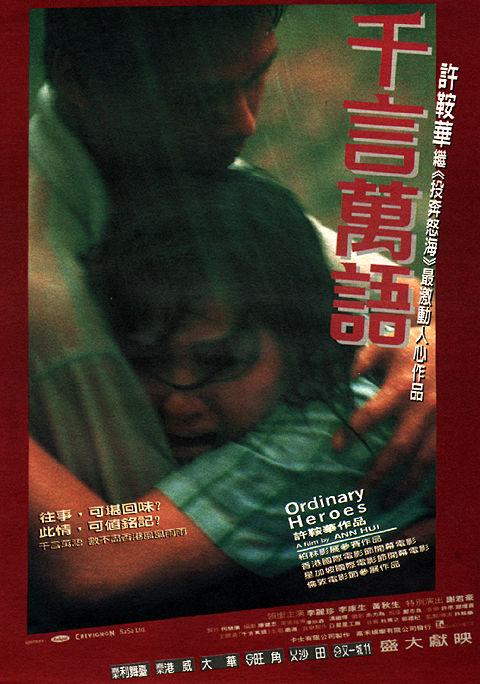
Ordinary Heroes (千言萬語, Ann Hui, 1999)

ordinary heroes posterThroughout her long career, Ann Hui has become adept at making subtle political points through addressing the struggles of the recent past. Ordinary Heroes (千言萬語) was released in 1999, just two years after the handover which signalled the end of British colonial rule. The Chinese title of the film is taken from a Teresa Teng song heard on a car radio and means “thousands of words, tens of thousands of languages” – a sentiment which could apply to the work of the activists as they work tirelessly to little effect, but the English title perhaps hints more closely at the film’s essential purpose as a tribute and pean to these ordinary people who dared to stand up to authority to fight for what they thought was right.

After a brief prologue from the street performer (Mok Chiu-yu) – inspired by the real life figure Ng Chun Yin, who will become the Brechtian narrator of the ongoing drama, Hui cuts to a title card reading “to forget”, only to open with the words “I remember”. The heroine has, however, forgotten her former life for reasons of which we aren’t yet sure. Sow (Loletta Lee) is a young woman and former activist being cared for by her friend, Tung (Lee Kang-sheng) who has been nursing a longterm crush on her ever since she pickpocketed him when he was in high school. Sow, however, had been involved with an activist, Yau (Tse Kwan-ho), who later married someone else, but remains committed to the cause, as hopeless as it might seem.

The cause is that of the Yau Ma Tei boat people. A historic community of former fisherman, the Yau Ma Tei boat people live off the shore of Hong Kong in what was constructed as a typhoon shelter after a fierce storm destroyed almost an entire fleet in 1915. During the 1950s, the community moved away from fishing and became a a kind of tourist spot and centre for petty crime. With their own distinctive accents, clothing, and isolated way of life the boat people were not always welcome on land but also faced an additional problem in that many of their wives were refugees from the mainland and technically illegal migrants forbidden from setting foot on Hong Kong proper. Though the government instituted an amnesty for the children of boat people, it took advantage of the women who came forward to get official birth certificates, deporting them back to mainland China and separating them from their families.

The boat people find few friends, but an Italian Catholic priest and, incongruously enough, committed Maoist, Father Kam (Anthony Wong) becomes a staunch defender, living with the boat people and providing education for the children as well as ministering to his flock. Yau and Kam work together to advance the cause of the boat people while Sow assists Yau and Tung follows Sow whilst also becoming close to Kam and influenced by his peculiar ideology. Kam, often to be found strumming his guitar and singing the Internationale, becomes a figurehead for the movement, even committing to a hunger strike in an attempt to get the authorities’ attention.

Structuring her tale in a non-linear fashion, Hui weaves the complex narrative of political descent in ‘70s Hong Kong, splitting her focus between the single issue activism of Yau and Kam and the wider leftist movement as recounted in the street theatre of Ng Chun Yin. Ng, a longterm leftist activist, was the founder of the Trotskyist Revolutionary Marxist League who later went to China to deliver a true Marxist, democratic revolution but ended up betraying his cause and being kicked out of his own movement. Such obviously left-wing agitation was, perhaps, difficult in the early 70s when news of the cultural revolution had discredited Chinese communism, especially as many residents of Hong Kong had arrived as refugees from the oppressive regime, but there are those who continue to believe in and fight for the values that they believe should be present North of the border.

Sadly these hopes are crushed by the Tiananmen Square incident in 1989 after which it was impossible to argue for the moral superiority of the Chinese state over the colonial government. The bursting of a political bubble runs in parallel with the sad love story of Sow and Tung who find themselves at odds with each other, never quite in the same temporal space. Hui signals the closing coda with another title card, this time reading “to not forget”, as Sow and Tung are forced to acknowledge their painful pasts as they look forward to an uncertain future. Forgetting and not forgetting become the central themes as the boat people plead for recognition, while there seems to be an active choice in play to decide to forget these “ordinary heroes” and the various sacrifices they made in the name of social justice as Hong Kong begins to look forward to its own uncertain future as one master is swapped for another and the silent majority sit idly by, opting for the consumerist revolution over the human one. Ng, in his opening statement, talks about heroes with unfulfilled missions. Tung and Sow find themselves at a new dawn with their illusions shattered, filled with thousands of words and nothing at all to say. 


Screened at Creative Visions: Hong Kong Cinema 1997 – 2017

Original trailer (Cantonese, no subtitles)

Teresa Teng’s Thousands of Words

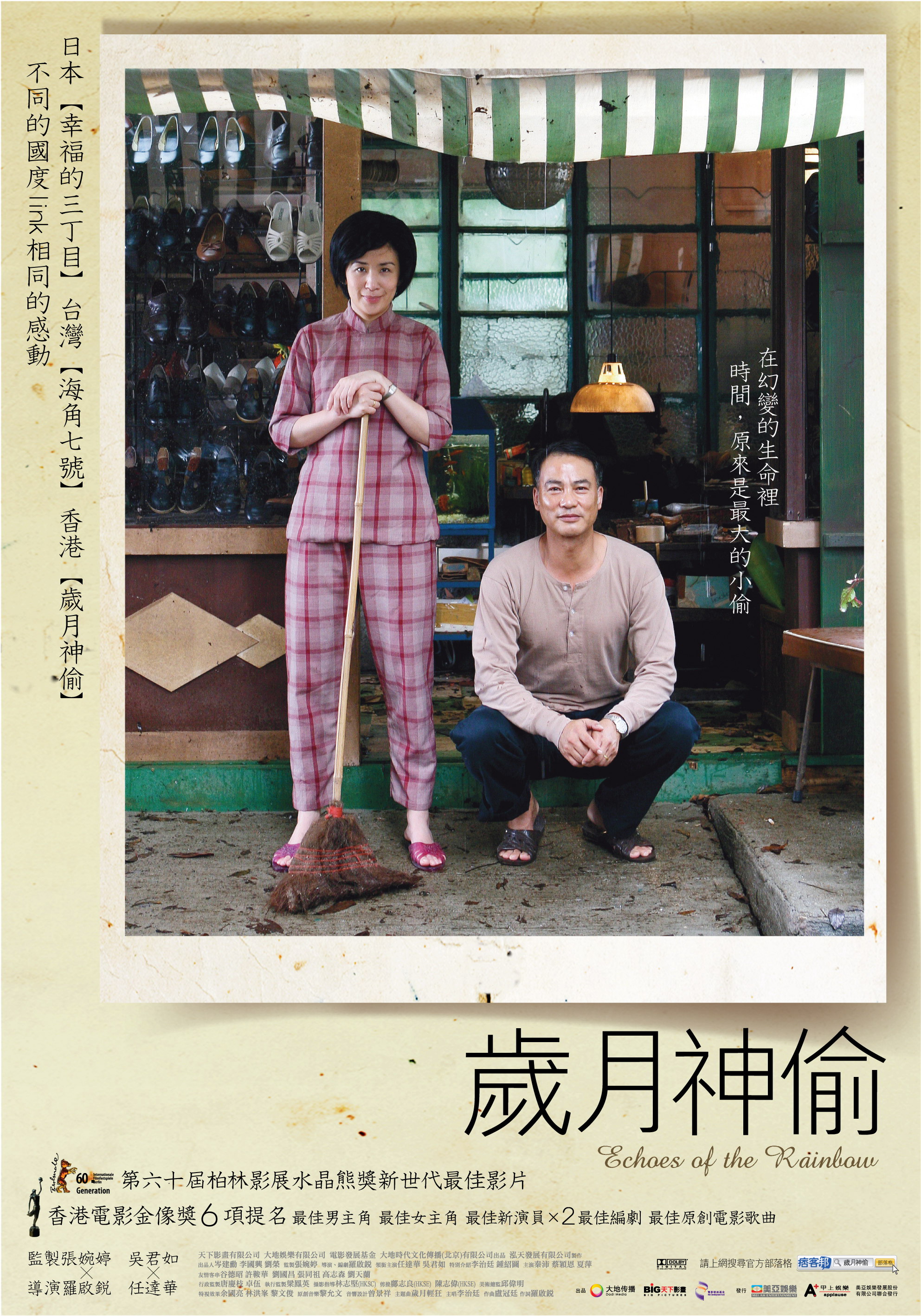
Echoes of the Rainbow (歲月神偷, Alex Law, 2010)

echoes of the Rainbow posterThe tragedy of childhood is that you can’t quite see it on the ground. Looking back the truth is plainer but it’s also painful, containing all the warmth of those times but also the regrets and irreconcilable longings. Alex Law’s small scale personal tale of inevitable tragedies mixed with intense nostalgia, Echoes of the Rainbow (歲月神偷, Shui Yuet Sun Tau), is deeply sincere and more than earns its turn for the sentimental in its never wavering feeling of authenticity as it paints a picture of a rapidly disappearing Hong Kong and a childhood lived in a big brother’s shadow.

Eight-year-old “Big Ears” (Buzz Chung) lives with his cobbler father (Simon Yam) at the end of a long, run-down street of shopkeepers. Amusingly enough, Big Ears’ uncle (Paul Chun) lives at the other end of the street where he cuts hair so the family kind of has the full run of the place, head to toe. While Big Ears whiles his time away daydreaming,  putting a fish bowl on his head and pretending to be an astronaut or indulging in his favourite hobby – kleptomania, his big brother Desmond (Aarif Lee) is busy doing everything right. A tall, strong teenager with more than a passing resemblance to Bruce Lee, Desmond is a track and field star and academically gifted student at the prestigious Diocesan Boys’ School. Big Ears loves everything about his big brother, including his sort of girlfriend Flora (Evelyn Choi).

Law sketches the everyday lives of this ordinary family with the sort of details which randomly recall themselves years later – the tear on his father’s T-shirt from where it hits the end of his chisel, the taste of Autumn Moon Cake, the random conversations with passersby. The small community on this run-down street more is like an extended family in and of itself as the families take their meals on tables outside, each overhearing each other’s conversations and interfering in various family dramas. Big Ears quips that his mum (Sandra Ng) is known as “Mrs. Outlaw” because she’ll talk her way into or out of anything and has a talent for talking people around to her way of thinking, but the warmth and love between his parents is never shaken. Even in the midst of an encroaching tragedy, Mr. Law takes the time to design a pretty pair of ultra comfortable shoes for his harried wife who often complains about her corns.

Seen through little Big Ears’ eyes, the film avoids the bigger picture or any political concerns save for the presence of the corrupt colonial forces as represented by Sergeant Brian who speaks fluent Cantonese but stresses that English is essential for “getting on” in Hong Kong. Sergeant Brian is also going to get one whole box of the moon cakes Big Ears wanted all for himself and his mum has been paying for in instalments for the last few months, but the reason for his visit is a rise in the protection money the local police takes from shopkeepers. If the Laws can’t pay it (and they can’t, really) they’ll be evicted. Not that Big Ears would know, but business is bad and the family is spending most of its income on Desmond’s expensive school fees so it’s doubly galling to them when his grades and athletic success begin to decline.

Big Ears is a naughty little boy, but often gets away with it because he’s just so darn cute. His pilfering habit goes largely undetected even though he steals quite ostentatious items like a glowing goblet souvenir from a movie starring his favourite actress whose picture he also sells with a fake signatures attached, a British flag from a nearby base, and even a pottery statue of the Monkey King from an actual temple. Desmond has this theory about about double rainbows that are an inversion of each other – something that could easily work for himself and his brother with Desmond’s essential goodness contrasting nicely with Big Ears’ roguish adventures whilst also speaking for the enduring bond between the brothers.

Even before the literal typhoon rips through Big Ears’ idyllic childhood home, there are signs of trouble on the horizon – firstly in Desmond’s melancholy love story with fellow tropical fish enthusiast Flora who turns out to come from an entirely different world filled with all the ease and possibility so absent from the Law’s, and then in Desmond’s gradual slowing down. The respective catch phrases of Big Ears’ parents signify the twin pillars of the age with his father’s insistence that “nothing is more important than the roof” as he works steadily to keep one over his boys, and his mother’s instances that life is “half difficult, half wonderful” but “you have to keep believing”. Earning a right to melodrama through fierce authenticity, Echoes of the Rainbow does not negate its tearjerking premise but rings it for all of its joy and sorrow, revelling in nostalgia but also in a kind of hopefulness born of having weathered a storm and survived to witness the birth of new rainbows lighting up the sky.


Screened at Creative Visions: Hong Kong Cinema 1997 – 2017

Original trailer (English subtitles)