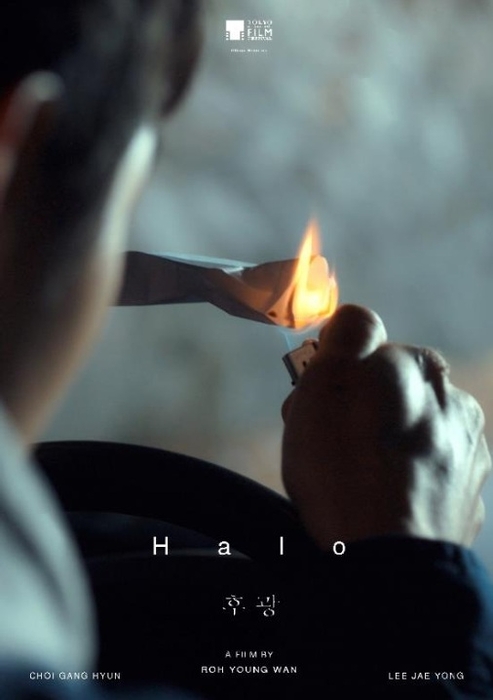
Halo (후광, Roh Young-wan, 2025)

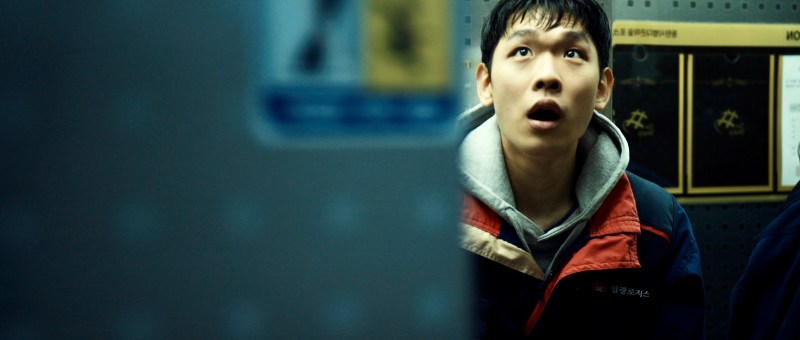
An astrologer delivery driver Min-joon (Choi Gang-hyun) meets tells him that he’s unlikely to achieve his dreams of becoming a film director in Korea. He was born under an unlucky star, destined to be a self-sacrificing figure overshadowed by his toxic family. However, the astrologer points out, the stars look different depending on where you stand, and according to him the best place for Min-joon is the UK, as unlikely as that might seem.

The astrologer doesn’t seem to hold out much hope that he’ll make it, though. He feels sorry for people like Min-joon who have an over-developed sense of responsibility for those around them and are incapable of putting themselves first. They may very well be toxic and dragging him down, but as Min-joon says, they’re still his family. When we first meet them, his parents are having a physical altercation in the police station while his older brother, Min-ha, who has learning difficulties, screams in terror and confusion. It seems that Min-joon’s father has taken to drink and either can’t or doesn’t work. He criticises the state of the nation that reduces people to living like this, but as his wife points out rather than worrying about the country perhaps he could fix the light in the bathroom that’s been broken for months. He asks why he should when it’s not their place anyway, which might explain a few things about the state of the nation.

In any case, Min-joon is surrounded by radio broadcasts about North Korean missiles and various other disasters that lend an additional sense of doom to his monotonous life. Min-joon is honest and hard-working, diligently delivering parcels all day long and taking good care of his van, only to be treated with contempt and a constant stream of problems from his family. He dreams of becoming a film director, but is always frustrated, first by being unable to afford a colour print of his script and pitch for a producer he met through a connection. He shows up in a neat suit ready to discuss his idea, but she immediately shoots him down by saying that no one makes this kind of film any more and he has zero chance of directing anything. She advises working on the set to gain more experience, but those kinds of jobs don’t usually pay very well and Min-joon probably couldn’t afford to take it even if he weren’t hurt and demoralised by the humiliating experience of being so casually dismissed.

That might be why he takes the astrologer’s advice to heart and starts working overtime to save money to move to the UK while sleeping in his van and washing in a local public toilet. He makes the convenience store guy put his buy one get one free sandwiches in separate bags as if ashamed to have him know he’s going to eat them both himself and that that’s his only meal. Even so, his mother asks him to lend them money to buy his brother, the oldest son, a wife from North Korea so he can live a settled family life, seemingly thinking little of Min-joon’s right to do the same. Meanwhile, Min-ha has suspiciously also come into quite a lot of money, and is later arrested for getting involved with a gang running telephone scams. Min-joon thinks Min-ha probably didn’t know or at least fully understand what he was getting into and was exploited by the gang because of his disability but the police won’t listen to him and a lawyer seems to suggest there’s nothing he can do, bearing out the inherent injustice of the contemporary society.

There really is no way out for him. He’s insulted by residents of the snooty apartment blocks he delivers to who don’t like him using their lift, his van gets robbed, and he ends up bumping it too, requiring even more money to repair and now he can’t even sell it to help his brother pay the compensation money for victims of the scam so he can stay out of prison. He repeatedly visits the apartment of a hoarder with a piles of boxes outside her door that she never opens. It’s like he too is trapped in the room surrounded by cardboard with only his family for company. His desperation mounts with frightening intensity until reaching its unavoidable conclusion as he seeks the only kind of escape available to him.


Halo screens in Chicago March 28th as part of the 20th edition of Asian Pop-Up Cinema.

Trailer (English subtitles)

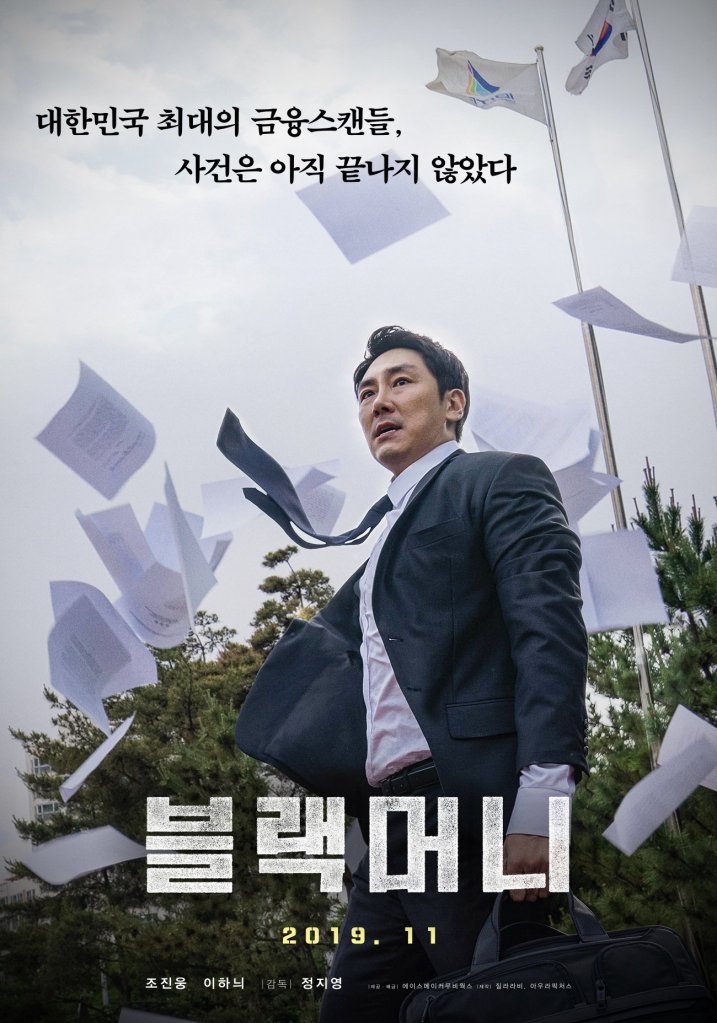
Black Money (블랙머니, Chung Ji-young, 2019)

Following hot on the heels of Default, Chung Ji-young’s financial thriller Black Money (블랙머니) once again has some questions to ask about the nature of capitalism in South Korea. Loosely based on a real life incident concerning the sale of the Korea Exchange Bank (KEB) to American private equity firm Lone Star Funds, Chung’s film points the finger at systematised corruption as its collection of greedy financial elites peddle national interest as a reason for keeping the public in the dark when it comes to their dodgy dealings.

The trouble starts in 2011 when an illicit couple, one working for Daehan bank and the other for the Financial Supervisory Service, are bumped off after being called in by the Supreme Prosectors’ Office in connection with an ongoing corruption investigation into the sale of the bank at rock bottom prices. The male bank employee is killed when the couple is run off the road by a truck but the FSS woman, Su-gyeong (Lee Na-ra), manages to escape. Fully aware that her life is at threat, she tries to get herself arrested by the police for protection but fails and is later discovered dead in her car next to a charcoal briquette. A “suicide note” in the form of a text message to her sister suggests that she has chosen to take her own life because of the aggressive tactics of prosecutors one of whom sexually harassed her after which she felt too humiliated to go on living. 

The mention of sexual harassment is intended to act as a tiny bomb by the shady forces in play, fully aware that just mentioning those words makes the entire case toxic ensuring it will be shut down never to be mentioned again. They have, however, picked the wrong man for their patsy in “bulldozer” Yang Min-hyuk (Cho Jin-woong) who is outraged to have been unfairly labelled a sex offender and will stop at nothing to clear his name, eventually uncovering the entire conspiracy after realising that Su-gyeong’s death was almost certainly a murder.

In this, Yang is obviously acting in self interest, which isn’t to say that he doesn’t care about the conspiracy, but it’s not his primary motivation. His opposing number, Kim Na-ri (Lee Honey), is perhaps much the same, a victim of her upbringing but increasingly conflicted. Brought up by a right-wing, ultra-capitalist professor who is good friends with former prime minister Lee Gwang-ju (Lee Kyoung-young) now working on the Daehan bank sale, Na-ri tells herself she’s acting in the national interest in her desire to set up her own international trade law firm to prevent Korea being taken advantage of by bigger foreign economic powers and in particular the Americans. Despite her law background, what Na-ri has mainly found herself doing is more like PR, finding palatable ways forward to make sure the deal goes through on favourable terms despite the already widespread public outcry.

Surprisingly, Na-ri and Yang end up bonding over the course of the investigation, discovering they have more in common than either might have assumed. Given the kind of evidence that Yang is digging up which points to a wide scale conspiracy involving complex fraud and murder, Na-ri finds herself conflicted. Maybe she isn’t quite as committed to ultra-capitalism as her father is, giving Lee’s speech at the Davos conference the heart-warming title of “free trade with a human face” which apparently went down very well with the audience. Whatever else she is, she’s a lawyer, and the kind of lawyer who doesn’t really like it when people break the law, so she’d rather not think that she’s been party to criminality without ever realising. Lee, meanwhile, uses their familial closeness against her, adopting a sleazy kind of sexist paternalism as he brushes off her concerns as if telling her not to worry her pretty little head about it while tacitly admitting what he’s up to isn’t quite right but is justifiable because the economy must be protected at all costs. 

Only, that’s a difficult claim to square when Na-ri’s restructuring plans for Daehan involve hundreds of workers being laid off and some of them are currently on a hunger strike in the public square to protest. Na-ri is used to thinking in big numbers, she’s not usually confronted by the human face of their results and the weight of her responsibility does perhaps shake her. Yang too is used to being equivocal, declaring himself a neutral force because his job is to enforce the law equally, but he got into this after his dad was involved in a traffic accident where the other driver turned out to be a chaebol kid, so he knows all about systemic inequality and entrenched corruption. Nevertheless, self interest continues to play its part. The sympathetic chief prosecutor who put his career on the line to take the case forward is ousted through a trumped up charge while his replacement offers to shelve it in return for a promotion. A combination of bribery and violence conspires to keep the financial elites doing what they’re doing because no one is secure enough to stop them. 

Trying to discourage her from her newfound sense of responsibility, Na-ri’s father reminds her that Lee is like family to them, which is one reason he’s put her forward for a top job as a financial commissioner, explaining that “that’s how we live through capitalism. Just accept it. It’s not something you can change on your own”. Chung ends the film with a sense of triumph as the common man, Yang, makes an impassioned speech in front of an angry mob, but according to the on screen text his was an empty victory because no one was ever brought to justice over the “illegal” bank sale which put a lot of ordinary citizens out of work while already wealthy elites lined their pockets aided by the financial authorities and a rotten judiciary. An attack on rampant capitalism, Black Money is not afraid to announce where its allegiances lie but seemingly has few answers other than indignation towards an inherently corrupt society ruled by greed and indifferent to the suffering of ordinary people.


Original trailer (no subtitles)

Steel Rain (강철비, Yang Woo-suk, 2017)

Steel Rain posterA little way in to Steel Rain (강철비, Gangchulbi), one of its heroes – a Blue House official, gives a pointed lecture on Korea’s past to some students of Geopolitical History. Fiercely critical of Korea’s previous subjugation by Japan, he laments that his nation was not able to free itself from the Japanese yoke and was awarded its freedom with the end of a wider political conflict which saw the Japanese “empire” collapse. According to Kwak Cheol-u, Korea has never quite lost its cultural admiration for its former colonisers which is why its most prominent corporations – Samsung, Haeundae etc, are all direct competitors with similar Japanese firms (and are only now pushing past them in terms of global market penetration and technological innovation).

Switching tack, he wonders why it is that Japan lost a war and Korea got cut in two by two new “colonising” forces. In his oft observed mantra, Kwak (Kwak Do-won) insists that the citizens of a divided nation suffer more from those who seek to manipulate the division for their own ends than they do from the division itself, which is where we find ourselves in the contemporary era of my button’s bigger than his button in which “capitalist pig dogs” face off against “dirty commies”. Adapting his own webcomic, Yang’s action thriller is among the most recent in a long line of North/South buddy movies and even if its cold-war paranoia feels distinctly old hat, it just goes to prove that everything old is new again.

Eom Cheol-u (Jung Woo-sung), a former North Korean special forces agent, is called back into the fold by his old commander for a very special mission. Tensions are about to boil over in the perpetually precarious state and the Dear Leader’s life is under threat from a suspected coup. Eom is to silence one of the conspirators in return for which he will be given elite status and his family will be well looked after. Unfortunately, the mission does not go to plan and Eom ends up witnessing a missile strike on a welcome meeting at a Chinese managed factory in which the (mostly young and female) employees are murdered in cold blood. Managing to escape with the Dear Leader himself who is seriously wounded, Eom travels over the border along with two young girls. From this point on he’s in conspiracy thriller territory trying to work out just what’s going on and who he can really trust.

The symbolism is rammed home by the fact that our two heroes, Kwak and Eom, have the same first name – Cheol-u, only one uses the characters for “strong friendship” and the other “bright world”. Taken together they paint a pretty picture, brothers in arms despite the political difficulties which place them on differing sides of an arbitrary line drawn up by a foreign power without much consideration for those divided by it. As in many North/South buddy movies of recent times, the North Korean agent displays the best qualities of his nation in his essential “goodness” – a caring husband and father, he executes his mission with maximum efficiency but bears no ill will towards those outside of it and is keen to protect the people of North Korea from almost certain doom should a nuclear war break out between the two peoples. Kwak, by contrast, is more of a schemer whose moral universe is much less black and white. A fluent Mandarin speaker he’s in tight with a North Korean official who keeps trying to talk him into taking a research post at a Chinese university while his family life is somewhat complicated thanks to a divorce from his plastic surgeon wife.

Meanwhile, the film is at pains to point out that Korea became the focus point of the first East/West proxy war and, in Kwak’s view at least, remains insufficiently important in the eyes of its “allies” to merit much direct consideration. Thus our boardroom squabbles are often reduced to the looming face of the American President “advising” the Korean officials on the best course of action while others worry about what Japan is going to think and wonder if the US secretly values the opinion of the Japanese more than the Koreans on the ground. The situation is further complicated by the fact that the government is in a transitionary phase in which a new president has been elected but not sworn in. The crisis may well play out entirely within the old president’s final hours which means that diplomatically he has little to lose and as he is a conservative, might as well milk the situation for all it’s worth. In short, he’s as keen to ruffle diplomatic feathers and bring the situation to a head as everyone else is and war looks more likely than not. The central message is that, as Kwak is fond of implying, governments care little for their people or that millions may die when idea of division is so easily manipulated, especially if it’s not “their” people who will be doing the dying.

Not for nothing is the new president seen reading copy of Willy Brandt’s book on successful reunification, even if he begs his outgoing predecessor to consider the economic impact of any possible change in relations with a Northern neighbour. The North Korean official also warns that China is not keen on the idea of a war seeing as that will necessarily mean an influx of North Korean refugees no one wants to take responsibility for. The cold war may be about to turn hot, but the heroics that cool it down turn out to be of a much less gung-ho nature than might be expected, relying on personal sacrifice and a perhaps outdated code of honour. Nevertheless, the crisis is averted not through macho posturing but through “diplomatic channels” and a careful balancing of powers. Perhaps not so farfetched after all.


Streaming worldwide via Netflix.

Steel Rain will also receive its international festival premiere as the opening night gala of the Udine Far East Film Festival on 20th April.

Far East Film Festival trailer (no subtitles)