
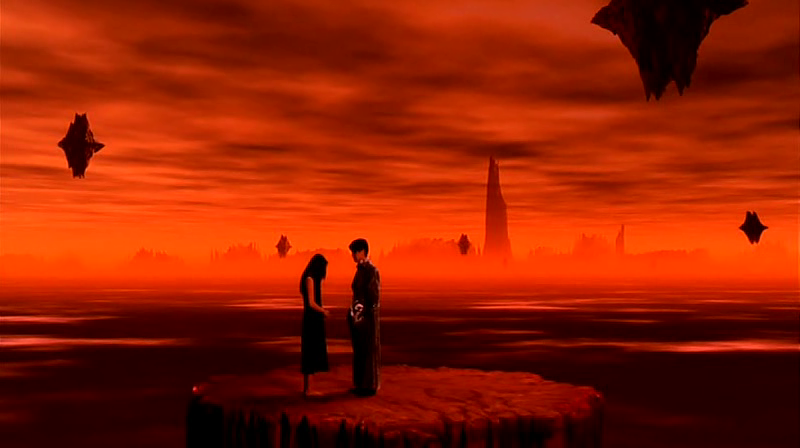
Ghost in Love (자귀모, Lee Kwang-hoon, 1999)

Caught in limbo, a young woman finds herself torn between the desire for revenge and letting go in Lee Kwang-hoon’s supernatural drama, Ghost in Love (자귀모, Jagwimo). Is love really what Chae-byul (Kim Hee-sun) was in, or is it more the sense of humiliation that’s she’s carried into the afterlife while obsessing over her cheating ex-boyfriend who was two-timing her with the boss’ daughter? Her colleague Kantorates (Lee Sung-jae), by contrast, had a love that was purer and reminds her that though it’s painful, if she really loved him, she’d be rooting for her ex’s future happiness rather than plotting how to mess up his life. 

Then again, the Korean title is “Suicide Ghost Club” and refers to the group into which Chae-byul is press-ganged after two of its grim reaper agents help her on her way having overheard her say she wanted to die because of all the romantic drama in her life. This literal purgatorial space located between heaven and hell is run like an exploitative company/cult in which the only metric of success is claiming more members. Chae-byul is warned that she doesn’t really have any choice but to join them, because otherwise she’ll become a vengeful spirit and lose all her memories, though she’s drawn to a mysterious presence known as Pale Face who does indeed become a terrifying spirit of vengeance, taking revenge primarily on the men who gang raped her while her fiancé, who later dumped her, looked on helplessly.

There is a kind of misogyny that’s most obvious in the afterlife but exists in the real world too. The film opens with a woman about to take her own life because of persistent fat shaming. She’s fat shamed by the grim reapers too and on into the afterlife, though in ghost form it’s revealed that she could be skinny if she wanted but is happiest in herself like this. Meanwhile, the grim reappears make other suggestive comments, leering over Chae-byul and remarking that a girl should have nice hips. Pale Face took her own life because of the trauma of her rape, the stigma of being a rape victim, and the betrayal of her fiancé who she says broke up with her because he thought that she was tainted. Even in the afterlife, she’s constantly washing in an attempt to make herself clean which is why she’s become so pale. 

Despite being told primarily from Chae-byul’s perspective, the film more or less normalises her boyfriend’s sexist views and behaviour in which he sees nothing really wrong with two-timing each of the women. Chae-byul tries to confront him, but he tells her Hyun-ju (Kim Si-won) was only visiting “to check on her stock transactions,” and shifts the blame onto Chae-byul for being paranoid and unreasonable. He says he liked her because she was “nice and comfortable,” but now she’s changed, so if she’s going to carry on “nagging” him like this, he may as well break up with her. HIs domineering attitude and characterisation of Chae-byul as a crazy girlfriend have the desired effect of causing her to back down and apologise to him. He may be a bit pathetic and materialistic in dating the boss’ daughter solely for advancement claiming it was his only chance to get on, but his behaviour isn’t really regarded as being particularly negative while Chae-byul’s desire for vengeance is, belittled in part because it involves disrupting not only his bright future but pointlessly harming Hyun-ju too.

Then again, perhaps these attitudes are intrinsic to the latent authoritarianism of the afterlife which is governed by the mysterious “messengers” who punish the transgressions of wandering ghosts. One grumpily rants about now having to work for a living, unlike in the old days in which some people would even try to bribe them for a longer life which they don’t do anymore in an allusion to Korea’s recent democratisation. The Messengers From Hades have a serious whiff of the KCIA mercilessly pursuing those who threaten to destabilise the system and then “disappearing” them. Nevertheless, Chae-byul eventually begins to come around to Kantorates point of view while quietly falling for him even as he struggles to move on from his own lost love. He knows he can’t be with her any more, but needs to find a way to tell her to move on so that he can do the same. A strange twist of fate gives them another chance at life and at love to live without wanting to die and try to find happiness even in a world of financial anxiety where consumerist desire has replaced spiritual fulfilment.
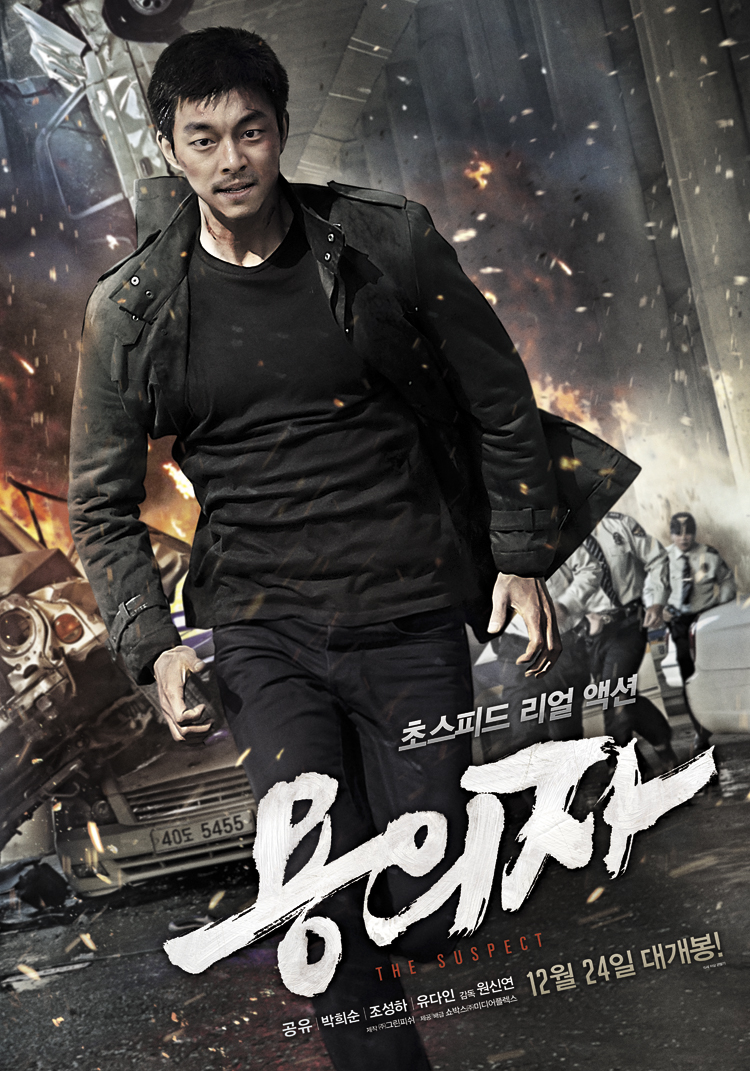

The Suspect (용의자, Won Shin-yeon, 2013)

suspect posterNorth Koreans have become the go to bad guys recently, and so North Korean spies have become the instigators of fear and paranoia in many a contemporary political thriller. The Suspect (용의자, Yonguija), however, is quick to point the finger at a larger evil – personal greed, dodgy morals, and the all powerful reach of global corporations. Opting for a high octane action fest rather than a convoluted plot structure, Won’s approach is (mostly) an uncomplicated one as a wronged man pursues his revenge or redemption with no thought for his own future, only to be presented with the unexpected offering of one anyway alongside the equally unexpected bonus of exposing an international conspiracy.
Ji Dong-cheol (Gong Yoo) is former top North Korean asset now defected to the South and working as a driver for an important CEO. His boss thinks he ought to just go home, but Ji has a mission – he’s looking for a former friend, also defected, who was responsible for the deaths of his wife and daughter as part of a wide ranging purge following the accession of Kim Jong-un. Taking pity on him, the CEO eventually gives him the address of his target, adding that he hopes Ji can learn to forgive him (which seems unlikely), but is assassinated by other agents that same night. Arriving at the scene too late, Ji finds himself framed for the killing and charged with taking care of a secret message also in the CEO’s possession at the time of his death. Teaming up with a documentary filmmaker, Ji is now on the run and determined to find his former friend turned mortal enemy before the authorities catch up with him whilst also trying to work out what to do with his boss’ coded message.

Family, debts of honour, and bonds between men are at the centre of this fast paced thriller as Ji attempts to navigate this ever changing conspiracy torn between friends turned enemies and enemies who may become friends. His main adversary is a government agent, Min (Park Hee-Soon), whom he previously encountered during a mission in Hong Kong during which he made the decision to spare Min’s life after catching sight of a photo of his wife and son in his wallet. Min, however, is less than grateful as the failed mission greatly damaged his career prospects and so he has a personal grudge with Ji which he hopes to exorcise through arresting him. On the other side, Ji is also on the hunt for his former training buddy, Lee (Kim Sung-Kyun), whom he believes to have been responsible for the death of his own wife and child though later discovers that perhaps they have all merely been pawns in a much larger game.

The larger game appears to include worldwide arms sales by turns frustrated and conducted by North Korean agents. The conspiracy, however, is very much home grown in terms of its South Korean genesis but makes clear the complicated relationship between the two territories which is very much open to abuse by those who have access to both sides. The big bad turns out not to be the totalitarian regime with its constant purges and rigid enforcement of its political power, but the greedy and venal, power hungry petty officials of the democratic regime working in concert with big business.

Won has obviously drawn inspiration from the first Bourne film, offering several blatant homages including a long car chase referencing The Italian Job by proxy. His shaky cam aesthetic is perhaps overworked, but the fight scenes are undoubtedly impressive, anchored by the astounding performance of unlikely action star Gong Yoo – hitherto known as a sensitive leading man and frequent romantic lead. Having piled on the pounds, Gong is a credible vengeful presence apparently providing many of his own stunts including a strangely overblown sequence which sees him rock climbing bare chested only to emerge panting and glistening next to the flapping North Korean flag. Nevertheless, his near silent performance is a masterclass of physical acting, adding a much needed emotional dimension to the otherwise straightforward script which leaves little time for character development in between its admittedly impressive set pieces. Overlong yet moving at a rip roaring pace, The Suspect is a surprisingly well photographed action fest which manages to add a degree of pathos to its closing scenes even if failing to completely earn it whilst engaging in a series of subtle political allegories.


International trailer (English subtitles)

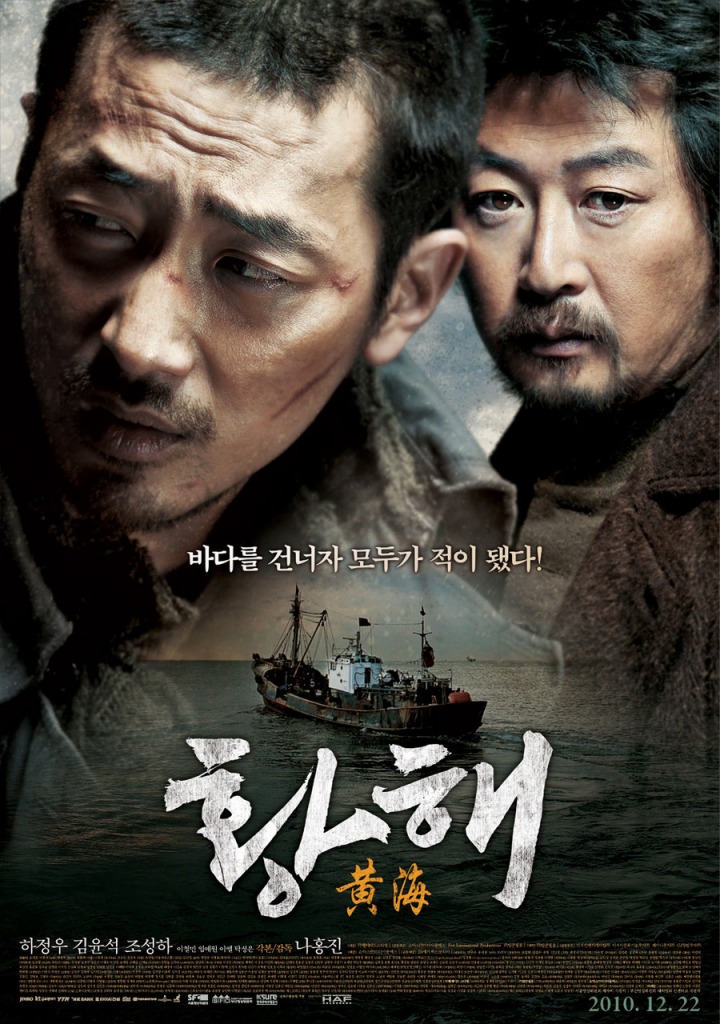
The Yellow Sea (황해, Na Hong-Jin, 2010)

yellow sea korean posterReview of Na Hong-Jin’s The Yellow Sea (황해, Hwang Hae, AKA The Murderer) – revised form of a piece first published by UK Anime Network in March 2012.


Gu-Nam (Ha Jung-Woo) is a taxi driver with a gambling problem. If the gambling wasn’t enough to get him into trouble, he’s also in debt to some gangsters over the money for his wife’s passage to South Korea. His wife was meant to be sending the money she’d make there back to him and their daughter to help pay off the debt, but no one’s heard from her in months. The obvious assumption is that she’s made a new life for herself and doesn’t want to be found, but Gu-Nam can’t quite bring himself to believe it. As a Joseonjok – a Chinese Korean from the Yanbian Korean Autonomous Prefecture, Gu-Nam had little chance of living an honest and prosperous life. Disowned by both China and Korea, many Joseonjoks are forced to resort to criminality in order to survive.

Just as it seems things are about to hit a crisis point, Gu-Nam receives an interesting job opportunity. Myung-ga (Kim Yun-Seok), the dog seller at the market, suggests Gu-Nam go to South Korea, kill a prominent businessman, look for his wife and return back to China (with the businessman’s thumb for proof). Assuming all goes well, Gu-nam will receive the pin number for an account with 57,000 Yuan, maybe return with his wife in tow or at least find out once and for all what the situation is between them, and finally get these gangsters off his back.

Still, sneaking into South Korea and committing a murder – it’s a big ask, and first off Gu-Nam rejects the idea out of hand but one conversation with his decidedly tough mother later and Gu-Nam has accepted. However, when he gets to Korea he finds things aren’t as simple as Myung-Ga made out. There seems to be a much bigger game in play than Gu-nam bargained for and it’s not long before he’s running from the police, gangsters, and just about everyone else.

If there’s one thing there’s a lot of in this film, it’s running. It’s difficult to think of another film that manages to make a good old fashioned foot chase quite so exciting. The set pieces are astonishing – multi-car pile-ups, police driving into and over each other, an extended chase sequence through a cargo boat – the list goes on, all with Gu-nam running desperately towards the camera. Propelled by pure survival instinct and later an intense need for revenge and an explanation, Gu-nam keeps running no matter what is coming for him.

One of those things is, of course, Myung-ga who’s now got a total mess on his hands that’s threatening to derail all of his current business arrangements (well, except the dog selling – something to fall back on). If there’s another thing there’s a lot of in this film, it’s stabbing (and later axing). Luckily for him, it seems Myung-ga is something of an expert at this as we find out in one scene where we see him, badly wounded, enter a room full of angry gangsters – the camera cuts away and we return to find all of the gangsters seemingly dead with very little fuss. He even tries to kill someone with a lamb bone at one point! Myung-ga is certainly not someone one would want to be meeting on a dark night (or ever buy a dog from). He is though, one of the most compelling film villains of recent years.

Speaking of stabbings, The Yellow Sea is a very violent and extremely bloody film. If you’re well versed in Korean crime dramas, you might be aware that South Korea has very tight gun laws, so much so that not even the toughest gangsters carry guns. Consequently what you have here is a lot of people sneaking around trying to get the drop on each other to stick the knife (or occasionally, hatchet) in. Obviously, it’s much quieter than gunfire but also much messier and much more physical. The only guns in the film are those which belong to the police, who are largely depicted as bumbling idiots who can’t tell one end of a gun from the other.

This Bounty Films release (distributed by Eureka in the UK) is the shorter 140 minute ‘Director’s Cut’. There is, however, some controversy about whether it really is a director’s cut or an international version prepared by the film’s co-producers Fox International. For the record, it runs about sixteen minutes shorter than the version seen in Korea. Despite being the shorter version, The Yellow River does still feel a little long at times and really pushes the ideal running time for a thriller of this kind. Nevertheless it does manage to keep the momentum going throughout and even has a streak of morbid humour running right through it.

A sad meditation on the futility of life, particularly for those who find themselves at the bottom of the pile and are forced to scrap like dogs for the little other people have left behind, The Yellow Sea is an exciting addition to the recent wave of Korean crime thrillers. Following on from his impressive debut The Chaser, The Yellow Sea certainly catapults director Na Hong-jin right into the top tier of Korean cinema.


The Yellow Sea is available on DVD and blu-ray from Eureka in the UK and on DVD from 20th Century Fox in the US.