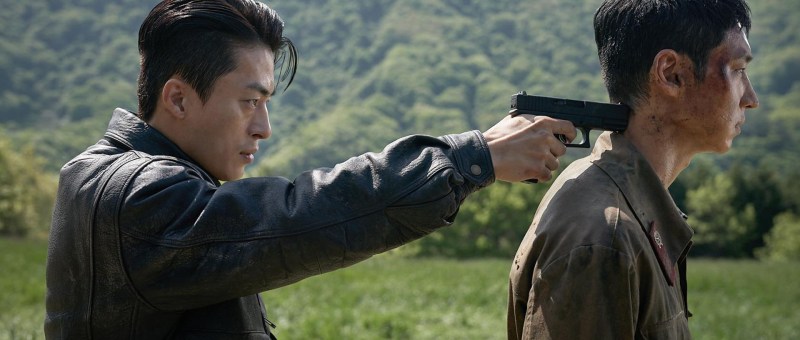
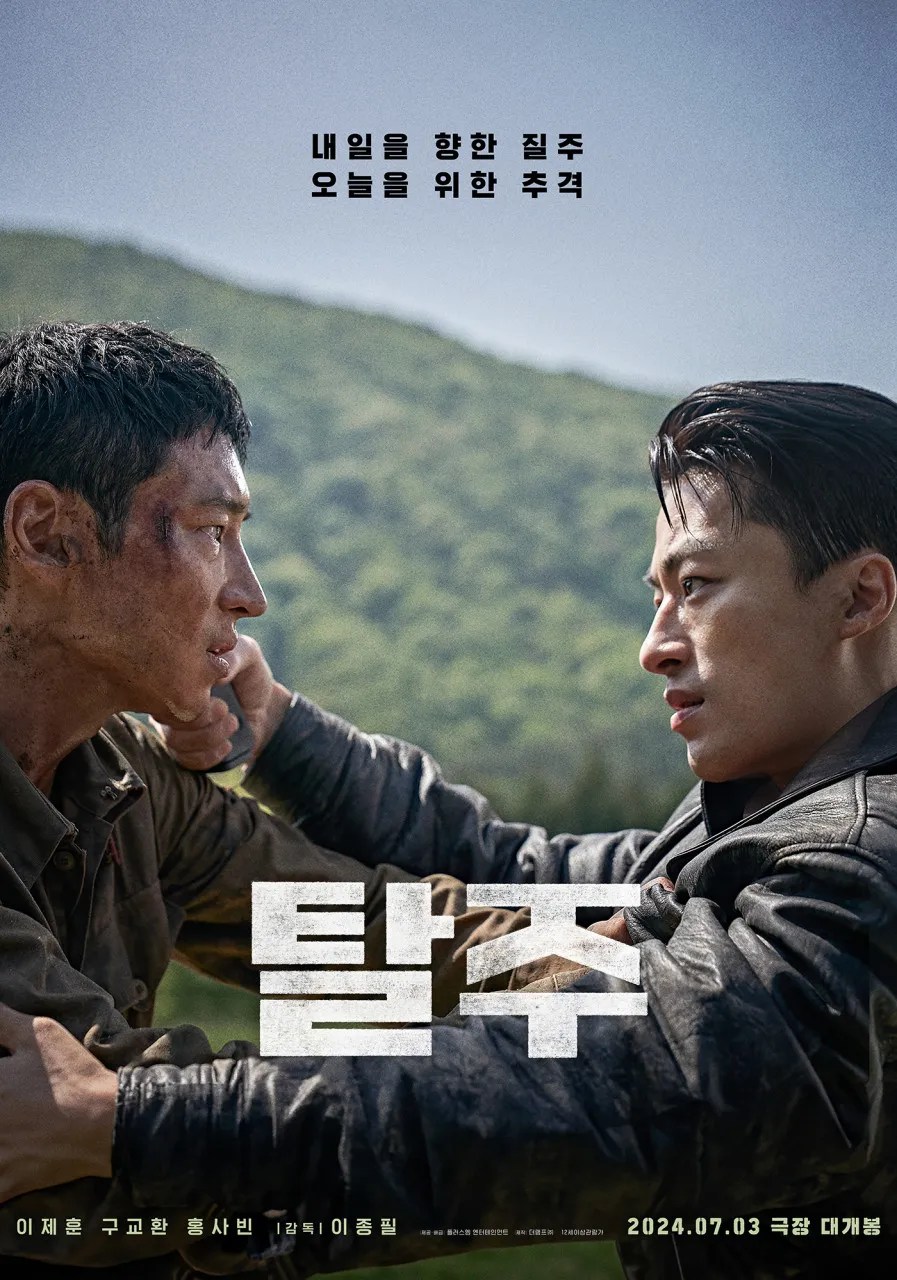
Lee Jong-pil’s existential action drama Escape (탈주, Talju) opens with scenes of a man running. He runs his way through the rest of the film, continually on the move and chasing a dream of freedom outside of the oppressive society in which he is otherwise trapped. The man who chases him, meanwhile, is himself running away. His movements are slow, calculated, and cold but also somehow tender and almost it seems an act of self harm.
The fact that the oppressive regime is North Korea is almost irrelevant and the film is less about Communism than it is lack of autonomy that may be found in any other democratic or developed nation in which people are driven to erase a part of themselves in order to fit in or to prosper amid rigidly defined social codes. Nevertheless, there is a direct criticism of the Democratic People’s Republic in the ironic signage, a car ploughing straight through a sign that reads “for freedom and happiness of people”. But then, even if deserter Kyu-nam (Lee Je-hoon) finds happiness in the South we can’t be sure it’s really any better. The welcome message blasted through loudspeakers over the wall that marks the border doesn’t sound all that different from the propaganda messages on Kyu-nam’s radio, while the deserter’s phone positioned to appeal to men like him appears to be out of order.
But to Kyu-nam, “the South” is only really an idea and it’s clear he intends to transcend those borders too, venturing on to the wider world and wherever it pleases him to go. What he rails against is fate, that his life is dictated by forces outside of his control or more accurately by Field Officer Hyun-sang (Koo Kyo-hwan) from State Security who takes him under his wing and tries to make something of him as a loyal soldier of the North. What becomes clear is that Hyun-sang is a man who fears freedom and that the presence of a man like Kyu-nam is a threat to him because he awakens his own deeply buried desire for liberation.
From the longing looks he directs at a man with whom he studied abroad in Russia we infer that Hyun-sang is gay and the suppression of his authentic self in order to keep himself safe in a repressive culture has made him cruel and vindictive. Unfortunately, this presumably unintentionally plays into a homophobic trope which aligns queerness with sadistic villainy, but does nevertheless lend a kind of poignancy to Hyun-sang’s otherwise vindictive quest to prevent Kyu-nam’s escape precisely because he himself desires to be free but is too afraid to free himself. From a wealthy and prominent family and with an important position within the regime, this system otherwise works out well for Hyun-sang but he is also imprisoned by it and will forever be prevented from becoming his authentic self or gaining what he truly wants so long as he remains within North Korea.
A homoerotic charge exists between the two men though what Hyun-sang may really be chasing is himself and half-hoping he’ll be caught. Kyu-nam meanwhile has a single-minded desire for autonomy and individuality, to live and die on his own terms rather than live with no right or power to decide his future. There are those who’ve found other ways to reject the system, a group of mostly female nomads seeking a new place to belong after being kicked out of their village but seemingly with no intention of leaving the country, but for Kyu-nam there is no freedom inside the walls and his determination to find it is what makes him so dangerous to Hyun-sang for whom the very idea of freedom is so painful he’s sublimated himself entirely into an oppressive regime.
With pulsing synth scores, Lee keeps the tension high as Kyu-nam runs and runs through minefields and bullets while pursued by the full force of the North Korean army and the steely Hyun-sang who always seems to be one step ahead. His passage takes on an existential quality, risking death rather than continue to live a “meaningless life” in which he has no power to decide his own fate. His escape is finally self-liberation, taking the decision to free himself because no one else is going to, while Hyun-sang remains a prisoner too afraid of freedom to actively pursue it though perhaps tempted by his encounter with Kyun-nam, a man free in his mind if nowhere else.
Escape screened as part of this year’s London East Asia Film Festival.
US trailer (English subtitles)
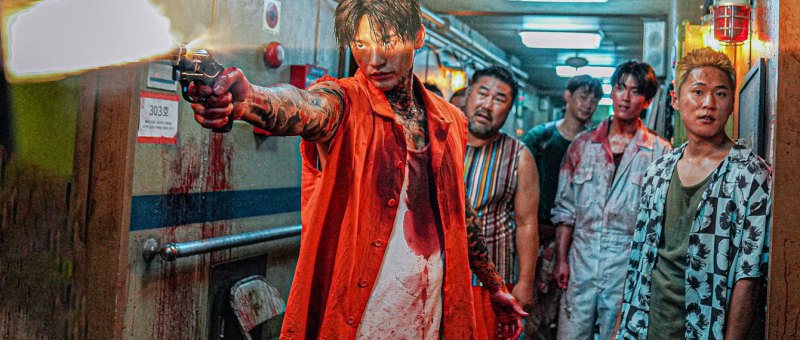





 You gotta know how to hold ‘em, know when to fold ‘em, know when to walk away and know when to run. Apparently these rules of the table are just as important in the cutthroat world of the Korean card game Hwatu as they are in the rootinest tootinest saloon bar. Like most card games, having the winning hand is less important than the ability to play your opponent and so it’s more a question of who can cheat the best (without actually breaking the rules, or at least being caught doing so) than it is of skill or luck. A second generation sequel to 2006’s Tazza: The High Rollers, The Hidden Card (타짜-신의 손, Tajja: Shinui Son) is a slick, if overlong, journey into the dark, underground world of gambling addicted card players which turns out to be much more shady than the shiny suits and cheesy grins would suggest.
 Since ancient times drama has had a preoccupation with motherhood and a need to point fingers at those who aren’t measuring up to social expectation. E Oni’s Missing plays out like a Caucasian Chalk Circle for our times as a privileged woman finds herself in difficult circumstances only to have her precious daughter swept away from her just as it looked as if she would be lost through a series of social disadvantages. Missing is partly a story of motherhood, but also of women and the various ways they find themselves consistently misused, disbelieved, and betrayed. The two women at the centre of the storm, desperate mother Ji-sun (Uhm Ji-won) and her mysterious Chinese nanny Han-mae (Gong Hyo-jin) are both in their own ways tragic figures caught in one frantic moment as a choice is made on each of their behalves which will have terrible, unforeseen and irreversible consequences.
 Windows on Worlds