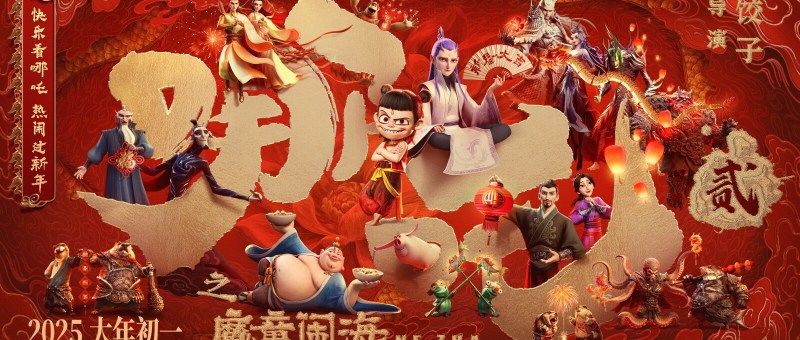
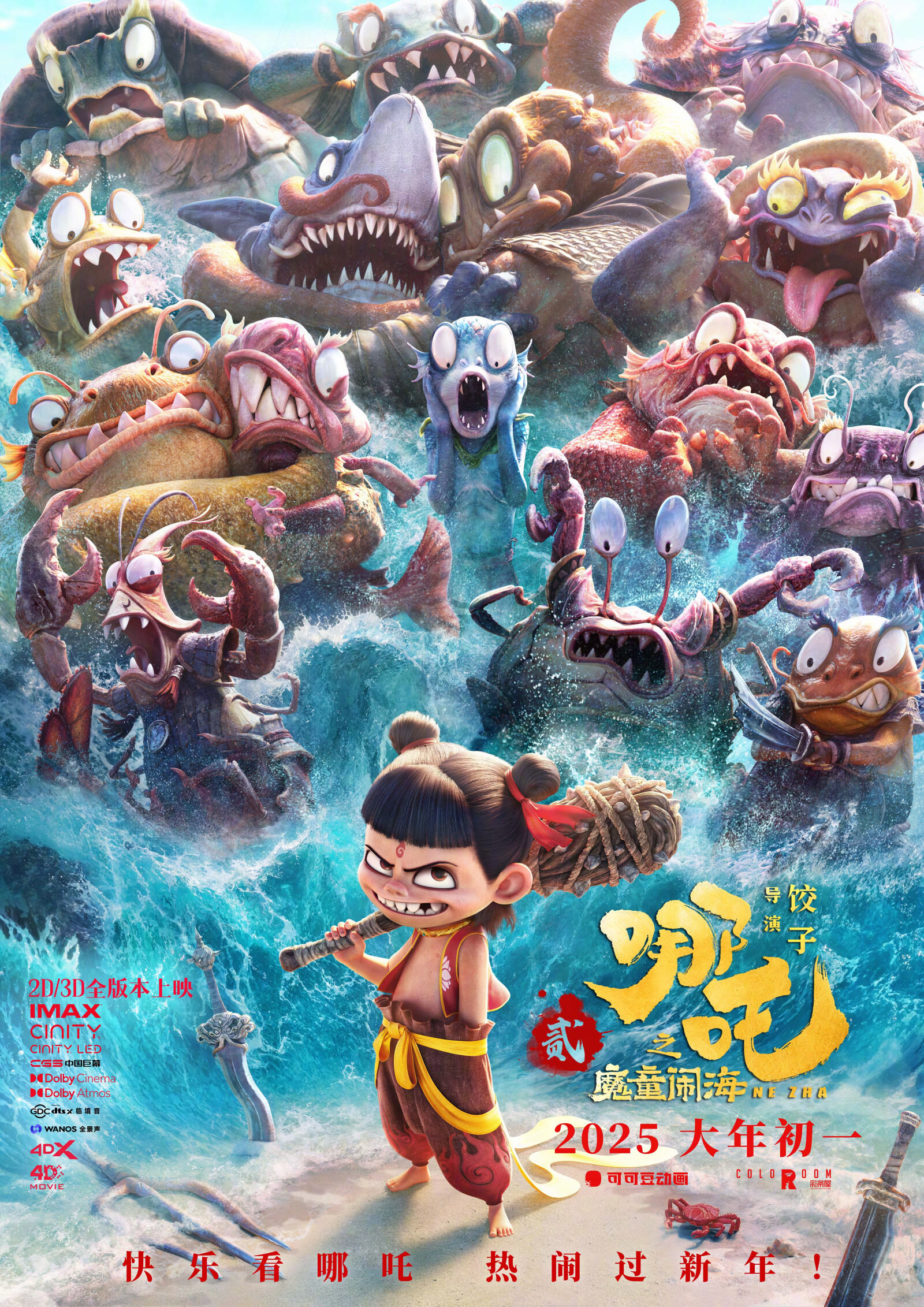
Ne Zha 2 (哪吒之魔童闹海, Jiaozi, 2025)

By the end of 2019’s smash hit animation Ne Zha, the titular hero (Lü Yanting) and his opposite number Ao Bing (Han Mo) had figured out that they were two halves of the same whole and were much better off fighting alongside instead of against each other, but even after getting their physical forms reconstituted with the help of a little lotus flour, they discover that the evil Shen Gongbao (Yang Wei) isn’t done yet. The first film may have been in its way subversive in the hero’s bold assertion that he will defy his fate and define his own identity, but Ne Zha 2 (哪吒之魔童闹海, Nézhā zhī Mó tóng nào hǎi) takes things a step further as Ne Zha comes to discover that not even the Heavens are free of corruption or prejudice.

Indeed, it’s this idea of prejudice which lies at the heart of the film for even if Ne Zha had won the hearts of the townspeople by saving Chentang Pass in the first film, he realises that there are some among the immortals who wish to erase all demon kind. The conclusion he eventually comes to is that demon and immortal are arbitrary terms used to control those who are different. He’s sick of hiding his demon nature and thinks it’s time he reveal himself to the world while fighting the injustice that’s taken over the Heavens in the Master’s absence. 

Meanwhile, his desire to break free of oppressive authoritarianism is symbolised in his breaking Wuliang’s (Wang Deshun) cauldron and freeing those inside who were otherwise to be turned into pills of immortality and fuel the heavenly economy. While he and Ao Bing resolve that the real enemies are those who bully the weak and bring evil to the world, the villains insist that siding with the strong is the only way. Ne Zha and Ao Bing’s response to this is to insist that if there is no place for them, they will create it for themselves and if they are not accepted they will change people’s minds. As they later say, they are young and have nothing to fear echoing a spirit of resistance among contemporary youth confronting an oppressive and authoritarian society.

Then again, a key feature of Ne Zha’s goodness is his love for his parents and desire to be a “good son” by traditional standards. It’s clear that even Ao Bing’s father the Dragon King of the East, Ao Guang (Li Nan / Yu Chen), acted only in the best interests of his son and has otherwise been framed by ambitious forces around him who decided they were better off entering a more active partnership with a corrupt authority rather than appease them by accepting their oppression. Even so, both sets of parents eventually tell their sons that they should now follow their own paths and do what they think is right. The world is no longer as was is when they were young, and they are not well equipped to understand these problems nor to solve them. If the Heavens are to be purified once again, it will be up to Ne Zha and Ao Bing to do it.

Aside from this more series and potentially subversive message about asserting one’s identity and challenging authoritarianism, the film has a lot of fun with its anachronistic worldview as drunken Taiyi Zhenren (Zhang Jiaming) struggles to remember the password to open the lotus before remembering he can use a fingerprint instead, while another villain later runs into a problem trying to open a door that works by face recognition because he’s sporting so many bruises and swellings after getting a beating from Ne Zha. He then realises he’ll have to wait another 10 years to try again because he cursed the technician for laughing at his ridiculously battered face. The film’s action sequences are also tremendously well animated and exciting as Ne Zha’s parents try to fight off the demon hordes which mainly consist of the “Monsters of the Abyss,” various sea creatures such as octopuses and sharks that were previously held in check by the Loongs but have now been set loose because of a dragon queen’s ambition. In any case, improving on the original the sequel maintains its quirky humour and charming worldview while doubling down on its surprising messages of acceptance and diversity as Ne Zha and Ao Bing prepare to forge their own paths and fight for justice to clear the Heavens of their corruption.


Ne Zha is in UK cinemas now courtesy of CineAsia.

UK trailer (English subtitles)
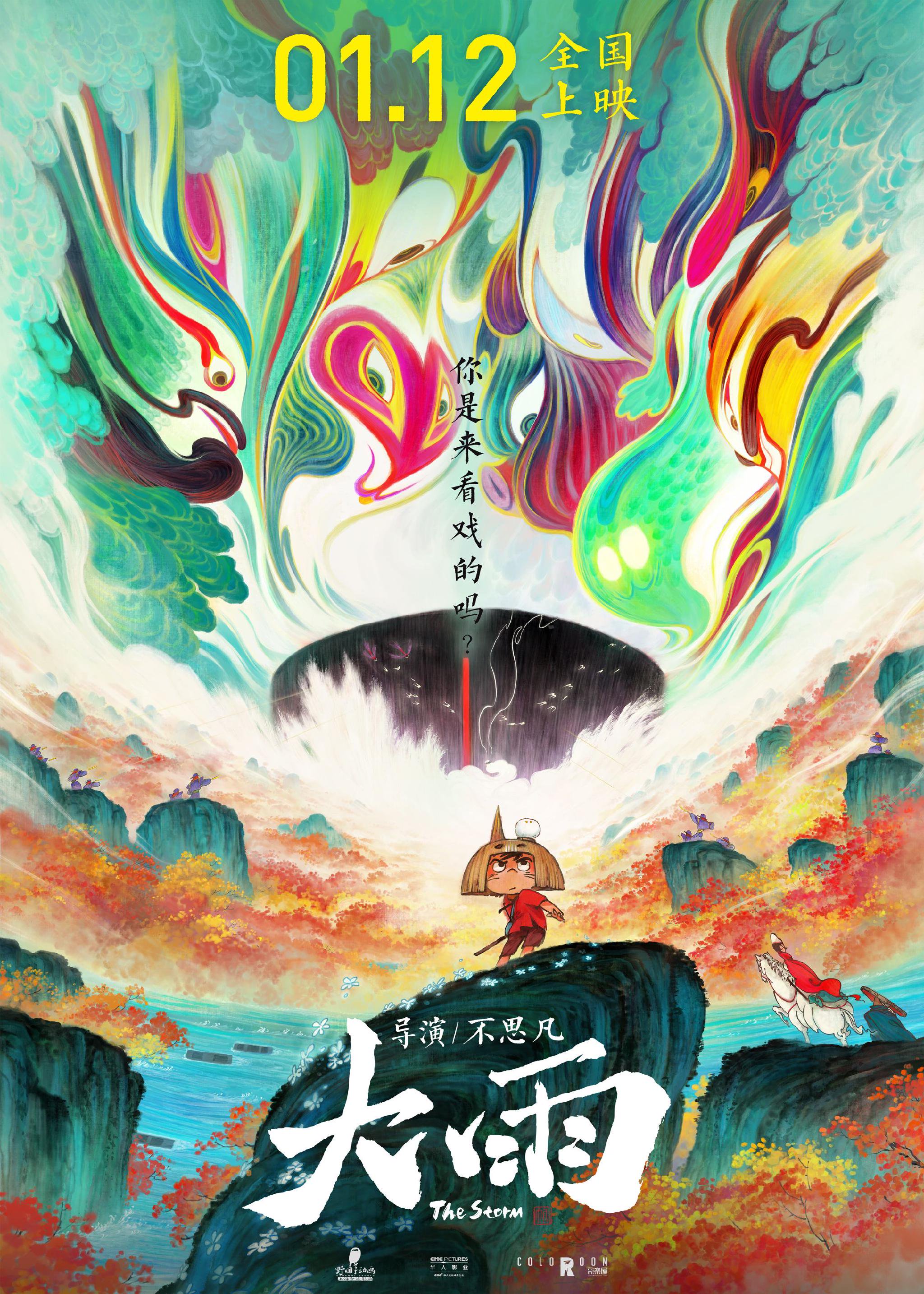
The Storm (大雨, Yang Zhigang, 2024)

A cosmic storm is likened to the chaos of life in Busifan’s beautifully drawn but narratively obscure family animation, The Storm (大雨, dàyǔ). Set seemingly in a fantasy past which is also a kind of post-apocalyptic future in which mankind has ruined itself through greed, the film is at heart a kind of redemption story in which those left behind attempt to exorcise the negative emotions of the past and ease the destruction they have wrought by abandoning outdated ideas of wealth and status. 

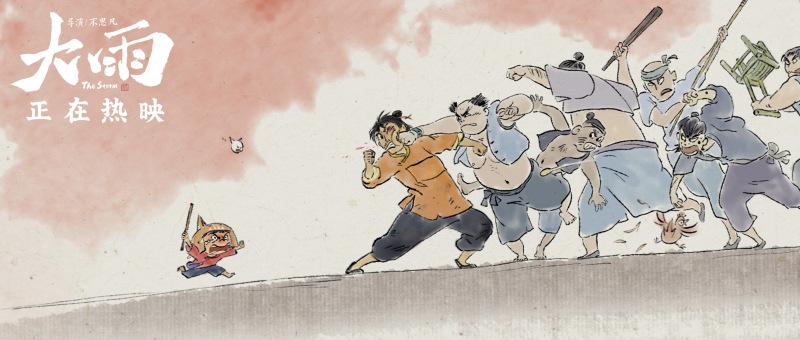
The hero, Bun, is a young orphan adopted by the elusive Biggie who found him drifting down a river in a chest. Biggie decided to adopt the boy as his own but never allowed him to call him father while himself struggling the stigma of having been a criminal. Biggie sometimes leaves Bun on his own while he goes off to try and earn money to give him a better life and justifies his actions that everything he’s doing is only for Bun. Later in the film he expresses regret for “lying” to him, pretending the world was not so chaotic as is it is as the pair become embroiled in a supernatural curse while looking for the famed Nuralumin Satin said to be aboard a mysterious black ship filled with monsters. 

According to biggie, the Black Dragon Army hunting the Nuralumin birds into extinction led to an explosion in the jellyfish population while a prophesy states that the jellyfish will soon unite with another monstrous force during a cosmic storm becoming an awesome dragon that casts a shadow over the land. The ship itself seems to be a symbol of insatiable greed, a kind of floating marketplace in which people entered in search of riches but did not leave again. Inside, they became monsters devoid of all humanity and hungry only for material gain. 

The king’s own mother is said to have fallen victim to the curse, while his nephew also knew a troupe of opera singers who boarded the boat in search of an audience but have apparently lost their way. The spirits of the opera singers recount their plight, that as lowly entertainers they were only ever looked down on and abused no matter if they entertained the king himself and all his other royals. That they fell victim to the curse seems to be a condemnation of outdated ideas about social class and the stigmatisation of a profession, while Biggie’s fate seems to imply something similar. No matter how much he tried to turn himself around and be a good father to Bun, the world continued to reject him and he was left only with crime as a means to support himself. That’s one reason he wants the Satin, so that Bun will be looked after for the rest of his life and they won’t have to debase themselves anymore. 

We can see that the area they live in which is close to the famed Dragon Bay where the Black Ship eventually resurfaces is rundown and abandoned perhaps itself because of the lore that surrounds the area. Even so, the backgrounds are gorgeously animated with flowers in full bloom and Bun making his way through colourful and lively vistas of rural beauty. Yet it’s just this beauty that mankind’s greed has destroyed in the Dragon Army’s senseless killing of the Numalurin birds for which their guardian tribe has never forgiven them. Only the return of these birds and the giant deity that protects them can help end the curse, restoring the proper balance to the land in which the jellyfish are kept in check and the dragon cannot be formed. 

It has to be said that narratively the film is incredibly confusing and difficult to follow, at least for viewers who do not speak Mandarin. Nevertheless, what shines through is Bun’s redemptive power as he desperately tries to rescue Biggie from his own worst impulses, his greed and desperation in being drawn to the black ship like moth to a flame and in danger of being turned into one of the monsters. Constantly accompanied by round ball of fluff he encounters several other cute creatures while otherwise guided by a handsome young man who seems to be made of cloud while his wish that he really could stop Biggie from leaving by treading on his shadow might in an odd way come true. Boundlessly inventive, the film’s ideas sometimes get ahead of itself but are more than made up for in the unshowy beauty of its fantasy world. 


International trailer (Simplified Chinese / English subtitles)