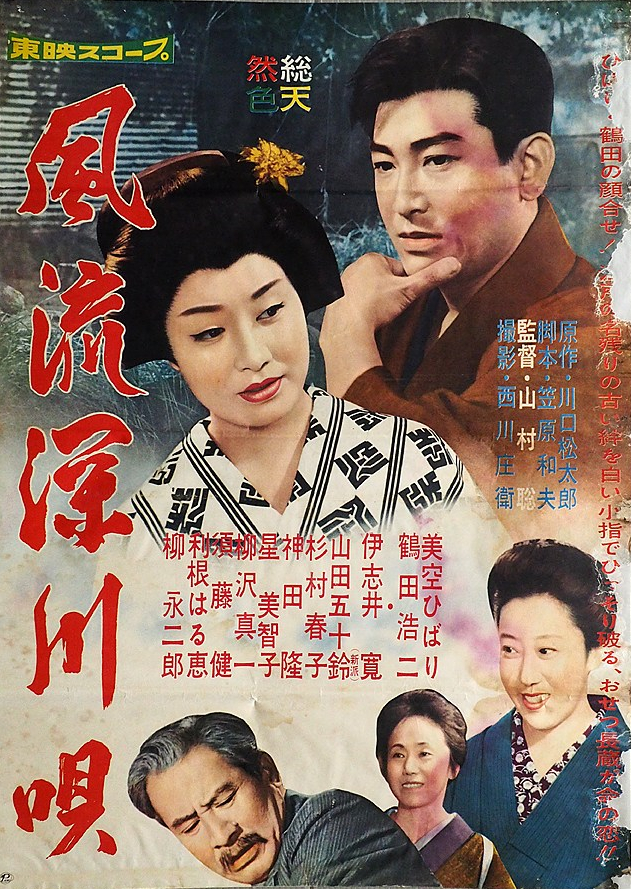
The Sands of Kurobe (黒部の太陽, Kei Kumai, 1968)

Kei Kumai’s three-hour epic of human engineering The Sands of Kurobe (黒部の太陽, Kurobe no Taiyo) opens with a titlecard to the effect that the film testifies to the courage of the Japanese people who brought the nation back to life after the war. Partly produced by Kansai Electric Power along with the production agencies of stars Toshiro Mifune and Yujiro Ishihara, the film is therefore somewhat conflicted, part bombastic celebration of Japanese engineering skill and ambivalent critique of the wilful decision to place success above all else including the welfare and safety of ordinary workers.

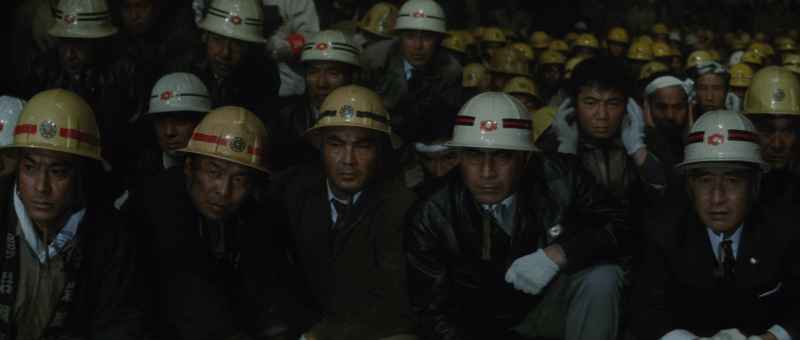
This critique is most evident to the flashbacks to the construction of Kuro 3 in 1938 which as many point out was conducted by the military under brutal and primitive conditions. The construction of the new Kurobe hydroelectric dam, by contrast, is a much more modern, enlightened affair in which workers have proper equipment and are not simply hacking at rocks with pickaxes wearing only a vest. But then as the conflicted Takeshi (Yujiro Ishihara) points out, it’s all effectively the same. Just because no one is pointing a gun at their heads, it doesn’t mean the men actually building the dam aren’t being exploited rather simply pressured by a vague notion of national good that they should be ready to lay down their lives. Could it be that “prosperity” is worse thing to die for than “patriotism”, especially when it appears as if your employer cares little for your physical wealth and economic wellbeing simply pledging that they will support the families of men killed during the dam’s construction. 

That there will be deaths seems inevitable. The man placed in charge of building a tunnel through the mountain, Kitagawa (Toshiro Mifune), is haunted by the vision of a man falling from a cliff that he witnessed when they first hiked to the dam site. He originally described the project as “crazy” and wanted to resign but was convinced to stay on. Kitagawa is himself fond of insisting on safety first where others are minded to cut corners, but also troubled by domestic issues in the film’s sometimes insensitive use of his daughter’s terminal leukaemia as a mirror for the dam project in considering what is and isn’t possible through human endeavour. The suggestion is that Kitagawa wants to believe the miracle of the dam is possible because needs to keep believing in a scientific miracle that can save his daughter, though obviously even if it is ultimately possible to build this dam that’s designed to fuel the post-war rocket to economic prosperity there are limits and unfortunately decades later we have still not found a cure for cancer though treatment may be more effective. 

Takeshi meanwhile has a similar battle with his hard-nosed father whose devotion to the dam project he describes almost like an addiction, suggesting that he values nothing outside of tunnelling and is willing to sacrifice everything in its name including the lives of himself and others. A flashback to to 1938 reveals that he asked his own teenage son to place dynamite and inadvertently caused his death though lax safety procedures which is the understandable reason why his wife eventually left him taking Takeshi with her. But the strange thing is for all his original opposition, Takeshi too is later captivated by the immensity of the challenge if also wary that the workers are falling victim to the same sickness as his father and are still being exploited by those like him who expect them to offer up their lives while paying them a pittance and complaining when the project does not proceed along their schedule. 

The almost nationalistic, bombastic quality of the film seems at odds with some of Kumai’s previous work save the discussion of the building of the 1938 tunnel though this largely serves as a contrast to imply that this time is different because they’re doing it for love of country rather the forced patriotism of the militarist past. Kitagawa justifies himself that if they don’t build the dam, economic prosperity will stall, companies will go bust, and people will lose their jobs but it seems somewhat hollow in the knowledge many men are certain to die while building this dam. Kumai undercuts the bombast with a series of scenes shot like a disaster movie in which supports collapse and the tunnel floods, or men are hit by falling rocks, eventually closing on an ironic Soviet-style statue dedicated to the labour of the workers that seems to question the immense loss of life along with the destruction of the natural beauty of Mount Kurobe but cannot in the end fully reconcile himself, torn between a celebration of human endeavour and its equally human costs. 


Original trailer (no subtitles)
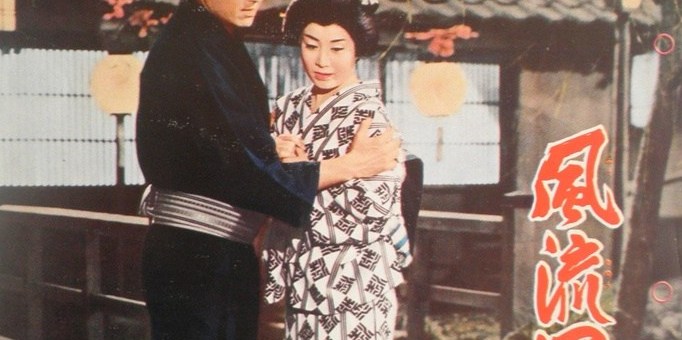
Deep River Melody (風流深川唄, So Yamamura, 1960)

Deep River Melody poster 2An actor with a long and distinguished career, So Yamamura first stepped behind the camera in 1953 with an adaptation of the famous proletarian novel by Takeji Kobayashi, The Crab Cannery Ship (later adapted by Sabu in 2009), and eventually completed six features. Deep River Melody (風流深川唄, Furyu Fukagawa Uta), released in 1960 and adapted from a novel by Matsutaro Kawaguchi, was last among them and starred post-war singing sensation Hibari Misora in the leading role. Hibari Misora was a frequent presence at Toei through the ‘50s and ‘60s, appearing in a series of musical dramas both period and contemporary but Deep River Melody is among the small number of purely dramatic pieces in which she starred which do not feature any musical numbers even over the opening and closing.

Set in the early years of militarism, the story revolves around Setsu (Hibari Misora) – the daughter of a restaurant owner, and her head chef, Cho (Koji Tsuruta). Having grown up together, Setsu and Cho have quietly fallen in love but these are times in which it is difficult to state one’s feelings plainly. Luckily, Setsu’s father, Isaburo (Kan Ishii), and his warm hearted mistress (Isuzu Yamada), have noticed the growing affection between the pair and are only too happy for them. What could be better after all than the head chef marrying into the family? Despite some qualms on Cho’s side in breaking a class ceiling taboo, the matter appears to be settled and both he and Setsu are blissfully happy.

However, tragedy soon strikes. Isaburo unwisely agreed to become the guarantor of a loan taken out by Shunsuke Ohta (So Yamamura) – the leader of the communist party in Japan (not an easy thing to be amid the rising tides of militarism). He, of course, defaults on the loan putting the restaurant at risk. The other relatives, learning of the prospective marriage between Setsu and Cho are extremely unhappy, viewing it as improper for mere servant to inherit the restaurant. Isaburo stands firm, but matters are pushed to crisis point by grumpy uncle Koshikawa who is determined to act as a go-between for the wealthy son of a rival restaurant who has long had designs on Setsu.

Though this is definitively a pre-war story, many of the problems faced by Setsu and Cho are the same as those in Hibari Misora’s contemporary movies in that she, in particular, finds herself trapped by a series of outdated social codes in which her extended family expect her to consent to marry a man she does even like for money in order to save their “good” name. They believe Isaburo is a feckless fool who has lost the restaurant through a needless gesture of loyalty towards a man who had been good to him in the past and was now in trouble. Isaburo places human relationships above money and politics, remaining uninterested in the relatives’ insistence on class hierarchies and preservation of the family’s good standing. Though he may, to a degree at least, be sympathetic towards Ohta’s political intentions, he acts as guarantor out of respect and gratitude rather than deep belief in a cause.

Nevertheless, the barriers between Cho and Setsu are less physical than they are psychological. Cho, raised as a servant, feels himself inferior and has difficulty accepting Isaburo’s talk of marriage owing to their differing social status. Isaburo, somewhat embarrassed, has not yet spoken with Setsu, but then knows his daughter well and is right in assuming the pair will eventually sort things out on their own if given a gentle push. When the relationship is tested by the restaurant’s failure, Isaburo and Setsu stand firm. No one entered this relationship for the wrong reasons – Cho loves the restaurant and everyone who works in it, but he fell in love with Setsu independently and would marry her for nothing. He remains uncertain, however, if his devotion is selfish and if the best way to love her is to leave her and allow her to save her familial legacy by marrying a man with money.

Like many post-war films, Deep River Melody is essentially about learning to let go of outdated ideas and that the maintenance of tradition is less important than individual happiness. Setsu and her father are ready to let go rather than commit themselves to a course of lifelong unhappiness solely to please their snooty relatives. Cho, however, struggles to free himself of a feeling of social inferiority. His own family tell him that his desire to marry Setsu is not only wrong but dangerous, that they have built a life for themselves though being loyal servants and that crossing the class divide risks all of their futures. Conflicted, Cho remains unwilling to fight for his love because he does not believe he can win and not only that, he feels it would be inappropriate to even try. If the pair are to find true happiness, they will have to find the courage to move on from the past and build their own future free of feudal ideas but to do so will require both sacrifice and support in the belief that a better life is possible.