Sunset Sunrise (サンセット・サンライズ, Yoshiyuki Kishi, 2024)

In a way, the 2020 coronavirus pandemic presented a kind of turning point in which it became possible to envision a different kind of future brokered by technological advance in which society was no longer ruled by the dominance of the cities. If people could work remotely from anywhere, then they could easily improve their standard of living by moving to more rural areas for cheaper rents and healthier environments. Assuming the infrastructure was in place to allow them to do so, they could also support and reinvigorate communities struggling with depopulation in which the young have all left for the cities leaving the elderly behind to fend for themselves.

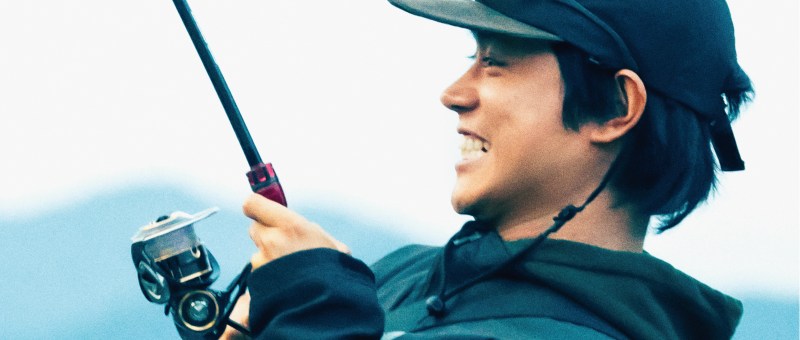
It’s an elegant solution that solves many of the problems of the contemporary society, but change isn’t always as straightforward as it seems as the hero of Yoshiyuki Kishi’s Sunset Sunrise (サンセット・サンライズ) finds out after he jumps at the chance to move into an abandoned house in Tohoku for a fraction of the rent he’d have to pay for a flat in Tokyo if he didn’t still live with his parents. The catch is, however, that houses have souls too and are more than just places to live for those that own or inherit them. Momoka (Mao Inoue), who decides to put her own empty house on the market, has her reasons for not wanting to live there herself nor for selling it completely but renting it out is also emotionally difficult. In the end, she only really does it after being put in charge of the town’s empty house problem at her job working for the council and thinking she should probably start with her own. Not knowing what to charge, it hadn’t really occurred to her someone would be as interested as Shinsaku (Masaki Suda), a fishing enthusiast longing to escape his salaryman life in the city for something a little more traditional in a peaceful rural area. 

Then again, that’s not to say that Shinsaku is a traditionalist and his decision quickly sparks controversy but also attracts the attention of his boss who senses a promising business opportunity. Momoka’s is a slightly special case, but Japan is filled with these so-called “akiya” which might, amid the work from home revolution of the pandemic, now be attractive to young professionals looking for a better environment to start a family. Houses generally start to deteriorate quite quickly when no one lives in them, and it’s true a lot of them need some work doing but it’s an idea that could work out well for everyone. Younger people who can’t find decent living space in the cities would be able to afford larger homes in the country where they would also then be contributing and integrating into the local community to provide support for its elderly residents.

Shinsaku becomes a part of the local community quite quickly and strikes up a friendship with an elderly woman whose children have all moved to Tokyo and rarely visit now that their own children are getting older. They’ve asked her to move to Tokyo with them, but as she points out, it would be the same as them moving back. There’s nothing for her to do there, and she’d have no friends. She’d only feel in the way and that she was getting under her daughter-in-law’s feet. Nevertheless, they fear for her especially as the area is still dealing with the scars of the 2011 earthquake which have left many clinging to a now bygone past. Once Momoka and Shinsaku start working with his boss on the akiya project, they find it hard to convince the inheritors of the houses to agree. Though they won’t live there, they might want to pop back a few times a year just for the memories and somehow can’t bear to part with their childhood or relative’s homes. But Shinsaku points out, it doesn’t necessarily have to be a case of either or and the renovation projects they undertake modernise the houses in a sympathetic way that brings them up to date with modern living yet honours the past even sometimes incorporating some of the previous resident’s furniture and belongings while issuing a caveat that the owners are welcome to visit should they wish to.

Essentially, the idea is a kind of co-existence with the past but also with unresolved trauma such as that presented by the earthquake and the ongoing pandemic. Momoka too is struggling to move on and while a gradual romance seems to arise between herself and Shinsaku, she isn’t sure she can ever let the past go though he makes it clear it’s okay to bring it with her. For his part, despite the initial fears of the early pandemic period and the suspicion of him as an outsider, Shinsaku’s quickly taken in by the community and adapts to a more rural way of life with relative ease though his boss’ big plan is rather undermined by his later insistence that he come back to Tokyo to run the project from the office like a many a contemporary CEO rolling back promises of flexible working environments that make this kind of utopian ideal much harder to materialise. In any case, there’s something quite refreshening in the eventual resolution just to do their own thing, not particularly paying attention to labels or what other people might think, but just doing what makes them happy right now. As an old fisherman’s song says, the sun sets but then it rises again. Scripted by Kankuro Kudo and adapted from a novel by Shuhei Nire, the film has kind of wholesome optimism that is rooted in a sense of continuity but also the potential to start again and make a new life inside the old that is less bound by outdated social norms than brokered by the gentle solidarity between people and a generosity of spirit that allows all to seek happiness in whatever way they choose.


Sunset Sunrise screens in Chicago 22nd March as part of the 19th edition of Asian Pop-Up Cinema.

Trailer (English subtitles)

The Three Sisters of Tenmasou Inn (天間荘の三姉妹, Ryuhei Kitamura, 2022)

Caught in a space of existential limbo, a young woman struggles with the uncertain nature of life. What’s the point of living in a world that might end, she asks herself, seemingly not having realised that it’s as it always was, the world is always ending and may blink out at any given second. Ryuhei Kitamura’s adaptation of the manga by Tsutomu Takahashi The Three Sisters of Tenmasou Inn (天間荘の三姉妹, Tenma so no San Shimai) plays out a little like a mashup of Hirokazu Korea’s Afterlife and Our Little Sister, but ultimately meditates on how to live on in the shadow of loss.

After all, as the relentlessly cheerful heroine Tamae (Non) later says, life is hard but the world is not so bad and everyone has their part to play. That’s something she discovers for herself after falling into a coma following a traffic accident and arriving at Tenmasou Inn in the picturesque seaside town of Mitsuse. As is explained to her, the inn exists in a liminal space between Heaven and Earth where those caught between life and death are expected to make a choice on their direction of travel. 

But Tamae begins to enjoy her time at Tenmasou in part after learning that the owner’s daughters, Nozomi (Yuko Oshima) and Kanae (Mugi Kadowaki), are her half-sisters. They are fully aware of their liminal status and that unlike Tamae they can never return to the mortal world or make any kind of life for themselves in Mitsuse where time stands still. Nevertheless, Tamae’s relentless cheerfulness and knack for human empathy prove key assets, beginning to return an energy and warmth that has those around her giving new thought to their cosmic inertia and if it’s really possible to go on living in a constant state of timelessness. 

Tamae might want to stay, experiencing for the first time the sense of family that she’s searched for all her life. She considers giving up the rest of her time to stay with them, but is reminded that no one can stay in this transient place forever while this version of Mitsuse which seems to hang over the “real life” town may soon disappear. Those who live there describe it as like living in a dream, a confusing simulacrum of life in which no time passes. There are those who make the eventual decision to pass on towards rebirth while others opt to stay, still having unfinished business or perhaps just not quite yet ready. 

Recalling the 2011 tsunami, the film touches on the difficult subject of survivor’s guilt and how to come to terms with loss on a mass scale while Tamae tries to process what it means to live and to not to. She resolves that “people don’t end when they die” but live on in the memories of those who remember them, though her conviction that she must live on as a kind of conduit for the souls of others may also rob her of a degree of her selfhood in her own right to live simply as herself.

Even so as she admits life is hard. An old woman suffering with liver cancer who had been blind for many years looks for beauty in the afterlife only to be reminded that there are beautiful things everywhere if you take the time to look. She too has had a life of sadness, but discovers that it might not be too late to make up for lost time, while a very young woman who felt herself to be alone learns that she has a friend and there are those who care for her even she did nearly burn the inn down in a fit of temper. Unabashedly sentimental, the film is as much about moving on as it is about learning to live in the present as the various guests contemplate whether to return to the world of the living with all of its pain and loneliness, or proceed to that of the dead knowing that there’s no guarantee the next life will be any better. Melancholy but also in its way uplifting, Kitamura’s empathetic drama eventually settles on a note of poignancy in which the act of living becomes its own memorial and defiant act of remembrance in the face of constant and unexpected loss.


The Three Sisters of Tenmasou Inn screens in New York Aug. 6 as part of this year’s JAPAN CUTS.

Original trailer (English subtitles)

Sakura Guardian in the North (北の桜守, Yojiro Takita, 2018)

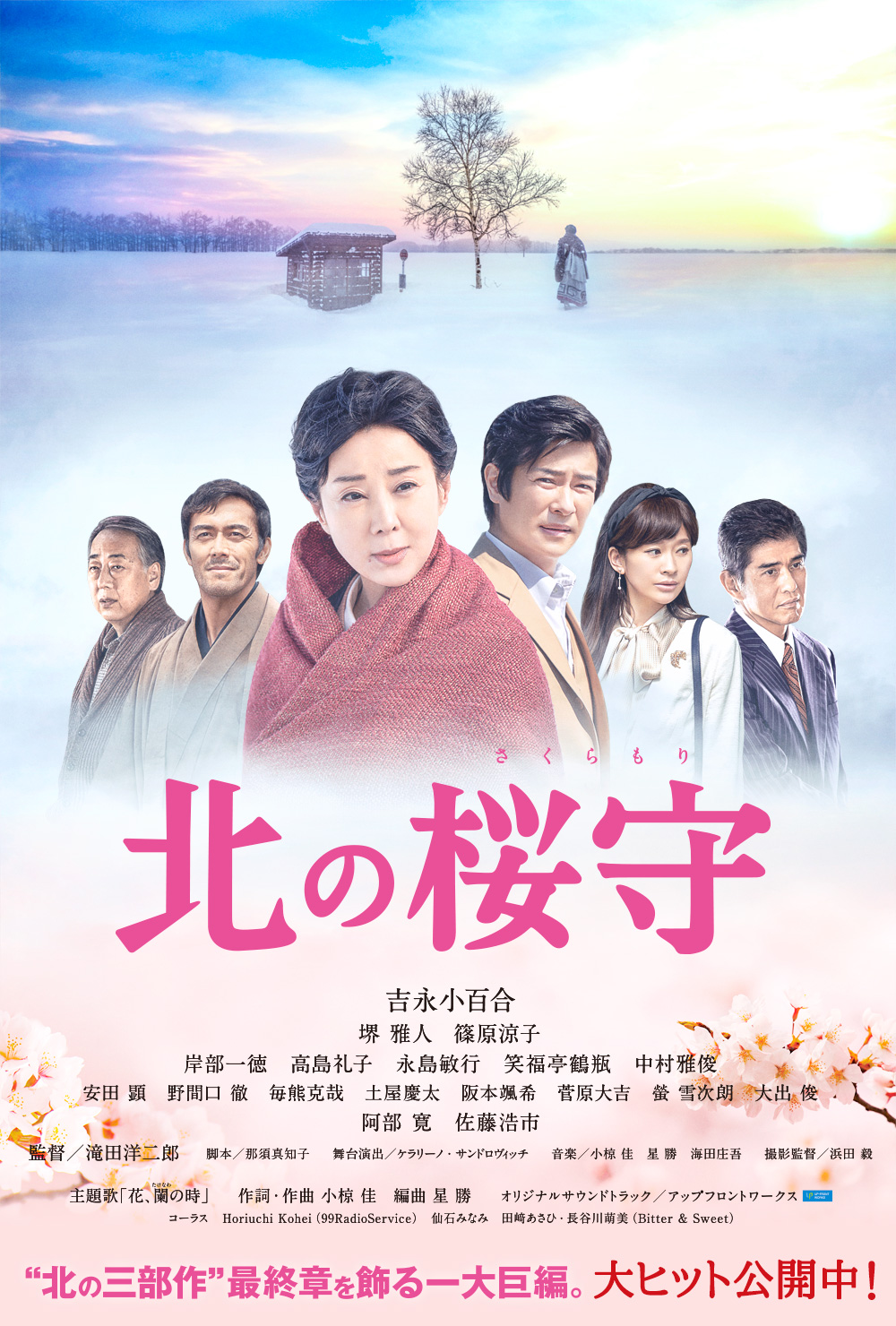
Sakura Guardian in the North posterStill a major marquee star and one of the few golden age actresses regularly playing leading roles in box office hits, Sayuri Yoshinaga has for one reason or another become somewhat synonymous with a brand of quietly patriotic tales of wartime endurance and maternal suffering. Sakura Guardian in the North (北の桜守, Kita no Sakuramori), apparently the conclusion of a loose trilogy of “Northern” films which began with Year One in the North in 2005 and led on to Junji Sakamoto’s A Chorus of Angels in 2012, sees her once again engage with post-war trauma as a mother eventually driven out of her mind by the inability to come to terms with the weight of tragedy.

The tale begins on Sakhalin in spring 1945. Despite the intense cold of the frozen North, Tetsu (Sayuri Yoshinaga) – mother to two young sons, Seitaro and Shujiro, has carefully nurtured cherry trees grown from seeds brought from the mainland ensuring that they blossom even here. The family’s happiness will however be short lived. Dad Tokujiro (Hiroshi Abe) is sent off to the war while Tetsu and the children are eventually forced to evacuate to escape the Russian invasion, planning to wait for Tokujiro in Abashiri on the north coast of Hokkaido.

Flashing forward to 1971, we find ourselves in Tokyo with Shujiro (Masato Sakai), now a grown man married to the Japanese-American daughter of an LA hot dog entrepreneur, Mari (Ryoko Shinohara). Having made something of himself in the New World, Shujiro has returned to Japan to open the first branch of his father-in-law’s convenience stores. His plans are disrupted when he gets an unexpected call from Abashiri about his mother, whom he hasn’t seen since she told him to leave her behind and seek his fortune 15 years previously. The public housing shanty town where Tetsu ran her restaurant is being torn down but she’s showing no signs of leaving, and not only that, she’s begun to act strangely.

This Shujiro finds out for himself by visiting her and witnessing Tetsu talk to her own reflection as if it were a long lost friend. His sudden decision to bring his mother back with him to Tokyo without talking to his wife, who has never even met her mother-in-law, places a strain on his marriage on top of the already heavy burden of the store but Shujiro is determined to make it work. Tetsu, however, finds its hard to adjust. Used to living in small country towns where everyone knows everyone, she doesn’t realise you can’t just walk off from stores shouting “put it on my tab”, and annoys the neighbours by starting a smoky fire outside trying to cook rice the old fashioned way. With Shujiro busy with work, the burden falls disproportionately on the patient but exasperated Mari who is forced to apologise when Tetsu walks off in someone else’s shoes after trying on city-style outfits at a department store, and looks on in horror as her new mother-in-law starts an intense conversation with a cherry blossom tree.

Tetsu’s down home charm does, however, begin to give Shujiro some business inspiration as he ponders why his top American hotdogs aren’t selling now the novelty’s worn off. As his staff tell him, maybe they need to think a little more “Japanese” – more fresh veggies and innovative toppings, less ketchup and mustard. Shujiro has another idea – the original Japanese “convenience” food, onigiri, made with rice cooked in a pot and roughly shaped by a loving mother’s hands.

Rice, however, despite its ubiquity in the comparatively comfortable world of 1971 brings with it traumatic memories. Starving after the war, white rice was something Shujiro and Tetsu could only dream of, getting their first taste of it in many moons only when cooked to place on a funeral altar. Meanwhile, rice was also the only reason they survived after running into a slightly dodgy young man who gave them “jobs” helping him to smuggle it for sale on the black market. Shinji (Koichi Sato) helped them in other ways too, eventually putting up the money for Tetsu’s homely eatery, and would have married her if she were not on the one hand loyal to the memory of her absent husband, and so troubled by survivor’s guilt as to believe that she is “a person who does not deserve happiness”.

To punish herself for perceived failures, Tetsu has lived a life of austerity – working hard in the restaurant, dressing in simple ragged clothes, and eating only enough not to starve. She forced Shujiro away to make something of himself, but never spent any of the money he sent home to her nor answered any of his letters. Shujiro, by contrast, has swung the opposite way – determined to live a life of luxury and becoming unforgiving with it. Mari sees an ugly side to him when he’s visited by one of the boys who used to bully him (Ken Yasuda) for being a refugee and a black-marketeer back in Abashiri now fallen on hard times. Superficially polite, Shujiro humiliates him with undignified zeal while wilfully planning to exploit his workforce, quickly silencing an employee who tries to point out violations to the labour code.

Yet like Tetsu, who is somewhat unstuck in time, he begins to find a softer side of himself as the pair of them journey back into the past and revisit the sites of their shared traumas. Yojiro Takita stages Tetsu’s internal confusion somewhat incongruously as an avant-garde stage play offering occasional background info on the exodus from Sakhalin, an experience Shujiro is seemingly shut out from as he tries to reconnect with his mother only to lose her again but rediscovering a better version of himself before he was hardened by the burden of his memories and the hardships of the post-war era. Tetsu keeps the cherry blossoms in bloom in the North, cultivating beauty as a means to connect with her loss, and eventually finding a kind of resolution in the returned ghosts of her past given life once again by the strength of her devotion.


Singapore trailer (English / Simplified Chinese subtitles)

Abacus and Sword (武士の家計簿, Yoshimitsu Morita, 2010)

•Žm‚̉ƌv•ë•The stories of samurai whose soul is placed not in the sword but in another tool are quickly becoming a genre all of their own. Coming from the same screen writer as A Tale of Samurai Cooking: A True Love Story, Abacus and Sword is a similarly structured tale of penny pinching samurai accountants and a pean to the undersung heroes of the admin department without whom everything would fall apart.

Abacus and Sword (武士の家計簿, Bushi no Kakeibo) could almost be titled “a story of my father” as it begins with a voice over by the youngest adult generation seen in the film, Nariyuki Inoyama, who is at the time of speaking a naval accountant in the new post restoration world. As good an account as he is (and he must be, given his position), he feels he pales in comparison to his father, Naoyuki, whose skills with the abacus were somewhat legendary even if his people skills were often not on the same level.

Dubbed an abacus fanatic by his colleagues, Naoyuki’s top maths abilities get him into trouble right away when he notices an extreme discrepancy in the accounts details for the imperial rice dole. Around this time there are riots from farmers who are being squeezed to deliver more grain to the authorities during a time of famine but not seeing enough returned to them as well as starving people petitioning for food in the streets, so when Naoyuki asks why around a third of the rice is disappearing from the accounts or listed as “reserved” his superiors start getting nervous. As a mini underling, Naoyuki is not in a position to stop his bosses from exploiting their authority in the most devious of ways – creating a food panic and then profiting on the side through black market trading, and is simply instructed to “ensure the final accounts balance”. Unwilling to falsify his precious calculations, Naoyuki finds himself facing the possibility of exile from the imperial centre but eventually finds his persistence rewarded when the scam is finally uncovered by a higher level.

Accountants are often not respected in this era of samurai warriors who place an almost religious faith in the power of the sword. Their pay is low, hours long and taxing, and they have little prospects of advancement. After hearing the story of Naoyuki’s career Nariyuki returns to the subject of himself a little more as the conflict between austere father and wayward son takes centre stage. Naoyuki is a pragmatic man, he sees their family debts are unsustainable and embarks of prolonged plan of austerity in which he forces the entire extended family to sell all their non essential possessions and live as cheaply as possible until the debts reach a more manageable level so they can at least keep the social position their larger family home affords them rather than being moved to something less prestigious. This is an unusual move in status driven samurai circles and proves embarrassing for the rest of the family such as in one episode where Naoyuki can’t afford to buy fish for his son’s coming of age ceremony so simply puts a painting of a fish at each place setting. Creative accounting at its finest!

Nariyuki, however, can’t quite give up on the idea of the sword and goes off to fight in the various civil wars which erupt during the Meiji Restoration causing great worry to his parents, wife and children. He too becomes an accountant and is at first disappointed that it’s his skills with an abacus that can best serve the country rather than those needed on the frontlines but later comes to understand the tactical importance of maintaining the smooth financial functioning of an army.

A late career effort from the prolific Yoshimitsu Morita, Abacus and Sword is an uneven experience which is more or less devoid of the director’s usual attempts at experimentation pushing for a more general, sometimes even televisual approach to storytelling. At heart the film praises the virtues of living a thrifty, honest, and balanced life in which hard work is always fairly rewarded in the end and even when not provides its own set of rewards. However, virtuous as it is to live honestly and simply in tune with the clack of an abacus, it can prove fairly dull which is unfortunately also true of Abacus and Sword which despite brief episodes of light humour never quite engages with its twin dynamics of father son conflict which echoes that of the changing world as it emerges into the new Meiji era, and of shining a light on the forgotten admin workers who keep the world turning when everything else is falling apart. Morita’s anti-consumerist, transparency in government sympathies come to the fore and are once again timely, but like Naoyuki he fails to make his complaints sufficiently engaging to ensure his messages are received by those with the ability to take action.


English subtitled trailer: