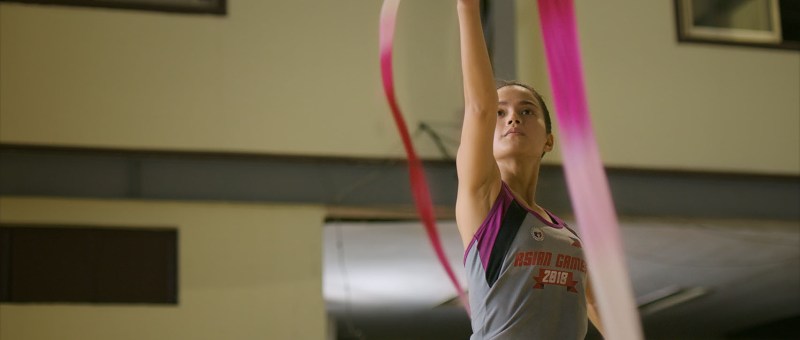

Sunshine (Antoinette Jadaone, 2024)

“Don’t drag me into this,” a boy says after hearing that his girlfriend is pregnant, having already questioned if the baby’s really his. Miggy signals his lack of responsibility by directly asking Sunshine what “her” plan is, making it plain that she’s on her own and he does not see himself playing an active role in a predicament he essentially sees as nothing to do with him. Aside from Miggy’s father Jaime, who happens to be a protestant pastor, men are largely absent from Antoinette Jadaone’s Sunshine and even when they appear rigid figures of patriarchal control. 

Sunshine implies that she’s only in this mess because Miggy pressured her into unprotected sex, but she’s left to deal with the fallout on her own. Still in school, she’s about to take her last shot at getting onto the Olympic rhythmic gymnastic team but risks losing everything she’s worked so hard for if her pregnancy is discovered. Even when she goes to buy a pregnancy test, she’s asked for ID and judged by the woman behind the counter while it’s otherwise true that abortion is illegal in all circumstances in the Philippines, meaning Sunshine’s only options are finding and paying a wise woman for medicine to provoke a miscarriage. 

It’s the reactions of other women that Sunshine most fears from her otherwise supportive coach, whose ambitions also rest on her performance, to her best friend who does in fact shun her on her mother’s insistence, and her older sister who is caring for the whole family and seems to be a single mother herself having had a baby at a young age. Like a grim siren, Sunshine’s niece won’t stop crying as if echoing the alarm of her impending maternity and her own discomfort with it. It’s a network of women that she turns to for solutions if not for advice. There’s no one Sunshine can ask for that, because what she’s looking for is illegal. All she can do is stand outside the church and pray that God take mercy on her by allowing her to wake up from this nightmare. There’s something quite ironic when she’s told to ask forgiveness from God “the father” by a religious and judgemental female doctor as if laying bare the patriarchal and oppressive underpinnings of the entire society. 

Yet cast onto a surreal odyssey through Manila in search of solutions, Sunshine finds herself becoming the supportive presence she herself doesn’t have. While pursued by a very judgmental little girl who echoes her inner confusion by branding her a “murderer” and questions her decision making, Sunshine is approached by another little girl who appears to be heavily pregnant and is begging for money to see a faith healer whom she hopes will help her end her pregnancy. Despite her own experience, Sunshine asks her why she doesn’t ask her boyfriend for help but the girl explains that he’s not her boyfriend, he’s her uncle, so she’s even more powerless and alone than Sunshine is. No one’s going to do anything about the Uncle Bobots of the world, but they’re only too happy to criminalise and abandon a little with no one else to turn to. 

Realising that the girl was trying to abort her child, the male doctor at the hospital refuses to treat her knowing full well there is a possibility she may die. Only a sympathetic female doctor is later willing to help. Sunshine too almost dies after her first attempt at taking an abortion pill which she does all alone at a love hotel where the woman on the counter didn’t want to give her a room because people who go to hotels on their own are a high risk for suicide. When she does eventually find out, Sunshine’s sister is actually sympathetic and stands up to Jaime on her behalf when he makes a bid to take over her life and force her into maternity by getting Miggy to apologise and unconvincingly insist that he actually loves her and their baby while leveraging his wealth and privilege against her by recommending that she be cared for by his family doctor and the best hospitals at his expense. It does however provoke a degree of clarity in Sunshine’s insistence that she doesn’t want to be a mother and has no intention of becoming one while rediscovering herself in rhythmic gymnastics and making peace with her younger self. A sometimes bleak picture of young womanhood in the contemporary Philippines, the film nevertheless finds relief in pockets of female solidarity and the conviction that it doesn’t have to be this way for the younger generation who should be free to pursue their dreams and make their own choices about what they do with their bodies.


Sunshine screens April 26 & 30 as part of this year’s San Diego Asian Film Festival Spring Showcase.
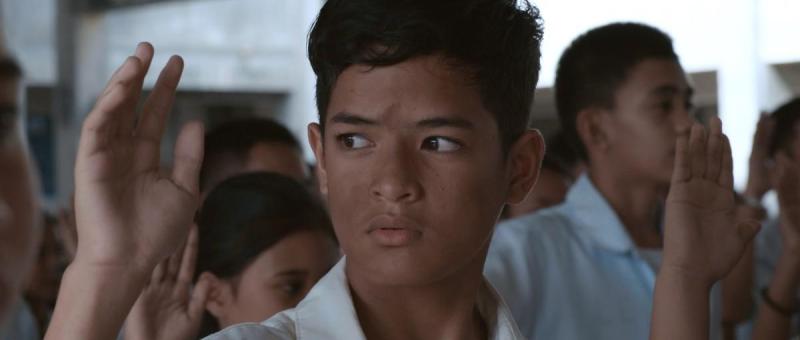
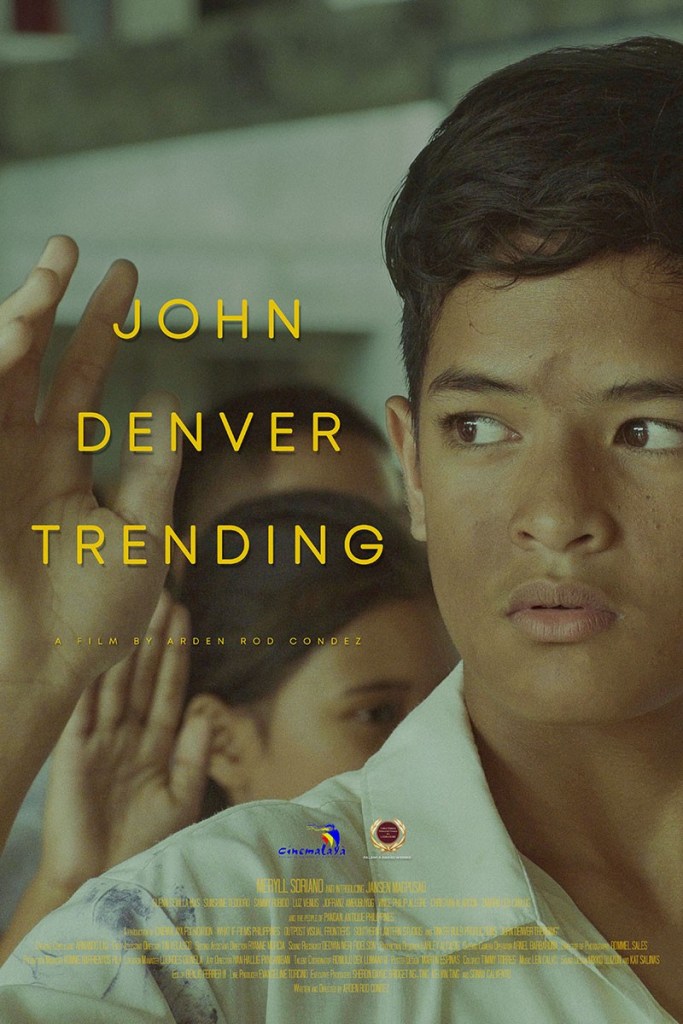
John Denver Trending (Arden Rod Condez, 2019)

We like to think that we live in a more enlightened age in which we’re able to react with compassion and understanding, striving to see both sides of every story rather than rushing to judgement. The truth is, however, that we’re often just as malicious and mean-spirited as we ever were. Social media has turned us all into thoughtless curtain twitchers, hungry for the next scandal and willing to take any hint of salacious gossip at face value. The online world has no place for fairness, and when everyone agrees on a collective “truth” facts are no defence in the court of public opinion. 

14-year-old John Denver Cabungcal (Jansen Magpusa) is the oldest son of a poor family. His father was in the military and has apparently passed away, while his mother, Marites (Meryll Soriano), now makes ends meet weaving bags and baskets while the family lives in a traditional village way out of town. A slight, angry boy John Denver is classically unlucky, mercilessly bullied just for being poor and getting punished when he dares to fight back. So it is when he’s humiliated during a dance rehearsal by having his trousers pulled down by another boy live on Facebook, after which they all laugh at him because his boxers are full of holes. When the rehearsal is over, one of the other boys accuses him of stealing his iPad, a situation compounded by the fact John Denver has apparently stolen before. The boy, Makoy (Vince Philip Alegre), snatches John Denver’s bag and demands to look inside. John Denver is innocent, but resents being forced to prove it and so refuses to let them see. He chases Makoy to the roof and wrestles the bag away from him, viciously beating him as he does so while another boy, Carlos, smirks from the sidelines as he records everything on his phone. Smug in the extreme, Carlos uploads the video to his Facebook with a hateful caption claiming to expose the “real” John Denver for the thieving little thug he is. 

The first of John Denver’s many problems is that he doesn’t have access to data on his phone and only limited connection to wi-fi while passing through his aunt’s place to pick up his siblings, so it’s hours before he knows anything’s wrong and then there’s nothing much he can do about it. He tries to ring Carlos, but he doesn’t answer. We don’t know who took the iPad, or even if it was stolen at all. Perhaps Makoy lost or broke it himself and needed someone to blame, or this is all an elaborate setup for cyberbullying, but events soon spiral out of control. John Denver tries to explain, he didn’t take the iPad and he was only defending himself after Makoy picked a fight, but the grownups don’t believe him. Everyone already seems to think John Denver is a bad boy, and nothing he says is going to change that. 

Trapped in this kafka-esque cycle of repeatedly stating his innocence, John Denver becomes the subject of a witch-hunt, a cursed figure despised by all. The village in which he lives is a hotbed of gossip and superstition where people still turn to the Village Chief for arbitration and the Shaman for advice. Even John Denver himself mutters a curse under his breath as he’s passed by a strange old woman (Estela Patino), herself the subject of local gossip for supposedly being a witch and having murdered a young man. Social media has, perhaps, merely turned us all into the gossiping old biddies in the square but amplified their nonsense tenfold and given it more weight through the authenticity of print. 

Soon enough, more witnesses start turning up to blacken John Denver’s name – a boy he hit with a stone during a fight, a girl he apparently stole food from. He denies neither of these crimes, but they now have new colour and intensity as the storm around him quickens. Meanwhile, a wealthier neighbour who seems to have a beef with his mother has been extorting money from them for supposedly causing the death of his water buffalo. He creates two versions of an online video. In the first he tells the truth with a mean-spirited spin, explaining that he’d seen John Denver looking for odd jobs in the market to make extra money to pay him compensation, once again using his poverty and “bad character” against him, while in the second he lies and says he saw him sell the iPad.

There is not, and perhaps has never been, any clear way to discern truth from fiction, supposition from malicious gossip. Everyone decides John Denver is guilty because John Denver is not liked. Makoy’s mother ropes in her neighbour, a policeman, who too insists John Denver is to blame and is being stubborn and unreasonable in refusing to conform to the majority view. The policeman takes his gun from his holster and hovers his hand over it on the desk, not quite pointing it but the effect is much the same. John Denver must accept his guilt, the mob must be appeased, the authorities have to be seen to act. The “truth” no longer matters, the semblance of it is all that counts. John Denver resists, he refuses to own a crime that is not his, but finds that innocence is an under appreciated quality when society itself refuses to admit its hate-fuelled hypocrisy. 


John Denver Trending screens in Amsterdam on March 5/6 as part of this year’s CinemAsia Film Festival.

Original trailer (English subtitles)