Filipiñana (Rafael Manuel, 2026)

“If one of them dies, it will be replaced,” a worker reassures a wealthy client, ostensibly talking about a dried-out tree, but it’s clear his comment extends even to the largely anonymous employees of an upscale Manila golf course in Rafael Manuel’s satirical drama, Filipiñana. 17-year-old country girl Isabel (Jorrybell Agoto) has come here from her rural hometown to become a “tee girl,” which is to say her job consists of sorting golf balls and placing them in front of the wealthy men who are the course’s main clientele.

The sunlight glints ominously off the club fondled by Renato (Carlos Siguion-Reyna), a golfing supplies magnate who has brought his niece Clara (Carmen Castellanos) to the resort in the hope of convincing her to come “back” to the Philippines from the US and join his company. Manuel’s sound design captures every thwack of the club with an eerie violence that hints both at the damage this place is doing to the natural world and social fabric, and the power and privilege wielded by men like Renato against young women like Isabel. Noticing that the man she’s teeing keeps mis-hitting his balls, Isabel fears one is going to hit her and asks another girl for advice only to be told that it doesn’t hurt that much really and the golfer will probably feel guilty and tip more.

Isabel is temporarily handed the club herself when charged with returning it to the course’s mysterious manager, Dr. Palanca (Teroy Guzman) whom she first saw snoozing with one of the caddies under a mango tree. The club gives Isabel a free pass to wander through the parts of the resort where she would not ordinarily be allowed to go and also grants her access to some of its grimmest secrets. It seems that Isabel might have come here with revenge on her mind, recounting how Dr. Palanca’s trucks arrived to turf her out of her hometown, which is also his hometown though it seems like it means something different to him. But at the same time, she doesn’t quite know what to do with this power that she’s temporarily been given, give it back to those who think it’s theirs, or use it to begin dismantling this system even if it requires violence to do so.

In that sense her dilemma might not be that different from Clara’s, despite the extreme differences between them. Clara is the only female golfer that we see in a world otherwise entirely set up for men. Ina (Isabel Sicat), Clara’s caddie, asks her if all the caddies in America are female too, but is surprised to learn that in America people mostly carry their own bags. Perhaps this might suggest a rather simplistic characterisation of America as an egalitarian paradise, yet America once colonised the Philippines and these golf courses, even if now mostly catering to Chinese tourists, are a legacy of its occupation. Towards the end of the film, Manuel inserts black and white photos of plantations on the grounds of which these courses have been built.

Clara makes a point of telling Ina that her uncle is “harmless,” which is something there wouldn’t be any need to say if she actually believed it. Like Isabel, she seems uncomfortable with the course and what it represents, values implied to be born of her US upbringing, yet it’s exactly this discomfort that her uncle weaponises in suggesting she change the system from the inside. He tells her that they urgently need to diversify their customer base seeing as all their clients are older men and they urgently need people like her do it, so this country can progress. By “progress”, he likely means in his favour preserving the power and privilege of men like himself, but couched in more compassionate language such as his attempt to pass the hat round for golfers to donate to a fund to support the caddies’ families during the drought, when the best way to do that would obviously be to turn the sprinklers off at the gold course.

In the opening scenes we a minibus carrying Chinese tourists to the hotel pass through a crowd of people waiting to collect their water ration under the blistering Manila sun. It’s as if the course itself has sapped the life out of the surrounding city, rendering all too tired to want to resist having internalised the status quo as just that. The wealthy golfers relentlessly cheat at the game and are allowed to get away with it, while the smallest transgression can spell disaster for an employee. “I should aim for the left,” Clara says while looking at a hole despite her uncle and Ina’s advice that it bends right, only for Renato to reassure her that she’s “still learning” as he pulls her towards accepting this privilege despite her misgivings over the excess and exploitation on which the golf course is founded. Somewhat bleak in its implications, Manuel subverts the film’s quirky production design to create a sense of uncanniness in its essential unreality as a ruling class seeks to recreate the idyllic pastorality of a bygone age that they themselves have largely destroyed while seeking to keep it purely for themselves.


Filipiñana opens in UK cinemas 20th November courtesy of BFI Distribution.

Trailer (English subtitles)
John Denver Trending (Arden Rod Condez, 2019)

We like to think that we live in a more enlightened age in which we’re able to react with compassion and understanding, striving to see both sides of every story rather than rushing to judgement. The truth is, however, that we’re often just as malicious and mean-spirited as we ever were. Social media has turned us all into thoughtless curtain twitchers, hungry for the next scandal and willing to take any hint of salacious gossip at face value. The online world has no place for fairness, and when everyone agrees on a collective “truth” facts are no defence in the court of public opinion. 

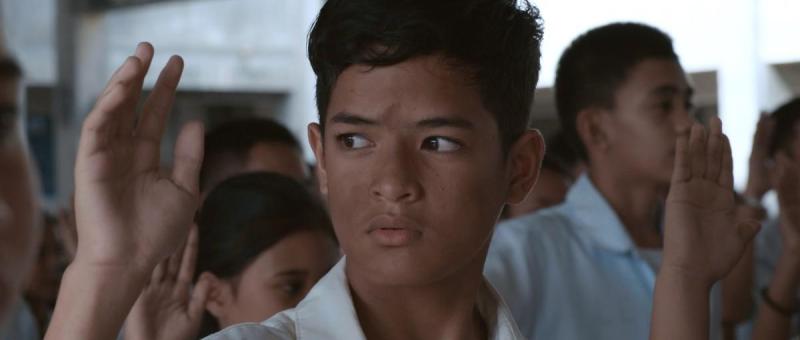
14-year-old John Denver Cabungcal (Jansen Magpusa) is the oldest son of a poor family. His father was in the military and has apparently passed away, while his mother, Marites (Meryll Soriano), now makes ends meet weaving bags and baskets while the family lives in a traditional village way out of town. A slight, angry boy John Denver is classically unlucky, mercilessly bullied just for being poor and getting punished when he dares to fight back. So it is when he’s humiliated during a dance rehearsal by having his trousers pulled down by another boy live on Facebook, after which they all laugh at him because his boxers are full of holes. When the rehearsal is over, one of the other boys accuses him of stealing his iPad, a situation compounded by the fact John Denver has apparently stolen before. The boy, Makoy (Vince Philip Alegre), snatches John Denver’s bag and demands to look inside. John Denver is innocent, but resents being forced to prove it and so refuses to let them see. He chases Makoy to the roof and wrestles the bag away from him, viciously beating him as he does so while another boy, Carlos, smirks from the sidelines as he records everything on his phone. Smug in the extreme, Carlos uploads the video to his Facebook with a hateful caption claiming to expose the “real” John Denver for the thieving little thug he is. 

The first of John Denver’s many problems is that he doesn’t have access to data on his phone and only limited connection to wi-fi while passing through his aunt’s place to pick up his siblings, so it’s hours before he knows anything’s wrong and then there’s nothing much he can do about it. He tries to ring Carlos, but he doesn’t answer. We don’t know who took the iPad, or even if it was stolen at all. Perhaps Makoy lost or broke it himself and needed someone to blame, or this is all an elaborate setup for cyberbullying, but events soon spiral out of control. John Denver tries to explain, he didn’t take the iPad and he was only defending himself after Makoy picked a fight, but the grownups don’t believe him. Everyone already seems to think John Denver is a bad boy, and nothing he says is going to change that. 

Trapped in this kafka-esque cycle of repeatedly stating his innocence, John Denver becomes the subject of a witch-hunt, a cursed figure despised by all. The village in which he lives is a hotbed of gossip and superstition where people still turn to the Village Chief for arbitration and the Shaman for advice. Even John Denver himself mutters a curse under his breath as he’s passed by a strange old woman (Estela Patino), herself the subject of local gossip for supposedly being a witch and having murdered a young man. Social media has, perhaps, merely turned us all into the gossiping old biddies in the square but amplified their nonsense tenfold and given it more weight through the authenticity of print. 

Soon enough, more witnesses start turning up to blacken John Denver’s name – a boy he hit with a stone during a fight, a girl he apparently stole food from. He denies neither of these crimes, but they now have new colour and intensity as the storm around him quickens. Meanwhile, a wealthier neighbour who seems to have a beef with his mother has been extorting money from them for supposedly causing the death of his water buffalo. He creates two versions of an online video. In the first he tells the truth with a mean-spirited spin, explaining that he’d seen John Denver looking for odd jobs in the market to make extra money to pay him compensation, once again using his poverty and “bad character” against him, while in the second he lies and says he saw him sell the iPad.

There is not, and perhaps has never been, any clear way to discern truth from fiction, supposition from malicious gossip. Everyone decides John Denver is guilty because John Denver is not liked. Makoy’s mother ropes in her neighbour, a policeman, who too insists John Denver is to blame and is being stubborn and unreasonable in refusing to conform to the majority view. The policeman takes his gun from his holster and hovers his hand over it on the desk, not quite pointing it but the effect is much the same. John Denver must accept his guilt, the mob must be appeased, the authorities have to be seen to act. The “truth” no longer matters, the semblance of it is all that counts. John Denver resists, he refuses to own a crime that is not his, but finds that innocence is an under appreciated quality when society itself refuses to admit its hate-fuelled hypocrisy. 


John Denver Trending screens in Amsterdam on March 5/6 as part of this year’s CinemAsia Film Festival.

Original trailer (English subtitles)