
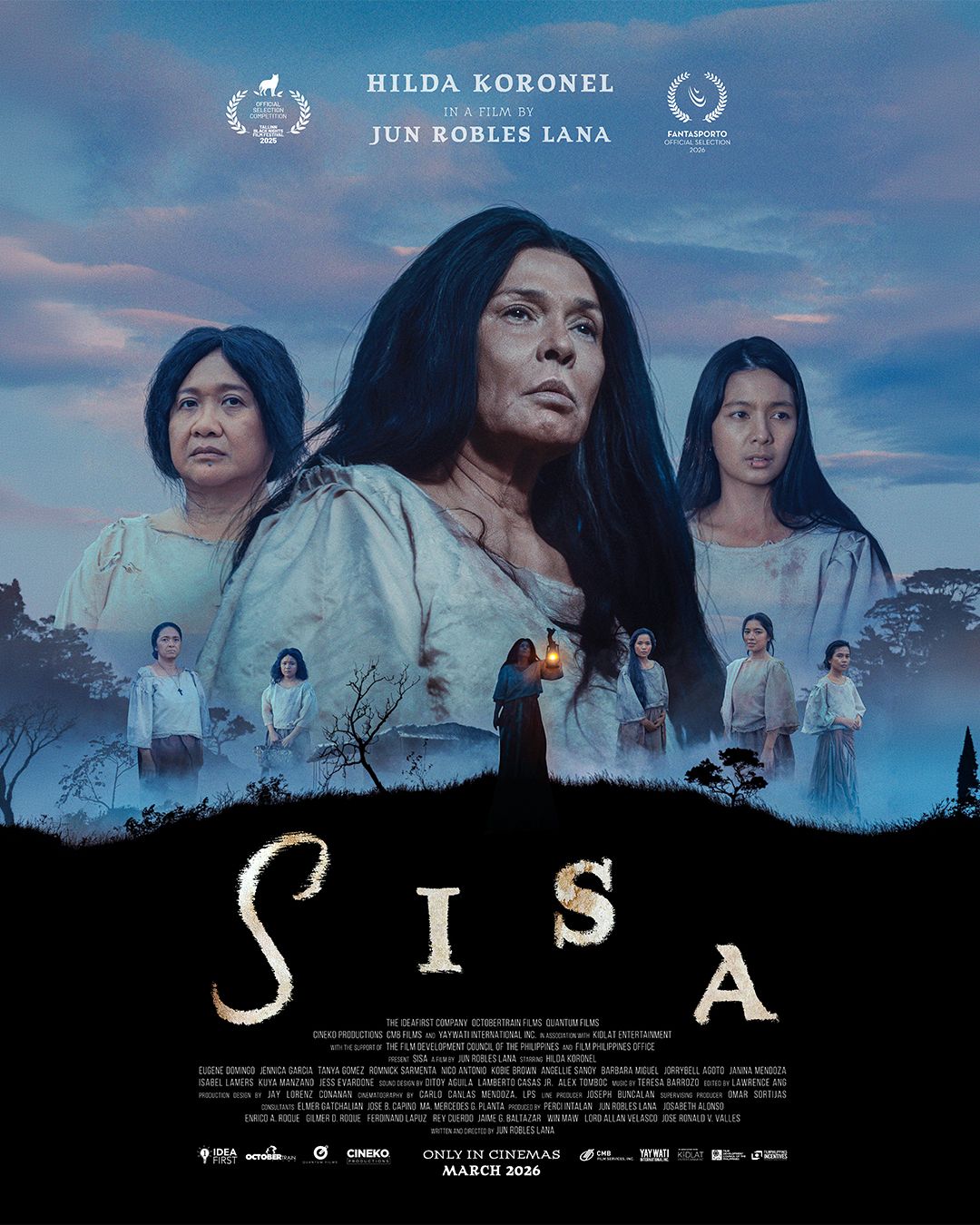
The woman who will come to be known as Sisa (Hilda Koronel) enters the frame like a wandering spirit, a ghost of a ruined land come to haunt those who would now attempt to “rebuild” it. She looks at the young soldier atop a guard tower with witchlike intensity, cursing him with her eyes though smiling beatifically before urinating on the ground. This land that you have scorched, I shall water, she seems to say, even as her actions are intended to make her seem “mad” and in that way essentially harmless, or at least harmful only to herself.
Set in 1902, Jun Robles Lana’s steely drama explores the traumatic legacy of colonialism through the experiences of a collection of women living a concentration camp during the Philippine–American War. America had annexed the Philippines after the Spanish American War, denying the nation’s attempt to assert its own independence after the collapse of the Spanish Empire. According to the title cards opening the film, America pursued a scorched earth policy when faced with resistance resulting in the genocide of thousands of Filipinos. The community of women at the film’s centre who have been forced into a concentration camp have each lost husbands and children as a result of the war and are then both dependent on and brutalised by the American military.
In fact the camp’s commander, Harrison (Kuya Manzano), describes Sisa as “another lunatic thanks to this war.” Her “madness” is understandable, yet her “inability” to remember her name is also an expression of the ways in which her culture has been taken from her. Harrison assumes her to be an insensible fool, though it seems that Sisa is able to understand his incredibly ham-fisted attempts at speaking Spanish along with his English, yet makes no reply because for now silence is her weapon. It is useful for her to appear “mad” as it gives her an excuse to go wandering and no one much expects that she could secretly be plotting against them.
On the other hand, this “madness” is also a rejection of the forced assimilation the Americans seem to be intent on. When none of the women respond to Harrison’s Spanish, he complains that if no one can speak it after 300 years of colonisation, what hope does English have. He does not appear to consider that perhaps they just don’t want to talk to him. In any case, the Americans have made it compulsory for the children to learn English with 13-year-old Nena (Angellie Sanoy) a perfect model of what they hope to achieve. Proud of her accomplishments and enamoured with this new culture, she comes to sympathise with the Americans while the older women remain wary and much more aware of the wilful erase of their culture. Mrs Warren (Isabel Lamers) speaks condescendingly of their lack of the “civilisation” which she is bestowing on them as a gift. She encourages Nena to use cutlery, which, her mother points out, is a rather moot point when all you ever get to eat is baked sweet potato.
Mrs Warren rather insensitively organises a ball to cheer everyone up, forcing the women to wear American-style ballgowns she actually picked up cheap from a disbanded theatre troupe. Just like Sisa’s madness, these are costumes they are forced to wear to survive, but the women are all but ignored at the party and completely bored by this offensive celebration of the legitimisation of their enslavement. Most of them leave early with only Leonor (Jennica Garcia), who has become Harrison’s mistress, staying behind. Leonor has convinced herself that Harrison is actually a “good man who cares about out country” hamstrung by the wider politics of the situation. This is perhaps also a costume she wears to survive, enjoying the perks of being close to Harrison such as receiving fresh bread from Manila while believing that the other soldiers see her as his “wife”. But at the same time, Harrison forces her to turn on her fellow countrymen, publicly slapping a woman who had criticised her as a traitor and a whore.
This theme of sexual exploitation and humiliation is later extended to the nation as a whole which is left with little option but to accept its subjugation. Sisa looks on in silence in rage along with buried maternal compassion such as her sympathy for Nena who has become pregnant by a young American soldier she believes loves her. Like many of the other women, Sisa has nothing left to lose. Her family, name, and identity have all already been taken from her, and in the end she too will have no option but to turn on her fellow countrymen in order to exact her revenge. “Our grief is endless,” she tells one of the other women, bearing out the weight of all she’s lost which only “madness” can assuage.
Sisa screened as part of this year’s San Diego Asian Film Festival.
Trailer (English subtitles)