Kazuo Umezu’s Horror Theater: Present (楳図かずお恐怖劇場 プレゼント, Yudai Yamaguchi, 2005)

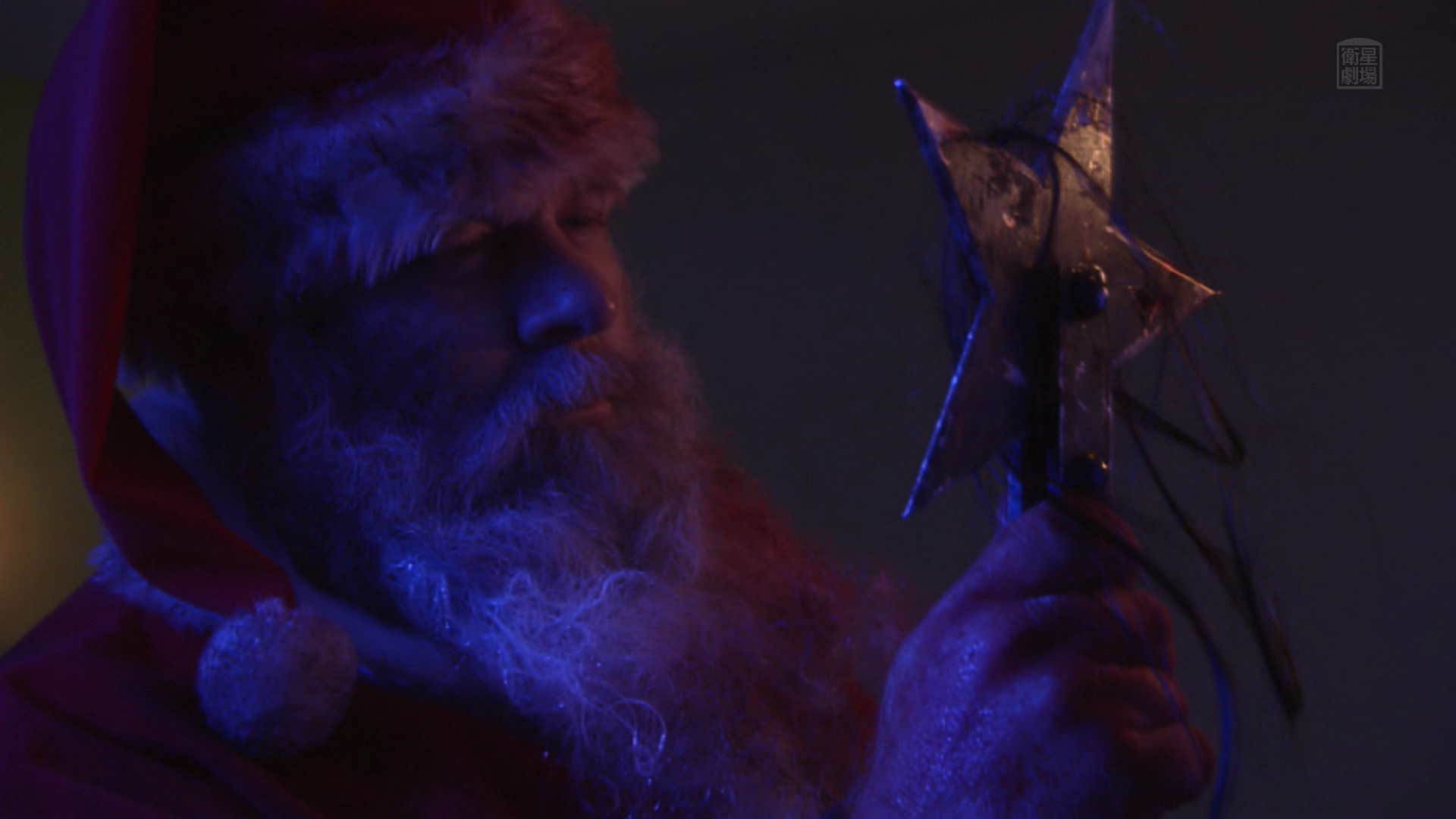
Generally speaking, Santa is quite a benevolent figure. Even the children who are naughty usually just get left out or else awarded a single piece of coal or some other worthy yet dull gift that lets them know how badly they’ve behaved. Not so in the world of Kazuo Umezu, however. You don’t want to get on the wrong side of this Santa, though in other ways it’s less “Santa” that is haunting these youngsters than the disappointed spectres of the children they once were.

As a small child, Yuko (Seiko Iwaido) had a funny dream, though her parents reassured her that Santa would come to save her. However, if she did anything wrong, he’d come after her too. Years later, when Yuko is a student, she writes a Christmas card to a boy she likes and goes to spend the night at a hotel with her friends. But the hotel looks weirdly like her doll’s house from when she was little, and other things from her childhood bedroom seem to turn up here and there. In case that wasn’t weird enough, the reception desk is manned by a creepy Santa, while the atmosphere inside couldn’t really be called “jolly” so much as mildly depressing.

Meanwhile, it almost seems as if Yuko is being bullied by her female friends and has been set up in some way as a figure of fun, though it turns out that Ryosuke (Takamasa Suga) seems to like her too. Only, that’s largely because she seems “pure” in comparison to her friends, which is a bit of a red flag. In any case, though this is a slasher film, it doesn’t really seem to be the case that Yuko is a “bad” girl for getting it on with Ryosuke but for some other transgression. As one of the kids says, they’re all apparently guilty of “desecrating” Christmas, which is what has annoyed Santa to the extent that he’s decided to take back all the gifts he previously gave them. What he actually takes, however, is most of their limbs and internal organs which he feeds to his reindeer.

How they “desecrated” this non-religious event isn’t really clear, but on the other hand it’s true that they don’t make much of an attempt to save each other apart from Ryosuke who is protective of Yuko suggesting that he did actually have feelings for her and wasn’t just looking for a bit of festive nookie. Yuko, by contrast, is revealed to be not quite all she seems and there are other reasons someone, like Santa, might judge her to have been “bad” not least in her rather callous disregard for her parents who were looking forward to seeing her over Christmas. The contrast with her younger self couldn’t be starker, while in her dream, the young Yuko believes herself to have beaten “the evil one” by pulling out her rotten brain which is either a fantastically grim paradox and metaphor about the various ways we disappoint our younger selves, or a kind of course correction in which the young Yuko “became Santa” and removed all the “rotten” parts of her future self’s mind so she won’t end up turning out like that.

The fact that everyone sees a different version of Santa also lends weight to the idea that they’re coming out of their own psyches and Santa is really a manifestation of their own fears and anxieties, though Yuko’s is a fairly conventional take based on what her mother told her Santa looked like. Her mother also attributes young Yuko’s rather gory dream to watching too many splatter films and reflects that perhaps she shouldn’t be letting her do that. “Who on earth would make such films?” she ironically asks in a meta moment while Yuko cheerfully plays “hide and seek” with her new stuffed toys of Santa and Rudolph smiling sweetly while her mother adds that she’s sure Yuko will grow up to be as gentle a woman as she is a child. Meatball Machine director Yudai Yamaguchi, however, indulges in some surreal Christmas gore as Santa goes on his killing spree utilising festive items to hack off the kids’ limbs before stuffing them in his sack and retreating to his decidedly unjolly grotto with his psychotic reindeer. The Christmas spirit is it seems alive and well.


The Chrysanthemum and the Guillotine (菊とギロチン 女相撲とアナキスト, Takahisa Zeze, 2018)

Chrysanthemum and the Guillotine poster 1“I see it now, we can’t change anything” a despondent would-be-revolutionary decries in a moment of despair. Almost 100 years later, you might have to concede they have a point when the world finds itself on a tipping point once again and the same old prejudices refuse to disappear. Takahisa Zeze’s The Chrysanthemum and the Guillotine (菊とギロチン 女相撲とアナキスト, Kiku to Guillotine Onna Zumo to Anarchism) casts an unflinching eye back towards the Japan of 1923 caught in the aftermath of a devastating natural disaster which followed on from a chaotic era of rapid social change and bewildering modernisation during which a series of battles were being fought for the future direction of a nation still trying to define itself in world dominated by empires.

When the Great Kanto Earthquake struck claiming mass loss of life and extreme damage to infrastructure, the ensuing chaos gave rise to a vicious rumour that Koreans were taking advantage of the situation to foment the independence movement by poisoning wells and committing arson leading to a pogrom against anyone who failed to prove themselves Japanese enough to satisfy the mob. Meanwhile, the same forces also turned on political opponents whose influence they perceived as destructive to their own aims culminating in the murder of prominent anarchist Sanae Osugi along with his feminist wife Noe Ito and their six-year-old nephew.

We begin, however, with a different band of outsiders in the Tamaiwa itinerant female sumo wrestler troupe many of whom have taken refuge in an isolated world of female solidarity in order to escape abusive relationships. Kiku (Mai Kiryu) is one such woman who found the courage to run away from a violent husband on catching sight of the powerful female wrestlers who made her realise that she too could become strong like them. Having accepted that “weak people can’t change anything”, Kiku has vowed to become “strong” in order to claim her own agency and ensure that she can’t be pushed around ever again.

Meanwhile, an anarchist sect known as the Guillotines are fomenting a more general kind of revolution but have not been very successful and are now on the run from the authorities which is how they end up running into the female wrestlers and more or less bringing them into the struggle. Led by libertine and (as yet) unpublished poet Tetsu Nakahama (Masahiro Higashide), the Guillotines are more romantic bandits with high ideals than serious revolutionaries. They rob the rich to fund their “activism” but spend most of the money on sex and drink while plotting revenge for the murder of Osugi with various schemes which imply that at heart they aren’t so different from that which they hate.

Nevertheless, the forces of darkness are rising and history tells us that, temporally at least, they will win. The vigilante militias which carried out the massacres were largely made-up of farmer soldiers who’d served in Russia and experienced terrible hardship. Unable to bear the idea that their traumatic wartime experiences had been a senseless waste, they doubled down on militarist ideology and insisted on their nationalistic superiority. This led them to hate, to regard anything that lay outside of their code as inferior and dangerous. Though the massacres were condemned by the government and the perpetrators prosecuted for their crimes, the convictions were largely quashed a short time later which is why we see our major villains rewarded by the state and our revolutionary “heroes” imprisoned for their resistance towards state oppression and desire to create a fairer, more equal society.

Ironically enough, Nakahama’s big utopian idea is an overly idealistic vision for a future Manchuria which in hindsight proves extremely uncomfortable but is perhaps an indication of the naivety of the times. Even so, the Guillotines for all their romanticism are essentially progressive in their thinking and in full support of sexual equality, insisting on the necessity of the wrestlers to embrace their physical capabilities in order to defend themselves against an oppressive and patriarchal society fuelled by male violence. Though this in itself might be mildly problematic in implying that in order to become “equal” women must learn to be more like men, it also plays into the film’s subtle sense of irony in which the tools of militarism are being subverted in order to oppose it. The “intellectual” Guillotines find their revolutions failing, while fighting fire with fire may be the only surefire way to win even if it legitimises the problematic act of violence in the process. Then again, as another of the Guillotines puts it, the truly strong are those who have no need of killing. 

In any case, the Tamaiwa stable becomes a tiny enclave of progressive values built on female solidarity though they ultimately discover that solidarity is not quite enough and they cannot protect each other from the ravages of the times without external assistance. Even so, they attempt to hold the line, literally pushing back against the fascist incursion while insisting on their right to resist as human beings with will and agency. The prognosis seems bleak. 100 years later the same battles are still being fought and the same tensions rising in the wake of new disasters yet there are also those who will continue to resist and like the Tamaiwa wrestlers refuse to give in to those who threaten to restrict their freedom.


The Chrysanthemum and the Guillotine was screened as part of the 2019 Nippon Connection Film Festival.

Original trailer (no subtitles)

It’s Me, It’s Me (俺俺, Satoshi Miki, 2013)

It's Me It's Me posterSome say it’s good to be your own best friend, but then again perhaps too much of your own company isn’t so good for you after all. The hero of Satoshi Miki’s adaptation of the Tomoyuki Hoshino novel, It’s Me, It’s Me (俺俺, Ore Ore), is about to put this hypothesis to the test as his identity literally splinters, overwriting the source code of strangers and replacing it with its own. How can you save your identity when you aren’t sure who you are? Perhaps getting to know yourself isn’t as straightforward a process as most would believe.

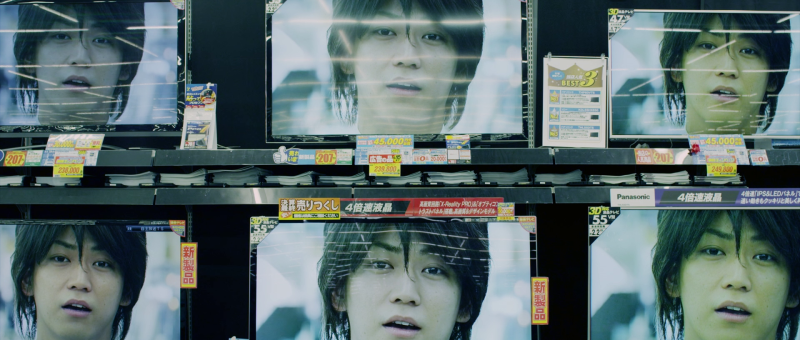
Hitoshi (Kazuya Kamenashi), an aimless 20-something, had dreams of becoming a photographer but they’ve fallen by the wayside while he supports himself with a dead end job on the camera counter in a local electronics superstore. Virtually invisible to all around him and so anonymous the woman in the fast food restaurant almost wouldn’t give him the fries he’d ordered, Hitoshi is irritated when two salaryman-types gossiping about how one of them plans to quit the company to pursue his dreams rudely invade his space. Perhaps for this reason, he finds himself taking off with the irritating stranger’s phone after he carelessly allows it to fall onto Hitoshi’s tray.

Emboldened, Hitoshi decides to use the phone to commit an “Ore Ore” scam – a well known telephone fraud in which a stranger rings an elderly person and shouts “it’s me, it’s me!” in a panic so they won’t twig it’s not really their grandson who is ringing them and claiming to be in some kind of terrible trouble which can only be relieved with cold hard cash. Not the sharpest knife in the drawer, Hitoshi gets the money wired to his account and then tries to dispose of the phone but it’s already too late. When he gets home, a strange woman (Keiko Takahashi) is in his apartment and she keeps calling him “Daiki”. What’s more, when he tries to go and see his mum (Midoriko Kimura), another guy is there who looks just like him and his mum won’t let him in.

Hitoshi eventually becomes friends with “Daiki” who introduces him to another “Me”, Nao – a cheerful student slacker. Each in their own way slightly disconnected, the trio build up an easy friendship – they do after all have quite a lot in common, and begin jokingly referring to their shared apartment as “Me Island”. Hitoshi, remarking that he’s never felt so carefree among others, begins to see the upsides of his strange new situation which obviously include the ability to be in two places at once, but too much of himself eventually begins to grate when Nao begins tracking down and bringing home all the other Mes he can find with the intention of launching a Me Empire.

A member of a lost generation, Hitoshi is a perfect example of modern urban malaise. Though he once had dreams, they’ve been steadily killed off by an oppressive society leaving him alone and adrift, unable to connect with others as the light slowly dies in his eyes. Perhaps, however, there is the odd flicker of resistance in his intense resentment towards those who have defiantly not given up – the chatty salaryman talking about his individualist dreams and later his work colleague who has been secretly taking accountancy classes in an effort to escape casual employment hell for a steady, if dull, regular job.

Hitoshi has always regarded relationships as “troublesome” but begins to feel differently through bonding with himself. As Daiki puts it, accepting others means that you’ll be accepted – something Hitoshi unconsciously longs for but is too insecure to believe is possible. His actualisation receives another stimulus when he meets the beautiful and mysterious Sayaka (Yuki Uchida) who again encourages him to accept the one who accepts you and is the only other person who seems to be able to see the “real” him as distinct from all the other Mes. Yet Hitoshi struggles – he can accept parts of but not all of himself, eventually leading to a disastrous turn of events in which the parts of himself he does not like begin being “deleted” as one Me decides to make war on all the others.

Only by ridding his psyche of imperfections can Hitoshi reformat his personality and once again resume full autonomy as the one and only Me. Yet can we be so sure final Hitoshi is the “true” Hitoshi? Who can say – only Hitoshi himself can know the answer to that (or not), the rest of us will just have to accept him as he is in the hope that he will also be able to accept us so that we can in turn accept ourselves.


Original trailer (no subtitles)