
New Female Prisoner Scorpion (新・女囚さそり 701号, Yutaka Kohira, 1976)

After the fourth film in the Female Prisoner Scorpion series, star Meiko Kaji decided to move on but Toei had other ideas and opted for a reboot as signalled by the addition “shin” or “new” to the otherwise identical title to the very first film. New Female Prisoner Scorpion #701 (新・女囚さそり 701号, Shin Joshu Sasori: 701-go) moves in a slightly different direction spinning a tale of a less straightforward revenge coloured by conspiracy cinema and a series of real life high-profile corruption cases including the Lockheed Scandal, itself name checked in the film. Just a few months earlier, Roman Porno actor and fervent nationalist Mitsuyasu Maeno had lost his life in a suicide attack on the home of underworld figure and right-wing fixer Yoshio Kodama who had been instrumental in “convincing” Japanese airlines to buy Lockheed planes over McDonnell Douglas.

In any case, this Nami Matsushima (Yumi Takigawa) is an ordinary young woman who becomes concerned about her sister Taeko (Bunjaku Han) when she uncharacteristically drops out of contact after behaving strangely. Taeko is a political secretary to assemblyman Miura (Ichiro Nakatani) who is currently the vice-minister for justice and at the centre of a burgeoning corruption scandal. After Nami and her fiancée Toshihiko (Yusuke Natsu) manage to meet up with Taeko, she is suddenly kidnapped from the hotel car park while the man who was with her, Sugino (Nenji Kobayashi), is gunned down. Sugino is found to be carrying his passport and two airline tickets to Paris which, along with Taeko’s strange behaviour, imply they were planning to flee the country together. Looking more closely at the wedding presents her sister had given her, Nami realises she’s left her a cassette tape with the instruction to leak its contents to the press should anything untoward happen to her. 

Nami uses the tape as leverage with Miura to try and rescue her sister but ends up learning some unpleasant truths before being framed for Taeko’s murder and sentenced to 15 years in prison. Toshihiko, who had originally been supportive, betrays her, testifying at her trial that she may have been resentful that Taeko was against their marriage only to later marry Miura’s daughter and go into politics apparently siding with the bad guys. Toshihiko may have seemed like a nice guy, but it’s also true that he tried to pressure her into premarital sex that she didn’t want by insisting that he couldn’t wait for marriage, suggesting they blow off her sister and go to a hot springs in Hakone instead. Most of the men in the film are equally spineless and duplicitous not least the guards who with the exception of one are all corrupt and/or abusing the inmates. 

Not content with sending her to prison, Miura tries to have Nami offed with the assistance of the warden who puts her in a cell with the prison’s most notorious offender. Fusae (Mitsuyo Asaka) orders her minions to beat and torture Nami, at one point gang raping her while the only way she can think of to save her life is by claiming there’s another tape so if they kill her they’ll never know where it is and run the risk of the contents leaking. 

Meanwhile, she’s approached by a group of anarchists who tell her they need a leader which seems a little contradictory but nevertheless enables a jailbreak even as Nami develops a rivalry with the feisty prisoner number 804. Though she obviously didn’t commit the murder for which she was imprisoned, Nami is no pushover and in fact burns one of her tormentors alive not to mention stabbing another in the eye with a pencil and cunningly splitting a pair of scissors to gain twin knives. Rather than the classic scorpion look, she appears almost batlike, spreading her arms in her cape as she prepares to make her final act of revenge right outside the Diet building itself as if she were making a point about cleaning up politics aside from avenging her sister’s death and her own mistreatment. Director Kohira lends her a supernatural quality in her eerie silhouette as if she’s already become something else, a force of nature transformed by her righteous anger towards a corrupt society largely ruled by venal men willing to kill and use women for their own benefit or pleasure. Even Nami is forced to admit her complicity having learned her sister may have paid for her education through allowing herself to be traded by Miura as a political bargaining chip. She is not, however, willing to let it stand, resisting a controlling a patriarchal society with all of the resources available to her.
Fine, with Occasional Murders (晴れ、ときどき殺人, Kazuyuki Izutsu, 1984)

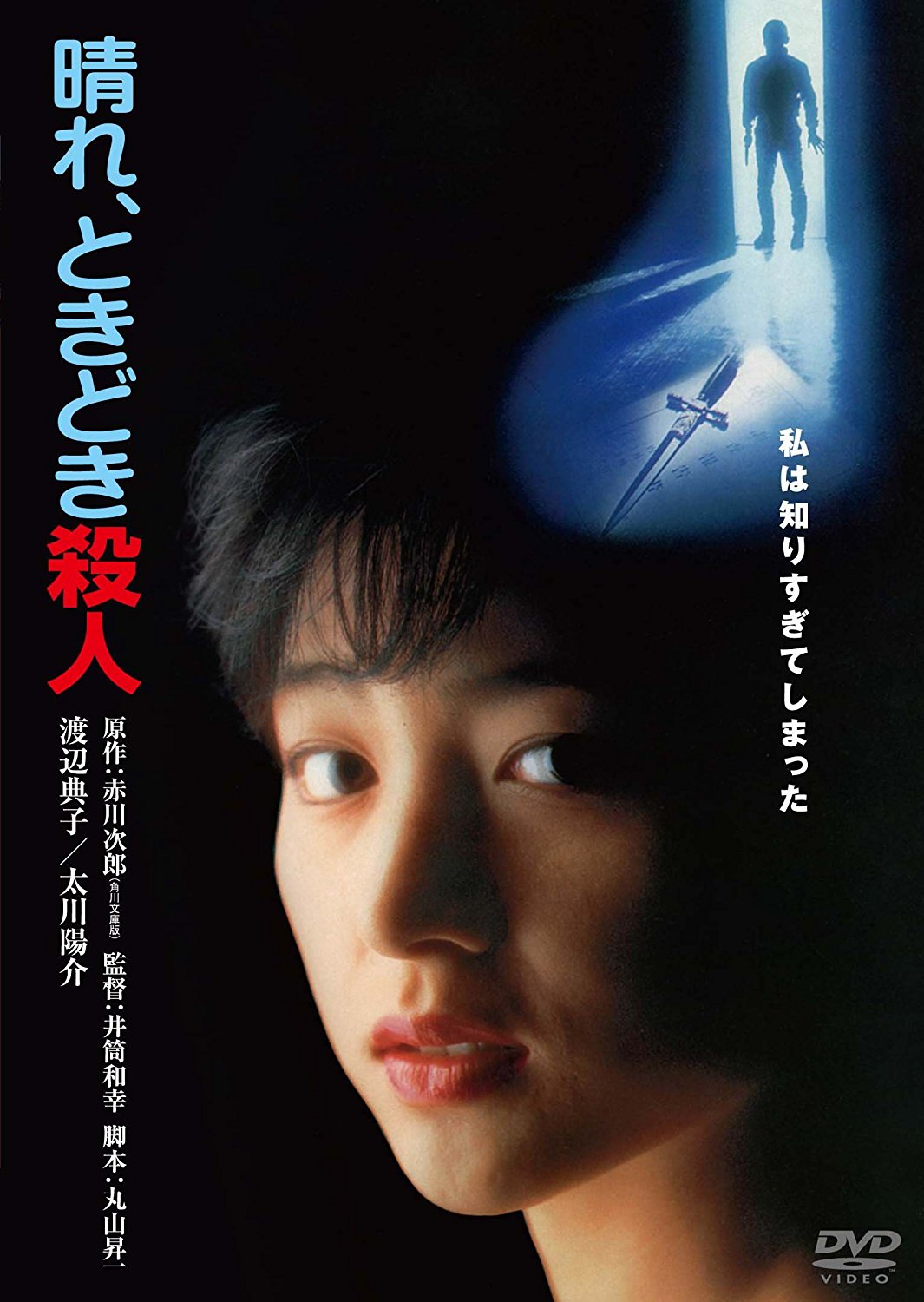
fine with occasional murders posterIn Japan’s ailing late ‘70s cinema market, studios were taking extreme decisions to get the public away from their TV sets and back into movie houses, yet one enterprising would-be media mogul had another idea. Haruki Kadokawa, a man with a publishing house and cinematic ambitions hit on a then innovative marketing strategy which amounted to a perfect storm for his own particular capabilities. Amassing a small stable of idols, he resurrected the studio system to produce a steady stream of youth movies adapting novels he also published and featuring title songs which his idols sang and he released on his record label. Hitting their heyday in the early to mid-1980s, Kadokawa’s idol films are a perfect time capsule of their pre-bubble setting in which, unlike the “seishun eiga” of twenty years before, upperclass young girls solved crimes and defied authority all whilst remaining prim, elegant and innocent. Fine, with Occasional Murders (晴れ、ときどき殺人, Hare, Tokidoki Satsujin) is a prime example of this gentle yet somehow dangerous world as its heroine returns home from studying abroad only to become embroiled in a conspiracy lodged firmly within her own home.

As the film opens, a middle-aged man and woman pay a nighttime visit to the site of a new factory, reminiscing about their youth and the small soap business they started thirty years ago which is now a full scale plastics film. The woman catches sight of someone leaving and stops to wish him goodnight only to suddenly wonder why he’s there in the first place. The reason becomes apparent when she steps forward a little and discovers the body of a young woman lying against her fence post. As if that weren’t worrying enough, factory owner Mrs. Kitazato (Mitsuyo Asaka) then starts getting threatening letters telling her she must go to the police and confirm that an innocent man is the killer or her daughter, Kanako (Noriko Watanabe), studying overseas, will be in danger. Mrs. Kitazato frets and worries but goes along with the killer’s demands to save her daughter only to be confronted with the dead body of the patsy as it lands right at her feet after being thrown from a police station window.

Suffering from a heart condition, Mrs. Kitazato remains unwell until Kanako comes home but then lasts only long enough to impart two important secrets – one being that the man Kanako assumed was her father may not have been, and secondly the whole story with the threatening letters and her belief that they were sent by someone in the family from whom she received a New Year card written in the same handwriting.

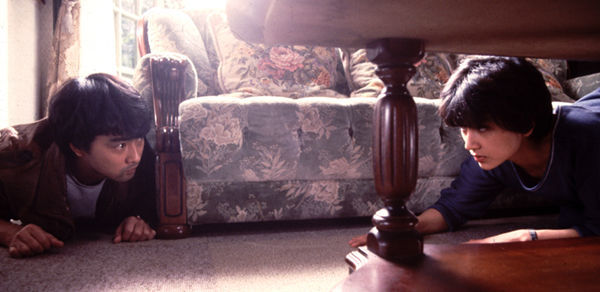
As usual Kanako is left to deal with all of this on her own, though slightly less usually remains within her own family home for the vast majority of the picture. Paid a visit by the police, Kanako comes into contact with their prime suspect in the first murder, Kamimura (Yosuke Tagawa) – a young man who had been a high school friend of the victim and had given her a place to stay while she was trying to escape her career as a hotel hooker. Kamimura becomes Kanako’s innocent love interest as she hides him in the secret room her mother had built behind a dresser in the dining room. Together the pair try to investigate the strange goings on in the Kitazato household whilst also exploring their very different backgrounds. 

Like many of Kadokawa’s idol movies (often adapted from the novels of Jiro Akagawa) the setting is both dark and hopefully innocent as Kanako is burdened with the knowledge that someone close to her is a murderer but faces her situation with cheerful resilience and determination. Whilst pursuing her spiky relationship with Kamimura, she’s also being haunted by the spectre of an arranged marriage to the dreadful son of a business associate, Masahiko (Akihiro Shimizu), who attempts to rape her with her mother’s body still still lying on the bed in the same room, and is also having an affair with their maid, Mari (Mariko Miike). Masahiko is also revealed as a prime suspect in the murders when another body is discovered in the living room with Masahiko standing red handed over it. The murder scenes (and there are more than you’d expect), are nasty, bloody and violent. Despite the innocence of Kanako’s wide open world, misogynistic killers lurk round every corner as do corrupt businessmen, untrustworthy servants, and enemies masquerading as friends.

As darks as it gets, the tone is always one of irony filled with bumbling policemen who form an odd double act in their humorous black and forth, running jokes about hard contact lenses and improbably large sandwiches, and the general whimsy of a young man’s dream of building a real flying bicycle. Despite being one of Kadokawa’s new “Sannin Musume” (alongside Hiroko Yakusushimaru and Tomoyo Harada), Noriko Watanabe played fewer leading roles than her two compatriots. Fine with Occasional Murders (released in the same year as Someday, Someone Will Be Killed), is her first big idol movie lead for which she also sings the theme song which has an almost identical title. She is, however, the archetypal Kadokawa heroine – steadfast, strong, confident, kind, and noble, calmly solving the mystery behind her own mother’s death mere days after losing her, figuring out that poor boys are probably OK, and that awful CEOs and their sons will always be awful. Valuable lessons indeed for increasingly wealthy 1980s teens. 


TV Commercial

And the song itself which has the same title as the movie only the last two characters are read differently – Hare, Tokidoki Kirumi