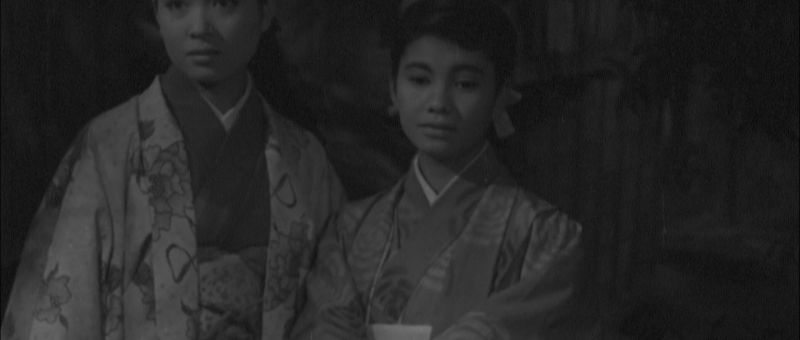
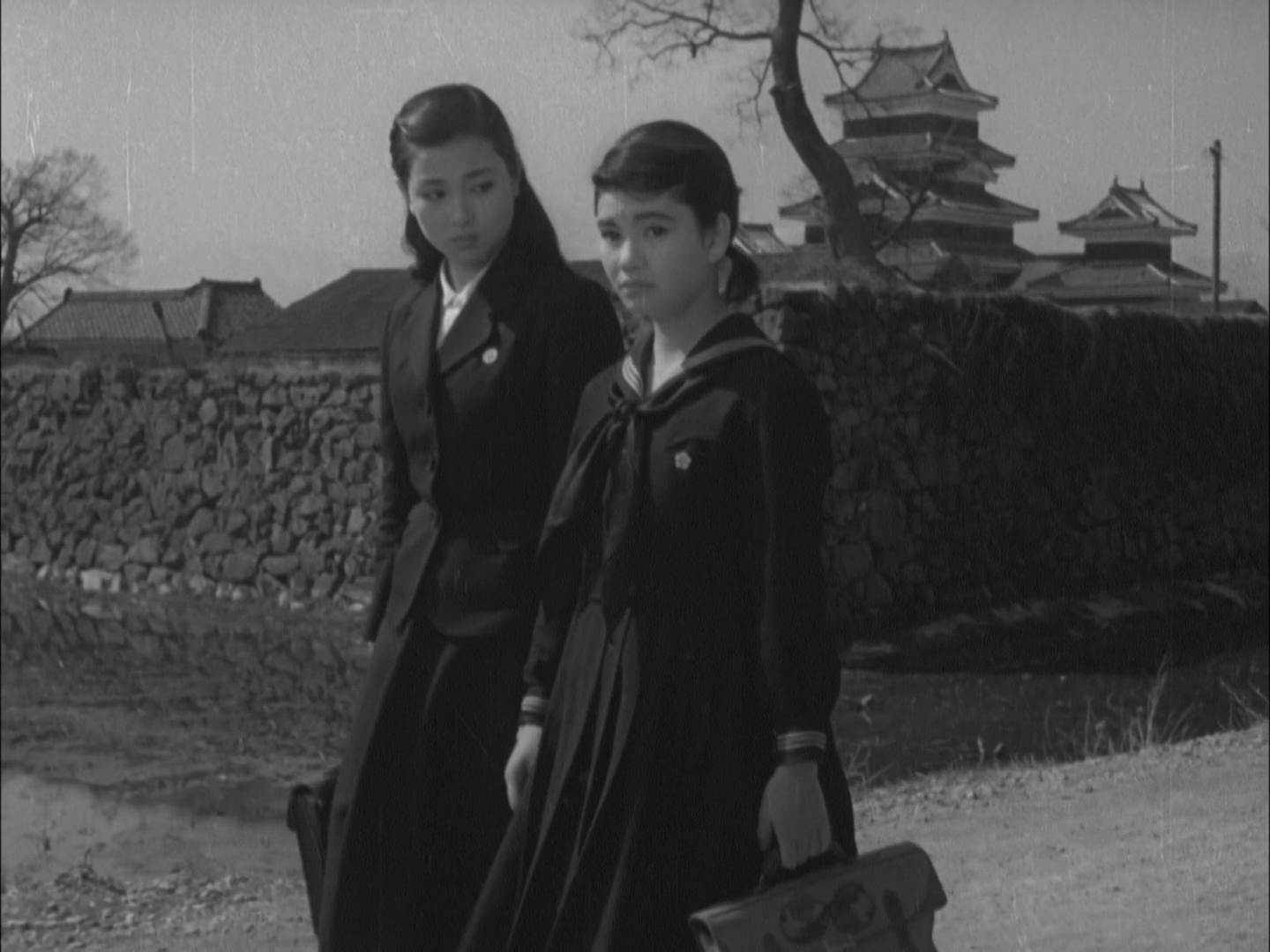
Two sisters find their paths diverging amid the changing society of post-war Japan in Miyoji Ieki’s adaptation of the autobiographical novel by Fumi Kuroyanagi, Sisters (姉妹, Kyodai). Updated to the present day and co-scripted by Kaneto Shindo, the film paints the sisters as representing a generational divide with the older, much more conservative of the girls is drawn to a traditional lifestyle while equally corrupted by the city in her conversion to Christianity, while the younger is a truth-telling free spirit deciding that she doesn’t want that kind of life and will find a husband for herself if indeed she ever decides to marry.
The Kondo family is evidently quite progressive in that they are not wealthy but have chosen to send both of their older daughters to study at middle and high school in the town where they lodge with their mother’s sister (Yuko Mochizuki). They also have three younger brothers who have stayed with their parents in the village, while their father (Akitake Kono) works at a hydroelectric dam. The fact that he works at a power plant aligns him with the post-war recovery which is largely built on the back of these new engineering endeavours, but there is little discussion of the ways in which they’ve changed and disrupted rural life.
As New Year approaches, everyone is looking forward to them meeting their end of the year challenge so they’ll get a 1000 yen bonus only for a sudden outage to occur on the deadline day. The older sister, Keiko (Hitomi Nozoe), becomes fond of a worker named Oka (Taketoshi Naito) who is part of the labour movement and often sings Russian songs but is an economic migrant from another town living frugally while sending most of his pay back to his mother and siblings. He is already supporting a family, and therefore has no prospect of marriage for the foreseeable future. Even if he and Keiko have taken a liking to each other, they each accept the practical reality and agree that it is better that Keiko accept an arranged match her parents have set up for her with a young man who works in a bank. The groom’s occupation echoes the increasing urbanisation of the nation, as the parents clearly believe the marriage will buy Keiko a much more comfortable life in a higher social class even if Keiko seems to want to stay in the village.
While they lived in the town, Keiko converted to Christianity out of loneliness because she could talk to God any time she wanted. Toshiko (Hitomi Nakahara), the younger sister, points out it might have been a better idea to make friends who were a bit more local, but despite appearances Keiko seems better suited to a more old-fashioned way of life. Christianity reinforces her conservatism in that she hopes to always be pure and correct and takes against those she does not think to be. On their visit home, the girls witness a young woman they know be beaten by her husband who is much older than her. Keiko takes against the woman and rudely leaves her home. Later the woman is beaten again because her husband discovers a young man in their home. No additional explanations are sought, the woman is assumed to have been involved with another man more her own age, but surprisingly some of the villagers speak in her defence telling her husband he’s being unreasonable and raising the double standard that men do this sort of thing all the time. The woman tells Keiko to be careful whom she chooses for a husband. She came to this village never having met the man she would marry, and now she’s stuck here with a child. Her only ray of light is that she will raise her son to be a better man than his father.
Keiko’s future happiness depends entirely on the nature of a man she doesn’t know. In the town, the girls had been somewhat disillusioned when their long-absent uncle Ginzaburo (Jun Tatara) returns home from working away and they catch him drunk in the street cavorting with geisha. This is really a double betrayal, not only stepping out their aunt, but selfishly spending what little money they have on trivial pleasures for himself. But like an inverted picture of village life, their aunt seems not to mind and accept it as just something men do. The same uncle is also picked up for illegal gambling, which is more of problem in a practical sense aside from additional evidence of this moral failings.
All of these experiences have certainly soured Toshiko’s view of marriage, and most particularly of arranged ones which are something that belongs to the older Japan that Keiko still inhabits. A worker at the plant asks Keiko if she’ll be going to university, but she replies that girls in her family don’t and that she’d rather be married. Toshiko, meanwhile, on witnessing the suffering of those around her and most particularly the poor decides she’d rather be a doctor or politician to try and change society. She supports the strikers at the plant who are protesting against job cuts, but also says they should have resisted more when the protests fail as if they were somehow at fault in their lack of commitment. Her father’s reaction to failing to stop the lay-offs is to stop Toshiko going on her school trip because the other workers’ children can’t even go to school now their fathers have been let go, which doesn’t really make sense and is not really fair, though he is also worried about his job amid this very changeable society.
For Toshiko’s part, she remains staunchly of the village but is ironically more suited to life in the town, which is to say the future. People are always telling her that she speaks her mind too often and that people in the town aren’t as forgiving as those in the village, but she continues to speak as she finds and indifferent to censure. Keiko criticises her for behaving like a boy, wearing rustic work clothes and chopping wood while they’re home for New Year and not helping out with the domestic work like cooking and cleaning which she thinks of as a daughter’s duty. Toshiko develops a friendship with a wealthy girl from school who apparently likes her more than a friend and asks her to be her first kiss, lending a queer-coded dimension to Toshiko’s rejection of traditional gender roles and desire for a more independent life in the town.
She recognises both that greater class disparities exist in the urban environment than they did in the village, but also feels sorry for her friend who shares the same name but is trapped by her privilege. When Toshiko visits their home, it’s clear the girl’s mother looks down on her because she’s not of their social class, while Toshiko’s friend has an older sister and younger brother with apparent disabilities that the family keeps hidden away in shame. Meanwhile, the sisters become aquatinted with an elderly couple who are both disabled themselves while their daughter is ill with TB. Without thinking, Toshiko uses a slur word to describe a disabled person when talking about her friend’s family without thinking about the fact that the father is also blind. They don’t mind at all, but if even Toshiko is thoughtless enough to use a word like that it only reinforces the prejudice of the world around her.
The implication is that if the old couple lived in the village, there would be people around to help them, but in the town everyone is anonymous and indifferent. The state should be filling in for the community, but it isn’t and there’s no one to help the vulnerable in the increasingly capitalistic post-war society. The irony is that Uncle Ginzaburo says everything was better in the war and that Japan can’t survive without conflict, while the fact the economy is improving in the mid-1950s is entirely due to the stimulus of the Korean War. Even so, Toshiko remains generous of spirit. She doesn’t agree with her sister’s decision and is worried for her, but also agrees that they can only be true to themselves and follow their own paths. This is what Keiko has chosen, no matter how it might turn out, while Toshiko has rejected it, insisting she’ll find her own husband if she wants one and vowing to be useful and fight injustice in the wider world whatever form that may take. She wishes her sister good luck as she watches her disappear over the horizon, and sets off on her own path into a future that’s equally of her own choosing.
 Windows on Worlds