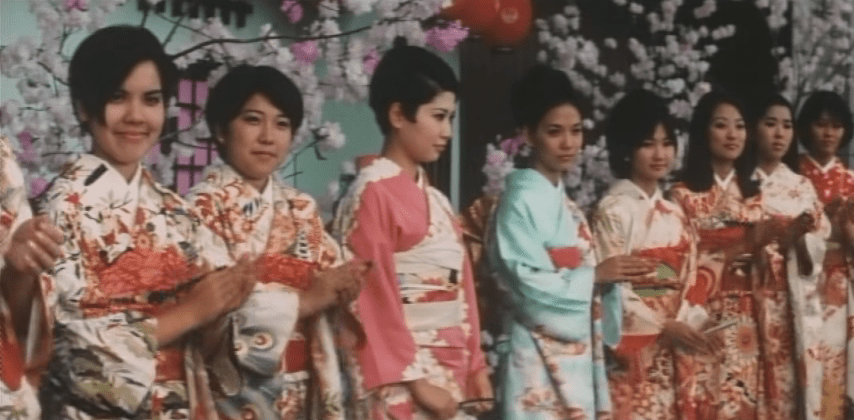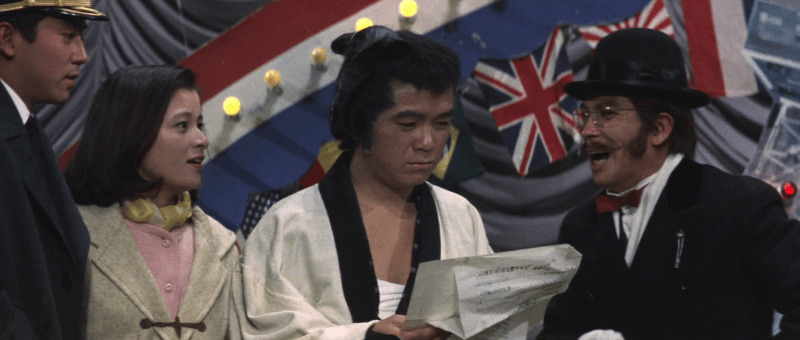
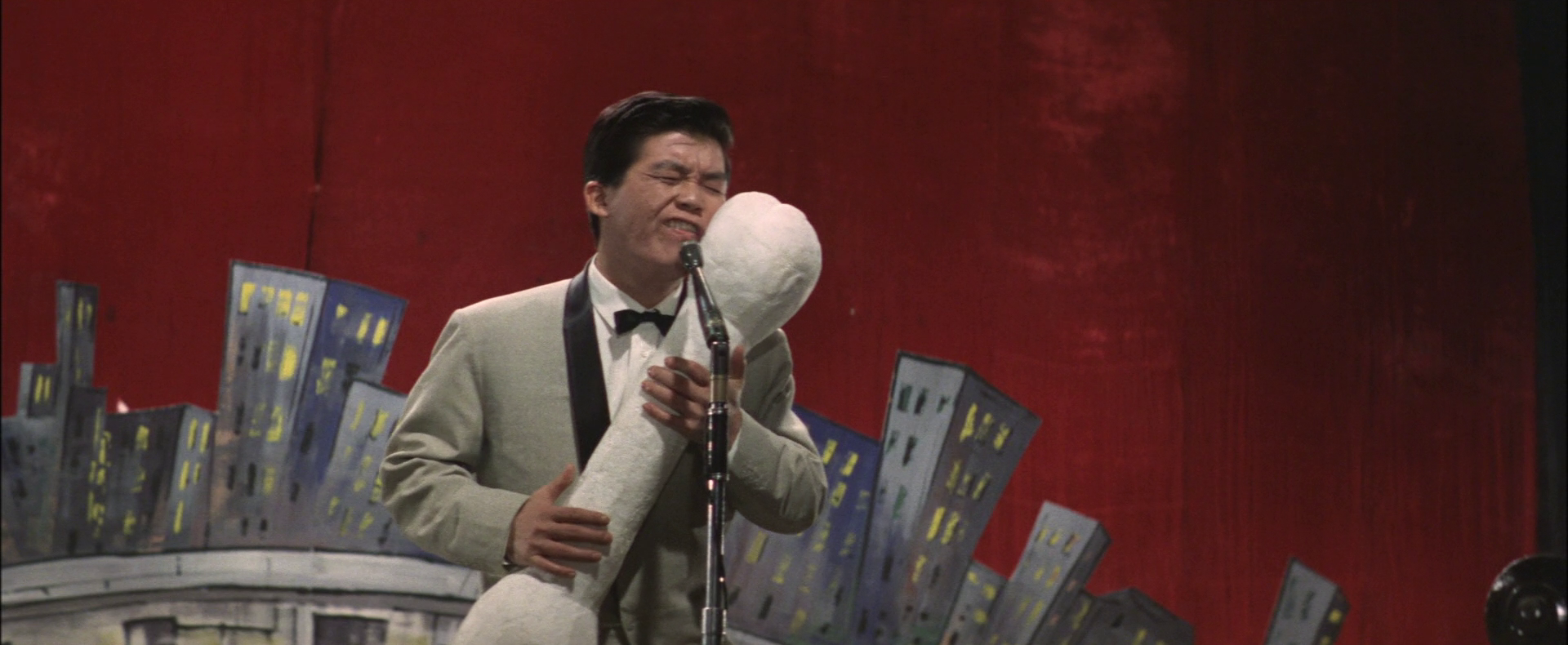
Let’s Have A Dream (九ちゃんのでっかい夢, Yoji Yamada, 1967)

Convinced he’s dying of a terminal illness, a young nightclub singer yearns for death in Yoji Yamada’s romantic farce, Let’s Have a Dream (九ちゃんのでっかい夢, Kyu-chan no Dekkai Yume). In fact, the Japanese title is “Kyu’s Big Dream,” directly putting the name of the star into the name of the picture though he does in fact play a character called “Kyutaro” whose music career is starting to take off just as he convinces himself that his life is hopeless. Best known for “Ue o Muite Aruko”, Kyu Sakamoto was a huge singing star throughout the 1960s until his death in a plane crash at the very young age of 43.

Based on a novel by Nobuhiko Kobayashi who was working with Sakamoto on a television show at the time (and asked for a pseudonym because he wasn’t sure how the movie would turn out), the film is however partly an exploration of the nation’s growing internationalism. Indeed, the film opens with the Pan Am logo and then immediately travels to Switzerland where an elderly lady is dying having apparently never married or had children but still attached to the memory of her first love, a man from Japan. Accordingly, she decides to leave her entire fortune to that man’s grandson, Kyutaro (Kyu Sakamoto), which comes as a total shock to her closest living relative, “The wicked Mr Edward Allan Poe.” Her butler then vows to travel to Japan to tell Kyutaro the good news, but ends up sitting next to the hit man Edward Allan Poe hires on the plane.

But Kyu has already hired a hitman to take himself out because he thinks he’s suffering from a terminal disease and feels nothing other than fear and hopelessness. Though all he wants to do is die, he is unable to take his own life and so has decided this is the best way. He’s also in love with a childhood friend who works in a diner at the docks, but unbeknownst to him Ai (Chieko Baisho) has just got engaged to their other friend Kiyohiko (Muga Takewaki), a sailor. To add to the sense of European romanticism, Kyu writes long notes to himself about his sadness and melancholy all while the countess’ right-hand man continues to refer to him as the luckiest man in the world. 

In a running gag, the hitman speaks mainly in French and the Countess’ butler in cod German hinting at a new kind of internationalism. The hitman Kyu hires through shady local guy Pon (Kanichi Tani) is, however, much less sophisticated. He can’t afford a gun and fails to kill Kyu several times in other ways usually injuring himself in the attempt which again makes Japan look somewhat inferior to the rest of the world just as the opulent vistas of the Countess’ castle contrast so strongely with the down and dirty nature of the docks where Kyu lives and works. 

Despite being so desperate to die, Kyu pulls away when the hitman he hired tries to kill him which along with his inability to take his own life may suggest that he really does want to live after all. Though she evidently does not return his romantic feelings, Ai clearly cares for him deeply describing Kyu as like oxygen for her while trying to get to the bottom of what’s with wrong with him but it takes Kyu a little longer to figure out that people care about him even if not quite in the way he was hoping they would. Even so, there’s no denying the farcical quality of all that’s befallen him as he finds himself “the luckiest man in the world,” caught between two hitmen, and staving off eventual romantic heartbreak.

Still, even this plays into the melancholy sense of romanticism and elliptical ending as Kyu eventually gets to fulfil one of his big dreams by going to Europe and getting to live the life of a heartbroken count from a 19th century romantic novel. As a vehicle for Sakamoto, the film also features several of his songs along with dance routines and some otherwise goofy clowning while Chieko Baisho also performs a short but sweet rendition of My Bonnie Lies Over the Ocean. It’s all undoubtedly very silly but somehow heartfelt and wholesome for all its buried melancholy and deeply felt romanticism. 


Original trailer (no subtitles)

Rainbow Over the Pacific (夜明けの二人, Yoshitaro Nomura, 1968)

Yoshitaro Nomura is most closely associated with a series of gritty crime thrillers that dug deep into the dark heart of post-war Japan. It may seem surprising therefore to see him helming this generally cheerful if occasionally melancholy musical romance created as a star vehicle for singer Yukio Hashi in commemoration of 100 years of Japanese migration to Hawaii. Curiously pitched, Rainbow Over the Pacific (夜明けの二人, Yoake no Futari) arrives somewhere between extended tourist reel and accidentally colonialist soft propaganda that nevertheless never shies away from the complicated relationship between the two nations. 

As the film opens, hero Hideo (Yukio Hashi) is a something of a slacker working in a photo studio with a crush on an aspiring model. When she shows up late to what he thought was a date and then tells him she’s getting married before dumping her fiancé’s ex on him, he finds himself taking pity on the jilted girlfriend while they drown their mutual sorrows in the beerhalls of post-war Tokyo. Audrey Reiko Misaki (Jun Mayuzumi) is a third generation Japanese-Hawaiian who loves all things Japan and is becoming quite fond of Hideo though he abruptly tells her that it’s been fun but they live in different countries so it’s best they call it quits. Reiko goes back to Hawaii and tries to forget about her double romantic heartbreak in Japan while Hideo continues to be an unserious man berated by his grumpy granddad and exasperated mother not least because of his reluctance to get married. A year later his mentor takes him with him on a trip to the US stopping over in Hawaii where finds himself hoping for a fateful reunion with Reiko. 

Before that, however, he and his boss are met by a Japanese-American man who takes them on a tour of the island and explains that all the swanky hotels are owned by Japanese companies. “Anything you can find in Japan you can find in Hawaii” he insists, at once exoticising the environment and trying to sell it as a place that the growing Japanese middle classes might feel comfortable going on holiday because it is almost like being in Japan only of free of the intense atmosphere of the era of high prosperity where everyone works all the time. But then something a little strange happens, Sakata (Hiroyuki Nagato) points at the elephant in the room and begins talking about Pearl Harbour before visiting a cemetery where many men of Japanese descent who lost their lives fighting for the US in Europe are buried. Even so, he quickly points out that the Japanese community continue to dominate the political realities of the island with several Japanese-Americans elected to the Senate one of whom he actually interviews on camera. 

As for Hideo, he is at times a fairly crass tourist who accidentally mocks the traditional singing of a middle-aged Hawaiian. Much of the narrative appears to have been designed to take in most of the important tourist sites on the islands which are each marked with onscreen katakana as are several important landmarks in Japan in the later part of the film which almost does the same thing in showing off historical Kyoto and the Nara deer. After re-encountering Reiko, Hideo finds himself sucked into various kinds of romantic drama, accidentally coming between a local girl and her boyfriend whose relationship is strained by his wealthy father’s disapproval (much like Hideo he is thought to be an unserious man) and then getting into a dangerous situation with a rival suitor whose cool exterior masks a volatile intensity. 

Ironically enough, through his Hawaiian adventures Hideo becomes a “serious” man resolving to buckle down and work hard though seemingly abandoning his dreams of romance out of a kind of misplaced bro code that in a roundabout way undermines the message of solidarity between Hawaii and Japan in implying that Reiko must choose between the two but then refusing to respect her choice. Further parallels are drawn in the reunion of Hideo’s great uncle who has since become a respected teacher at a Japanese school and his grumpy grandfather who is exposed as a dissolute layabout who returned to Japan in disgrace after giving up in the face of the harshness of life for Japanese migrants, Nomura utilising stock footage to demonstrate the many difficulties they faced in trying to make new lives for themselves in Hawaii. Of course, this being a star vehicle for Hashi, he gets several opportunities to sing including a rendition of the title of song while the film at times turns into a musical though the melancholy, foggy conclusion perhaps plays against the expectations of the genre. In any case, the film appears to be a fascinating document of an increasingly globalising Japan which nevertheless looked for itself even while seeking escape.


Four Sisters (姉妹坂, Nobuhiko Obayashi, 1985)

Four SistersNobuhiko Obayashi takes another trip into the idol movie world only this time for Toho with an adaptation of a popular shojo manga. That is to say, he employs a number of idols within the film led by Toho’s own Yasuko Sawaguchi, though the film does not fit the usual idol movie mould in that neither Sawaguchi or the other girls is linked with the title song. Following something of a sisterly trope which is not uncommon in Japanese film or literature, Four Sisters (姉妹坂, Shimaizaka) centres around four orphaned children who discover their pasts, and indeed futures, are not necessarily those they would have assumed them to be.

Yasuko Sawaguchi plays the third oldest sister and more or less protagonist of the story, Anzu, who is facing a very common teenage dilemma in that there are two boys (best friends) both interested in her and she can’t decide if she likes both, one, or either of them. Eventually, Yuzuki (Ichirota Miyakawa) wins out leaving his friend Oba (Toshinori Omi) depressed and on the sidelines. However, Yuzuki is from a wealthy family and it was intended he marry a cousin so his mother does some digging and discovers more about Anzu than Anzu knew about herself.

As it turns out, the four sisters are not actually related by blood as only one was the biological child of the goodhearted couple who raised them. Unfortunately, the children’s adoptive parents died in a car accident leaving their birth daughter, Aya (Misako Konno), as a kind of maternal figure to Akane (Atsuko Asano), Anzu, and Ai (Yasuko Tomita) though Akane was the only one old enough to remember their lives before coming to live with Aya and her family. The rediscovery of the truth knocks both younger girls for six, especially as Anzu’s birth mother has reappeared and presents an existential threat to their insular family of four.

Set once again set in a peaceful, countryside town, Four Sisters revisits many of Obayashi’s constant concerns in its evocation of memory, mislaid truth, and the need to come to terms with the past in order to go on living in the present. The four young women are each very different, but bound tightly together by their shared experience, including the recent loss of their parents. Anzu’s discovery threatens to destroy the family firstly through the exposure of a lie (or, what is really an omission of truth), and secondly to speed up the inevitable fracturing as she begins to seek a new life and eventually family of her own. Though Akane has been able to forge a career for herself (less pleasant part-time work aside), she rightly points out that in becoming their maternal figure, Aya has in a sense lost or rejected the opportunity to pursue her own happiness. The sisters’ bond is tight and near unbreakable, but it’s also, in a sense, constraining.

Obayashi begins the picture with in a polaroid-like frame in which the two boys declare their intentions to duel for Anzu’s affections. As the film moves on, Obayshi returns to these intertitle-like captions particularly in bookending the various seasons throughout which the film turns. Though not as radically as in some of his other work, Obayashi once again uses colour filtering as a highlighting tool which is most obvious towards the end as the edges of the screen start to blur, greying out everything other than our central heroines. However, other sequences take place in a noticeably expressionist environment with extreme colour contrasted backgrounds and unreal, star filled skies and Obayashi also allows the real world weather with its storms and raging rivers to dictate the mood.

Four Sisters is, at heart, a family drama though one seen through a slightly distorted mirror. The four girls are indeed a unit which would inevitably have to split or stagnate in the normal order of things but the bonds are strong enough to withstand the unusual amount of pressure placed on them, enabling the sisters to move on with their individual lives whilst remaining close. Obayashi keeps things relatively low key (by his own standards) but gently builds a melancholy, nostalgic tone filled with loss and regret yet also with hope for the future. Beautifully shot, with Obayashi’s characteristically unusual use of imagery and wistful, ethereal atmosphere Four Sisters may not be among the director’s most experimental efforts but does provide a warm tale of love lost and gained in the lives of four ordinary women.