Samurai Vengeance (木挽町のあだ討ち, Takashi Minamoto, 2026)

The life of a samurai is to some extent dependent on ritual. It’s as much a performance as anything else, yet, unlike a play, these actions often have very real and destructive consequences that result in bloodshed or exile. Though absurd and arbitrary, it’s adhering to this code of ethics that makes one a samurai, and once set in motion the consequences of a particular action proceed with inevitability. One cannot, in the end, escape one’s duty or destiny even by resigning samurai status.

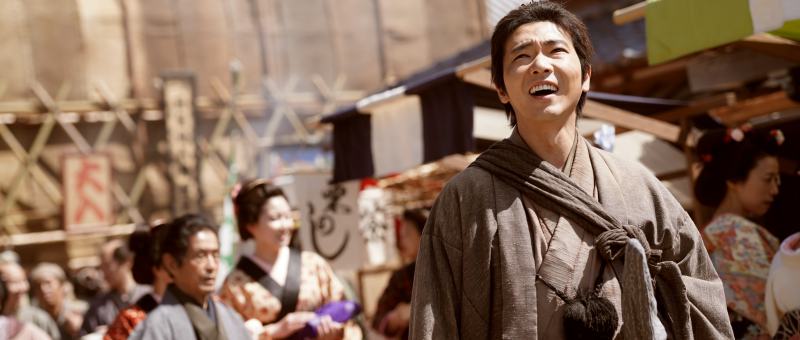
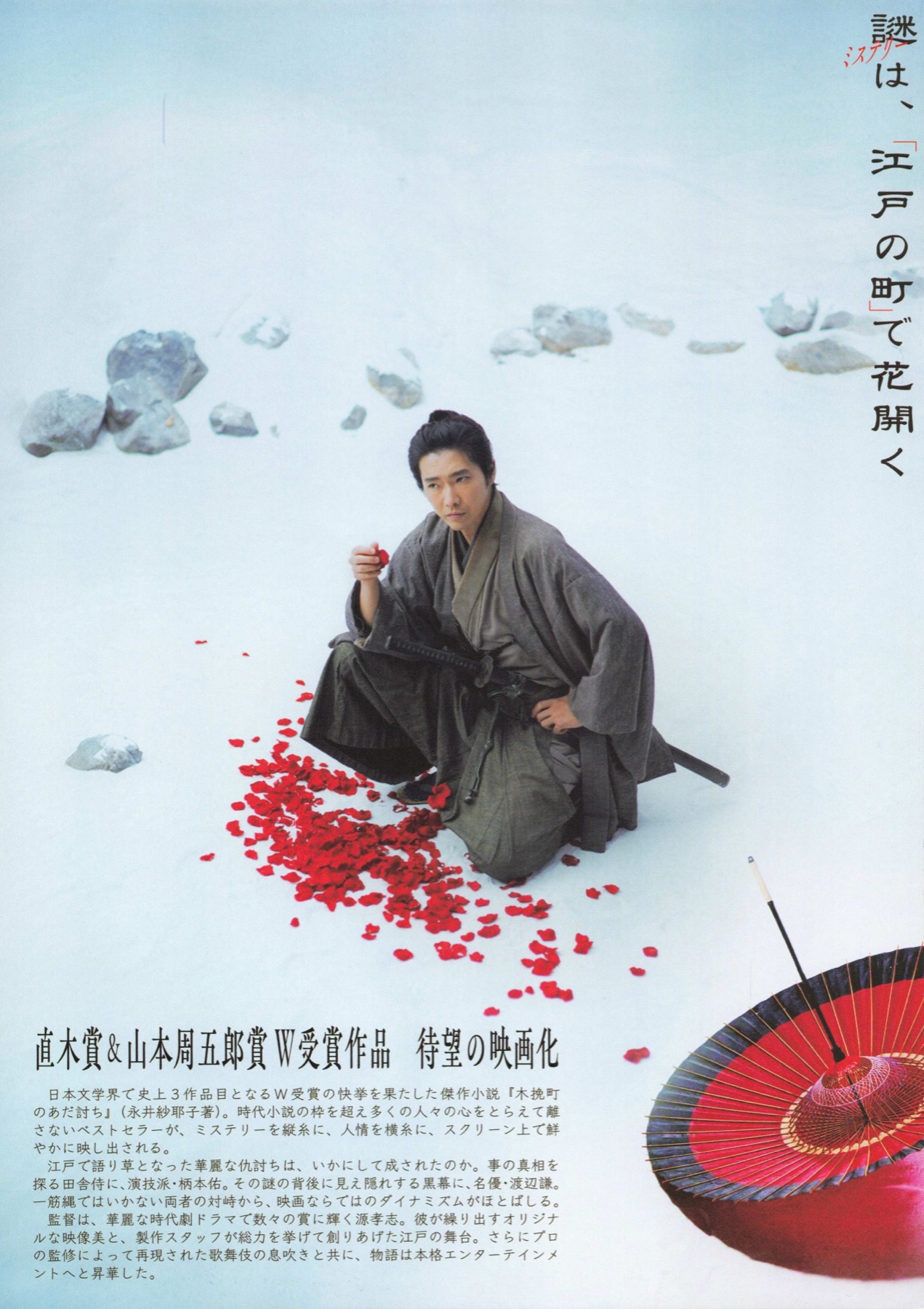
This is really the idea at the centre of Takashi Minamoto’s Samurai Vengeance (木挽町のあだ討ち, Kobikicho no Adauchi) in which a playwright conspires to take the blood out of revenge and finds largely that the conditions are met for the samurai world to continue on without incident. The fact that the act of vengeance is essentially theatre is clear from the opening sequence in which fallen samurai theatre director Kinji (Ken Watanabe) orders the spotlight-like lanterns to be turned on the scene of a young man who has raised his sword against an older one he holds responsible for the death of his father. The action takes place adjacent to a theatre where a performance of the 47 Ronin, one of the most famous tales of vengeance in Japanese history, has just concluded, and this is, in a way, a continuation of that. Attracted by the commotion, a crowd has started to gather around the two men that becomes both audience and witness to this act of performative justice.

But then the film wrong-foots us slightly, and we realise the central mystery is not to do with the staged performance itself, but the true identity of the man who has come around asking questions about it. Kase (Tasuku Emoto) too is playing a role, in this appearing as a bumbling, Kindaichi-like presence claiming to be a friend of the dead man, Sakubei (Kazuki Kitamura), who to some extent did not really exist having been giving an entirely new persona to suit the narrative of the staged revenge plot. Though Kase claims to have been kicked out of his clan and become a ronin himself, which explains why he has no money and is always hungry, he is later revealed to be a clan investigator who has fallen foul of the authorities after attempting to expose the corruption of a senior retainer.

Though the rules of samurai society may be strict, they can be gamed by those ruthless enough to subvert them for their own ends. This seems to be something that Lady Tae, the mother of the revenge-seeking Kikunosuke (Kento Nagao), knew all too well and understanding the performative nature of samurai justice, turned to her old friend Kinji to save her son from falling victim to the cruelty of their class. At only 17, Kikunosuke is a slender and effete young man of delicate features and sensibility. He does not appear to be suited to the harshness of samurai mores and being forced to take the head of a man who not only saved his life but is someone he’s been close to since the day he was born would likely destroy him.

His fragility is signalled in the fact he first appears dressed as a woman in a beautiful red kimono passed down from a retired onnagata to the current holder of his name. As they say, the world of the theatre is like another country and a place where those who do not otherwise fit into Edo society can be accepted. Kikuosuke’s vulnerability and the unfairness of his plight endear him to the members of the theatre company who all feel an instinctive need to protect him. Indeed, Kikuosuke himself says that he is sorry to have to leave the theatre behind and will never forget the six months that he has spent there. It may be that he is much more suited to living in this environment which is the antithesis of samurai rigidity. In the end, the symbolic need for “vengeance” is satisfied without actual bloodshed. Though those in power know this to be so, they accept it and decline to ask further questions, but still the samurai world continues as it is and others will not be so lucky as to avoid paying with their lives for offending its exceedingly arbitrary values.


Samurai Vengeance screens as part of this year’s Toronto Japanese Film Festival.

Trailer (no subtitles)
Actress (映画女優, Kon Ichikawa, 1987)

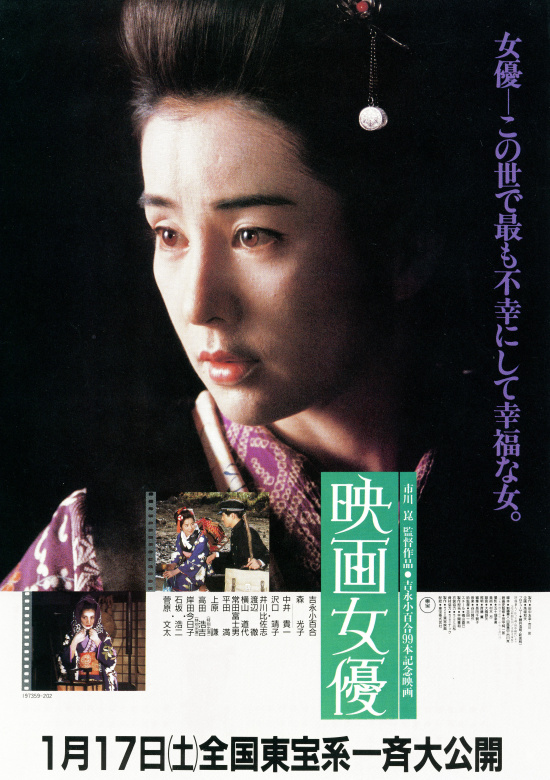
actressKon Ichikawa was born in 1915, just four years later than the subject of his 1989 film Actress (映画女優, Eiga Joyu) which uses the pre-directorial career of one of Japanese cinema’s most respected actresses, Kinuyo Tanaka, to explore the development of Japanese cinema itself. Tanaka was born in poverty in 1909 and worked as a jobbing film actress before being “discovered” by Hiroshi Shimizu and becoming one of Shochiku’s most bankable stars. The script is co-written by Kaneto Shindo who was fairly close to the action as an assistant under Kenji Mizoguchi at Shochiku in the ‘40s before being drafted into the war. A commemorative exercise marking the tenth anniversary of Tanaka’s death from a brain tumour in 1977, Ichikawa’s film never quite escapes from the biopic straightjacket and only gives a superficial picture of its star but seems content to revel in the nostalgia of a, by then, forgotten golden age.

The film begins with the young Tanaka awaiting a visit from her mentor, Hiroshi Shimizu (Toru Watanabe), whom her family are keen to thank for bringing them all to Tokyo away from their life of hardship. Although everyone is very happy for Tanaka’s success, there is shadow hanging over the party in the form of missing oldest brother Ryosuke who went on the run to avoid the draft and has not been heard of since.

Shimizu gives Tanaka (Sayuri Yoshinaga) her first roles at Shochiku where she becomes a contract player but is put out when another director, Heinosuke Gosho (Kiichi Nakai), wants to give her a leading role. Overruled by studio bosses, Shimizu becomes increasingly jealous of Tanaka’s career – a situation which is further complicated by the couple’s growing romantic entanglement which sees them living together in an unofficial marriage allowing Tanaka to continue acting. However, Shimizu continues to meddle in Tanaka’s professional life whilst also continuing his hard drinking, womanising playboy lifestyle. The couple eventually divorce but reunite from time to time on the film set.

Vowing never to marry again, the rest of Tanaka’s life is dedicated to acting and sees her working with some of the best directors of the age including Ozu (Shigemitsu Ogi) and later Mizoguchi (Bunta Sugawara). It is Tanaka’s professional and personal relationship with Mizoguchi which occupies the second half of the film. Judging by the first experience on the now lost Woman of Osaka in 1940, you wouldn’t think the two would ever wish to work together again though they eventually completed fifteen films together over the next fifteen years.

Mizoguchi’s process is completely different from any other Tanaka had worked with. Rather than meeting to rehearse and discuss the work, Mizoguchi abruptly sends her a lifetime’s supply of books about bunraku and changes the script that she has painstakingly committed to memory with on set rewrites communicated via a large blackboard he expects the actors to read from. Exasperated, Tanaka finally asks him for actual direction but he coldly states that she’s the actress and her acting is not part of his job description. Mizoguchi and Tanaka are very different people but each driven and ambitious so their frequent locking of horns produces a fiercely creative collaboration in which each was able to find worth even if it was frequently difficult.

The film ends around the time of Life of Oharu which would mark the final time the pair would work together. In terms of the film’s narrative, this unspoken development is foreshadowed by the idea that the two artists are heading in different directions but in the real world the reasons are a little less clear. Tanaka became the second woman to direct a feature film with Love Letters in 1953 which was even featured at Cannes, but for reasons unknown Mizoguchi attempted to block her access to the Director’s Guild of Japan, effectively ending both their friendship and any professional relationship. Ironically enough, Actress seems to imply that Tanaka’s desire to direct may have been inspired by Mizoguchi and his all powerful on set status prompting her to wonder how he does it, and, perhaps how she could do it too.

Ichikawa weaves the history of Japan through its cinema into the narrative to recount the changing tastes of the eras as naturalism came in and out of fashion and Japanese films began to experience international as well as domestic acclaim. Skipping huge portions of time to focus on the two directors – Shimizu and Mizoguchi, Ichikawa avoids mentioning Tanaka’s post-war visit to America which had a profound impact on her later career, not only in what she learned there but also in the extremely hostile reception she received on returning home. The main takeaway from his depiction of Tanaka is a woman ahead of her time, independent and headstrong, willing to work hard to achieve the things she wanted to achieve even if flying in the face of social convention though it makes no particular judgement on her character other than in her success as an actress.

Taking on the conceit of being a film about film, Ichikawa’s sets are theatrical, creating a deliberately artificial, half unreal world. This also extends into the scriptwriting which is extremely talky and more like a stage play than film, offering pointed, long stretches of monologuing which are already far away from the more naturalistic approach of early talking cinema. Characters have improbable, exposition filled conversations in which they each tell each other things they already know for the audience’s benefit – an effect which enhances the overall theatricality, but does draw attention to itself and eventually becomes wearing. Ichikawa’s picture of Tanaka is one of steely determination and of a woman ahead of her time, but even if Actress proves less than enlightening regarding its subject it does help to shed some light on both classic Japanese cinema and that of the late 1980s.


Original trailer (traditional Chinese subs only)

Four Sisters (姉妹坂, Nobuhiko Obayashi, 1985)

Four SistersNobuhiko Obayashi takes another trip into the idol movie world only this time for Toho with an adaptation of a popular shojo manga. That is to say, he employs a number of idols within the film led by Toho’s own Yasuko Sawaguchi, though the film does not fit the usual idol movie mould in that neither Sawaguchi or the other girls is linked with the title song. Following something of a sisterly trope which is not uncommon in Japanese film or literature, Four Sisters (姉妹坂, Shimaizaka) centres around four orphaned children who discover their pasts, and indeed futures, are not necessarily those they would have assumed them to be.

Yasuko Sawaguchi plays the third oldest sister and more or less protagonist of the story, Anzu, who is facing a very common teenage dilemma in that there are two boys (best friends) both interested in her and she can’t decide if she likes both, one, or either of them. Eventually, Yuzuki (Ichirota Miyakawa) wins out leaving his friend Oba (Toshinori Omi) depressed and on the sidelines. However, Yuzuki is from a wealthy family and it was intended he marry a cousin so his mother does some digging and discovers more about Anzu than Anzu knew about herself.

As it turns out, the four sisters are not actually related by blood as only one was the biological child of the goodhearted couple who raised them. Unfortunately, the children’s adoptive parents died in a car accident leaving their birth daughter, Aya (Misako Konno), as a kind of maternal figure to Akane (Atsuko Asano), Anzu, and Ai (Yasuko Tomita) though Akane was the only one old enough to remember their lives before coming to live with Aya and her family. The rediscovery of the truth knocks both younger girls for six, especially as Anzu’s birth mother has reappeared and presents an existential threat to their insular family of four.

Set once again set in a peaceful, countryside town, Four Sisters revisits many of Obayashi’s constant concerns in its evocation of memory, mislaid truth, and the need to come to terms with the past in order to go on living in the present. The four young women are each very different, but bound tightly together by their shared experience, including the recent loss of their parents. Anzu’s discovery threatens to destroy the family firstly through the exposure of a lie (or, what is really an omission of truth), and secondly to speed up the inevitable fracturing as she begins to seek a new life and eventually family of her own. Though Akane has been able to forge a career for herself (less pleasant part-time work aside), she rightly points out that in becoming their maternal figure, Aya has in a sense lost or rejected the opportunity to pursue her own happiness. The sisters’ bond is tight and near unbreakable, but it’s also, in a sense, constraining.

Obayashi begins the picture with in a polaroid-like frame in which the two boys declare their intentions to duel for Anzu’s affections. As the film moves on, Obayshi returns to these intertitle-like captions particularly in bookending the various seasons throughout which the film turns. Though not as radically as in some of his other work, Obayashi once again uses colour filtering as a highlighting tool which is most obvious towards the end as the edges of the screen start to blur, greying out everything other than our central heroines. However, other sequences take place in a noticeably expressionist environment with extreme colour contrasted backgrounds and unreal, star filled skies and Obayashi also allows the real world weather with its storms and raging rivers to dictate the mood.

Four Sisters is, at heart, a family drama though one seen through a slightly distorted mirror. The four girls are indeed a unit which would inevitably have to split or stagnate in the normal order of things but the bonds are strong enough to withstand the unusual amount of pressure placed on them, enabling the sisters to move on with their individual lives whilst remaining close. Obayashi keeps things relatively low key (by his own standards) but gently builds a melancholy, nostalgic tone filled with loss and regret yet also with hope for the future. Beautifully shot, with Obayashi’s characteristically unusual use of imagery and wistful, ethereal atmosphere Four Sisters may not be among the director’s most experimental efforts but does provide a warm tale of love lost and gained in the lives of four ordinary women.