Terrifying Girls’ High School: Women’s Violent Classroom (恐怖女子高校 女暴力教室, Norifumi Suzuki, 1972)

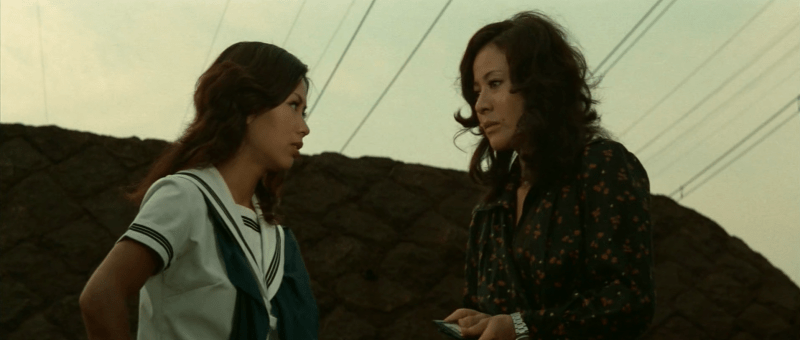
“Society fucking sucks” according to the delinquent teens at the centre of Terrifying Girls’ High School: Women’s Violent Classroom (恐怖女子高校 女暴力教室, Kyofu joshikoko: Onna boryoku kyoshitsu). The first of four in a Toei pinky violence series, the film presents a feminine rebellion against the societal tenets of womanhood, if doing so largely within the realms of male fantasy, but nevertheless kicks back against the corruption and hypocrisy of the older generation otherwise hellbent on controlling them.

Seiko Girls’ High School is, we’re told, both a private institution and a “trash bin” established to handle the “trash” transferred from “normal” schools. Nevertheless, the sign which hangs outside proclaims conservative values playing on the “good wife, wise mother” truism of traditional femininity in insisting the girls must become wise wives and kind mothers. Needless to say, most of the young women are quite uninterested in becoming any such thing. The unruliness of the school is signalled in the opening sequence as an older male teacher gives a boring lesson about curves while the girls all ignore him. Some are putting on makeup, others are eating or talking amongst themselves. After all, what’s the point of their education if the expectation is they’ll all become obedient housewives dependent on their husbands for support and allowed little in the way of free thought or interest?

A teacher later ironically suggests that the school’s reputation will later reflect badly on them when it comes to getting jobs or getting married only for one of the girls to snap back no one here is going to university and their reputations are all ruined anyway. It might be tempting to assume the problem is mostly generational, but the arrival of a young male teacher who has himself been transferred for violent conduct suggests a kind of backlash to the increasing freedoms of the contemporary society. He tells the girls that he won’t be soft on enforcing his three rules for education which are surprisingly gentle, being friendship, companionship, and harmony, but they simply laugh at him. Not only do they pelt the new teacher with pants and condoms but insist that it they who make the rules here and he will have to follow them. 

Then again there don’t seem to be any rules of any sort other than the absurdity of social hierarchy as they girls square off in various factions vying for dominance of the school, The implication is that gang leader Michiko (Miki Sugimoto) turned rebellious after being raped by strangers on her way home and witnessing her father, a politician, actively cover it up while she continues to feel shamed by her family. Another girl, Yoko (Natsuko Miura), otherwise not involved in the school violence, is working as a hostess to support herself as an orphan living with her grandmother but is lusted after by lecherous teacher who eventually forces her into a sexual relationship and then drops her when she becomes pregnant despite giving the implication he would marry her. Takeo tries to force her to have an abortion though she is determined to have the child despite the scandal causing him to hire another delinquent faction to beat her into a miscarriage. When she takes her own life, the school is most concerned about its reputation despite having done nothing when it was discovered the headmistress’ own daughter, the leader of the other gang, was also engaging in sex work. 

Takeo is also the target of a revenge plot at the hands of mysterious transfer student Yuki who avoids taking any categorical side until pulled into the conflict because of her friendship with Yoko and the growing sense of solidarity between the young women oppressed by a corrupt social system that uses shame to control them. “The rapists win in our society,” one sighs in an oddly contemporary moment. To celebrate their liberation, they burn their sailor suits having stripped and bound their teachers before posing before a sign announcing that they have enacted justice on the “three pigs” who financially exploited them through abusing the educational system. Full of ironic details such as the girls introducing themselves through the classic gambler’s pose, Suzuki films with a punkish irony quite clearly fetishising female violence yet also poking fun at lecherous middle-aged men, youthful hard cases, and matronly older women while in the end handing agency back to the girls even if society continues to suck. 


Sex and Fury (不良姐御伝 猪の鹿お蝶, Norifumi Suzuki,1973)

An orphaned daughter takes revenge against the corruptions of the late Meiji society in Norifumi Suzuki’s pinky violence classic Sex and Fury (不良姐御伝 猪の鹿お蝶, Furyo anego den: Inoshika Ocho). As the opening voiceover explains, the Japan of the early 1900s is already stoking imperial ambitions closely linked with the ideas of “modernisation” and “civility” it is seeking though in reality it is very much a gangster society as the three villains the heroine searches for have come to dominate the new Japan. 

This moment of schism is depicted in the opening sequence set in 1886 in which the little girl who will later take the name Ocho witnesses the murder of her policeman father by three unseen assassins who steal from him evidence of a scandal they then use for their own gain. The murder takes place in a shrine, the young Ocho rolling her paper ball onto a discarded charm that reads “misfortune”, while the film then jumps on to 1905 through a series of historical images prominently featuring the emperor Meiji along with a host of patriotic symbols that seem to signal the wrong path that is being taken. 

As for Ocho (Reiko Ike), she has survived by living on her wits as an excellent pickpocket and gambler but is otherwise uncorrupted continuing to dress in kimono and giving off an air of refined elegance that belies her toughness. In the course of her revenge, she is met by her opposite number, Shunosuke (Masataka Naruse), whose father was also killed by the same three duplicitous yakuza and is dragged into geopolitical intrigue by means of plot by the British to turn Japan into the site of the second opium wars using a spy disguised as a dancer played by Swedish starlet Christina Lindberg who is really in Japan for Shunosuke with whom she fell in love abroad only to be cruelly abandoned. 

Somewhat contradictorily, it’s these Western intrusions that are being resisted with Ocho the representative of an older Japan, and the gangsters that of a newer, largely amoral society of burgeoning militarism. Arch villain Kurokawa (Seizaburo Kawazu) lives in a huge Western-style mansion and is preparing to transition into national politics in the post-feudal society insisting that he and his organisation will soon control “everything”. His underling Iwakura (Hiroshi Nawa), who travels by motorcar, will also be handling the construction of Tokyo Harbour. When the girls from Ocho’s adopted family are kidnapped, they are taken to dance hall Panorama which is bedecked both with Christmassy tinsel and signs celebrating the victory in the Russo-Japanese conflict, while in an anachronistic touch scenes of the war are projected inside. Just to ram the point home, the man who throws a knife at Ocho is wearing stereotypical Chinese dress, while Kurokawa is later seen to have at his disposal a secret attack squad of nuns armed with switchblades and has Ocho whipped, by British spy Christina, in front of a large mural of Christ in some kind of underground chapel. 

In taking her revenge, Ocho is also in a sense attempting to right a historical wrong in removing these usurping men and their accomplice from power while fighting their perversion with her sexuality over which only she is master going so far as to kill one with poison rubbed on her own skin. In accidentally having exposed the equally duplicitous practices in a gambling hall, she is attacked while in the bath but instantly leaps into action entirely in the nude in a strangely beautiful sequence of elegant violence and poetic bloodletting that echoes the film’s conclusion in finally moving out into the snow. Eventually captured, she is bound tightly with rope and tortured but manages to cut herself free using only one of her trademark hanafuda cards which also symbolise her skill as a gambler even if her climactic game with Christina is played with Western cards for casino chips over a dining table. 

Suzuki signals the chaotic nature of this early 20th century world in his riotous use of colour and frequent anachronisms along with canted angles and a spinning top shot that seems to echo the world spinning out of control as Iwakura breaks a sacred promise between gamblers and rapes a young woman he had agreed to spare if Ocho was victorious in her bout with Christina. He saves his most expressionistic technique for the film’s closing moments in which Ocho singlehandedly puts a stop to Kurokawa’s corruption, another picture of Emperor Meiji looking down at her as she launches her final attack, and then stops to purify herself in the snow before wandering off into a storm of hanafuda cards with only darkness ahead of her.


Original trailer (English subtitles)

*Norifumi Suzuki’s name is actually “Noribumi” but he has become known as “Norifumi” to English-speaking audiences.

A Taxing Woman (マルサの女, Juzo Itami, 1987)

A Taxing Woman posterIn bubble era Japan where the champagne flows and the neon lights sparkle all night long, even the yakuza are incorporating. Having skewered complicated social mores in The Funeral and then poked fun at his nation’s obsession with food in Tampopo, Juzo Itami turns his attention to the twin concerns of money and collective responsibility in the taxation themed procedural A Taxing Woman (マルサの女, Marusa no Onna). Once again starring the director’s wife Nobuko Miyamoto, A Taxing Woman is an accidental chronicle of its age as Japanese society nears the end of a period of intense social change in which acquisition has divorced mergers, and individualism has replaced the post-war spirit of mutual cooperation.

Ryoko Itakura (Nobuko Miyamoto), a single mother and assistant in the tax office, has a keen eye for scammers. She demonstrates this on a stakeout with a younger female colleague in which she keeps a shrewd eye on the till at her local cafe and comes to the conclusion that they’ve been running a system where they don’t declare all of their cheques. Running her eyes over the accounts of a mom and pop grocery store, she notices some irregularities in the figures and figures out the elderly couple feed themselves from the supplies for the shop but don’t “pay” themselves for their own upkeep. That might seem “perfectly reasonable” to most people, but it’s technically a small form of “embezzlement” and Ryoko doesn’t like figures which don’t add up. Seeing as the couple probably didn’t realise what they were doing was “wrong” she lets them off, this time, as long as they go by the book in the future. A more complicated investigation of a pachinko parlour finds a more concrete form of misappropriation, but Ryoko is fooled by the owner’s sudden collapse into inconsolable grief after being caught out and leaves him in the capable hands of his confused accountant.

Nevertheless, Ryoko may have met her match in sleezy corporate yakuza Hideki Gondo (Tsutomu Yamazaki). Dressing in a series of sharp suits, Gondo walks with a pronounced limp that hints at a more violent past but as his rival from the Nakagawa gang points out, violence is a relic of a bygone era – these days gangsters go to jail for “tax evasion” as means of furthering their “business opportunities” and facilitating ongoing political corruption. Gondo’s business empire is wide ranging but mainly centres on hotels, which is how he arouses Ryoko’s interest. She looks at the numbers, does a few quick calculations, and realises either the business isn’t viable or the correct figures aren’t being reported. Ryoko doesn’t like it when the books don’t balance and so she sets her sights on the seedy Gondo, but quickly discovers she has quite a lot in common with her quarry.

Itami was apparently inspired to make A Taxing Woman after the success of Tampopo shoved him into a higher tax bracket. Given Japanese taxes (at the time) were extremely high, getting around them had become something of a national obsession even if, in contrast to the preceding 30 years or so, there was plenty of money around to begin with. More than the unexpected tendency towards civil disobedience the times seemed to cultivate, Itami homes in on the increasingly absurd desire for senseless acquisition the bubble era was engendering. Thus Gondo who owns a large family home well stocked with symbols of his rising social status, also occupies a bachelor pad where he keeps a mistress which reflects the gaudy excess of the age right down to its random stuffed hyena. Nevertheless when one of the tax clerks asks for some advice as to how to have it all, Gondo replies that that’s easy – to save money, you simply avoid spending it. Gondo lets his glass run over and delights in licking the edges. It’s all about delayed gratification, apparently, and having a secret room full of gold bars to gaze at in order to relieve some of that anxiety for the future.

Gondo, like many of his ilk, has “diversified” – yakuza are no longer thuggish gangsters but incorporated organisations operating “legitimate” businesses through “illegitimate” means. Thus we first find him using a nurse who allows herself to be molested by an elderly, terminally ill client whose identity they will steal to found a company they can quickly dissolve when he dies to shift their assets around and avoid the tax man. Later he pulls another real estate scam by pressing a desperate family but his real focus is the love hotels, whose slightly embarrassing existence ensures that not many come poking around. Ryoko, however, is unlikely to let such a large scam slide and delights as much in closing loopholes as Gondo does in finding them. Noticing a kindred spirit, Gondo quite openly asks his new tax inspector “friend” what she’d think if he married his mistress, gave her all his money, and divorced her – divorce proceeds are after all tax free. Sounds great, she tells him, as long as you trust your wife not to skip town with all the doe.

Ryoko, a modern woman of the bubble era, single and career driven, is a slightly odd figure with her officious approach to her job and unforgiving rigour. Unlike her colleague who dresses in the glamorous and gaudy fashions of the times, Ryoko wears dowdy suits and her mentor boss is always reminding her about her “bed hair”, meanwhile she stays late at the office and offers instructions to her five year old son over the phone as to how to microwave his dinner. Though there is another woman working with her at the tax office, when she’s finally promoted to full tax inspector status she finds herself in a room full of guys who apparently hardly ever go home. On her first job she’s only really brought along because she’s a woman and they want to threaten a mob boss’ mistress with a strip search to find a missing key for a safety deposit box. The mistress, however, tries to throw them off the sent by publicly stripping off and encouraging them to check her “cavity” if they’re so keen to find this key, only for Ryoko to find it under the sink while all the guys are busy being shocked. Ryoko’s methods are occasionally as underhanded as Gondo’s and, like his schemes, built on gaming the system but she’s certainly a force to be reckoned with for those considering defrauding the Japanese government.

Gondo’s schemes excel because they aren’t entirely illegal, only clever ways of manipulating the system, but they’re also a symptom of a large conspiracy which encompasses improprieties right up the chain as banks, corporations, and politicians are all part of the same dark economy managed by a corporatising yakuza. Gondo takes frequent calls from a local representative who often “helps him out”. Later the same representative tries to put pressure on the tax office to back off, but Ryoko’s boss points out that he doesn’t need to because the press are already on the story so he should probably get started on his damage control rather than bothering public servants. Gondo and Ryoko, perhaps as bad as each other, lock horns in a battle wills but discover a strange degree of respect arising between them in having discovered a worthy adversary. There’s something undeniably absurd in Ryoko’s firm determination to catch out struggling businesses and the confused elderly with the same tenacity as taking on a yakuza fronted conspiracy, and there’s something undeniably amusing in Gondo’s attempts to beat the man by playing him at his own game, but the overall winner is Itami who once again succeeds in skewering his nation’s often contradictory social codes with gentle humour and a dispassionate, forgiving eye.


Currently available to stream in the US/UK via FilmStruck.

Original trailer (no subtitles)

The Killing Game (殺人遊戯, Toru Murakawa, 1978)

the killing gameFollowing the success of The Most Dangerous Game, the second in what was to become a trilogy arrived within the year and once again stars Matsuda as the ice cold hitman Narumi. Sunnier in outlook, The Killing Game (殺人遊戯, Satsujin Jiken) unfolds along the same pattern as the first instalment as Narumi is dragged out of the shadows to intercede in a gang war only to find himself surplus to requirements.

Narumi (Yusaku Matsuda) has been retired from the killing game for the last five years and now lives a life of poverty and dissipation. Gone are his swanky apartment and stylish suits, now he lives in a bare hovel which is covered in dust and cobwebs, and he dresses like a farm boy in a white vest and jeans with a straw hat hanging on his back. He’s trying to lie low, but gets pulled into the kind of hostess bar he can’t really afford where he meets the first of two familiar faces which threaten to send him back into the middle of chaos. Akiko (Kaori Takeda), now a hostess at Bar Tako, is the daughter of the chairman Narumi bumped off in his last job before retiring but far from bearing a grudge against him, Akiko is grateful to have been set free. The second familiar face belongs to the same chairman’s former secretary/mistress, Misako (Yutaka Nakajima), who is now a mama-san at a bar popular with the local goons. All those years ago Narumi let Misako go in a moment of weakness and now regrets it but attempting to “reconnect” is going to land him right back in the thick of things.

Murakawa begins with a prologue which takes place in the noirish urban darkness of The Most Dangerous Game, but shoots in dreamy soft focus to emphasise that this is all memory before jumping forward five years. Exactly why Narumi has decided to give up a career in assassination is not revealed, nor is what he’s been doing the last five years, but he has apparently got himself an annoying sidekick who, in contrast to Narumi’s intense reserve, does not shut up. The first half of the movie is Narumi and his buddy trying to get by as outlaws including one humorous skit where they get themselves a van with a nudie pinup on the front plus a loudspeaker to humiliate debtors into paying up.

Things take a darker turn when Narumi runs into Misako – a chance meeting that seems almost like fate. Gradually the old Narumi begins to reappear. Deciding to pay Misako a visit he runs into her new man, gang boss Katsuda (Kei Sato), who figures out who he is and wants him to bump off another old gang boss. Narumi needs to get back in shape which he does via the tried and tested method of a training montage, lifting weights and running through the town with his trademark perm returning to its stylish buoyancy. This time around Narumi has buddy to help out, even if he only ends up being a liability, but the same strange dichotomy occurs – he may be an ace hitman, but Narumi is a mess without a gun in his hand.

Perhaps weathered by his experiences, Narumi is also much less cocky and much more unwilling to take a chance on trust. Once again he is betrayed by clients who’d rather not pay up and forced to play a “dangerous game” to bring the whole saga to a close in such a way as to keep both his life and the money. Rather than the surprising and largely inexplicable devotion of Dangerous’ Kyoko, Narumi finds himself torn between two women – the youthful Akiko who is grateful to Narumi for releasing her from an overbearing father, and the jaded Misako whose feelings for Narumi are complex, mingling fear, gratitude, attraction, and resentment into an irresistible storm of ambivalence. Again Narumi’s cool, animalistic aggression seems to be the key to his mysterious sex appeal but this time around there are no flickers of response as there were for the devoted Kyoko, these “relationships” are opportunistic and transactional.

Ironically titled, The Killing Game makes plain that Narumi will never be able to escape his chosen profession even if he wanted to. Without a gun in his hand Narumi is a pathetic wastrel, playing around at tuppenny schemes with his rather dim but talkative friend, and trying to play the big shot by buying out a hostess bar he is entirely unable to afford despite his recent windfall. The setting may be brighter, but Narumi’s word is still a nihilistic one in which he’s conditioned to expect betrayal and the only remaining vestiges of his humanity are his strange friendship with his bumbling sidekick and his ongoing fecklessness at coping with everyday life. Matsuda is as cool as ever in his effortless ability to cope with any given situation and kill with ruthless efficiency, but as Narumi edges ever closer to machine it is clear there is only one way to beat The Killing Game.


Original trailer (no subtitles)