
The Many Faces of Ito (伊藤くん A to E, Ryuichi Hiroki, 2018)

Many Faces of Ito posterRyuichi Hiroki’s career has been oddly varied, but he’s never been one to avoid straying into uncomfortable areas. Adapted from the novel by Asako Yuzuki, The Many Faces of Ito (伊藤くん A to E, Ito-kun A to E) explores the risks and rewards of modern existence through the prismatic viewpoint of five women messed around by the same terrible man as he seems to breeze through life buoyed up by the sense of superiority he gains through their unwavering appreciation. Then again perhaps his air of ultra confidence is yet another mask for his insecurity as he paints every failure as a conscious rejection, sneering superciliously at the desires of others while wilfully negating his own. Our guide, a blocked TV drama scriptwriter, may have imagined this entire scenario as she attempts to break through her own sense of painful inertia but it remains true that the world she inhabits is far from kind to women seeking the key to their own destinies.

32-year-old Rio (Fumino Kimura) won a scriptwriting competition which developed into a top TV hit some years previously but has struggled to replicate her success and now makes her living teaching screenwriting and acting as an expert on love for women captivated by the idealised romance of her debut “Tokyo Doll House”. Her longterm editor/producer (and former lover but that’s a problem we’ll get to later) encourages her to mine her romance sessions for possible material through interviewing women with unusual romantic dilemmas on the pretext of helping them find a way out. Rio, now jaded and cynical, is of a mind to make money from other people’s misery and the advice she gives is less in service of her clients and more in that of the story as she tries to engineer “naturalistic” drama but as in all things, her writing becomes increasingly personal and she is in effect in dialogue with herself.

Unbeknownst to Rio, each of the four women she decides to interview is involved with the same man – Ito (Masaki Okada), who is, because coincidence is real, a student in her screenwriting class. With his patterned black and white shirts and handsome yet somehow anonymous appearance, Ito is earnest but superior, shifting from over eager puppy to dangerously possessive stalker. 28-year-old Tomomi (Nozomi Sasaki) has been carrying a torch for him for five years longing for an intimacy that will never develop while Ito insensitively tells her about his crush on a workplace colleague, Shuko (Mirai Shida). Shuko is in no way interested in his advances but Ito refuses to take no for an answer, eventually forcing her to leave the company because of his constant harassment. Wounded, he retreats to university “friend” Miki (Kaho) who he knows has been nursing a long time crush and is shy and naive enough for him to push around without much resistance. Luckily (in one sense) Miki has a devoted roommate, Satoko (Elaiza Ikeda), who is keen to look out for her friend but there is perhaps more to this relationship than meets the eye and Satoko’s jealously eventually pulls her too into Ito’s web of romantic destruction.

The question Rio finds herself asking if each of these women, and she herself in her failure to get over the betrayal of her producer Tamura (Kei Tanaka) who eventually broke up with her to marry someone else, is in a sense complicit in their own inability to move forward. It’s almost as if their collective sense of low self-esteem and fear of rejection has conjured up its own mythical monster in the figure of Ito who displays just about every male failing on offer. He uses and abuses and when rejected proudly states that he never wanted that anyway because he’s simply far too good for whatever it is that you might prize. Yet through battling his cruelty and emotional violence, each of the women is able to cut straight through to the origin of all their problems, correctly identifying what it is that ails them and committing to moving forward in spite of it even if the part of themselves they most feared was the one the saw mirrored in Ito’s insecurities.

The “battle” between Ito and Rio comes out as a draw which sees them both lose but only provokes a final confrontation which is as much with Rio herself as it is with the Itos of the world. Ito rejects his failure, sneers at the TV industry and claims to have loftier goals but Rio has figured him out by now and correctly assesses that his life philosophy is to back away from the fight to avoid the humiliation of losing. Pushed by the unexpectedly profound interventions of fellow writer KazuKen (Tomoya Nakamura) who reminds her that she was once a writer unafraid to bare her soul, Rio realises that a life without risk is mere emptiness and the soulless (non)existence of a man like Ito is no way to live. To be alive to is open yourself up to pain, but if you refuse to engage in fear of getting hurt you might as well be dead and if what you want is to make art you’ll have to lift the lid on all that personal suffering or you’ll never be able to connect. Each of our timid ladies finds themselves ready to stand tall, no longer willing to afford the likes of Ito the esteem which allows him to sail on through papering over his lack of self-confidence by sapping all of theirs. The masks are off, and the game is on.


Currently streaming on Netflix in most territories along with the companion TV drama.

Original trailer (no subtitles)

Steel Rain (강철비, Yang Woo-suk, 2017)

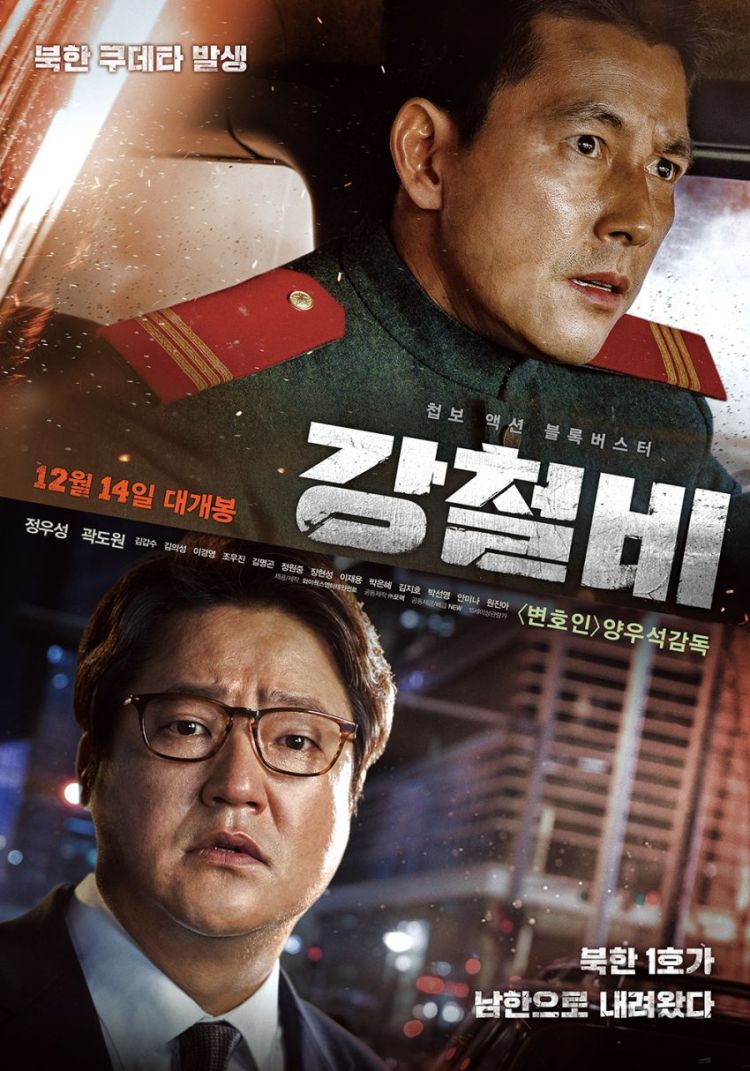
Steel Rain posterA little way in to Steel Rain (강철비, Gangchulbi), one of its heroes – a Blue House official, gives a pointed lecture on Korea’s past to some students of Geopolitical History. Fiercely critical of Korea’s previous subjugation by Japan, he laments that his nation was not able to free itself from the Japanese yoke and was awarded its freedom with the end of a wider political conflict which saw the Japanese “empire” collapse. According to Kwak Cheol-u, Korea has never quite lost its cultural admiration for its former colonisers which is why its most prominent corporations – Samsung, Haeundae etc, are all direct competitors with similar Japanese firms (and are only now pushing past them in terms of global market penetration and technological innovation).

Switching tack, he wonders why it is that Japan lost a war and Korea got cut in two by two new “colonising” forces. In his oft observed mantra, Kwak (Kwak Do-won) insists that the citizens of a divided nation suffer more from those who seek to manipulate the division for their own ends than they do from the division itself, which is where we find ourselves in the contemporary era of my button’s bigger than his button in which “capitalist pig dogs” face off against “dirty commies”. Adapting his own webcomic, Yang’s action thriller is among the most recent in a long line of North/South buddy movies and even if its cold-war paranoia feels distinctly old hat, it just goes to prove that everything old is new again.

Eom Cheol-u (Jung Woo-sung), a former North Korean special forces agent, is called back into the fold by his old commander for a very special mission. Tensions are about to boil over in the perpetually precarious state and the Dear Leader’s life is under threat from a suspected coup. Eom is to silence one of the conspirators in return for which he will be given elite status and his family will be well looked after. Unfortunately, the mission does not go to plan and Eom ends up witnessing a missile strike on a welcome meeting at a Chinese managed factory in which the (mostly young and female) employees are murdered in cold blood. Managing to escape with the Dear Leader himself who is seriously wounded, Eom travels over the border along with two young girls. From this point on he’s in conspiracy thriller territory trying to work out just what’s going on and who he can really trust.

The symbolism is rammed home by the fact that our two heroes, Kwak and Eom, have the same first name – Cheol-u, only one uses the characters for “strong friendship” and the other “bright world”. Taken together they paint a pretty picture, brothers in arms despite the political difficulties which place them on differing sides of an arbitrary line drawn up by a foreign power without much consideration for those divided by it. As in many North/South buddy movies of recent times, the North Korean agent displays the best qualities of his nation in his essential “goodness” – a caring husband and father, he executes his mission with maximum efficiency but bears no ill will towards those outside of it and is keen to protect the people of North Korea from almost certain doom should a nuclear war break out between the two peoples. Kwak, by contrast, is more of a schemer whose moral universe is much less black and white. A fluent Mandarin speaker he’s in tight with a North Korean official who keeps trying to talk him into taking a research post at a Chinese university while his family life is somewhat complicated thanks to a divorce from his plastic surgeon wife.

Meanwhile, the film is at pains to point out that Korea became the focus point of the first East/West proxy war and, in Kwak’s view at least, remains insufficiently important in the eyes of its “allies” to merit much direct consideration. Thus our boardroom squabbles are often reduced to the looming face of the American President “advising” the Korean officials on the best course of action while others worry about what Japan is going to think and wonder if the US secretly values the opinion of the Japanese more than the Koreans on the ground. The situation is further complicated by the fact that the government is in a transitionary phase in which a new president has been elected but not sworn in. The crisis may well play out entirely within the old president’s final hours which means that diplomatically he has little to lose and as he is a conservative, might as well milk the situation for all it’s worth. In short, he’s as keen to ruffle diplomatic feathers and bring the situation to a head as everyone else is and war looks more likely than not. The central message is that, as Kwak is fond of implying, governments care little for their people or that millions may die when idea of division is so easily manipulated, especially if it’s not “their” people who will be doing the dying.

Not for nothing is the new president seen reading copy of Willy Brandt’s book on successful reunification, even if he begs his outgoing predecessor to consider the economic impact of any possible change in relations with a Northern neighbour. The North Korean official also warns that China is not keen on the idea of a war seeing as that will necessarily mean an influx of North Korean refugees no one wants to take responsibility for. The cold war may be about to turn hot, but the heroics that cool it down turn out to be of a much less gung-ho nature than might be expected, relying on personal sacrifice and a perhaps outdated code of honour. Nevertheless, the crisis is averted not through macho posturing but through “diplomatic channels” and a careful balancing of powers. Perhaps not so farfetched after all.


Streaming worldwide via Netflix.

Steel Rain will also receive its international festival premiere as the opening night gala of the Udine Far East Film Festival on 20th April.

Far East Film Festival trailer (no subtitles)

Forgotten (기억의 밤, Jang Hang-jun, 2017)

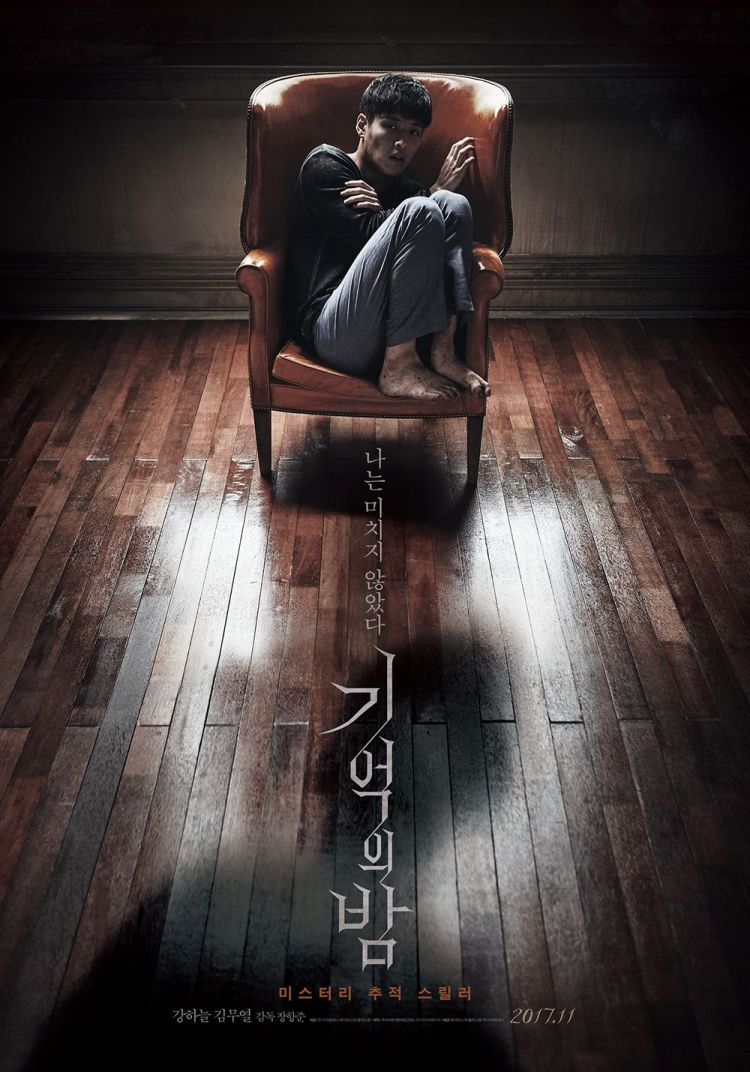
forgotten posterEver wondered if you’re living in a simulacrum? Strangely, the thought isn’t one which occurs to the hero of Jang Hang-jun’s Forgotten (기억의 밤, Gieokui Bam) despite his sense of déjà vu and the uncanny eeriness of his world. Then again, perhaps that’s because he is wilfully complicit in his own life lie, afraid to open the door and confront the ghosts trapped inside his psyche seemingly desperate get out. A tense psychological thriller, Forgotten is also a symbolist drama in which Jin-seok, a man literally trapped in the past, is forced to free himself from a locked room mystery only to discover his own dark truths.

Following some distressed sounds from someone who claims not to be able to remember whatever it is they’re being interrogated about, we find a young man, Jin-seok (Kang Ha-neul), peacefully asleep on his mother’s shoulder as his family drive to their new home. Jin-seok is an anxious young man under a lot of stress studying to retake university exams while his brother, Yoo-seok (Kim Mu-yeol), is the archetypal good Korean son. He is handsome (if a little geeky looking), clever, good at sports, patient and kind. In short Yoo-seok is everyone’s hero, not least his little brother’s, while Jin-seok is a nervous wreck who rarely leaves the house and makes sure to have his discman with him when he does to block out the noise and fury of city life. According to the prominently displayed calendar, it is May 1997.

Things start to go awry when Jin-seok finds out that the house’s previous owner has left some property in the upstairs room which he will collect at a later date. The family aren’t supposed to go in there ’til he does and so the brothers will be sharing a room. Jin-seok is however fascinated by the locked door and the strange noises he thinks he can hear coming from upstairs. Things go from bad to worse when Jin-seok witnesses Yoo-seok being kidnapped in the street only to return 19 days later with no memory of where he’s been. Little by little, Jin-seok comes to doubt that the man who has returned is really his brother, but if he isn’t, then who is he and why is any of this happening?

Like all good gothic mysteries, the first problem is Jin-seok’s supposedly fragile mental state. His family repeatedly check he’s taking his medication and take care to ensure his life is as stress free as possible, apparently afraid that he will relapse into some kind of breakdown the cause of which may be partly the reason that the family has moved to a quieter area. Thus neither he nor we can be sure if everything he experiences is real, a product of his strained mind, or a problem with his medication.

Wedded to this story is the coded past of Korea in 1997 struck by the Asian economic crisis which, the film seems to say, provoked a kind of paranoid madness generalised across society. In this difficult climate in which jobs were scarce and even those in professional occupations faced a significant drop in living standards, extreme solutions began to seem attractive. A young woman and her daughter are murdered and the killer never caught, a little boy orphaned and abandoned by his relatives who keep his family’s money for themselves, a young man resolves to commit a terrible transgression in the hope of saving a loved one, and all because of a tragic accident and some random numbers on a screen. 

Jang Hang-jun turns the relatively low budget to his advantage in creating a world of intense uncanniness, somehow realer than real but never quite right. Gradually peeling back the layers of Jin-seok’s existence to expose the wires below, Jang’s artistry becomes apparent as the world comes into focus albeit presenting a different kind of mystery. Anchored by the impressive performance of a deglammed Kang Ha-neul, Forgotten is as bleak a tragedy as they come. The truth may set one free, but not quite in the way the saying implies and there are some things with which is it impossible to live. The unseen legacy of a traumatic era sends its invisible shockwaves through the present and out into the future, and perhaps the only way to survive them is to avoid opening the door.


Streaming worldwide via Netflix.

Original trailer (no subtitles)

Fullmetal Alchemist (鋼の錬金術師, Fumihiko Sori, 2017)

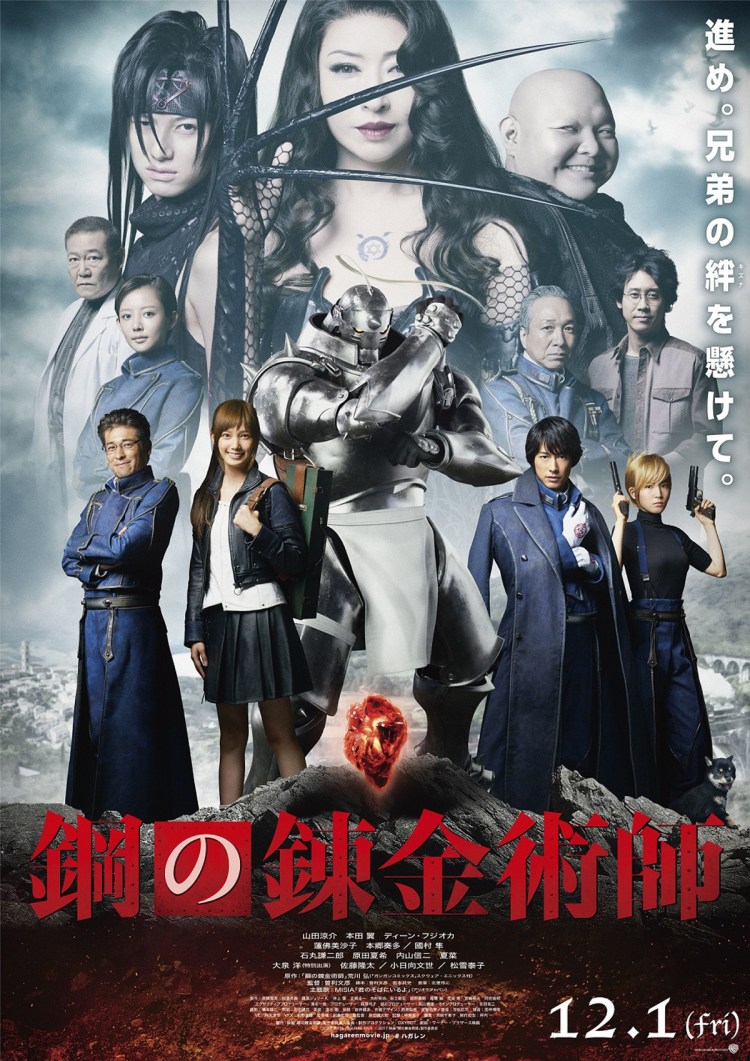
Fullmetal Alchemist posterEvery so often a film comes along which makes you question everything you thought you knew. Fullmetal Alchemist (鋼の錬金術師, Hagane no Renkinjutsushi) is just such as film but less for the philosophical questions fans of the source manga may have been expecting, than for the frankly incomprehensible fact that it exists at all. Produced not by a major studio but by Square Enix – best known as a video game studio but also the publisher of manga magazine Monthly Shonen Gangan in which the series was originally serialised, and effects studio Oxybot Inc., Fullmetal Alchemist is not the big budget extravaganza a franchise of this size might be expected to generate but a cut price blockbuster attempting to pack a much loved, long running saga into just over two hours.

For the uninitiated, the movie begins with the little Elric Brothers – Ed and Al, who live in the countryside with their doting mother while their father is away. When their mother is struck down by a sudden illness and dies, the boys raid their dad’s Alchemy library for clues as to how to bring her back. There is, however, a taboo surrounding human transmutation and when the brothers cast their spell they pay a heavy price – Al loses his entire body though Ed manages to save his soul and bind it to a suit of armour by sacrificing his own right arm.

Many years later, Ed (Ryosuke Yamada) and Al (Atomu Mizuishi) are still looking for the mythical “Philosopher’s Stone” which they believe will allow them to cast another spell and get their fleshy bodies fully restored. This takes them to a small town where they encounter a dodgy priest and their old commander, Captain Roy Mustang (Dean Fujioka), who wants to bring them back into the State Alchemist fold. The priest’s stone turns out to be a fake though his connections to the film’s shady antagonists are all too real, and the brothers are soon faced with another dilemma in their quest to restore all they’ve lost.

Sori shifts away from the frozen Northern European atmosphere of the manga for something sunnier and less austere, shooting in Italy’s Volterra with its narrow medieval streets and iconic Tuscan red roofs. He is, however, working on a budget and it shows as his cast are costumed at cosplay level with awkward blond wigs attempting to recreate the manga’s European aesthetics. Al, rendered entirely (and expensively) in CGI, is deliberately kept off screen while the quality of the effects often leaves much to be desired.

Al’s frequent absence is a major problem seeing as the series’ major theme is brotherhood and Ed’s tremendous sense of guilt over his brother’s condition coupled with his recklessness in his need to put things right is only explained in a piece of bald exposition following a fight between the pair after Al’s mind has been corrupted by a mad scientist who implied that he may not really be “real” after all. While Al’s false memory paranoia may be among the more interesting issues the film attempts to raise, it’s quickly pushed into the background, eclipsed by the ongoing conspiracy narrative which places the Elric Brothers in a difficult position regarding their need to get their body parts back. 

A symptom of the attempt to condense such a much loved and well known manga into a two hour movie, there is rather a lot of plot going on and numerous side characters on hand to enact it. Though fans of the original manga may be pleased to see their favourite characters have made it into the movie, they maybe less pleased about how one note they often are or the various ways their personalities have needed to shift in order to fit into the new narrative arcs the film employs. Aside from the young and pretty cast, Fullmetal Alchemist also finds room for a host of veteran talent from the ubiquitous Jun Kunimura in a small role to Yo Oizumi turning villainous and Fumiyo Kohinata at his most Machiavellian.

Extremely silly, poorly put together and burdened with some very unfortunate wigs, the Fullmetal Alchemist live action adaptation is as much of a misfire as it’s possible to be but viewers hoping for a continuation to the tale would do well to stay tuned for a post-credits sting strongly hinting at a part two.


Streaming worldwide on Netflix.

Original trailer (English subtitles)

BLAME! (ブラム!, Hiroyuki Seshita, 2017)

blame posterCities. The pinnacle of human achievement and an almost living monument to civilisation. Does the same principle of human collective settlement also relate to the digital realm or will increasing interconnectedness eventually destroy everything we’ve built? Following their landmark CGI adaptation of Tsutomu Nihei’s Knights of Sidonia, Polygon Pictures return to source by adapting the author’s debut work BLAME! into a feature length animated movie. Like Sidonia, BLAME! (ブラム!) takes place many years after a climactic event has led to the fall of human civilisation – an event so long in the past as to have become mere myth to the small number of humans still clinging on to life in a now inhospitable terrain, but BLAME!’s dystopia is very much one created by man, losing control of its technology in its ever advancing hubris.

As the young girl who offers the opening monologue tells us, no one knows how all of this happened. Once, a long time ago, humans lived in a city but a virus came and they lost the ability to communicate with the environment in which they lived. The city began to grow, and the “Safeguard” system decided that humans were “illegal immigrants” in their own land. The exterminators swooped in to wipe them out but a small band of humans has managed to survive a few hundred years in a kind of safe zone protected by a perimeter wall the city’s systems are prevented from monitoring.

The rapid expansion of the city has also meant a reduction in vegetation and the surviving humans are running low on food. An intrepid team of children ventures out into the wasteland in search of sustenance, but they’re spotted and targeted for elimination. A mysterious figure appears on the horizon and saves them. The man calls himself a “human” and is disappointed to realise none of the children are carriers of the “Net Terminal Gene” which he is seeking. Killy (Takahiro Sakurai) claims that the Net Terminal Gene will enable the humans to take back control of the city’s systems, halt the excessive building program and call off the Safeguard attack dogs.

Killy’s appearance brings new hope to the villagers, trapped within their perimeter stronghold but facing the prospect of staying and starving or taking their chances with Safeguard. Concentrating on action rather than philosophising little time is given over to considering how humanity lives though it’s certainly puzzling that there is so little reaction when the band of children returns home much depleted in numbers. Indeed, aside from Pops (Kazuhiro Yamaji), the de facto leader of the community, no other “adults” appear.

Using Killy as a kind of deflective shield, the gang press on until they find an abandoned robot, Cibo (Kana Hanazawa), who tells them about an “Automated Factory” in which she can generate both an abundant food source and a synthetic tablet which will allow them to get back into the city’s systems. What ensues is a deadly firefight as the system fights back. Cibo pleads with The Authority in the digital realm while Killy and the villagers hold back the forces of order with firepower from the outside.

Killy remains a man of few words, his language dulled through inactivity and his expression inscrutable, but the villagers, perhaps lulled into a false sense of security thanks to long years of isolation, never question his motives or reliability. Likewise, Cibo clearly knows more than she lets on but offers the only lead so far on a way back to a less precarious way of life. Killy’s sudden appearance becomes a mythic event, a point of transition in the history of the post-apocalyptic world, but also seems to be without resolution as the closing coda implies.

Like Sidonia, the animation quality is at times variable but often excels in its highly detailed backgrounds, allowing production design to smooth over any narrative gaps. What BLAME! lacks in terms of plot and character complexity it makes up for in world building though it is difficult to ignore the feeling of the loss born of condensing something far larger into an easily digestible whole. Nevertheless, BLAME! does what it sets out to do with quiet brilliance in detailing what might be the first of many adventures of the wanderer known as Killy as he explores a world ruined beyond repair looking for the key to unlock a brighter future.


Netflix trailer (Japanese with English subtitles/captions)

Lucid Dream (루시드 드림, Kim Joon-sung, 2017)

lucid dream posterA relatively rare phenomenon, a lucid dream is one in which the dreamer is aware they are asleep and “awake” enough to influence the outcome. Rather than using the ability to probe some kind of existential question, Korean science fiction thriller Lucid Dream (루시드 드림) focusses on the evidence gathering possibilities, going one step further than hypnotic regression to revisit old memories and zoom in on previously missed details.

Dae-ho (Ko Soo) is an investigative reporter currently in hot water over a controversial story. He’s also a doting single father to a little boy, Min-woo (Kim Kang-Hoon), who resolves to put his work aside for a day to take his son to an amusement park. Tragedy strikes as Dae-ho is busy having words with a paparazzo and then notices Min-woo has disappeared from his horse on the carousel. Catching sight of Min-woo walking off with another man, Dae-ho collapses, a tranquilliser dart sticking out of his leg. Dae-ho searches for his son with no concrete leads until, three years later, he hears about the possibilities of lucid dreaming and attempts to figure out exactly what happened that day by reliving it in his sleep.

Lucid Dream begins in true conspiracy thriller mode by introducing Dae-ho’s past as a controversial journalist responsible for ruining prominent businessmen by exposing their corruptions and manipulations of the laws everyone else is expected to abide by, but this potentially rich seam of social commentary is cut off in full flow as paternal concerns take centrestage.

Dae-ho is a single dad raising Min-woo alone with the help of a friendly nanny. Although he tells Min-woo his mother is “in America” no concrete information is given regarding her whereabouts though the fact that she is never heard from after Min-woo’s disappearance suggests she may be somewhere further away. Apparently a devoted and good father from the very beginning, Dae-ho will stop at nothing to find out what’s happened to his son. Three years on he remains distraught and desperate, willing to try anything that might help him uncover the truth. He finds an ally in the policeman handling his case who is in a similar predicament as his own daughter lies in a hospital bed, born with serious medical abnormalities. The true paternal love, determination, and sacrifice of men who are already good and devoted fathers raising pleasant, uncomplicated children define the drama as others attempt to subvert that same love in choosing to sacrifice one child in favour of another.

Though Dae-ho originally assumes the plot is directed at him alone, possibly revenge for his exposés, the truth is darker and moves towards child trafficking and the trade in illicitly harvested organs though this too is mostly glossed over in favour of competing parental needs. The men who’ve taken Min-woo veer between amoral gangsters and those who can’t stomach the outcome of their actions ultimately deciding to rebel against their own side, and even if the real perpetrator turns out to be someone not so different from Dae-ho, there can be little justification in this dark flip side to Dae-ho’s all encompassing paternal love.

The central premise of dreams and memory is an interesting one, but largely squandered by the increasingly dull narrative progression in which Dae-ho moves from clue to clue in linear fashion and along predictable genre lines. Most viewers even remotely familiar with similarly themed films will have correctly identified the villain right away thanks to the heavily signposted script, and will necessarily be disappointed by the rather predictable yet action packed finale.

Dae-ho travels through dream states, eventually learning to invade the dreams of others thanks to the guidance of a mysterious shared dreamer but the application is inconsistent and relegated to plot device only. The finale takes place within a dream and with the stakes heightened as it becomes clear death inside someone else’s mind results in death outside it, but the imagery remains clichéd as Dae-ho battles the villain inside a rapidly disintegrating building before being forced into a literal leap of faith. Despite the surface level grimness of the story, Lucid Dream remains firmly in mainstream thriller territory with under developed characters, dead end sub plots, and a satisfying if not entirely earned moment of final closure. It is, however, also a rare example of a broadly happy ending in a Korean procedural, in which a father’s love can and does save the day, if not the film.


Original trailer (English subtitles)

https://www.youtube.com/watch?v=ylJzvTgv3-Q