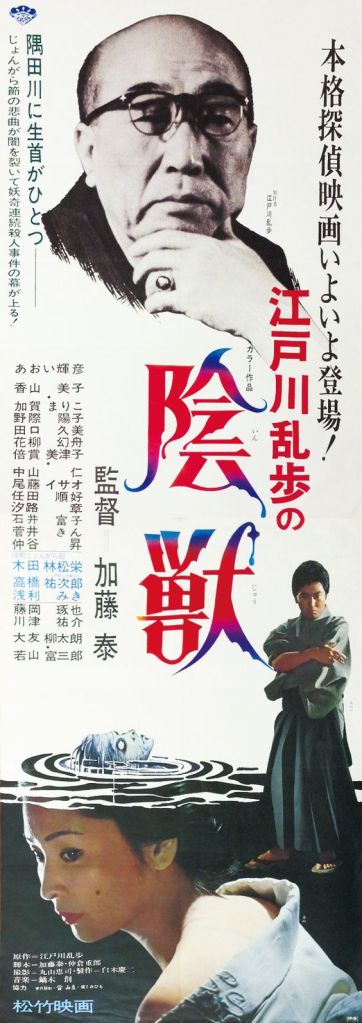
 Edogawa Rampo (a clever allusion to master of the gothic and detective story pioneer Edgar Allan Poe) has provided ample inspiration for many Japanese films from Blind Beast to Horrors of Malformed Men. So synonymous with kinky terror is his name, that it finds itself appended into the title of this 1977 adaptation of his novel Beast in the Shadows (江戸川乱歩の陰獣, Edogawa Rampo no Inju) by veteran director Tai Kato best known for his work in the yakuza genre. Mixing classic European detective intrigue with a more typically Japanese obsession with method over motive, Beast in the Shadows, like much of Edogawa Rampo’s work twists and turns around the idea of atypical sexuality, one side cerebral and another physical as the “Westernised” sadomasochism of the heroine’s husband becomes the driving force of the narrative.
Our hero, Koichiro Samukawa (Teruhiko Aoi), is a best selling author who likes to describe himself as the creator of “serious” mystery novels. In this he contrasts himself favourably with the coming younger generation who rely on sensationalised tricks and twists rather than the intricately plotted, traditionally constructed crime stories which Samukawa prides himself on writing. The particular object of his rage is a recently successful rival, Shundei Oe, who is making quite a splash in literary circles in part due to his mysterious persona. Refusing all in-person contact, Oe’s whereabouts are completely unknown and though he supplies a “real name” at the back of each book, there is great speculation as to who he really is, how he lives, and where he might be.
Down south to supervise a movie shoot based on one of his novels, Samukawa is thrilled to run into a fan – particularly as she’s such a beautiful young woman. Shizuko (Yoshiko Kayama) is the wife of a wealthy businessman, Oyamada, who has recently returned from an extended spell abroad though he doesn’t share her passion for literature even if he brings home such luxuries as fancy European gloves. The relationship moves beyond mutual appreciation when Shizuko asks for Samukawa’s help in investigating a series of threatening letters she’s been receiving from an old boyfriend who may or may not also be stalking her. The real kicker is that the letters purport to be from Shundei Oe – apparently the pen name being used by a man who fell deeply in love with Shizuko when he was a student but couldn’t take no for an answer when his creepy behaviour became too much for the then school girl. Though Samukawa is sure the letters are all talk and commits himself unmasking Oe for the perverted cretin he is, Shizuko’s husband is eventually murdered just as the letters threatened.
Though the final twist is one which most seasoned mystery lovers will have seen coming, Kato keeps the audience on its toes with plenty of intrigue and red herrings as Samukawa attempts to discover the truth behind the death of Shizuko’s husband as well as taking the opportunity to indulge in a little intellectual vanity by unmasking his rival. The movie subplot quickly gets forgotten but Samukawa is also helped/hindered by his publisher, Honda (Tomisaburo Wakayama), who keeps reminding him about the looming deadline for his latest work. The case at hand provides ample distraction for the harried writer whose writer’s block is only made worse by thoughts of Shundei Oe’s growing success and his resentment of this new, sensationalised form of crime novel which seems to be eclipsing his own.
If the way he acts in “real life” is anything to go by, Samukawa’s detective novels owe much to the European tradition but still, there’s a persistent fear of the foreign underlining much of the proceedings despite the heavy presence of Westernised clothing, music and culture which seems to diffuse itself throughout daily life. Shizuko’s husband may have just returned from abroad but it seems he brought back much more with him than some fancy gloves and an elegant English mistress (pointedly named Helen Christie). The English style riding crop in Oyamada’s study is not mere affectation but the cause of the nasty looking wound on Shizuko’s shoulder which first caught Samukawa’s attention. Oyamada’s sadistic tendencies are posited as a credible reason he could himself be masquerading as Oe, getting off on driving his wife half crazy with fear, but his eventual murder would seem to rule that out.
Nevertheless the game is one of pleasure and pain as Samukawa comes to the realisation that he is integral to the plot. Challenged by his literary rival to a game of minds, Samukawa is putting his detective abilities to the test as his rival is writing their latest story in reality rather than on the page. Love, lust, betrayal, violence and tragedy all come together for a classic gothic detective story which looks ahead to noir with its melancholy fatalism yet remains resolutely within the dark and ghoulish world of the gothic potboiler. Kato shoots a prestige picture with the undercurrent of repressed eroticism in his strange low level angles and unusual compositions which bind, tie and constrain the elusive Shizuko within the window panes and doorways of her home. Light levels fluctuate wildly, isolating the haunted protagonists in their supernatural gloom until we hit the expressionism of the theatrical finale which takes place in an entirely red, almost glowing attic space. The atmosphere is one of profound unease as Oe is thought to be perpetually watching, hidden somewhere in the house, out of sight.
The Beast in the Shadows does not just refer to the unseen voyeur but to the repressed eroticism which his actions symbolise and is perhaps brought out in the various sadomasochistic relationships created between each of the protagonists. Then again, where are we in all this – sitting in the dark, watching, undetected, seeing things we had no right to see. Kato takes our own voyeuristic tendencies and serves them back to us with visual flair in a late career masterpiece which perfectly captures Edogawa Rampo’s gothic world of repressed desire and brings it to its cinematic climax as two detectives go head to head in a game so high stakes neither of them quite realised what it was they were playing.
Original trailer (no subtitles, NSFW)
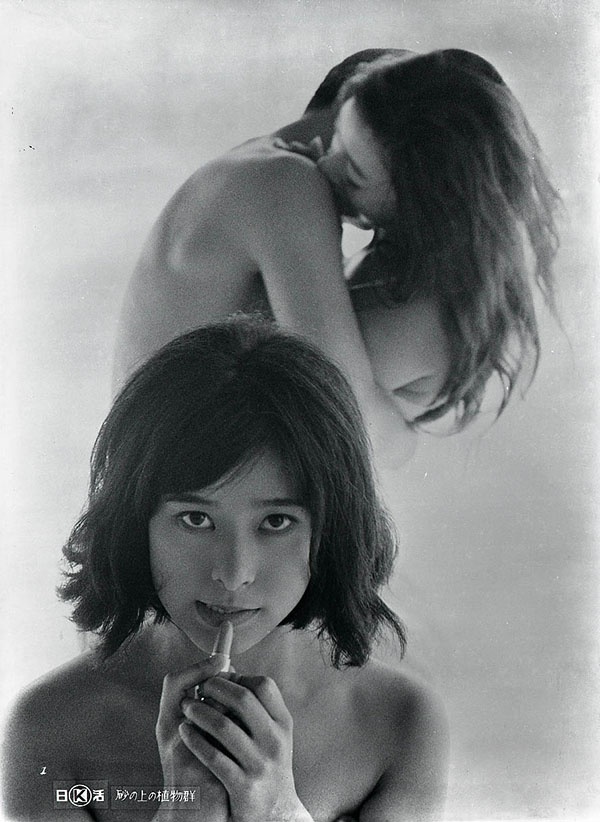 Despite being among the directors who helped to usher in what would later be called the Japanese New Wave, Ko Nakahira remains in relative obscurity with only his landmark movie of the Sun Tribe era, Crazed Fruit, widely seen abroad. Like the other directors of his generation Nakahira served his time in the studio system working on impersonal commercial projects but by 1964 which saw the release of another of his most well regarded films Only on Mondays, Nakahira had begun to give free reign to experimentation much to the studio boss’ chagrin. Flora on the Sand (砂の上の植物群, Suna no Ue no Shokubutsu-gun), adapted from the novel by Junnosuke Yoshiyuki, puts an absurd, surreal twist on the oft revisited salaryman midlife crisis as its conflicted hero muses on the legacy of his womanising father while indulging in a strange ménage à trois with two sisters, one of whom to he comes to believe he may also be related to.
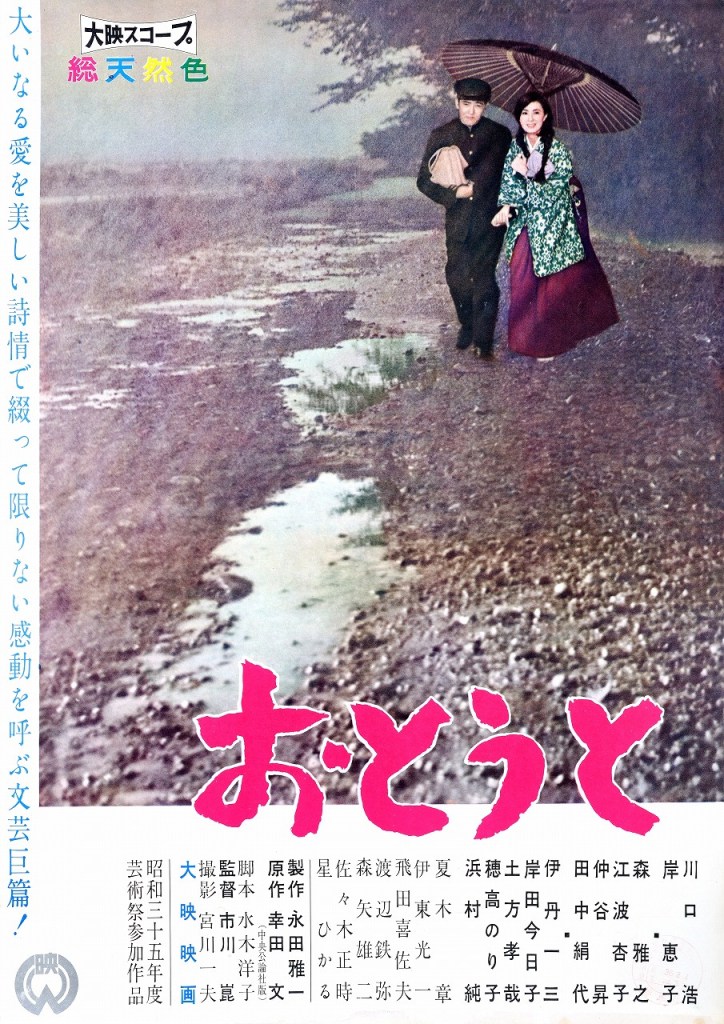 Perhaps oddly for a director of his generation, Kon Ichikawa is not particularly known for family drama yet his 1960 effort, Her Brother (おとうと, Ototo), draws strongly on this genre albeit with Ichikawa’s trademark irony. A Taisho era tale based on an autobiographically inspired novel by Aya Koda, Her Brother is the story of a sister’s unconditional love but also of a woman who is, in some ways, forced to sacrifice herself for her family precisely because of their ongoing emotional neglect.
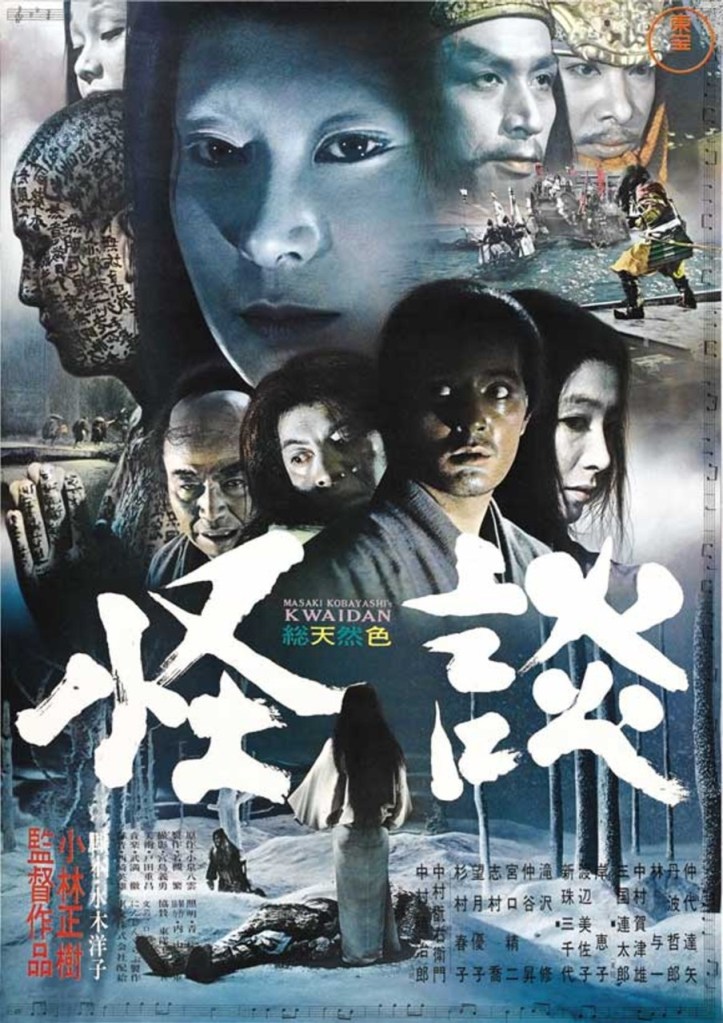 Kwaidan (怪談) is something of an anomaly in the career of the humanist director Masaki Kobayashi, best known for his wartime trilogy The Human Condition. Moving away from the naturalistic concerns that had formed the basis of his earlier career, Kwaidan takes a series of ghost stories collected by the foreigner Lafcadio Hearn and gives them a surreal, painterly approach that’s somewhere between theatre and folktale.
 Windows on Worlds