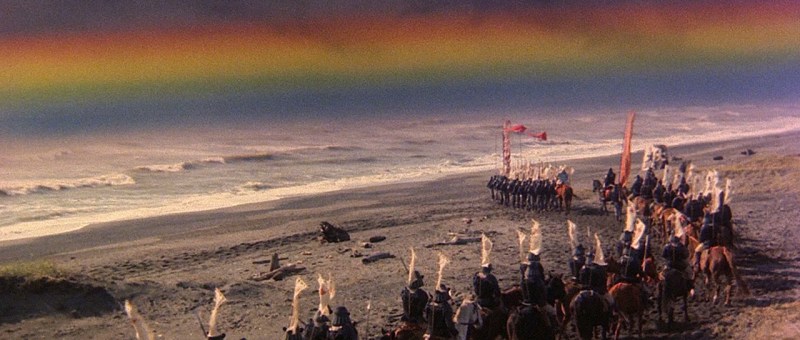
Kagemusha (影武者, Akira Kurosawa, 1980)

“The shadow of a man can never stand up and walk on its own” a shadow warrior laments, wondering what happens to the shadow once the man is gone. Set at the tail end of the Sengoku era, Akira Kurosawa’s Kagemusha (影武者) charts the transformation of a man reborn as someone else and discovers that he’s better at playing the role he’s been assigned than the man who was born to play it only to fall victim to his own hubris and self-delusion. 

The nameless hero (Tatsuya Nakadai) is a lowborn thief sentenced to death only to be reprieved thanks to his uncanny resemblance to the local lord, Takeda Shingen (also Tatsuya Nakadai), whose double he must play if he’s to keep his life. The shadow objects to this characterisation, outraged that a man who has killed hundreds and robbed whole domains dares to call him a scoundrel. Shingen agrees he too is morally compromised. He banished his father and killed his own son but justifies it as a necessary evil in his quest to conquer Japan hoping to unify it bringing an end to the Warring States period and ensuring peace throughout the land. 

The shadow goes along with it, but does not really realise the full implications of his decision. He tries to smash a giant urn hoping to find treasure to escape with, but is confronted by a corpse bearing his own face. Shingen has been killed by an enemy sniper in an act of hubris sneaking around a castle under siege hoping (not) to hear the sound of a flute. Before passing away, Shingen instructs his men to keep his death a secret for three years, retreating to defend their own domain rather than conquer others. But there are spies everywhere and news of his apparent demise soon travels to the allied Oda Nobunaga (Daisuke Ryu) and Tokugawa Ieyasu (Masayuki Yui), his rivals for the potential hegemony over a unified Japan. The shadow Shingen must keep up the pretence to keep the dream alive and protect the Takeda Clan from being swallowed whole by the advance of Nobunaga. 

Shingen had been the “immoveable mountain”, the solid force that anchors his troops from behind but also an implacable leader famed for his austerity. The shadow Shingen is almost caught out by the honest reaction of his grandson and heir Takemaru (Kota Yui) who immediately blurts out that this man is not his grandfather because he is no longer scary, while he’s also bucked by Shingen’s horse who in the end cannot be fooled. His retainers wisely come up with a ruse that he’s too ill to see his mistresses lest they realise the thief’s body does not bear the same scars even as everything about him from the way he talks and moves and laughs is different. Yet in his sudden conversion on witnessing Shingen’s funeral on lake Suwa and resolving that he wants to do something to serve the man who saved his life, the shadow proves an effective leader who earns the trust and affection of his immediate retainers but is equally struck by their sacrifice as they give their lives to protect him. 

Meanwhile, his illegitimate son Katsuyori (Kenichi Hagiwara), skipped over in the succession, complains that he can never emerge from his father’s shadow emphasising the ways in which the feudal order disrupts genuine relationships between people and bringing a note of poignancy to the connection that emerges between the shadow Shingen and little Takemaru otherwise raised to perpetuate that same emotional austerity. Hoping to eclipse his father, Katsuyori too experiences a moment of hubris, successful in his first campaign but then over ambitious, forgetting his father’s teachings and walking straight into a trap only to be defeated by Nobunaga’s superior technology. 

Nobukado (Tsutomu Yamazaki), Shingen’s brother and sometime shadow, remarks that he hardly knew who he was once his brother was gone, and wonders what will become of the shadow once the three years are up. In a sense, the thief is already dead. As Nobukado puts it, it’s as if Shingen has possessed him, his confidence in his alternate persona apparently solidified by the victory at Takatenjin castle. But the sight of so many dead seems to unnerve him in the hellish spectacle of death that is a Sengoku battlefield knowing that these men died if not quite for him than for his image. When he attempts to mount Shingen’s horse, it’s either born of hubristic self-delusion in wanting to prove that he truly has become him, or else a bid for freedom and to be relieved of his shadow persona. Either way, he becomes a kind of ghost, once again watching his men from behind but this time invisibly and powerless to do anything but watch as they are massacred by Nobunaga’s guns. 

Earlier on he’d had a kind of nightmare, painted in surrealist hues by Kurosawa who conjures battlegrounds of angry reds and violent purples along with ominous rainbows, seeing himself dragged down into the water by Shingen’s ghost which he has now seemingly become. In the end all he can do is accept his fate in a final act of futility running defenceless towards the enemy line and reaching out to retrieve his banner from its watery fate only to be carried past it on a current of red. “I’m not a puppet, you can’t control me” the thief had said, but in the end just like everyone else he was powerless, another casualty of the casual cruelties and meaningless struggles of the feudal order. 


Kagemusha screens at the BFI Southbank, London on 11th & 31st January 2023 as part of the Kurosawa season.

Original trailer (English subtitles)
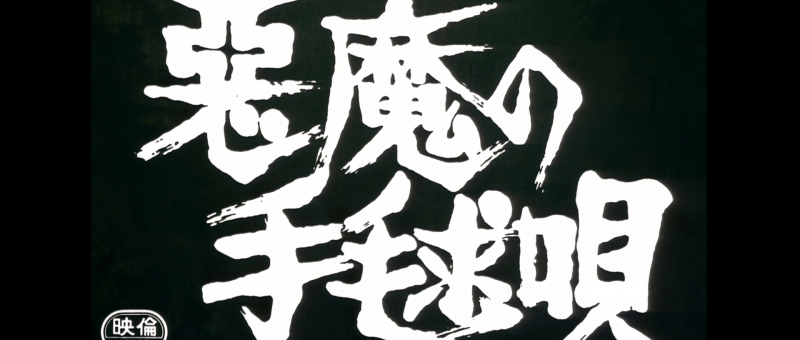
The Devil’s Ballad (悪魔の手毬唄, Kon Ichikawa, 1977)

Devil's Ballad posterA year after his box office smash The Inugami Family, Kon Ichikawa returns to the world of eccentric detective Kosuke Kindaichi with The Devil’s Ballad (悪魔の手毬唄, Akuma no Temari Uta). Like many a Kindaichi mystery, Devil’s Ballad finds him called upon to delve back into the past to satisfy an ageing detective’s anxiety about an old case, only to be faced with a series of new ones as a consequence. This time, however, the mystery leans less on buried secrets than deeply held grudges, betrayals, and lingering feudal feuds as the post-war society tries and fails to free itself from ancient oppressions.

The film opens with a tryst between two adolescent lovers in the ominously named “Devil’s Skull Village” in 1950. Yasu (Yoko Takahashi), the girl, is at pains to let her boyfriend, Kanao (Koji Kita), know that she is keen to take the relationship to the next level but he is old fashioned and wants to wait until their union is formalised. The pair are interrupted by some of their friends who are in the middle of planning a celebration for a visit from a girl who moved to the city, Chie (Akiko Nishina). Meanwhile, Kindaichi (Koji Ishizaka) has arrived at the inn owned by Kanao’s mother Rika (Keiko Kishi) on invitation from a retired policeman, Isokawa (Tomisaburo Wakayama), who wants Kindaichi to look into the murder of Rika’s husband twenty years ago. Isokawa, then a young rookie, is convinced that Rika’s husband was not the victim but the murderer and the corpse actually belonged to another man entirely – Onda, a drifter who defrauded half the village with a wreath making scam.

Rika and her children – 20-year-old Kanao and his younger sister Satoko (Eiko Nagashima) who has prominent facial birthmarks and rarely leaves the house, came to the village with her husband and are therefore slightly divorced from the longstanding social rivalries. The village has two noble families – the Yuras and the Nires. Feeling the need to modernise, the Nires bet everything on vineyards and it paid off. The Yuras, by contrast, were defrauded by Onda’s wreath scam and lost their fortune and social standing. Yasu, Kanao’s girlfriend, is a daughter of the Yuras, but the Nire’s have been petitioning Rika for quite some time to have her son marry their daughter, Fumiko (Yukiko Nagano), who also has a crush on him (though this is largely irrelevant to her father’s dynastic ambitions). When the younger generation start getting bumped off in ways eerily similar to a local folk song, Kindaichi and Isokawa are on the case, wondering if these new murders have anything to do with their old one.

Despite its 1950 setting, Devil’s Ballad is unusual in resolutely making an irrelevance of the war which only receives a brief mention as an explanation for why some of the case files have been destroyed and for why marriage is such a hot button issue given the lack of men and abundance of women. Nevertheless, the crimes span a turbulent 20 years of Japanese history with the original murder taking place in the early ‘30s during a period of economic instability following the Manchurian Incident. In the socially conservative pre-war era, it seems Onda also got around and may have fathered several illegitimate children with women in the village, some of them noble, some not. These buried secrets seem primed to bubble to the surface now that the children are coming of age and marriage again becomes an issue as worried parents try to think of acceptable ways to block potentially “inappropriate” matches without sending their children off into ruinous elopements or tipping off the wrong people that their kids may not be their kids.

The crimes themselves, old fashioned as they are, are partly reactions to a changing society. We discover that the reason Rika and her husband were forced to come back to the village was that their showbiz careers were stalling – she was a vaudeville performer specialising in shamisen, and he a “benshi” (narrator of silent films) who became convinced his job was obsolete after witnessing a subtitled print of Morocco. Likewise, the two rival families cannot let go of their petty provincial privileges, and as Kanao angrily snaps back at his mother, Japan is now a democratic country and he is free to choose his own wife at a time of his own choosing with or without parental blessing. This remote village is perhaps isolated from the privations of the post-war world but it’s also stuck in the past, hung up on past transgressions and unable to move forward into the new era. However, the primary motivations for murder are as old as time – guilt, humiliation, and self preservation.

Ichikawa keeps things simple but splices in a few strange, avant-garde sequences of kokeshi dolls menacingly bouncing balls coupled with shifts to black and white, fast-paced reaction shots, and stuttering still frame sequences all while Kindaichi showers innocent passersby with his famous dandruff, the idiot police officer continues to offer ridiculous theories while his sergeant dutifully follows him around, and the local bobby perfects a line in hilarious pratfalls. Overlong at two and a half hours and falling prey to the curse of the prestige crime drama in spoiling its mystery through casting, the Devil’s Ballad may not be the best of the Kindaichi mysteries but offers enough of a satisfying twist to prove worthy of the Kindaichi name.


Original trailer (no subtitles)