The Chatterboxes (みんな、おしゃべり!, Ken Kawai, 2025)

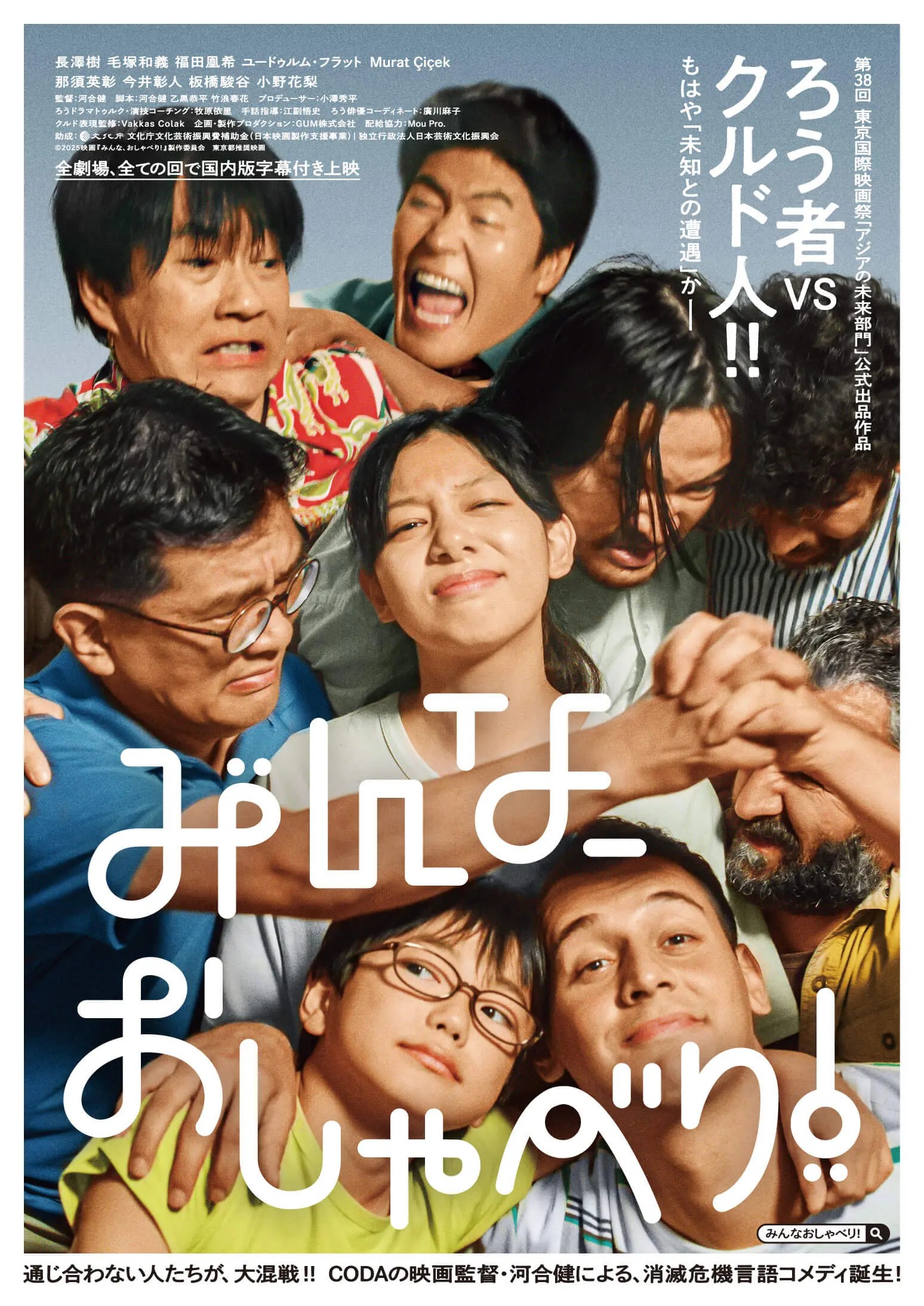
Kazuhiko (Kazuyoshi Kezuka) has been running his electrical appliance shop successfully for many years, but finds his business frustrated by the local council’s attempts to rejuvenate the area and a subsequent feud born of a minor misunderstanding with the owner of the kebab shop that opens across the way. Ken Kawai’s down to earth comedy The Chatterboxes (みんな、おしゃべり!, Minna, Oshaberi!) examines the radiating effects of occasionally wilful miscommunication in an atmosphere that sometimes encourages fear and suspicion rather than acceptance or understanding. 

At least, there’s no real reason why Kazuhiko should immediately take against the Rifat (Murat Çiçek) and the Kurdish community who open a kebab shop nearby, but jumps to conclusions on noticing broken glass in his entranceway with Rifat standing over it. It was actually a little girl who broke a bulb on her way out and was too afraid to say anything, but Kazuhiko almost assumes Rifat has come in and broken something deliberately as an act of war. Kazuhiko’s reaction echoes that of the wider society which is not always accepting of difference, but is also ironic as Kazuhiko also feels himself to be an outsider not accepted by those around him because he is deaf. His shop has a sign saying that it caters to both hearing and non-hearing people, but it seems most don’t notice it and hearing people can sometimes behave insensitively at what they see as inconvenient service. One couple leave the store when Kazuhiko doesn’t respond to their question before he’s even had time to get out his sign out.

He has many things in common with the Kurdish community, but at the moment cannot see common ground only danger. The Kurds have moved into the community through a local government initiative run by the well-meaning Okita who seems like he’s trying to do a good thing, but going about it in the clumsiest way possible. He turns up unannounced to film a PR spot with Kazuhiko as the poster boy of his campaign, but badly botches the transmission by ignoring his wishes about how he wishes to be identified. Though Kazuhiko identifies himself as “deaf”, the subtitles have “hearing impaired”, which he finds offensive because he does consider himself to have an impairment. As his hearing daughter Natsumi (Itsuki Nagasawa) points out, there’s nothing difficult about communicating through sign language in their home because it’s simply their normal.

At a meditation meeting, the Kurdish community have a similar problem in that Okita repeatedly refers to them as “Turkish” and has only hired a Turkish to Japanese interpreter who cannot speak Kurdish. Rifat is particularly attached to the Kurdish language and for a number reasons prefers not to speak Turkish even if he can understand it, though other members of the community prefer to speak other languages such as Arabic. Part of the problem is caused by Okita’s assumptions, something which to his credit he does try to rectify by listening to the concerns of each community, but still to an extent looks down on them while his plan to use minorities to rejuvenate the town economically while making the council look compassionate is also a little exploitative if not patronising. Meanwhile, by having all the shops in this area run by minorities, he may be excluding rather than including them by effectively segregating them away from the more prosperous part of town.

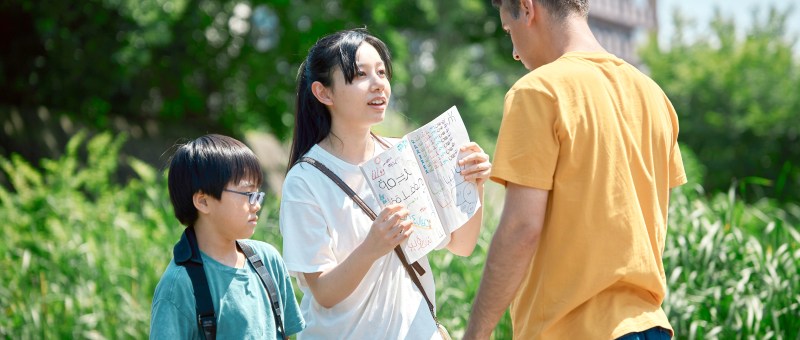
Kazuhiko’s daughter Natsumi and Rifat’s son Hiwa (Yildirm Firat), who was born and raised in Japan, end up caught in the crossfire while quicker to realise that they have a lot more in common than might first be thought. They have each been forced into the role of interpreter for their parents who cannot communicate with the wider society due to a language barrier, but also have differing views on their role with Hiwa thinking he should translate his father’s Kurdish as accurately as possible even if it causes a problem, and Natsumi deliberately softening what her father signs to avoid creating additional conflict. They nevertheless became interested in learning each other’s languages and culture and grow closer through a process of cultural exchange. 

Something similar happens to her younger brother, Shun (Ohki Fukuda), who may also be neurodivergent as his teacher complains that he pays no attention in lessons, preferring to doodle instead, and makes no attempt to communicate with the other children at his deaf school. Fascinated by picking up a note in Arabic dropped by one of the Kurdish men, he begins to develop his own language which he then shares with the other children who begin to contribute to it too. The way the teacher reacts is emblematic of the fear associated with the inability to understand what another community is saying as she clearly views the children’s secret language as a challenge to her authority. Kazuhiko also jumps to the conclusion that the Kurds have been putting funny ideas in his son’s head, but equally he and some of the other parents don’t fully trust the teacher because she’s a hearing woman. They worry she’s forcing the values of the hearing society on their children rather than allowing them to embrace their deafness. Just as Rifat is fiercely protective of Kurdish, so Kazuhiko worries sign language may die out with all the new implants and apps that are being developed.

He also complains about the discrimination he’s faced and that hearing people often justify their decision to exclude him as “consideration” when it’s really just that they find communicating in a different way inconvenient so prefer not to bother. Of course, his late wife was a hearing woman and so is Natsumi so some of his comments are hurtful to her while reflecting an us and them mentality Natsumi would like to reject, especially considering her growing friendship with Hiwa. Nevertheless, words are often unnecessary for basic communication. You don’t need words to make someone understand you want them to come quickly because you need their help, and Kazuhiko is eventually able to make a sale just through gestures to an old man who is no longer able to speak and cannot write either. Kazuhiko only starts to rethink his views when Okita tells him he’s leaving the Kurds out of the project to avoid controversy, uncomfortably echoing the various ways in which he’s been excluded. 

Once misunderstandings have been cleared up, the communities find a source of friendship and solidarity embracing cultural exchange that leaves them feeling less afraid of each other and more welcoming towards others. Kawai deliberately leaves some of the Kurdish dialogue untranslated, simply transliterating it in the subtitles to make it clear that what is being said is not being understood outside of the community, leaving the audience in the same position as Kazuhiko and hearing monolingual Japanese people like Okita, but equally proving that not understanding fully isn’t really that much of problem, while being ignored and excluded is. Warm, funny, and venturing into absurdity in its final stretches, Kawai’s film is a much needed counter to the growing animosity of our recent times and a reminder of how much better life can be when you open yourself up to world beyond that you already know.


The Chatterboxes screened as part of this year’s Camera Japan.

Trailer (English subtitles)

The Asadas! (浅田家!, Ryota Nakano, 2020)

There’s a kind of irony at the centre of Ryota Nakano’s The Asadas! (浅田家!,Asada-ke!) in that its photographer hero makes a name for himself photographing his family yet at times neglects them or appears curiously insensitive, perhaps even selfish in the pursuit of his dreams. Inspired by the life of photographer Masashi Asada, the film is at once a celebration of the family and an advocation for the tangibility of a photograph as a repository of memory that can bring comfort even in the absence of its subject.

The first part of the film is narrated from the perspective of Masashi’s (Kazunari Ninomiya) much more conventional older brother Yukihiro (Satoshi Tsumabuki) who is generally exasperated by and a little resentful of the family’s indulgence of Masashi, a seeming free spirit who acts on impulse and gives little thought to the consequences of his actions. People frequently describe both Masashi and his father Akira (Mitsuru Hirata) as “not normal,” and there is something unconventional in their family setup with Akira a househusband in a small town in the 1980s while his wife Junko (Jun Fubuki) supports the family with her career as a nurse. It’s Akira who first gives Masashi a camera and his dream of becoming a photographer which he eventually achieves through taking amusing pictures of his family in various scenes casting them as firemen, racing drivers, or even gangsters. 

Masashi attempts to get the photos published as a book, but is quickly dismissed and told that no one wants to buy his personal family photo album. Though the publisher may have a point that in general people value photos of their own family but not those of others, the family photo itself is treated as a triviality as if it had no real worth. The same could be said of Masashi’s work, that some do not take it seriously because the subject is his own family. Yet Masashi finds new value in it in his ability to capture the essence of a moment in family life through a staged photograph such as that he designs for the family of a little boy who is dying of a brain tumour.

In the back of his book, eventually published by an eccentric woman who runs a small press and decides to take a loss because she found the photos so funny, Masashi pledges to travel anywhere to take similar photos for other families which of course means he is often separated from his own whom he then rarely photographs much to his father’s disappointment. After leaving for university, he had barely contacted them for two years while after travelling to the zone of the 2011 earthquake and tsunami he abruptly drops out of contact with his long suffering girlfriend Wakana (Haru Kuroki) after becoming immersed in the task of cleaning up the orphaned photos found among the wreckage. 

Of course, there are those who object to his work thinking that there are more important things to do while so many people are still missing, but as he discovers recovering the photos gives people a sense of comfort and healing as if they were getting back a little bit of the past that had been taken from them and most particularly if the people in the photographs are no longer here. A little girl who’s lost her father is alarmed and resentful that she can find no photos of him, realising that he was rarely in the ones they took as a family and wondering if that meant he didn’t really love them hinting at an ironic sense of parental absence in that parents often take the photos of their children so do not appear themselves but still leave their imprint in a sense of absence in which every photograph also contains the invisible presence of the photographer.

And then sometimes the reverse is true. A grandmother comes looking for pictures of her grandchildren, but ironically finds pictures only of herself. The triviality with which the family photo was regarded seems almost offensive for something that can offer such comfort and warmth in a time of profound grief as a tangible link to a past that will never return. Masashi makes his family’s unrealised dreams come true through his photos, bringing them joy if also a little anxiety in a creating a perfect record of their unconventional family while Nakano does something similar capturing of the essence of a happy family life filled with equal parts laughter and tears.


The Asadas! screens Feb. 24 as part of Family Portrait: Japanese Family in Flux

Original trailer (Traditional Chinese / English subtitles)

Kagemusha (影武者, Akira Kurosawa, 1980)

“The shadow of a man can never stand up and walk on its own” a shadow warrior laments, wondering what happens to the shadow once the man is gone. Set at the tail end of the Sengoku era, Akira Kurosawa’s Kagemusha (影武者) charts the transformation of a man reborn as someone else and discovers that he’s better at playing the role he’s been assigned than the man who was born to play it only to fall victim to his own hubris and self-delusion. 

The nameless hero (Tatsuya Nakadai) is a lowborn thief sentenced to death only to be reprieved thanks to his uncanny resemblance to the local lord, Takeda Shingen (also Tatsuya Nakadai), whose double he must play if he’s to keep his life. The shadow objects to this characterisation, outraged that a man who has killed hundreds and robbed whole domains dares to call him a scoundrel. Shingen agrees he too is morally compromised. He banished his father and killed his own son but justifies it as a necessary evil in his quest to conquer Japan hoping to unify it bringing an end to the Warring States period and ensuring peace throughout the land. 

The shadow goes along with it, but does not really realise the full implications of his decision. He tries to smash a giant urn hoping to find treasure to escape with, but is confronted by a corpse bearing his own face. Shingen has been killed by an enemy sniper in an act of hubris sneaking around a castle under siege hoping (not) to hear the sound of a flute. Before passing away, Shingen instructs his men to keep his death a secret for three years, retreating to defend their own domain rather than conquer others. But there are spies everywhere and news of his apparent demise soon travels to the allied Oda Nobunaga (Daisuke Ryu) and Tokugawa Ieyasu (Masayuki Yui), his rivals for the potential hegemony over a unified Japan. The shadow Shingen must keep up the pretence to keep the dream alive and protect the Takeda Clan from being swallowed whole by the advance of Nobunaga. 

Shingen had been the “immoveable mountain”, the solid force that anchors his troops from behind but also an implacable leader famed for his austerity. The shadow Shingen is almost caught out by the honest reaction of his grandson and heir Takemaru (Kota Yui) who immediately blurts out that this man is not his grandfather because he is no longer scary, while he’s also bucked by Shingen’s horse who in the end cannot be fooled. His retainers wisely come up with a ruse that he’s too ill to see his mistresses lest they realise the thief’s body does not bear the same scars even as everything about him from the way he talks and moves and laughs is different. Yet in his sudden conversion on witnessing Shingen’s funeral on lake Suwa and resolving that he wants to do something to serve the man who saved his life, the shadow proves an effective leader who earns the trust and affection of his immediate retainers but is equally struck by their sacrifice as they give their lives to protect him. 

Meanwhile, his illegitimate son Katsuyori (Kenichi Hagiwara), skipped over in the succession, complains that he can never emerge from his father’s shadow emphasising the ways in which the feudal order disrupts genuine relationships between people and bringing a note of poignancy to the connection that emerges between the shadow Shingen and little Takemaru otherwise raised to perpetuate that same emotional austerity. Hoping to eclipse his father, Katsuyori too experiences a moment of hubris, successful in his first campaign but then over ambitious, forgetting his father’s teachings and walking straight into a trap only to be defeated by Nobunaga’s superior technology. 

Nobukado (Tsutomu Yamazaki), Shingen’s brother and sometime shadow, remarks that he hardly knew who he was once his brother was gone, and wonders what will become of the shadow once the three years are up. In a sense, the thief is already dead. As Nobukado puts it, it’s as if Shingen has possessed him, his confidence in his alternate persona apparently solidified by the victory at Takatenjin castle. But the sight of so many dead seems to unnerve him in the hellish spectacle of death that is a Sengoku battlefield knowing that these men died if not quite for him than for his image. When he attempts to mount Shingen’s horse, it’s either born of hubristic self-delusion in wanting to prove that he truly has become him, or else a bid for freedom and to be relieved of his shadow persona. Either way, he becomes a kind of ghost, once again watching his men from behind but this time invisibly and powerless to do anything but watch as they are massacred by Nobunaga’s guns. 

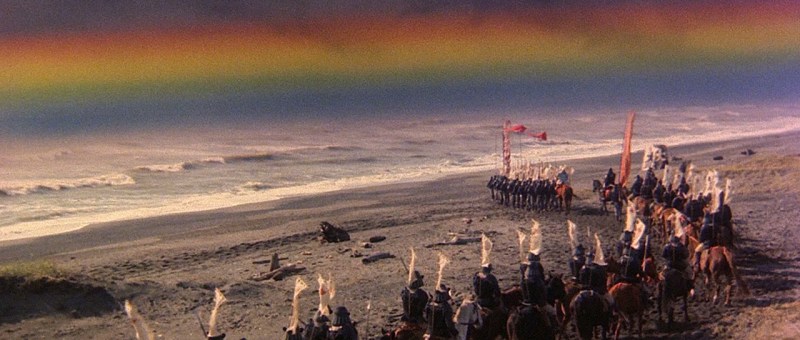
Earlier on he’d had a kind of nightmare, painted in surrealist hues by Kurosawa who conjures battlegrounds of angry reds and violent purples along with ominous rainbows, seeing himself dragged down into the water by Shingen’s ghost which he has now seemingly become. In the end all he can do is accept his fate in a final act of futility running defenceless towards the enemy line and reaching out to retrieve his banner from its watery fate only to be carried past it on a current of red. “I’m not a puppet, you can’t control me” the thief had said, but in the end just like everyone else he was powerless, another casualty of the casual cruelties and meaningless struggles of the feudal order. 


Kagemusha screens at the BFI Southbank, London on 11th & 31st January 2023 as part of the Kurosawa season.

Original trailer (English subtitles)

Ran (乱, Akira Kurosawa, 1985)

ran posterAkira Kurosawa is arguably the most internationally well known Japanese director – after all, Seven Samurai is the one “foreign film” everyone who “doesn’t do subtitles” has seen. Though he’s often thought of as being quintessentially Japanese, his fellow countryman often regarded him as too Western in terms of his filming style. They may have a point when you consider that he made three different movies inspired by the works of Shakespeare (The Bad Sleep Well – Hamlet, Throne of Blood – Macbeth, and Ran – King Lear) though in each case it’s clear that “inspired” is very much the right word for these very liberal treatments.

In the case of Ran (乱) – a loose adaptation of King Lear, Kurosawa moves the story to feudal Japan and an ageing king who this time has three sons rather than three daughters. This leaves Hidetora (Tatsuya Nakadai) with a smaller problem than Lear’s though in his original idea of making his eldest son his heir with the other two inheriting smaller roles it’s clear things aren’t going to end well. Just as in the original play, the oldest two sons Taro and Jiro sing their father’s praises with cynical glee but the youngest and most sincere, Saburo, refuses to play this game as his respect for his father is genuine. Unfortunately, Saburo’s honesty sees him banished from his father’s kingdom and his share of responsibility given over to his treacherous brothers. Predictably, neither is satisfied with what they’ve been given and it’s not long before a familial conflict has sparked into a bloody civil war.

How sharper than a serpent’s tooth it is to have a thankless child….Hidetora is not quite as far gone as Lear in Shakespeare’s original text at the beginning of the film yet he is still unable to see that his oldest two sons have placed personal ambition ahead of filial piety. Hidetora was once a fearsome, if cruel, warrior, famous for burning enemy villages and creating peace only through destruction. He’s old now, and tired and so he proposes to hand over the running of the kingdom to his eldest son, yet – he wants to remain the de facto leader until the very end. Of course, that doesn’t sit well with Taro, or more to the point his ambitious wife Lady Kaede. Hidetora is thrown out of Taro’s castle and then also from Jiro’s before all out war erupts between the two leaving him totally isolated – a king without a kingdom.

Hidetora’s true madness begins when he realises not only how little regard his eldest two sons hold for him, but also that his failure to recognise the true nature of the situation has lead to the deaths of the people in his care that have remained loyal to him to the very end. As the enemy begin to engulf the castle, concubines begin helping each other to commit suicide in order to avoid ravishment while others try to escape but are cut down by arrow fire. This is all his own fault – his ruthless cruelty has been filtered down to his two oldest sons who, as he did, will stop at nothing in the pursuit of power. What is a king if not the father of a nation, and as a father he has failed. Neither Taro or Jiro are worthy of the offices afforded to them and lack both basic humanity and the princely power one needs to become the unifying force of a people.

Only too late does Hidetora see the wisdom in Saburo’s words and finally understand that he has alienated the only one of his children that truly loved him. From this point on his madness increases and Nakaidai’s performance becomes increasingly mannered and theatrical as if Hidetora himself is acting in another play which only he can see. Wandering and lonely, the once great king is reduced to the estate of a beggar led only by his fool and sheltered by the ruins of a castle which he himself burned down.

However, as great as Nakadai is (and he always is), he’s very nearly upstaged by the young Mieko Harada as one of the all time great screen villainesses with the Lady Macbeth a-like Lady Kaede. Filled with a vengeful fury, Kaede is unafraid to use every weapon at her disposal to achieve her goal. No sooner is she brought the news of her first plan’s failure in the death of her husband than she’s embarking on a plot to seduce his brother which includes getting him to execute his wife. Vile as Kaede’s actions often are, her desire for revenge is an understandable one when you consider that Hidetora was responsible for the deaths of her family leaving her to become a trophy bride for the son of the man that killed them. Viewed from another angle, it would be easy to sympathise with Kaede’s desire to rid the world of these cruel and tyrannical lords were it not for her insistence on the death of Lady Sue – a woman in exactly the same position as herself whose death would not actually advance her cause very much at all.

Kurosawa films all of this from a distance. We, the audience, almost become the gods he speaks of – the ones who weep for us, watching silent and helpless, unable to save us from ourselves. We see the world for what it is – chaos, horses and men and blood. The battles aren’t glorious, they are frenetic, frightening and ultimately pointless. Though for all that there is a beauty to it too and the sheer scale of the production with its colour coded princes and immense armies is one the like of which we will never see again.

Ran presents us with a prognosis which is even more pessimistic than that of Lear. At the end of Shakespeare’s play, as profoundly tragic as it is, there is at least the glimmer of hope. There is a new, rightful king and the idea that something has been restored. Here there is no such resolution, we are the blind man casting a stick around the edge of a precipice, entirely alone and unable to see the gaping chasm which extends before us into which we may plunge headlong driven only by the chaos in our own hearts. In the end, Kurosawa’s message is not so different from Shakespeare’s – all the weight of this sad time we must obey, speak what we feel, not what we ought to say. Fathers and sons must strive to understand each other, and themselves, lest we fall into the eternal chaos which leads us to build our very own hell here on Earth.


Ran is currently playing in UK cinemas in a brand new 4K restoration courtesy of StudioCanal!