 Nobuhiko Obayashi might be most closely associated with his debut, Hausu, which takes the form of a surreal, totally psychedelic haunted house movie, but in many ways his first feature is not particularly indicative of the rest of Obayashi’s output. 1984’s The Deserted City (AKA Haishi, 廃市), is a much better reflection of the director’s most prominent preoccupations as it once again sees the protagonist taking a journey of memory back to a distant youth which is both forgotten in name yet ever present like an anonymous ghost haunting the narrator with long held regrets and recriminations.
Based on a novel by Takehiko Fukunaga, The Deserted City is a European influenced, nostalgic, coming of age tale in which university student Eguchi travels to a small Japanese backwater famous for its canals. Though not as sophisticated as Venice itself, the town shares something of the atmosphere of that city as it has often been evoked in literature in its slightly claustrophobic, decaying grandeur. Eguchi has come to the town on an invitation from his uncle and with the intention of spending the summer there to finish his undergraduate dissertation which concerns the work of Edgar Allen Poe.
However, Tokyoite Eguchi immediately finds the town strange, if mostly charming, with its old fashioned rhythms and almost silent soundscape in which only the lapping of the village’s many rivers is audible. Staying in a guest house run by 19 year old Yasuko and her grandmother, Eguchi begins to hear gentle sobbing at night and jumps to the conclusion it must belong to Yasuko’s married older sister, Ikuyo, whom he has yet to meet. Younger brother Saburo also lurks silently in the background with the brother-in-law, Naoyuki, making infrequent appearances. Eguchi had apparently almost forgotten about this single summer in his youth, but was reminded of it after reading a newspaper report that the town had been destroyed in a fire. His memories are coloured by the tragedy which occurred towards the end of his stay and which his youthful soul was not fully able to understand.
The Deserted City revisits many of the themes which came to define Obayashi’s career from the nostalgia for youth and the power of memory to a vaguely supernatural tone which prefigures the final traumatic event that will continue to haunt the protagonist, even if unconsciously, for the rest of his life. Fukunaga was himself very much influenced by European literature and The Deserted City has a distinctly Western feeling with its death ridden canal town and once grand family in decline. Eguchi’s thesis is on the work of Edgar Allen Poe and it wouldn’t be a stretch to say that he is reading his studies into the story of his own life with the mysterious crying and hidden sister not to mention family secrets and the frequent allusions to the sorry state of the moribund city.
Eguchi describes Yasuko as “cheerful” yet she herself offers the most melancholic commentary of her life. She says she hates the town and can’t stand the constant sound of the waters which she likens the death wail of her city – a slothful sound without energy or purpose. She can see all the other young people leaving with only the elderly remaining behind to decay along with the town, but when Eguchi asks why she doesn’t leave too she replies that she can’t, she’s bound to this place in life and death. Similarly when making a visit to her mother’s grave at a nearby temple she remarks that in this place of stillness, she can no longer discern a difference between the living and the dead. Finally, after all the tragedies that have befallen her, Yasuko declares herself to be “nothing at all” and in bidding Eguchi goodbye as he leaves, corrects him when he promises to visit – she knows she’ll never see him again, he will return to the world of the living. He’ll forget all of this, as if it happened in a dream.
Like many of these stories, The Deserted City is filled with the detached melancholy of the older man looking back at the young one. Eguchi says this incident taught him to expect tragedy from the very beginning of things though he also claimed to have forgotten all about the town and its sad stories of longing and misunderstandings, romantic and otherwise. Working with ATG here Obayashi opts for a nostalgic 4:3 frame and a moderately warm colour palate which echoes both the slightly idealised atmosphere of the idyllic waterside village and its nature as a place which exists solely in memory, shaded in tones of nostalgia but also of regret. Much more conventional than some of Obayashi’s other work, The Deserted City is a perfect blend of European romanticism, melodrama and slight gothic undertones which, though a little low on impact, is a perfect synthesis of his themes up to this point.
Unsubbed trailer:
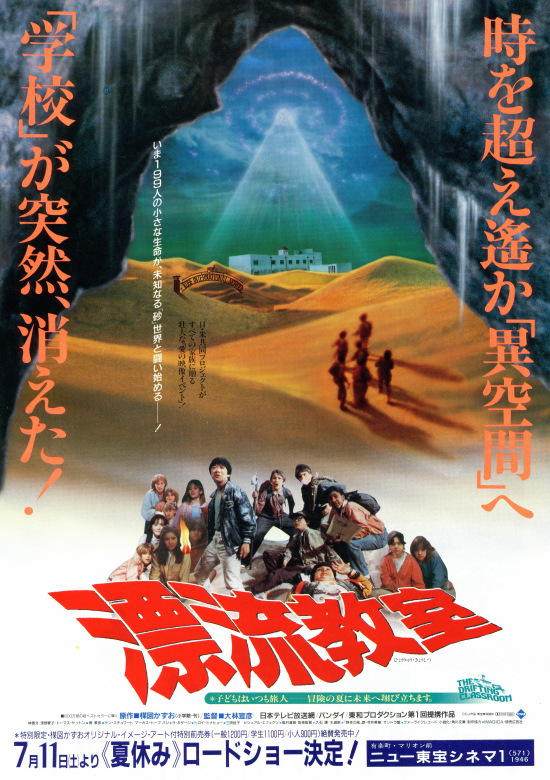 Nobuhiko Obayashi may have started out as an experimental filmmaker and progressed to a lengthy narrative film career but he remains best known for his “what the hell am I watching?” cult classic Hausu. Aside from his 1983 take on The Girl Who Leapt Through Time, very little of his other work has travelled outside of Japan. In the case of 1987’s The Drifting Classroom (漂流教室, Hyoryu Kyoshitsu), this is doubly surprising firstly because it’s based on a hugely popular manga by the godfather of horror comics Kazuo Umezu and secondly because it’s set in an international school so around 80% of the dialogue is in English.
 Windows on Worlds