My Wonderful Yellow Car (吹けよ春風, Senkichi Taniguchi, 1953)

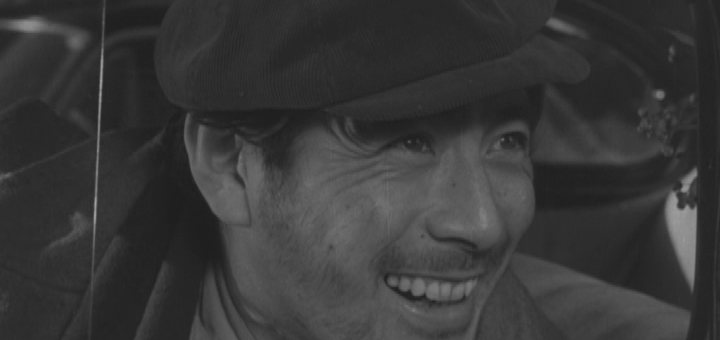
A kind-hearted taxi driver becomes our guide to the post-war society in a cheerful omnibus movie co-scripted by Akira Kurosawa and directed by Senkichi Taniguchi, My Wonderful Yellow Car (吹けよ春風, Fukeyo, Haru Kaze). Inspired by a Reader’s Digest column titled “human nature as seen in the rearview mirror”, the film follows cheerful cabbie Matsumura (Toshiro Mifune) as he drives around Tokyo in 1953 picking up various fares and sometimes adding commentary or trying to help with whatever kind of problem seems to be bothering them.

Then again, he stays well out of the first fare’s business as a young couple have obviously had some kind of falling out. Bursting into tears, the girl (Mariko Okada) announces that she wants to postpone the wedding and maybe even rethink this whole thing, while the boy reiterates with slight irritation that he’s said he’s sorry with the implication that that should be the end of it though we have no idea what (if anything) he’s actually done. In any case, they eventually patch things up over some canoodling in the back seat and ask to be dropped off so they can get something to eat. In some ways, the young couple represent a more hopeful vision of post-war youth who have no apparent worries besides their tiff and are financially comfortably enough not only to be getting married but can afford to travel by taxi and pay for a meal on the same occasion. 

Their situation is later contrasted with that of an older couple who’ve moved from Osaka to Tokyo in their old age and have bought a box of live lobsters to celebrate their silver wedding anniversary but as Matsumura notes though they appear to be quite well off they also seem somehow sad. That turns out to be because they lost their only son the previous summer and have moved into his old apartment. The old lady also cries in the back seat, but for a completely different reason. As they’ve only just moved here, they don’t have friends or anything to do and are completely lost in the wake of their son’s death. Matsumura’s kindness is demonstrated when he borrows three flowers from a bouquet delivered to a girl at the petrol station and presents them as an anniversary gift. The couple are so touched they invite him to enjoy their anniversary dinner with them and by the end of it have made the decision that they should go back to Osaka and restart their lives by re-opening their old business.

Throughout all this, Matsumura is very conscious of the meter. Every second he spent in the old couple’s apartment cost him money, but as he’s fond of saying you can’t always think of things like that. Even so, he reminds himself he has a wife and child so should be mindful of the clock but still turns down a fare to go back to the station and check on a young girl he’s pretty sure is trying to run away from home. A weird guy was sniffing around her and was in fact just about to lead her off when Matsumura gets back and announces he’s come to pick her up. Matsumura spends the rest of the ride trying to convince her to go home, repeatedly reminding her that most of the “panpans”, or streetwalking sex workers catering to US servicemen, were also once runaway girls. To more modern eyes we might wonder if sending her home is what’s best without knowing the reasons she wanted to leave. He goes so far as to buy her ramen which costs him more money on top of the lost fare which doesn’t collect from her either when he, a little less responsibly, abandons her when she refuses to tell him where she lives. Thankfully, it all seems to work out. The girl made a sensible decision to go home after all and is later seen happily doing her Christmas shopping with her mother who also thanks him for looking out for her.

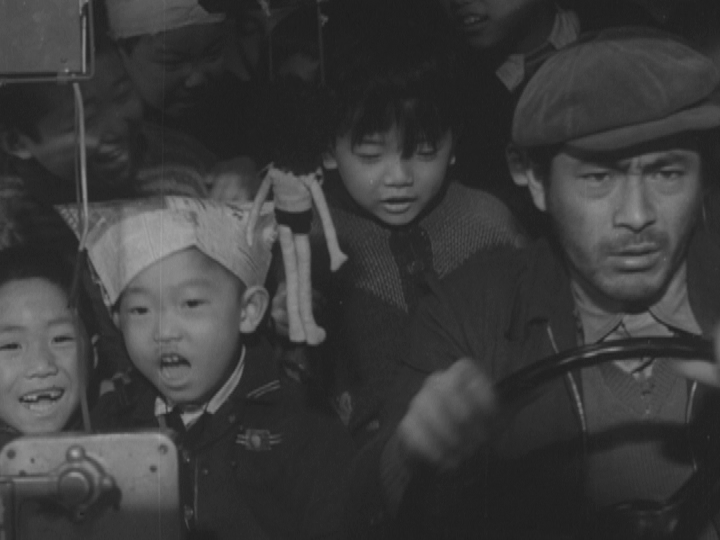
Perhaps these kinds of altruistic acts of kindness explain why Matsumura’s own clothes are quite ragged with a hole in his jumper and a tear to the shoulder of his jacket. He’s driving the cab in straw sandals which apart from anything else is probably quite cold in the winter. He spends another afternoon giving a free ride to some children, about 15 of them, who’ve crowdfunded 100 yen because they’ve never been in a car before and want to go as far it’ll take them having no idea that 100 yen is actually the initial charge so you can’t go anywhere on it all. Of course, Matsumura ends up taking them a bit further, and then realises he’ll have to take them back to where they were because they won’t have any other way of getting there or of knowing where they are now.

On the other hand, sometimes he ends up with nuisance fares such as two drunk guys who keep singing their university song. One of them even climbs out of the window and up onto the roof, causing Matsumura to assume he’s fallen off somewhere and he’ll have to go back and look for him to make sure he’s not hurt only to find him burbling in the footwell. He also ends up getting hijacked by a crook with a gun on his way back from Yokohama but getting a telling off from the police rather than a thank you for catching him after unwisely taking hold of the gun himself and messing up all the fingerprints. 

One might think the time he had a famous actress in the back of his cab who even sang along with the jingle he’d written for the cheerful yellow vehicle might make up for all that, but he says the story that best exemplifies why he loves driving a taxi is that of a middle-aged couple he picked up at the harbour shortly after a boat had docked repatriating people from China. Even in 1953, some had not yet returned after becoming trapped by the Chinese Civil War and eventual Communist victory. The man is dressed in military uniform and says he’s just been demobbed when Matsumura asks him, trying to lighten the mood while there’s obviously some degree of tension between the man and his wife. But as we gradually come to understand, it’s all just a ruse and he has in fact been in prison in Japan for the last seven years for an unspecified crime.

His wife asks Matsumura to drive around the city and attempts to show him how much things have recovered, suggesting that they can now put the past behind them and start over. But the man remains sullen and grumpy. He’s afraid to go home, afraid to face the neighbours worrying if they know what he did and that he’s been in prison. But most of all he’s afraid to face his children, the youngest of which he’s never met. The kids have been teaching themselves to say “Welcome home, Daddy,” in Mandarin believing he’s been in China all this time which the wife has to explain before they get there. The man tells his wife he understands if she doesn’t want him back, but she assures him that the children are excited as is she to start their new life together. Nevertheless, though they’ve been eagerly practicing, the older two children simply freeze when confronted by this anxious stranger who turns around to leave again feeling as if he doesn’t have the right to come back here after all only for the youngest one to suddenly pipe up with the phrase note perfect. It’s this kind of scene, getting people to where they need to be physically and emotionally, that seems to make Matsumura’s job worthwhile. In essence, he’s ferrying people towards the cheerful post-war future his cute yellow cab represents while driving round the rapidly changing city wondering who it is that’s going to end up in the rearview mirror today.


Title song (no subtitles)
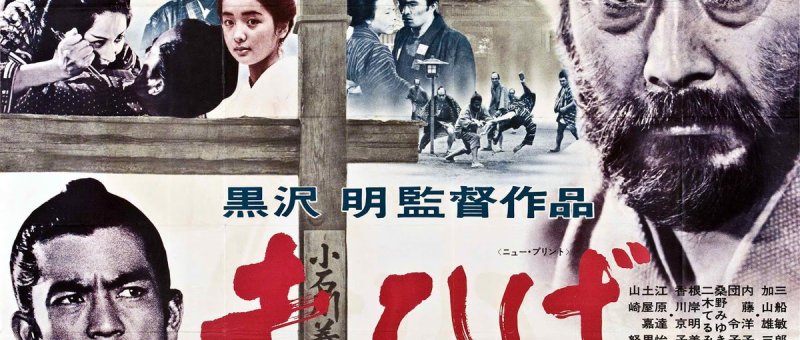
Red Beard (赤ひげ, Akira Kurosawa, 1965)

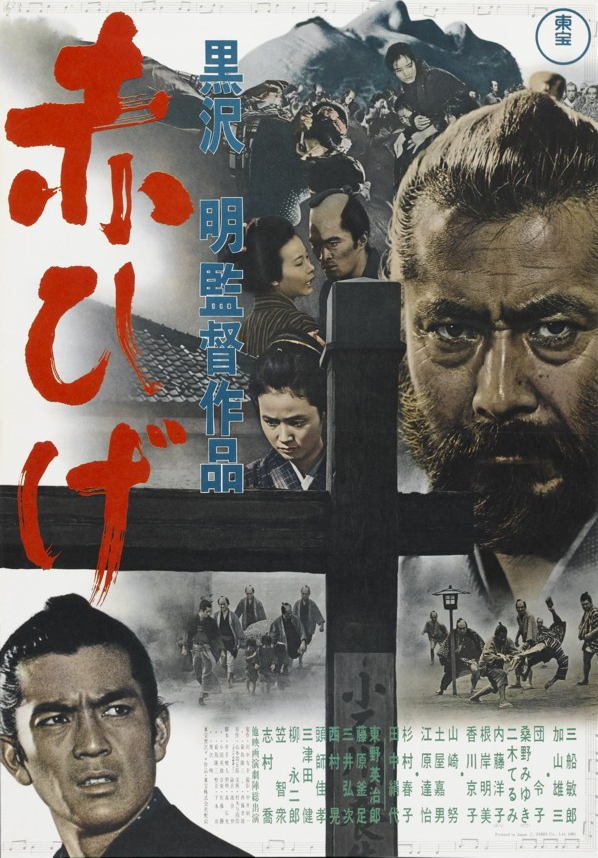
Red Beard posterAkira Kurosawa may be the most familiar golden age director of Japanese cinema to international audiences, but he was in many senses somewhat atypical. Where many of his contemporaries were eager to tell the stories of women, Kurosawa’s films are resolutely male and where many were keen to find the good among the bad, Kurosawa was often keen on the reverse. Nevertheless, that does not mean that he did not see goodness, merely that it was something which needed to be rooted out and fought for rather than simply permitted to exist. His final collaboration with Toshiro Mifune, Red Beard (赤ひげ, Akahige) finds the director at his most optimistic, fully embracing his natural tendency towards humanism even while making plain that goodness can often be hard to find, especially within yourself, and there may be no real cure for injustice but you have to treat the symptoms anyway.

The tale begins at the close of the Tokugawa era as a young doctor, Yasumoto (Yuzo Kayama), pays a courtesy call to the Koishikawa public clinic presided over by an old friend of his father’s, Doctor Niide (Toshiro Mifune) – otherwise known as “Red Beard”. Yasumoto, having just graduated from studying under the Dutch in Nagasaki, had only intended to make a brief visit on his way home and is therefore shocked to realise that he has been tricked into accepting a position at a hospital for the poor.

Our introduction to the Koishikawa clinic is through the eyes of Yasumoto as he receives a tour from another doctor who loudly remarks that he is glad that Yasumoto has now arrived because that means he can finally be free of this wretched place. Yasumoto’s nose wrinkles on smelling the “rotting fruit” of the poor waiting for afternoon appointments, while one of the patients complains about the “sterility” of the environment and his plain hospital clothes before a genial inpatient, Sahachi (Tsutomu Yamazaki), explains the reasoning behind such austerity and praises the attention to detail of head doctor Red Beard who has thought carefully about the best way to ensure his patients experience the best of care.

Yasumoto is extremely displeased by his predicament. He had believed himself on track to become a royal doctor working for the Emperor and being sent to poor clinic seems like a poor joke. He is indeed extremely full of himself, refusing to surrender his medical notes from Nagasaki as if he had made some great discovery and hoped to profit from it. Hoping Red Beard will fire him, Yasumoto behaves like a petulant child – refusing to wear his uniform, deliberately stepping into areas he knows are out of bounds, refusing to see patients, and just generally being unpleasant to have around. Red Beard is stoic and patient, though it gradually becomes apparent that perhaps Yasumoto has been sent here deliberately for a humbling everyone believes he had coming to him. Asked to perform the most routine of tasks, Yasumoto is forced to realise that the medical knowledge of which he was so proud is mostly book learning. He doesn’t know how to diagnose a living patient, has never been present at an operation, and has never sat with someone while they died knowing there was nothing more he could do for them. Reluctantly, he has to accept that the advice he received from the other doctors on his first day, that there was much to be learned here for those who wanted to learn it, was as true as it could be.

The first half of the film is indeed Yasumoto’s humbling as he begins to come around to the mysterious workings of Red Beard who gradually leads him to understand his first duty as a doctor is help those in need. Then again, Red Beard is an unwilling mentor. He is fully aware of the corruptions of the world in which he lives but has made a decision with which he remains conflicted to bend them to his advantage. Enraged to discover his government funding is being cut, Red Beard deliberately over charges the local lord whom he, amusingly enough, puts on a diet as he snorts like a piggy short of breath thanks to his unhealthy life of luxury. He also blackmails another local lord to save a young mother who turned a knife on an abusive husband, and later uses his medical knowledge to unfair advantage to take out a whole gang of yakuza. Red Beard isn’t sure he’s in a position to become anyone’s role model, but that only seems to make Yasumoto respect him more.

Nevertheless, there is darkness too in Red Beard’s philosophy. The real enemy here and perhaps everywhere is poverty and the selfishness which enables it. Most of the diseases Red Beard treats in his clinic are a direct result of impoverished living, mostly those of malnutrition and overwork as well as the necessity of living in cramped, unsanitary conditions. Yasumoto, a young man of means, has a puffed up sense of self and a natural ambition that tells him he is destined for the court and so he looks down on these unfortunate people as something other, something that does not concern him and is not worthy of his attention. He won’t put on his uniform out of spite, but eventually relents when Sahachi explains to him that the uniform marks him out as member of the clinic meaning that ordinary people who cannot afford to pay a doctor know that he is someone they can ask for help when no one else will help them.

As Red Beard says, there may be no real cures for disease. All they can do is fight poverty and mask their ignorance. Yasumoto learns by experience. He discovers the rampant injustice of his society in the sad stories that he hears. A “mad” woman who became a serial killer after years of childhood abuse, a woman who rejected a good father out of fear and allowed a bad mother to marry her to a bad man who was also her mother’s lover, a little girl adopted by a cruel madam who turned in on herself when she tried to press her into sex work at only 12 years old, a sex worker suffering with syphilis but too valuable to be released and sent home. This world is built is built on female suffering which is not, perhaps, something which Red Beard is in much of a position to treat.

The mad woman tries to hang herself and Red Beard wonders if it would have been kinder let her die, while the mother of a family who decided on group suicide asks him what the point was in saving her. The world is not an easy place to live in, but Red Beard’s prescription is refreshingly simple. One heals oneself by helping others, as he proves to Yasumoto through making him both doctor and patient to a wounded little girl who then passes her new found humanity on to another needy soul eventually reformed by kindness alone. Day by day, Red Beard goes to war against selfishness and indifference, treating the symptoms in order to undermine the disease which has infected his society in the hope that it might eventually decide to cure itself.


Original trailer (No subtitles)

Seisaku’s Wife (清作の妻, Yasuzo Masumura, 1965)

Seisaku's wife posterFor Yasuzo Masumura, sexuality is both freedom and constraint but also the ultimate act of social rebellion. Seisaku’s Wife (清作の妻, Seisaku no Tsuma), set in late Meiji as Japan prepares for the possibility of war with Russia, finds its melancholy heroine a defiant outcast as she first abandons her cruel, conformist society for empty independence and then reclaims her sense of self only through a love deemed inappropriate by those around her. The seeds of militarism are already being sown and breaking the programming is hard but transgressive acts of love can, it seems, overcome persistent societal oppression.

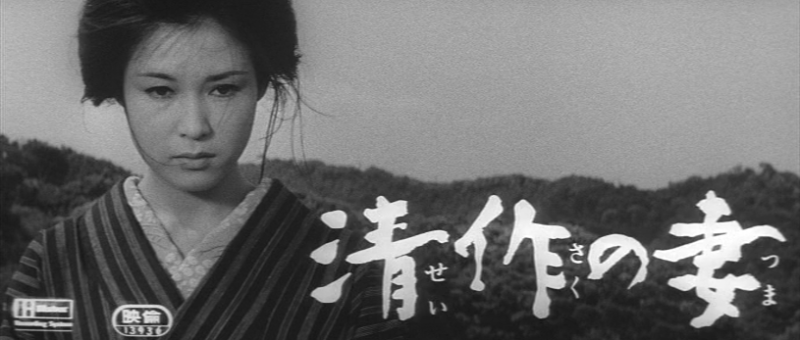
Okane (Ayako Wakao), our heroine, was sold as a bride to a much older man (Taiji Tonoyama) at 17 to provide for her parents. Three years later she views her husband, a wealthy kimono merchant, with contempt – as does much of the local area where he is derided as a sex crazed pervert. Luckily for her, Okane’s husband eventually dies leaving her a small sum of money while his extended family would rather she absent herself as quickly as possible to minimise embarrassment. Her father now too passed away, she and her mother (Tamae Kiyokawa) return to their home village which they were chased out of some years previously for their massive debts, but are now resented by their former neighbours for their seeming wealth and aloofness. Okane, traumatised by her experiences and having lost the will to live, barely interacts with the villagers who regard her as arrogant and haughty, and has been ostracised as a result.

The situation begins to change with the return of Seisaku (Takahiro Tamura) – the village’s bright hope. Seisaku had been away doing his military service and has come back with order and discipline on his mind. Now believing that the villagers are lazy and frivolous he has brought back with him a bell he had forged himself which he hooks to a nearby tree and bangs early in the morning to “awaken” them lest they sleep in rather than hasten to their fields. As might be anticipated, the villagers find this quite irritating but respect Seisaku too much to stop him and so find themselves going along with his new brand of militarist austerity. Meanwhile Okane is the only one to refuse the call, wasting no time in telling Seisaku that she has no intention of following his “orders” and his assumption that she should is in itself offensive.

Seisaku is intrigued rather than offended and finds himself attracted to Okane despite the villagers’ obvious animosity towards her. Convincing her that his feelings are real, the pair drift into an intense sexual relationship which eventually sees the model soldier Seisaku make a transgressive choice of his own in rejecting his longstanding betrothal to a village girl in favour of marrying Okane without the approval of his conservative mother and sister. Holed up together in Okane’s remote farmland shack, they remove themselves as much as possible from village life in an insular, obsessive world of their own.

Okane, rejected because of her past as the kept woman of a wealthy man (something over which she herself was powerless and means never to be powerless again), in turn rejects the village after having lost all faith in human relationships except perhaps that with her mother whose cruel treatment at the hands of her father she both identified with and resented. Intensely lonely, she subsumes herself entirely into her love for Seisaku, eventually trying to rebuild bridges in the village in order to strengthen their relationship but finding herself rejected once again by Seisaku’s austere mother even if his sister begins to come around. Meanwhile, the spectre of the war hovers on the horizon. Seisaku, as hopelessly in love with Okane as he is, is still the model soldier in his heart and unwilling to abandon his proto-militarist ideology which tells him that dying in service of the nation is man’s highest calling.

Having abandoned such obvious brainwashing to claim her independence, Okane struggles to convince Seisaku he should do the same. She clings to him and pleads, begging him not to leave her behind alone while he resolves to go off to battle and a glorious death. The village men too regard failure to die on the battlefield as a disgrace but send their sons away with cheers and celebration. Facing the possibility her dream of love may die, Okane takes drastic action to ensure its survival but does so at an ironic cost which sees her separated from her love possibly forever. Seisaku, meanwhile, angry and resentful, begins to understand something of Okane’s life when branded a coward and traitor by his former friends, no longer the model soldier but an outcast himself. Having suffered her fate, he begins to let go of his rage in favour compassionate understanding, allowing his love to triumph over his hate as he strives to forgive the woman who has both trapped and helped him to free himself from the oppressive ideology which turned him into an unthinking “model soldier” who wilfully abandoned his freedom in favour of internalised conventionality.

Freed from didactic social brainwashing, the pair are then in a sense imprisoned by their individualistic freedom, forced to isolate themselves within a bubble of love and mutual dependence but with a new hope for the future for which they now plan even while acknowledging that they cannot know what will come of it save that they will face it together. They can no longer live within the conservative society, but must form their own new world within it in which they can be fully free and express their freedom through their love. Melancholy but tranquil, Masumura ends on an uncharacteristically hopeful note which implies that love, though violent and transgressive, can be an effective weapon against destructive militarist ideology and the folly of war through a warmer path towards compassionate freedom.


Original trailer (no subtitles)

https://www.youtube.com/watch?v=ZBfptg9w7qk