Mr. Pu (プーサン, Kon Ichikawa, 1953)

Perhaps ironically, film censorship under the American Occupation was just as heavy as it had been under the wartime authorities if tilting in a different direction. Depicting the feudal past and straitened present were equally discouraged, as was anything that showed the Occupation forces in a less than ideal light. These restrictions were, however, lifted when the Occupation came to an end in 1952 and Kon Ichikawa’s adaptation of the comic strip by Taizo Yokoyama, Pu-san (プーサン), is a relatively early attempt to address this second round of post-war chaos characterised by high unemployment and defeated hopes for the future.

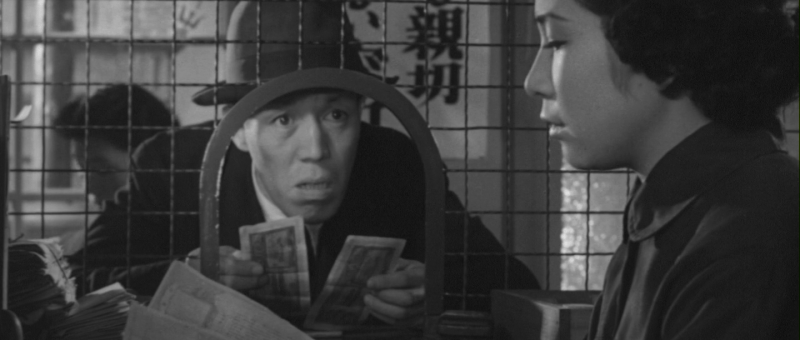
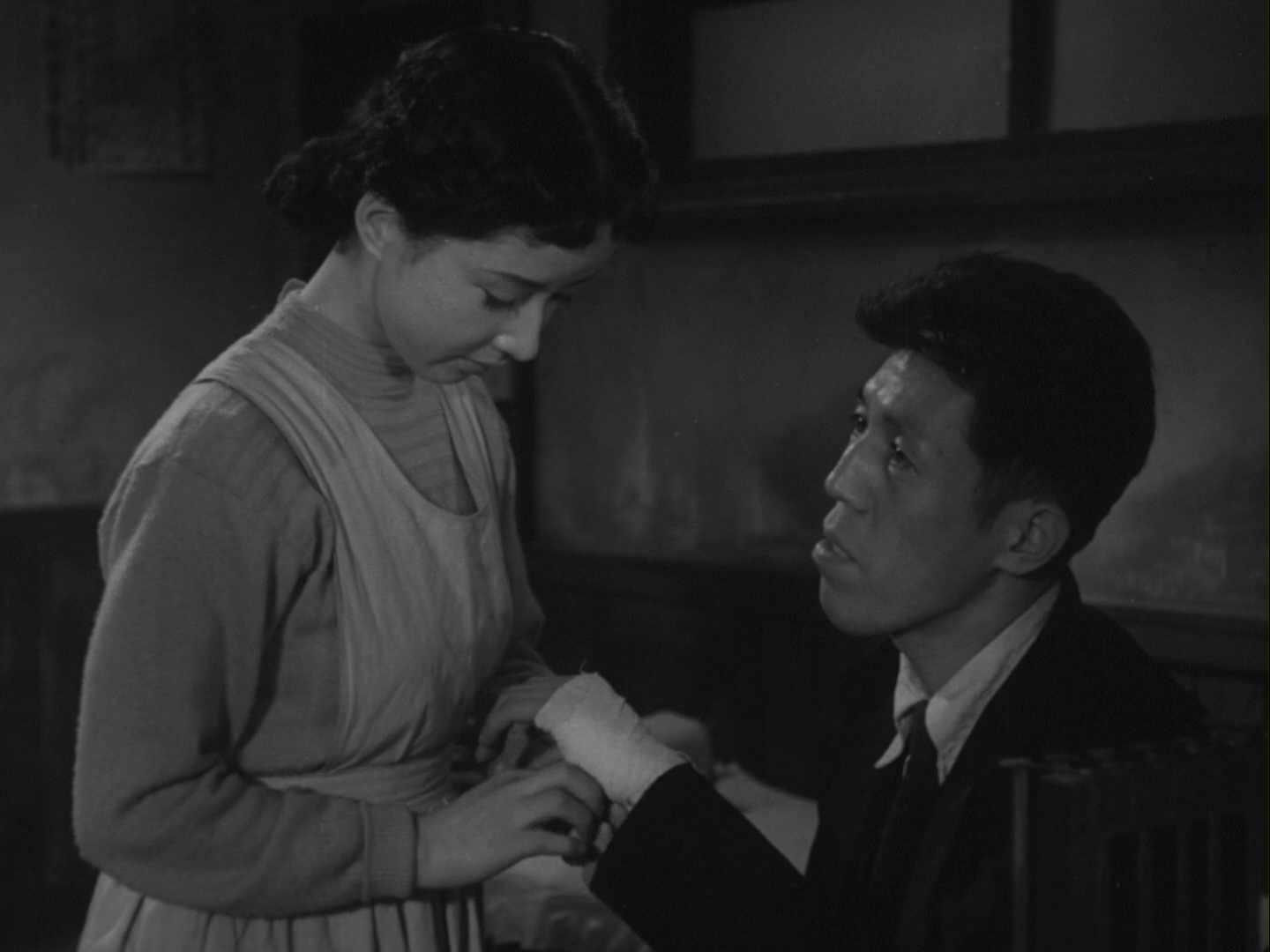
Yokoyama apparently settled on the nickname “Pu-san” just because it sounded funny, though the strip later moved away from the title character to focus more on an ensemble. That may be why the name is never mentioned during the film which also incorporates elements from another Yokoyama strip, Miss Ganko. The film then focuses on mild-mannered maths teacher Noro (Yunosuke Ito), a widower and war veteran living in a boarding house where he has developed a crush on the landlady’s daughter, Kanko (Fubuki Koshiji). Noro is the sort of person destined to suffer in life as evidenced by the opening sequence in which he is almost run over by a truck, but actually ends up injuring himself by becoming entangled with a fire hydrant in his botched attempt to move out of the way.

Nevertheless, he is really at the centre of a collection of people who are struggling amid the difficult economic environment of the early 1950s in which the nation still has not fully emerged from post-war privation. His boss at the school where he works (Daisuke Kato) is clearly exploiting his nature as someone unlikely to complain about ill-treatment by asking him to work both the day and night shift for no additional pay while forgoing a pay rise he suggests he may later to give to the other teachers. Noro goes along with it because he thinks it’s better to have a job than not and others are hard to come by. His students, meanwhile, are ideologically volatile, flirting with communism or trying to defend the nascent capitalism of the democratic society. It’s one of his students that invites him to the May Day march which leads to him being caught up in the “Bloody May Day Incident” of 1952 in which the police fired on protesters opposing the Anpo security treaty killing two and injuring 2,300 people.

Because Noro is an unlucky person, a photograph of him at the event is published in the newspaper which leads to him being fired from his job. He’s then thrown into a world of job hunters jostling for work outside the employment office with seemingly hundreds of applicants for every position. Many assume him to be further up the queue because he is a university graduate, but it’s clear that things like that no longer really matter in the post-war society and may even hinder his prospects. The job he eventually finds, thanks to his landlady’s recommendation which she only gets for him with the expectation of being able to raise his rent, is working as a deliveryman for a sewing machine company. 

After the war, Singer Sewing Machines gave the patent for the Singer 15 to Japanese factories so that those which once manufactured munitions could transition to making sewing machines. However, most in the film seem to be aware that these factories are actually still making bullets for machine guns, which turns out to be the case at the factory where Noro gets a job. Japan’s post-war recovery will largely be powered by manufacturing munitions and military equipment to be used in the Korean War. This leaves Noro understandably conflicted and leads to an ongoing sense of confusion about the nature of this new “pacifist” and “democratic society”, though he justifies himself that his is only a light crime as his complicity extends only to the delivery and not to the manufacture of these deadly weapons. The ranks of the protestors at the May Day march are contrasted with those of soldiers once again marching through the streets. Harried doctor Tezuka (Isao Kimura), sick of having to rush through patients, has apparently joined the Self Defence Forces instead. 

“Miss Stubborn” Kanko, by contrast, has a good job in a bank and though she goes on a kind of date with Noro, has fallen in love with a colleague she wishes to marry. Her mother objects to the match because her boyfriend is only a middle-school graduate, but as Kanko points out he’s had a steady job and worked his way up since he was 16. A university degree might not mean very much at the present time and those who entered employment earlier might actually have a head start. In a rather cruel moment, Noro overhears Kanko tell her mother that university graduates like him are “boring” while simultaneously suggesting they take part back of the area he’s currently renting to rent out separately without reducing his rent so they can make more money. Her father, an accountant who’s ironically never made enough to pay tax, has made himself ill through overwork leaving them largely dependent on rental income. Kanko intends to continue to working after marriage, though expects that her husband will eventually be promoted to a position offering a salary that will support a family.

This is not a realistic prospect for Noro, who has now essentially been cast aside by the post-war society. His hopes of romantic fulfilment with Kanko have been dashed, exposing his vision for a rosy future as nothing more than a delusional fantasy. Caught between idealistic students who have been, like him, displaced in the new democratic era, and amoral capitalists like his former boss and landlady, he has little other choice but to retreat into the mist of an uncertain future. Unexplored subplots including a sleazy right-wing politician’s collusion with the bank manager, hint at a still murkier world of backroom deals ruled by self-interest that betrays the “democratic” ideals of the new society along with those of a man mild-mannered man like Noro who can only survive by embracing his troubles with good humour.
My Wonderful Yellow Car (吹けよ春風, Senkichi Taniguchi, 1953)

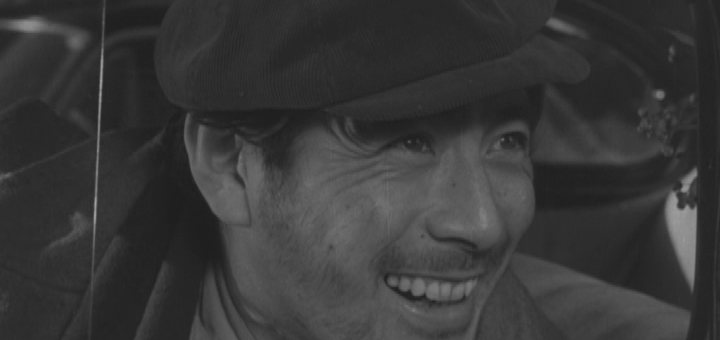
A kind-hearted taxi driver becomes our guide to the post-war society in a cheerful omnibus movie co-scripted by Akira Kurosawa and directed by Senkichi Taniguchi, My Wonderful Yellow Car (吹けよ春風, Fukeyo, Haru Kaze). Inspired by a Reader’s Digest column titled “human nature as seen in the rearview mirror”, the film follows cheerful cabbie Matsumura (Toshiro Mifune) as he drives around Tokyo in 1953 picking up various fares and sometimes adding commentary or trying to help with whatever kind of problem seems to be bothering them.

Then again, he stays well out of the first fare’s business as a young couple have obviously had some kind of falling out. Bursting into tears, the girl (Mariko Okada) announces that she wants to postpone the wedding and maybe even rethink this whole thing, while the boy reiterates with slight irritation that he’s said he’s sorry with the implication that that should be the end of it though we have no idea what (if anything) he’s actually done. In any case, they eventually patch things up over some canoodling in the back seat and ask to be dropped off so they can get something to eat. In some ways, the young couple represent a more hopeful vision of post-war youth who have no apparent worries besides their tiff and are financially comfortably enough not only to be getting married but can afford to travel by taxi and pay for a meal on the same occasion. 

Their situation is later contrasted with that of an older couple who’ve moved from Osaka to Tokyo in their old age and have bought a box of live lobsters to celebrate their silver wedding anniversary but as Matsumura notes though they appear to be quite well off they also seem somehow sad. That turns out to be because they lost their only son the previous summer and have moved into his old apartment. The old lady also cries in the back seat, but for a completely different reason. As they’ve only just moved here, they don’t have friends or anything to do and are completely lost in the wake of their son’s death. Matsumura’s kindness is demonstrated when he borrows three flowers from a bouquet delivered to a girl at the petrol station and presents them as an anniversary gift. The couple are so touched they invite him to enjoy their anniversary dinner with them and by the end of it have made the decision that they should go back to Osaka and restart their lives by re-opening their old business.

Throughout all this, Matsumura is very conscious of the meter. Every second he spent in the old couple’s apartment cost him money, but as he’s fond of saying you can’t always think of things like that. Even so, he reminds himself he has a wife and child so should be mindful of the clock but still turns down a fare to go back to the station and check on a young girl he’s pretty sure is trying to run away from home. A weird guy was sniffing around her and was in fact just about to lead her off when Matsumura gets back and announces he’s come to pick her up. Matsumura spends the rest of the ride trying to convince her to go home, repeatedly reminding her that most of the “panpans”, or streetwalking sex workers catering to US servicemen, were also once runaway girls. To more modern eyes we might wonder if sending her home is what’s best without knowing the reasons she wanted to leave. He goes so far as to buy her ramen which costs him more money on top of the lost fare which doesn’t collect from her either when he, a little less responsibly, abandons her when she refuses to tell him where she lives. Thankfully, it all seems to work out. The girl made a sensible decision to go home after all and is later seen happily doing her Christmas shopping with her mother who also thanks him for looking out for her.

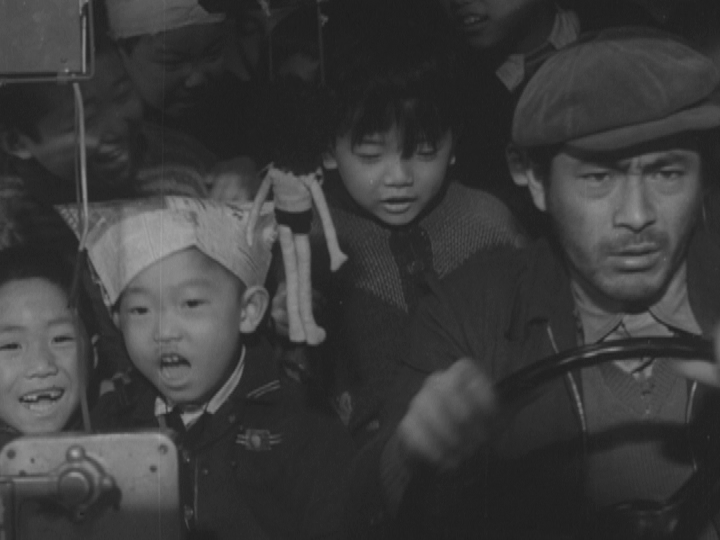
Perhaps these kinds of altruistic acts of kindness explain why Matsumura’s own clothes are quite ragged with a hole in his jumper and a tear to the shoulder of his jacket. He’s driving the cab in straw sandals which apart from anything else is probably quite cold in the winter. He spends another afternoon giving a free ride to some children, about 15 of them, who’ve crowdfunded 100 yen because they’ve never been in a car before and want to go as far it’ll take them having no idea that 100 yen is actually the initial charge so you can’t go anywhere on it all. Of course, Matsumura ends up taking them a bit further, and then realises he’ll have to take them back to where they were because they won’t have any other way of getting there or of knowing where they are now.

On the other hand, sometimes he ends up with nuisance fares such as two drunk guys who keep singing their university song. One of them even climbs out of the window and up onto the roof, causing Matsumura to assume he’s fallen off somewhere and he’ll have to go back and look for him to make sure he’s not hurt only to find him burbling in the footwell. He also ends up getting hijacked by a crook with a gun on his way back from Yokohama but getting a telling off from the police rather than a thank you for catching him after unwisely taking hold of the gun himself and messing up all the fingerprints. 

One might think the time he had a famous actress in the back of his cab who even sang along with the jingle he’d written for the cheerful yellow vehicle might make up for all that, but he says the story that best exemplifies why he loves driving a taxi is that of a middle-aged couple he picked up at the harbour shortly after a boat had docked repatriating people from China. Even in 1953, some had not yet returned after becoming trapped by the Chinese Civil War and eventual Communist victory. The man is dressed in military uniform and says he’s just been demobbed when Matsumura asks him, trying to lighten the mood while there’s obviously some degree of tension between the man and his wife. But as we gradually come to understand, it’s all just a ruse and he has in fact been in prison in Japan for the last seven years for an unspecified crime.

His wife asks Matsumura to drive around the city and attempts to show him how much things have recovered, suggesting that they can now put the past behind them and start over. But the man remains sullen and grumpy. He’s afraid to go home, afraid to face the neighbours worrying if they know what he did and that he’s been in prison. But most of all he’s afraid to face his children, the youngest of which he’s never met. The kids have been teaching themselves to say “Welcome home, Daddy,” in Mandarin believing he’s been in China all this time which the wife has to explain before they get there. The man tells his wife he understands if she doesn’t want him back, but she assures him that the children are excited as is she to start their new life together. Nevertheless, though they’ve been eagerly practicing, the older two children simply freeze when confronted by this anxious stranger who turns around to leave again feeling as if he doesn’t have the right to come back here after all only for the youngest one to suddenly pipe up with the phrase note perfect. It’s this kind of scene, getting people to where they need to be physically and emotionally, that seems to make Matsumura’s job worthwhile. In essence, he’s ferrying people towards the cheerful post-war future his cute yellow cab represents while driving round the rapidly changing city wondering who it is that’s going to end up in the rearview mirror today.


Title song (no subtitles)

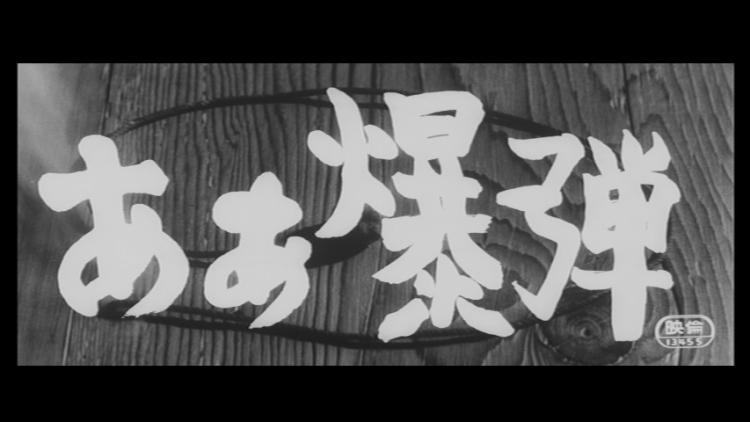
Oh, Bomb! (ああ爆弾, Kihachi Okamoto, 1964)

vlcsnap-2016-07-12-23h44m56s789Being stood up is a painful experience at the best of times, but when you’ve been in prison for three whole years and no one comes to meet you, it is more than usually upsetting. Sixth generation Oyabun of the Ona clan, Daisaku, has made a new friend whilst inside – Taro is a younger man, slightly geeky and obsessed with bombs. Actually, he’s a bit wimpy and was in for public urination (he also threw a firecracker at the policeman who took issue with his call of nature) but will do as a henchman in a pinch. Daisaku wanted him to see all of his yakuza guys showering him with praise but only his son actually turns up and even that might have been an accident.

His mistress has moved on, his wife got religion, and the clan has gone legit and formed a corporation. That last bit might have been OK except Daisaku isn’t the president, he’s the Chairman, and the new top dog is a pen obsessed political candidate who runs under the slogan that pens can save Japan and violence is the enemy! Taro and Daisaku come up with a way to get revenge on the usurper by sneaking a bomb into one of his beloved writing implements but it’s far from plain sailing in this typically anarchic Okamoto world.

Okamoto casts his ironic tale as a musical, cartoon style slapstick comedy with frequent digressions into musical interludes which take inspiration both from Hollywood movie musicals and classical Japanese drama. Daisaku may only have been inside for three years but he’s a man out of time with behaviour and attitudes more suited to the pre-war world than the modern era. Consequently he often breaks into theatrical rhythms inspired by noh or kabuki with their characteristic chant style recitative and stylised movements. Younger characters sing in the vernacular of the day with Taro and Daisaku’s son belting out a popular hit, and the office workers suddenly breaking into a musical set piece themed around the idea of overtime in which the men and women of the office bicker about balancing the books. Similarly, the would be mayor, Yato, takes his cues from ‘20s gangsters so he naturally dances the charleston before breaking into a tango when he gets some unwelcome news.

Rhythm is the key as the film continues to respond to its various musical fluctuations in highly stylised approach which takes advantage of Okamoto’s innovative editing techniques. Apparently inspired by a Cornell Woolrich story, this is nominally a noir inflected crime story of an ousted gangster trying to rub out his rival and get his old life back, but Okamoto neatly deconstructs the genre and turns it inside out with a hefty serving of irony on the top. Daisaku is an old guy and his era has passed, but Yato isn’t real enough to represent the future either which seems to either belong to bumbling bomber Taro, or Daisaku’s hardworking and straightforward son.

The plot to blow up Yato using his favourite prop becomes progressively more ridiculous as the pen ends up everywhere but where it’s supposed to be and threatening to explode at any second (to great comic effect). Things get even darker when Yato is talked into considering the orchestration of an “accident” for his mayoral rival involving a golf ball which once again causes everyone a lot of bother (though not the kind that was intended).

Daisaku has brought some of his old fashioned habits out of jail with him, quickly corrupting his old friend the chauffeur (who ultimately proves incorruptible even if grateful to have been reminded of the happiness he already shared with his wife, poverty or no) and allowing Taro and his crazy bomb plots access to the criminal mainstream, but ultimately he proves more of a loveable rogue living in the past than a criminal mastermind. Yato, by contrast, is a darker figure with his hypocritical campaign slogans and lack of personal integrity. Daisaku may be deluded in many ways but he never pretends to be anything other than he is, unlike the would be dictator.

Filled with Okamoto’s idiosyncratic touch of absurd irony, Oh, Bomb! (ああ爆弾, Aa Bakudan) is one of his most amusing and formally ambitious pieces of work. Mixing classical theatrical techniques with modern movie musicals, jazz rhythms, expressionist sets and unpredictable editing, he once agains creates a crazy cartoon world in which anything is possible but somehow it’s all quite good natured even when you’re talking about bank robbery and possible assassination plots. Hilarious fun but also intricately constructed, Oh, Bomb! ranks among Okamoto’s most charming masterpieces and is urgently in need of a reappraisal.