
Young Black Jack (ヤング ブラック・ジャック, Kentaro Otani, 2011)

The Black Jack of Osamu Tezuka’s classic manga is a morally ambiguous figure who cultivates an image of callousness through asking for exorbitant sums to cure often desperate people, but in reality will usually treat seriously ill patients if touched by their plight or is content to collect the money from another source ensuring a kind of social justice is done. A spin-off manga written by Yoshiaki Tabata and illustrated by Yugo Okuma, Young Black Jack (ヤング ブラック・ジャック), was published from 2011 to 2019 and was set in the 1960s when Black Jack was gifted young medical student living through a politically turbulent era. 

Broadcast in 2011, this television special meanwhile updates the action to the present day while acting as a kind of double origin story if one set in a more realistic world. As a nine-year-old boy, Black Jack asks his mother to meet him by the Christmas display in a local shopping mall. Not having had enough money to buy his mother a red rose, he patiently sits and draws one under the tree while otherwise oblivious to the news being broadcast on a large screen explaining that there has been a series of bombings in the city and the next target is this very mall. Black Jack’s mother has become mute after a traumatic incident but tries to call out to him only for the pair to be caught in the blast. Touched by their story, the genius doctor Honma (Masachika Ichimura) manages to save Black Jack by transplanting his organs and giving him a skin graft while his mother remains in a coma.

The story then jumps to the present day with Black Jack (Masaki Okada) a medical student with an underground lair where he keeps his comatose mother (who hasn’t aged at all in 15 years) and operates as a backstreet doctor treating undocumented migrants and yakuza. Aside from emphasising his contradictory nature as someone who both treats anyone who requires treatment no matter of their social status yet simultaneously demands incredible sums of money for doing so, associating with these kinds of people also places Black Jack among the lower ranks of society which is something that niggles at snooty doctor Naoki (Yukiyoshi Ozawa). Naoki is sort of betrothed to Yuna (Riisa Naka), the daughter of the chief doctor at a prestigious university hospital who is herself in the middle of taking her final exams to become a doctor. 

Familiar to fans of the manga, Naoki is Black Jack’s opposite number. As he tells Yuna, there are two kinds of doctors. Those who save lives and those who kill. In the manga, Naoki was a doctor traumatised by his wartime experiences who often wants to euthanise the patients that Black Jack is trying to save believing that there is no way to save them. Having encountered Black Jack cooly saving a patient who collapsed in the street, Yuna asks Naoki what he thinks makes a good doctor and he tells her it’s the belief that medical science has no limits and the doctor is omnipotent. Yet he later says just the opposite, telling Yuna that she is being childish and of course there are limits to what medical science can achieve so in effect he’s giving up. Black Jack meanwhile does believe in his own omnipotence, even if that’s not always such a good thing, and is confident he can save any patient even if in the end he cannot save the one most close to him (perhaps because she wanted him to stop trying). 

The film does not however go into very much detail and only gives brief snippets of backstory such as Black Jack’s mother going mute after a shadowy man enters and leaves their home while hinting at potential future stories in his opposition to Naoki who objects to him partly out of snobbishness, and a potential romance with Yuna who has now shifted away from the elitism that coloured her family towards a more altruistic kind of medicine represented by Black Jack even in his aloofness. Nevertheless, the film makes no real attempt to transcend its origins as a television movie, not that it has to, and is hampered by an uninspired script and low production values which contribute to its relatively more naturalistic setting yet sit awkwardly with the more outlandish parts of the narrative such as Black Jack’s keeping his mother in cryogenic status for 15 years or being able to transplant all of someone’s organs at once and in under 10 minutes. Still, as a minor outing for the iconic character it’s entertaining enough for fans of the franchise. 

The Phoenix (火の鳥, Kon Ichikawa, 1978)

The people of early Japan contemplate different visions of immortality in Kon Ichikawa’s sprawling adaptation of the first chapter in Osamu Tezuka’s manga series, The Phoenix (火の鳥, Hi no Tori). Featuring a mix of animation and live action, the film takes place in an ancient, pre-modern Japan in which just about everyone chases the mysterious fire bird in belief that drinking its blood will confer eternal life. They each want it for different reasons, some more to stop someone else getting it than for themselves but all discover that there are other ways of living on than the strictly literal. 

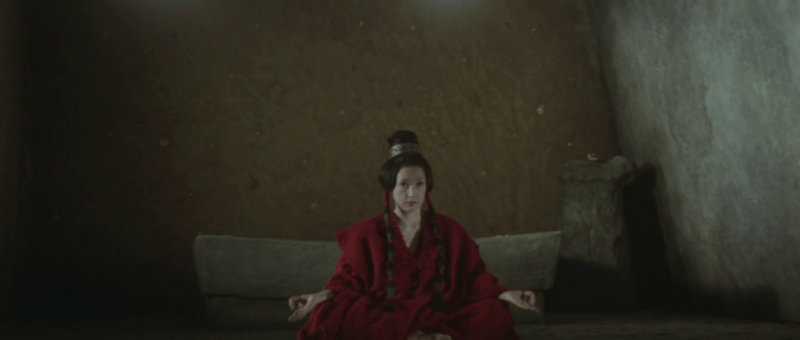
Broadly speaking the film takes place during the era of possibly mythical sorceress queen Himiko (Mieko Takamine) who rules over the nation known as Yamatai which is the name given to a kingdom in Japan in ancient Chinese sources. Himiko wants the phoenix because she fears that her power is founded on a youth and beauty which has begun to fade while the people are beginning to lose faith in her magic, not least because her rule is oppressive and authoritarian. She also fears that should the Chinese emperor drink the phoenix blood first, they will forever be under his yoke yet the seal that confers her rule was in fact given by him so perhaps they are already. Her brother, Susano (Toru Emori) whom she also fears may usurp her, enlists famed hunter Yumihiko (Masao Kusakari) from the state of Matsuro to help them capture the phoenix seeing as the two nations have some kind of treaty. Yumihiko says he doesn’t really care about that, but ends up helping anyway.

In any case, Matsuro is soon overrun in a surprise attack by warlord Jingi (Tatsuya Nakadai) from Takamagahara who is set on colonisation, which is in its way another bid for “immortality” if culturally rather than literally. After all, he claims “I will implant our civilisation in these lands” before explaining that “not even the greatest kings live forever” but history will. Meanwhile, Yamatai doctor Guzuri (Ryuzo Hayashi) is washed up on the shores of remote kingdom Kumaso where Uraji (Masaya Oki) is hunting the phoenix in the hope of saving his seriously ill wife Hinaku (Reiko Ohara). Uraji is soon burnt to a crisp by the Phoenix’s light, but Guzuri is able to save Hinaku using “modern” medicine, that is by applying “blue mould” which as the onscreen text explains contains penicillin. Perhaps feeding someone mould doesn’t sound much more scientific than the bizarre folk medicine proposed by the witchdoctor which involves rubbing the severed heads of cats and ravens together and putting fish bones on the patient’s head while burning their buttocks, but it works which is not exactly a means of “immortality” but does promise the ability of temporarily overcoming death without the Pheonix’s help. 

But medicine can’t help you with an invasion, and when the Yamatai suddenly turn up and raze the village to get better access to the phoenix after realising it lives in a nearby volcano only Hinaku and her brother Nagi (Toshinori Omi) survive. Hinaku reluctantly remains with Guzuri and vows to rebuild her kingdom through childbirth vowing that she will enable the survival of Kumaso by passing her culture on through successive generations. Uzume (Kaoru Yumi), a dancer from Matsuro, later says something similar to Jingi in reminding him that “women have their own weapons” and he will “never be able to destroy life” as an abstract concept. There might be something a little uncomfortable in the implication that the phoenix is an allegory for childbirth in suggesting that one body is born in the ashes of another, but it is in the end the continuity of a lifecycle which wins out as the natural order of things. In the film’s concluding moments, the son of Hinaku and Guzuri in a sense experiences a kind of rebirth as, guided by the phoenix, he climbs out of the cave in which he has lived all his life and gazes at the vast expanses of a new world all around him. 

Ichikawa originally trained as an animator and includes several animated sequences throughout the film from cartoonish special effects when an elderly courtier bangs his head to a trio of foxes dancing to pink lady. His visual design is also heavily influenced by Tezuka’s manga with the young boy Nagi in particular striking Tezuka-esque poses and otherwise resembling Astroboy who does in fact make a surprise appearance in a brief animated sequence in which Nagi is kicked by a horse. Similarly, the conflicted general Saruta (Tomisaburo Wakayama) later gains a ridiculous Tezuka-style nose after being locked in a room filled with wasps, and Ichikawa’s vistas sometime echo the centrefold of a manga with the heroes reduced to tiny figures dwarfed by the majesty of the landscape. Even so, a rain-soaked battle pays ironic homage to Seven Samurai, while Ichikawa otherwise keeps violence to a minimum. The heads are chopped off horses and fall like cushions, entirely bloodlessly, but there is also a scene of implied attempted rape which may be out of keeping with the otherwise family-friendly approach. Despite the sense of defeat which may colour some of the closing scenes, the film ends on a note of optimistic wonder in a new journey for humanity emerging from scenes of desolation towards a bright new world. 


Cleopatra (クレオパトラ, Osamu Tezuka & Eiichi Yamamoto, 1970)

Cleopatra posterMushi Pro’s first real foray into feature length (and feature length it really was at over two hours) animation for adults, A Thousand & One Nights, had earned some critical plaudits but nevertheless failed to set the box office alight. A year later they tried again as manga pioneer Osamu Tezuka and experimental animator Eiichi Yamamoto reteamed for a salacious tale of ancient Egypt. Or at least that’s what was promised by the suggestive title, Cleopatra (クレオパトラ), recalling Hollywood glamour and cinematic excess anchored by beauty to echo through the ages, but what emerges is less a tale of doomed love and imperial lust than a thinly veiled attack on the American “occupation” and associated foreign policy in an increasingly politicised age.

Because Tezuka likes to be perverse, he opens not with deserts and pyramids but with a silent ode to 2001: A Space Odyssey before a space ship drifts into view and sails into a very space age tower block filled with very ordinary corridors. Our team of space warriors are part of a colonising force hellbent on conquering nations which don’t which to be conquered. The Pasatorine have mounted a resistance and Earth intelligence has got wind of a covert operation codenamed “Cleopatra”. To figure out what the name might mean, they’ve decided to send three of their best agents back in time to hang out with the lady herself and gather a few clues.

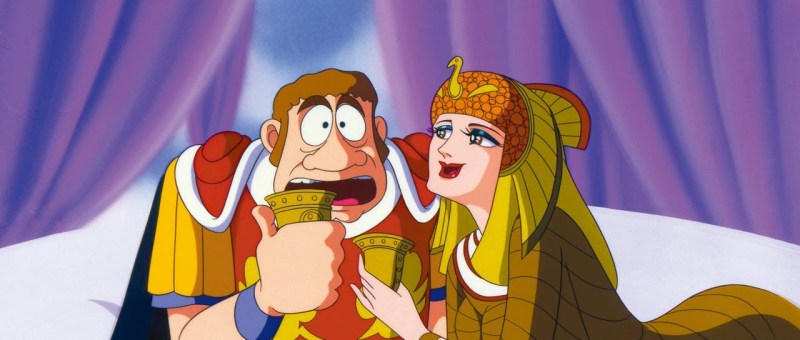
Back in Ancient Egypt, the nation has been overrun by lecherous Roman troops who ride roughshod over the local population (which includes a number of well known characters from popular 1960s manga). Caesar (Hajime Hana) himself is a jolly green giant with skin like Osiris who turns out to be a little more sympathetic than might otherwise be assumed. Nevertheless, a resistance movement has spun into action guided by the royal nanny, Apollodoria (Kotoe Hatsui), who has convinced exiled princess Cleopatra (Chinatsu Nakayama) that their best hope for freedom lies in her body which she must use as a weapon against the lusty foreign general in order that she might seduce and betray.

Cleopatra, however, is conflicted. Molested by her old nanny and falling for her unexpectedly “decent” captor, she wavers in her conviction and begins to wonder if the best path for her people might lie in working alongside rather than against her nation’s new masters. As history tells us, she may not get to make that choice for herself for her stony general has a weakness his countrymen can exploit leaving her all at sea once again.

In 1970 Japan was about to revisit the post-war security treaty with the Americans giving rise to a wide scale protests against what many saw as Japanese complicity in controversial American foreign policy and particularly the ongoing war in Vietnam. The Romans, thinly veiled stand-ins for Americans in Japan, march in triumph, oppressing the locals and erasing traditional culture in favour of “modernity”. Yet Caesar and his ilk perhaps turn out not to be so bad as once feared, seducing with false promise as they show off their wealth and prosperity whilst subtly gesturing to their superior numbers and technology to assure any doubters. The colonisers are technically our heroes – the spacemen and women from the beginning we’ve all but forgotten about have come back in time from the position of the imperialists, hoping to find out how Cleopatra’s doomed romantic destiny might inform modern insurgency, but have discovered only a righteous loathing for “occupying” forces and their relentless tendency to ruin the lives of pure hearted women for their own nefarious gains.

Perhaps emboldened by A Thousand & One Nights, Tezuka cannot resist inserting a number of idiosyncratic gags for manga enthusiasts, including a few references to his own back catalogue, while also sending up the pop-culture of the day. Cleopatra is, on one level, a distinctly lowbrow effort filled with deliberately cartoonish slapstick, silliness, and anarchic humour but it also harbours a subversive idea at its centre which was certain to prove popular with a particular section, at least, of its target audience. Mixing live action footage with experimental animation, if retaining a cartoonish sensibility, Cleopatra is a strange interdimensional political metaphor but not without its charms even in its most outrageous moments.


Available on blu-ray from Third Window Films as a part of double release with Eiichi Yamamoto’s A Thousand & One Nights.

Original trailer (English subtitles, NSFW)

A Thousand & One Nights (千夜一夜物語, Eiichi Yamamoto, 1969)

one thousand and one nights poster 2The “Godfather of Manga” Osamu Tezuka had been a pioneer of what later became the mainstream of a burgeoning industry, kickstarting TV anime in the process with the long running Astro Boy. His ambitions, however, increasingly ran towards the avant-garde and he feared that the heavy association between his production company, Mushi Pro, and genial kids’ cartoons would only lead to diminishing artistic returns even if the increasing merchandising opportunities would perhaps allow the studio to engage in other less profitable areas such the adult-orientated anime he longed to produce. By the late ‘60s, Tezuka’s polite, inoffensive brand of child-friendly adventure stories were becoming distinctly old hat while the “gekiga” movement, acting more or less in direct opposition, continued to gain ground with older readers keen to move on to more adult fare. The Animerama series was intended to prove that Tezuka still had something new and dynamic to bring to the table and that there was a market for “racy” animation which embraced mature themes and experimental artwork.

The first of the Animerama films, A Thousand & One Nights (千夜一夜物語, Senya Ichiya Monogatari), is, as the title implies, loosely inspired by classic Arabian folktales as its hero “Aldin” (Yukio Aoshima) finds and then loses true love, overcomes the urge for vengeance, is himself corrupted by wealth and power, and then is returned to the very same state in which we first encountered him walking off into the sunset in preparation for the next adventure.

The tale begins with a slave auction at which the lowly water seller Aldin first catches sight of the beautiful Milliam (Kyoko Kishida). He tries to buy her but is too poor while the son of the local police chief (Asao Koike) outbids all to win the prize. However, in the first of many strokes of luck that will befall Aldin, a sandstorm allows him steal away with Milliam who falls in love with him too and gives herself willingly to a man she sees as an equal rather than a master. Sadly, their true love story is short lived and they are soon separated sending Aldin off on a quest to return to his beloved that will only end in tragedy.

Despite the later protestations that the love of Aldin and Milliam is one of equals in which there are no masters or slaves, only a man and a woman, it remains true that Aldin watched the slave auction with a degree of titillation and would have bought Milliam had he only been able to afford her. Surviving on his wits, Aldin is a cheeky chancer waiting for that big lucky break he is sure is waiting somewhere round the corner but he is not, perhaps, above becoming that which oppresses him. Later, having become a wealthy and powerful man, he uses his wealth and his power in the same way that others use theirs against him in pressuring a vulnerable young girl to become his mistress against her will, ripping her away from her own true love in the same way he was once ripped away from Milliam by another man wearing a crown. As a “king” he wonders what “power” is, pushing his as far as it will go in order to find out and risking “losing himself” in a way he’d once thought he’d overcome in rejecting a pointless act of vengeance that would forever have changed him.

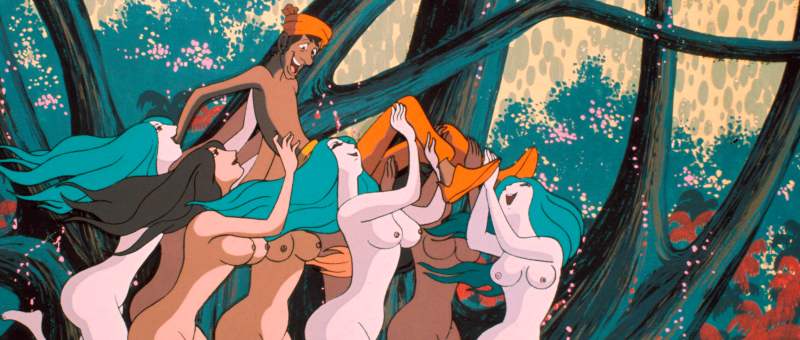
Milliam, and later Jallis – the daughter of Aldin and Milliam raised by their worst enemy, Badli (Hiroshi Akutagawa), fight for the right to decide their own romantic destiny. Like Madlia (Sachiko Ito), the feisty bandit’s daughter, they resist the social codes of their era in which women are merely prizes divided among men and actively attempt to free themselves through love only to find defeat and despair. Yet love, or more precisely lust, can also be a force of constraint and or ruin as Aldin discovers on a paradise island when he unwisely decides to abandon Madlia, who has also fallen in love with him, for the empty pleasures of orgiastic sex with the voracious islanders whose unrestrained desire soon threatens to consume him whole.

A picaresque adventure, A Thousand & One Nights is a bawdy, flippant retelling of the Aladdin myth in which the hero begins as a poor yet free and cheerful young man before experiencing what it is to be wealthy and all powerful and discovering that it only makes him mean and miserable. Shifting from model shots to live photography and abstract to cartoonish animation, Yamamoto’s direction may appear restrained in comparison to the more outlandish and surreal Belladonna of Sadness but is a masterclass in finding artistry through budgetary limitations. A psychedelic odyssey through freedom and constraint, desire and obsession, A Thousand & One Nights is a forgotten landmark of experimental animation as relentlessly strange as it is endearing.


Available on blu-ray from Third Window Films as a part of double release with Eiichi Yamamoto & Osamu Tezuka’s Cleopatra.

Original trailer (English subtitles, NSFW)