Dream Home (維多利亞壹號, Pang Ho-cheung, 2010)

“In a crazy city, if one is to survive, he’s got to be more crazy.” according to the opening titles of Pang Ho-cheung’s surprisingly poignant slasher satire Dream Home (維多利亞壹號). In the 10 years since the handover, the average wage has increased by a measly 1% while house prices have risen by 15% in 2007 alone. Sheung’s (Josie Ho) one overriding mission in life is to buy a flat for her family to live in, but it’s clear that her struggles to become a homeowner aren’t the only pressure points in her life in an increasingly capitalistic society. 

As we later discover, Sheung is set on one particular flat because the building it’s in stands on the spot where she once lived as a child before her family was pushed out by rampant gentrification. In essence, she’s just trying to take back what’s hers and restore her family’s sense of dignity and security. A flashback to her childhood reveals her father’s own insecurity in having been unable to secure a larger living space in which she and her brother could have their own rooms while her grandfather, a sailor, longed for a sea view and the sense of an expanding horizon otherwise denied to the family in a cramped Hong Kong council flat. In a touch of irony, Sheung’s father himself worked in construction building apartment blocks he couldn’t afford to live in and in the end it killed it him through exposure to asbestos and other dangerous fibres. 

Sheung works at a bank but is conflicted about her job cold calling account holders to try to get them to buy into dodgy loans neatly echoing the film’s closing moments which hint at a coming economic crash precipitated by the subprime mortgage crisis which will threaten Sheung’s homeowning dream. Her friends think she’s crazy to buy a flat at all, but she’s completely fixated on repairing her broken childhood by taking back her family home and ending her displacement. Meanwhile, she’s in a dissatisfying dead end relationship with a married man which largely takes place in love hotels he sticks her with the bill for and turns up late to only to immediately fall asleep. When Sheung asks him for a loan to help pay for her father’s medical care after the insurance she got for him is voided because he never told her he’d been diagnosed with a lung complaint before she took it out, he tells her to use her deposit fund instead and give up on homeownership because only fools like her would buy in such a volatile market. 

Disappointment in both her personal and professional lives continues to place a strain on Sheung’s fragile mental state that eventually tips her over the edge. Hoping to bring the apartment’s price down, she goes on a murder spree in the building killing it seems partly out of resentment and otherwise pure practicality. There is irony here too, in that she kills her victims with the weapons of their privilege. A cheating husband who comes home unexpectedly after lying to his wife that he’s gone golfing but was actually with his mistress is whacked on the head with a golf club while an obnoxious stoner kid is stabbed in the neck with his bong. Sheung murders a Filipina helper, but also the snooty middle-class woman who employed her by using the vacuum pack machine the helper had been using on her behalf. One might ask if she really needed to kill the helper or the pair of Mainland sex workers in the next apartment, but when it comes to devaluing property prices “massacre” sounds much better than “killing” and so it’s the more the merrier. 

In the end, it’s this city that’s driven her out of her mind with its status-obsessed consumerism and constant sense of impossibility. After her killing spree, she doesn’t even seem very conflicted about selling dodgy loans to vulnerable people not so different from herself while she was so desperately trying to get approval on a mortgage there was no way she could afford despite working a series of other part-time jobs including one selling designer handbags to the kind of wealthy women she resents. Her dream apartment has a view quite literally to kill for, though there’s a sense that Sheung’s dream will always be futile with the same motivations that brought her here leading to the mortgage crisis and economic shock that could eventually take it from her. Bloody, gory, and at times sickeningly violent Pang’s satirical horror show paints contemporary capitalism as the real villain and even in its dark humour reserves its sympathies for the wounded Sheung pushed to breaking point by a pressure cooker society. 


Dream Home available to stream in the UK until 30th June as part of this year’s Odyssey: A Chinese Cinema Season.

International trailer (English subtitles)
Women Who Flirt (撒娇女人最好命, Pang Ho-cheung, 2014)

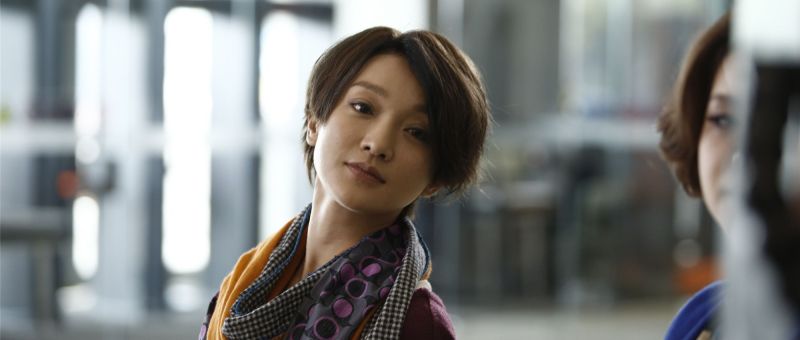
“Love’s not a competition” the heroine of Pang Ho-cheung’s Mainland rom-com Women Who Flirt (撒娇女人最好命, Sājiāo Nǚrén Zuìhǎo Mìng) snaps back, only according to almost everyone else that’s exactly what it is. Maintaining the slick, sophisticated atmosphere of his similarly themed Hong Kong comedies, Pang sheds his trademark salty humour but otherwise adopts the same mix of heartfelt silliness and acute social observation which have made his work so popular, neatly elevating the perhaps overly conventional narrative as two longterm best friends edge towards the realisation that they’ve been in love all along. 

Tomboyish Angie (Zhou Xun) has been carrying a torch for handsome Marco (Huang Xiaoming) since their uni days but owing to personal awkwardness and entrenched social codes feels she can’t make the first move and has been patiently waiting for Marco to get the message. He, however, keeps fobbing her off, claiming that he just wants to focus on his career etc even while she, ironically, keeps encouraging him to get a girlfriend. Angie gave up her dreams of becoming a sculptress to stay close to her man and the pair of them now work together in Shanghai as restaurant consultants, posing as regular guests to give restaurateurs the lowdown on where they’re going wrong with their customer service. Trouble brews when Marco drops the bombshell that he’s met someone, Hailey (Sonia Sui Tang), an extremely irritating airhead he bumped into on an airport transport shuttle during a business trip to Taipei which, to add insult to injury, Angie had actually sent him on. 

As expected, Angie is not happy about this development and turns to her friendship group who dub themselves the “Barbie Army” for help. The Barbie Army are firmly of the opinion that Hailey needs to go, not least so they can prove the superiority of Shanghai women over Taiwanese which they plan to do by showcasing their ability to flirt their way to success. Pang has great fun mocking entrenched societal gender codes, but does perhaps overdo it in the well developed cynicism of the Barbie Army who are all too happy to play along with society’s rules, roundly criticising Angie for her lifelong refusal to do so which is, they suggest, why Marco never got the memo. For his part, Marco reassures Hailey that he has no interest in Angie by referring to her as a “man” who “pees standing up”, later repeating the same logic to his guy friends who, unlike him, seem to be aware of Angie’s decade-long crush. 

With the aid the Barbie Army, Angie tries to play Hailey at her own game by perfecting the art of flirting, neatly flagging up that men are no better in her various dating app suitors who turn out to be either odd (makeup consultants for the recently deceased) or crass and chauvinistic (handsy middle-aged mansplainers). Unwilling to play the game, Angie walks out with a direct “I hate you”, only to be reminded by the Barbie Army that “I hate you” is a powerful tool if you learn to use it like a child. This is something the intensely annoying Hailey seems to have perfected to Marco’s satisfaction, a worrying confirmation that infantilisation is the key to “cute” and that what men want is a fawning fool who is helpless without them. 

Hailey is of course playing the game that Angie didn’t want to deign to play and largely doing it not out of love but of resentment. Marco out of earshot, she drops the cutesy voice and childish helplessness to tell Angie that she’s wasting her time, she can’t possibly win this battle of flirtations, though if Hailey was actually as secure as she made out perhaps she wouldn’t have needed to break cover and take on Angie in the first place. Nevertheless, Angie eventually comes to the conclusion that being a woman who flirts isn’t really for her, maybe she’s missed her chance and wasted too much time on a man who’s never going to notice. Meanwhile, Marco is having a series of parallel epiphanies in realising that women like Hailey are all about the game and she’ll soon enough by bored with him. His final declaration that he is in a way “gay” for Angie might be a little tone deaf not mention awkward in terms of its gender politics, but in its own way sweet as he comes to admit that he actually likes her for the “man” she is, acknowledging that the only reason he thought he wanted a “cute” girl was because he was afraid of real love. 

Completing the gender reversals, it’s Marco who has to change, Angie’s supposed tomboyishness given the seal of approval as she uses the spectre of romantic disappointment to become her true self, pursuing her abandoned dream of becoming a sculptress rather than being forced to conform to an idea of idealised femininity which is perhaps itself mocked in Hailey’s extreme affectation and the willing cynicism of the Barbie Army. Sweet and acutely observed, Women Who Flirt swaps Pang’s salty humour for biting cynicism but in the end comes down on the side of love as the hapless romantics flirt their way towards self-realisation. 


Women Who Flirt streams in the US Oct. 6 to 10 as part of the 11th season of Asian Pop-Up Cinema.

International trailer (English subtitles)

Aberdeen (香港仔, Pang Ho-cheung, 2014)

Aberdeen posterFamilies, eh? Too much history, not enough past. In Aberdeen (香港仔), Pang Ho-cheung applies his cheeky magic to the family drama, taking a long hard look at an ordinary collection of “close” relatives each with individual secrets, lies, and hidden insecurities which could destroy the whole at any given second. Fishermen driven ashore by the tyranny of “progress”, these troubled souls will need to decide in which direction to swim – “home” towards sometimes uncertain comforts, or away towards who knows what.

Grandpa Dong (Ng Man-tat), a Taoist priest, lost grandma a long time ago and is now in a relationship with Ta (Carrie Ng), a night club hostess. Dong’s son Tao (Louis Koo Tin-lok), a celebrity motivational speaker, does not entirely approve, feeling that the slightly taboo nature of Ta’s profession tarnishes his own veneer of glamour and may eventually cause him a public image crisis. Meanwhile, Tao’s wife Ceci’s (Gigi Leung Wing-kei) showbiz career is floundering now that she’s no longer as young as she was and she finds herself slipping into the seedier aspects of the business as her manager encourages her to “entertain” wealthy men to secure roles while her friend keeps inviting her to paid “parties”. Dong’s daughter, Wai-ching (Miriam Yeung), is married to a doctor, Yau (Eric Tsang Chi-wai), who unbeknownst to her is involved (unlikely as it seems) in a passionate affair with his nurse (Dada Chan) which she seems to think is more serious than it is.

Dong laments that his family can’t seem to stand being in the same room for more than a few seconds before someone ruins the whole thing with a stupid argument which might be a fairly common phenomenon in many families, but he worries that it’s all down to the fact that his ancestors were fishermen and now they’re paying for the bad karma of having killed all those fish. In fact, bad karma was one of the reasons his dad got him apprenticed to a relative who trained him up to be a Taoist priest so he could atone for generations of sin but it seems like the well ran far too deep.

Each of our protagonists is individually insecure, lacking the confidence that their family members truly accept them. Tao, vain and deeply cynical, doubts his daughter Chloe (Lee Man-kwai), whom he insists on calling “Piggy”, is really his because he thinks she isn’t very pretty and doesn’t fit with his slick, celebrity image. Nevertheless, he does love her deeply and worries that she will suffer in the long term through her lack of looks though this too is partly a self-centred projection stemming from long buried guilt over having bullied another “plain” girl while they were at school. He is also blind to the effect his constant references to Chloe’s supposed plainness are having on his wife, Ceci, who is carrying the scars of longterm insecurity regarding her appearance on top of the difficulties she is facing in her career.

Wai-ching’s problems run a little deeper in that she is convinced her mother stopped loving her after a slightly embarrassing childhood incident. The past literally returns to haunt her in the form of some paper offerings she made to her mother’s spirit which have been mysteriously sent back “return to sender” by the Hong Kong Post Office. Wai-ching’s mental instability seems to be a worry to her husband, but not so much so that he can’t just forget about it when his nurse comes calling with one of her cute little notes announcing that she’s in the mood.

Dong and Yau are in similar positions, each identifying with the figure of a beached whale – all washed up with nowhere else to go. As Dong puts it, as soon as you’re beached a part of you at least has died. Each of the older men has to accept that a choice has already been made and the energy needed to change it is no longer available. Pang allows each of the family members to find some kind of individual resolution, the family seemingly repaired as they chow down on generic fast food without making too much of a fuss, but then their solutions to their issues are paper thin and perhaps the family itself is merely the ribbon that flimsily binds an imperfectly wrapped gift that everyone has to pretend to like to avoid creating a scene. Still, sometimes the wrapping is the best part and it doesn’t do to go peeking inside lest you get a disappointing surprise.


Original trailer (English subtitles)

Missbehavior (恭喜八婆, Pang Ho-cheung, 2019)

Missbehaviour poster 1Pang Ho-cheung has become the king of salty, vulgar yet somehow sophisticated Cantonese comedy. Strangely, and then again maybe not, he’s never ventured into the realms of the New Year movie, until now. Missbehavior (恭喜八婆) returns the director to the bawdiness of Vulgaria but brings with it the sense of warmth and cheerful irony that marked his genial Love trilogy. A timely reminder that life’s too short for pointless grudges and maybe you should check in on that friend you haven’t seen in a while, Missbehavior is a grown up New Year treat that as silly as it often is has genuine heart and a cheerful, compassionate spirit.

The central crisis revolves around June (June Lam Siu-ha) – a model employee well used to putting up with the ridiculous requests of her boss who now demands to be known as “Luna Fu” (Isabella Leung Lok-Sze) after returning from maternity leave. Worried the new office girl Irene who is none too bright will end up offending an important client, June is charged with making his coffee but mistakes the milk labelled L.F. in the office fridge as “low fat” rather than belonging to her boss. That’s right, June has just poured her boss’ breast milk into her client’s coffee. He loved it, but Luna probably won’t which is why June calls her friend Isabel (Isabel Chan Yat-ning) who vows to mobilise their WhatsApp group to find June a new bottle of breast milk before 5pm so her boss will be none the wiser.

Once a tightly connected circle of friends, the usual middle-aged problems have led the “Bitches” to drift apart. Policewoman May (Gigi Leung Wing-kei) fell out with Isabel because she was convinced that she stole her boyfriend – her evidence being that his phone “inexplicably” connected to her wi-fi automatically despite his claims of never being in her house before. She is however big hearted enough not to let her animosity towards Isabel stop her helping out June whom, it seems, is the gang’s lynchpin and always there for everyone else in a crisis. Busy on the beat, May sends Isabel looking for some of the others all of whom have petty minor disagreements which make them reluctant to work together like rising ukulele star Minibus (Yanki Din) and her former partner Rosalin (Dada Chan Ching) who has fallen out with just about everyone thanks to writing a best selling book revealing her friends’ most embarrassing secrets.

Rosalin’s book became a hit not because of her writing talent (at least according to her friends) but because of the glamour shot she put on the cover which has earned her an army of adoring male fans which can be mobilised to help them get hold of some breast milk (though it’s unlikely any of them have babies of their own). Rosalin and Isabel chase dubious leads, while Minibus and gay couple Boris (Tan Han-jin) and Frank (Chui Tien-You) who seem to be having a few problems of their own try their luck on the black market.

Pang sends the gang all around Hong Kong (quite literally as he superimposes them on various skyscrapers so we can keep track of where they all are) on a wild goose chase trying to track down the elusive substance through various crazy capers while each of the friends gets a chance to readdress old grievances before finally coming back together again. A zany odyssey through the modern city, Missbehavior packs in the meta commentary with five year olds demanding payments to put towards their apartment funds while riffing strongly off local culture with references to aggressively rude waiters (in a scene stealing cameo from Lam Suet) and a bizarre fire fighting mascot which became an ironic internet hit.

Despite working within the relatively family friendly remit of the New Year comedy, Pang’s humour is (almost) as raucous and surreal as it ever was but he also makes time for more serious intent as in his sensitive inclusion of LGBT issues which eventually sees the gang set up a fake charity to collect milk for gay men raising babies and ends in a delightful set piece with everyone trying to evade shopping mall security by running around in rainbow capes like especially progressive superheroes. Packed out with cameos from Pang regulars, Missbehavior is an appropriately light and fluffy entry perfect for New Year that is above all else a tribute to the power of friendship and to the importance of putting aside petty disagreements and minor differences because a friend in need really is a friend indeed.


Missbehavior was screened as part of the 2019 Udine Far East Film Festival.

Original trailer (English subtitles)

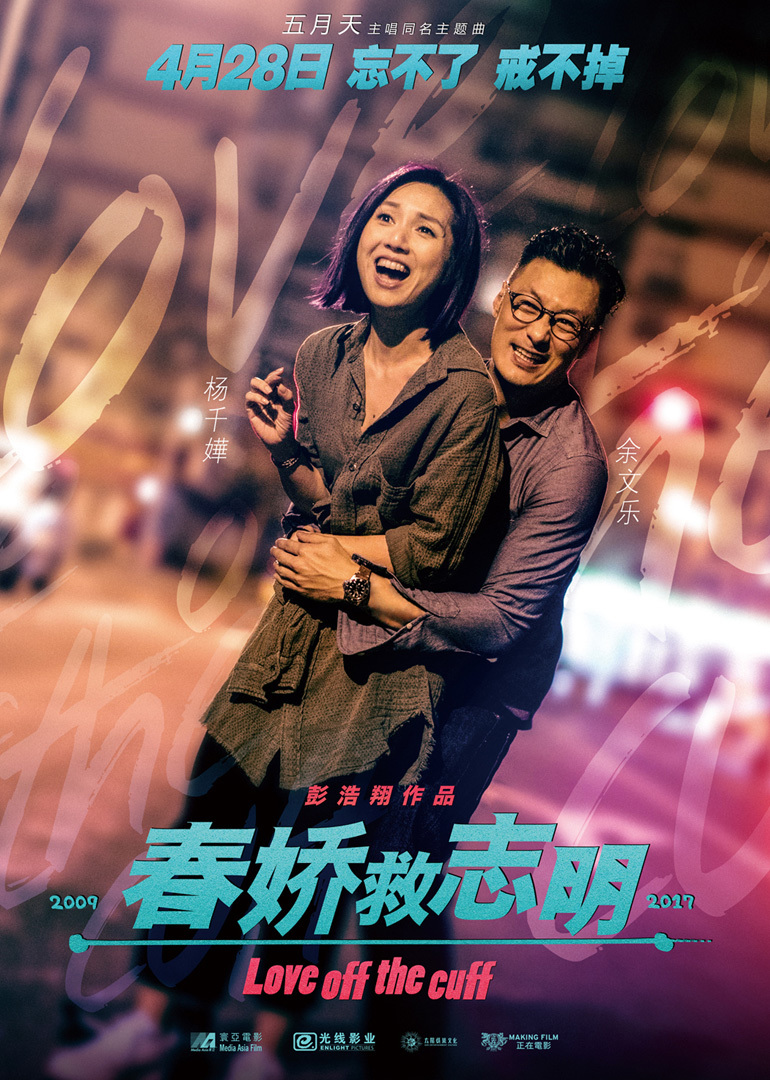
Love Off the Cuff (春嬌救志明, Pang Ho-cheung, 2017)

love off the cuff posterJimmy and Cherie, against all the odds, are still together and in a happy longterm relationship in the third addition to Pang Ho-cheung’s series of charming romantic comedies, Love off the Cuff (春嬌救志明). Following the dramatic declaration at the end of Love in the Buff, the pair have continued to grow into each other embracing each of their respective faults but after all this time Jimmy and Cherie have to make another decision – stay together forever or call it quits for good.

The major drama this time around occurs with the looming spectre of parenthood as Cherie’s long absent father and Jimmy’s “godmother” suddenly arrive to place undue strain on the couple’s relationship. These unexpected twin arrivals do their best to push Cherie’s buttons as she’s forced to re-examine her father’s part in her life (or lack of it) and how he may or may not be reflected in her choice of Jimmy, whilst Jimmy’s Canadian “godmother” makes a request of him in that he be the father of her child. Jimmy, a self confessed child himself, does not want anything to with this request but is too cowardly to hurt the feelings of a childhood friend and is hoping Cherie will do it for him. Cherie is wise to his game and doesn’t want to be trotted out as his old battle axe of a spouse but at 40 years of age children is one of the things she needs to make a decision on, another being whether she wants them with Jimmy.

Cherie’s father was an unhappy womaniser who eventually abandoned the family and has had little to do with any of them ever since. In his sudden return he brings great news! He’s getting married, to a woman much younger than Cherie. Building on the extreme insecurities and trust issues Cherie has displayed throughout the series, her faith in Jimmy crumbles especially after she intercepts some interestingly worded (yet totally innocent) text messages on his phone which turn out to relate to an unfortunate incident with their dog. Jimmy’s reliability continues to be one of his weaker elements as the behaviour he sees as pragmatic often strikes Cherie as self-centered or insensitive. Things come to a head during a disastrous getaway to Taipei in which the couple are caught in an earthquake. Cherie freezes and cowers by the door while Jimmy ties to guide her to safety but his efforts leave her feeling as if he will never value anything more than he does himself.

Moving away from the gentle whimsy of Love in a Puff, Cuff veers towards the surreal as the pair end up in ever stranger, yet familiar, adventures including a UFO spotting session which goes horribly wrong landing them with community service and accidental internet fame. A real life alien encounter becomes the catalyst for the couple’s eventual romantic destiny as does another of Jimmy’s grand gestures enlisting the efforts of Cherie’s father to help him win back his true love. Cherie’s troupe of loyal girlfriends even indulge in some top quality song and dance moves in an effort to cheer her up when it’s looking like she’s hit rock bottom though, improbably enough, it’s Yatterman who eventually saves the day.

Supporting cast is less disparate this time around relying heavily on Cherie’s dad and Jimmy’s godmother but Cherie’s friends get their fare share of screentime even if Jimmy’s seem to fade into the background. Cherie never seems to notice but one of her friends is in love with her and is not invested in her relationship with Jimmy, constantly trying to get her to come away on vacation to a nostalgic childhood destination, but most of the girls seem to be in the dump camp anyhow loyally making sure Cherie thinks as little about Jimmy as is possible lest she eventually go back to him.

Trolling the audience once again with the lengthiest of his horror movie openings (so long you might wonder if you’ve wandered into the wrong screen), Pang begins as he means to go on, mixing whimsical everyday moments of hilarity with surreal set pieces. It’s clear both Jimmy and Cherie have grown throughout the series – no longer does Jimmy skip out on family dinners with Cherie’s mother and brother but patiently helps his (future?) mother-in-law figure out her smartphone as well as becoming something like her errant father’s wingman. Things wrap up in the predictable fashion but it does leave us primed for the inevitable sequel – Love up the Duff? Could be, it’s the next logical step after all.


Love off the Cuff was screened at the 19th Udine Far East Film Festival.

Original trailer (Cantonese with Traditional Chinese/English subtitles)

Love in the Buff (春嬌與志明, Pang Ho-cheung, 2012)

love in the buff poster2010’s Love in a Puff was a delightfully low-key, slow burn romance in which two lonely smokers found each other over a back ally rubbish drum and a series of aimless text-based and ambulatory conversations. Jimmy and Cherie were both so diffident, fearful, and emotionally restrained that their grand love affair ended on a positive if ambiguous note, promising only to continue in forward motion. Where is there to go in a sequel? The same place again, apparently. Or, more precisely, Beijing.

So, Jimmy (Shawn Yue) and Cherie (Miriam Yeung) have found true love, moved in together and are very happy. Except, Jimmy is still Jimmy and Cherie is still Cherie and so there are problems. Things come to a head when Jimmy forgets a dinner arrangement with Cherie’s family, invites her to a beach party that turns out to be a work engagement, and then unwisely tries to win an argument by “reminding” her who plays the bills. Unsurprisingly, when Jimmy returns home Cherie has gone back to her mother’s. Jimmy takes a job in Beijing and starts dating an air hostess only for Cherie to also get an unexpected transfer to the mainland capital.

More or less following the pattern of the first film but with the roles of the protagonists reversed, Jimmy and Cherie find themselves falling back into the same old routine as they’re marooned in an unfamiliar city. Jimmy, still immature and self-centred, may have started an accidental relationship with a stewardess his friend intended to molest on an aeroplane, but it’s essentially superficial (at least from his side) and once again he finds himself texting Cherie whilst bored with his girlfriend’s elegant friend set. Cherie, not over Jimmy (much as she’d like to be) and perhaps regretting her over hasty grand gesture, begins a tentative relationship with a sensitive millionaire, Sam (Xu Zheng), whose only defects seem to be an old-fashioned idea of chivalry and the fact that he is extremely bald.

Despite Sam’s obvious goodness, Cherie can’t let Jimmy go and is ultimately disappointed to find that some of his childish strangeness has rubbed off on her – in fact, the very qualities which Sam finds attractive are ones she associates with Jimmy. Back to sneaking around, bickering, and exchanging cryptic text messages the pair are left to wonder if anything has really changed. The problems are exactly the same – neither one is willing to trust the other enough to make a real go of things. Cherie, still a little over sensitive about the (very small) age difference between herself and Jimmy as well as her ticking clock, resents being made to feel like the old ball and chain when Jimmy plays the coward in lying to her to go out drinking with friends. Jimmy still fears confrontation too much talk to Cherie in a straightforward way and so they’re locked in continuing cycles of passive aggressive drama.

Once again Jimmy and Cherie are the main draw though their friends take on a slightly larger role. Eunuch (Roy Szeto) remains Jimmy’s worst enabler as he urges him to make a series of bad decisions in making a life in the mainland capital, though there is a potential happy ending for Cherie’s “plain” friend Brenda (June Lam) whose lack of looks was the butt of such mean-spirited humour in the first film. Transposing the action to Beijing Pang takes another look at modern love with its marriage markets full of old women sitting in parks with signs selling the virtues of their sons not to mention the terrible blind dates but even if the actions of the central couple lean towards the sordid as they re-engage in accidental adultery, the romance is always gentle, innocent, and sincere. Jimmy and Cherie bonded in a puff, but now they have to learn to love each other “in the buff”, warts and all or call it quits.

Pang wisely drops the documentary conceit though maintains the laid-back aesthetic and whimsical music as the ballad of Jimmy and Cherie continues. The various cameo appearances threaten to derail the low-key style of the drama but once again Pang manages to capture something youthful, fresh, and heartfelt even if not moving very much beyond the original.


Original trailer (Cantonese with traditional Chinese/English subtitles)

https://www.youtube.com/watch?v=yoF6gwe1UOA

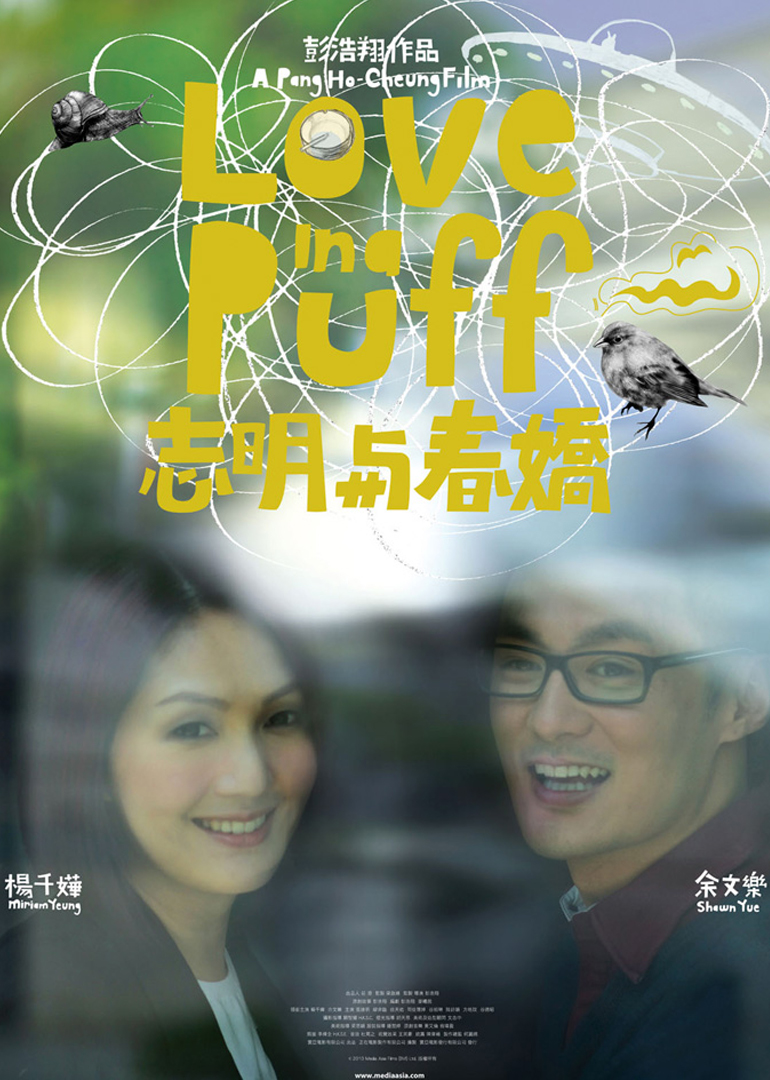
Love in a Puff (志明與春嬌, Pang Ho-cheung, 2010)

love in a puffSmokers. Is there a more maligned, ostracised group in the modern world? Considering the rapid pace at which their “harmless” pastime has become unacceptable, you can understand why they might feel particularly put out – literally, as they find themselves taking refuge in designated smoking areas or perhaps back allies where it seems no one’s looking. For all the nostalgia about how easy it was to strike up a friendship with a stranger just by asking for a light, it is also important to remember that smoking is not so “harmless” after all and there are reasons why smokers are asked to keep their activities amongst those who’ve also decided to ignore the warnings. The Smoking Ordinance, oddly enough, may have accidentally boosted the social potential of a smoke as those eager for a puff are given additional reasons to spend time together in an enclosed space, building a sense of community through nicotine addiction.

Pang Ho-cheung’s landmark romantic comedy Love in a Puff (志明與春嬌) takes this idea to its natural conclusion as recently dumped ad exec Jimmy (Shawn Yue) and trapped in a going nowhere relationship cosmetics girl Cherie (Miriam Yeung) begin to bond over a cigarette or two taken in a back ally near Jimmy’s office. Actually, Cherie doesn’t event work here, she’s wandered over and found a collection of kindred spirits whilst trying to avoid being spotted by her boss who thinks smoking is bad for your skin (not great when you’re supposed to be a walking advert for the makeup you’re pushing). Whilst the other guys and girls gossip about Jimmy’s great failed romance – his girlfriend cheated on him with and then left him for a Frenchman who has a better job in the company, Cherie listens patiently even though she’s clearly outside of this tight social circle. For Jimmy, this might be just what he needs – a breath of fresh (well, differently perfumed) air that has almost nothing to do with his current circle of work based friends.

Nothing in particular happens but the pair grow closer as they both attempt to escape the less satisfying elements of their lives. Relying on text messages delivered in a mix of text speak English and Chinese, Jimmy and Cherie message each other when they get bored – he eating hot pot with colleagues, she trapped at a fancy dress karaoke party, getting together to waste time but each unwilling to consider what any of this means. Eventually Cherie decides to make a real decision, but predictably enough, Jimmy freaks out and jumps on the brakes only to realise his hasty reaction might have been mistaken.

The tone is light and playful as Pang trolls the audience by beginning as a horror movie complete with dripping blood credits and scary music. The sequence turns out to be just one of the silly stories they gang entertain each other with during their cigarette breaks – in fact this one is a staple of Indian pizza delivery boy Bitta who tells it every time a new girl shows up. The grisly opening sequence even makes a fun return as Jimmy uses it to prank Cherie bringing them closer together whilst also highlighting his boyish, irreverent character. These same qualities which help Jimmy get through to Cherie may also be among the reasons his previous girlfriend ended the relationship, becoming bored with his familiar antics such as his strange love of buying ice-cream in a convenience store solely for the dry ice which likes to put in the toilet to enjoy the incongruous smoke effects.

Laid-back in style, Pang allows the back and forth between the leads to take centre stage whilst peppering the edges with a collection of background details about their friends and social lives. Cutting to a series of direct to camera documentary-style interviews, Pang adds a layer of commentary about modern love and relationships which extends right into the end credits with a hopeful man’s strange story about a girlfriend’s dog, all of which has the ring of authenticity even if occasionally mean-spirited as in its mocking of a plain girl stood up by an online date deceived by her overly flattering profile picture.

Love comes creeping and Jimmy and Cherie dance around each other, unable to speak plainly but occasionally moving forward through grand gestures. Each assuring the other they’re “in no hurry”, the great gateway to future happiness appears not with the traditional declaration of love but the “simple and straightforward” “I miss you”. Surprisingly cute and innocent for a Cat III comedy, Love in a Puff is an inconsequential tale of love blossoming in smokey city backstreets between a girl who’s tired of waiting and a guy who doesn’t know where he’s going but together they might just be able to figure it all out.


Love in a Puff was screened at the 19th Udine Far East Film Festival.

Original trailer (Cantonese with English/Traditional Chinese subtitles)