Virus (바이러스, Kang Yi-kwan, 2025)

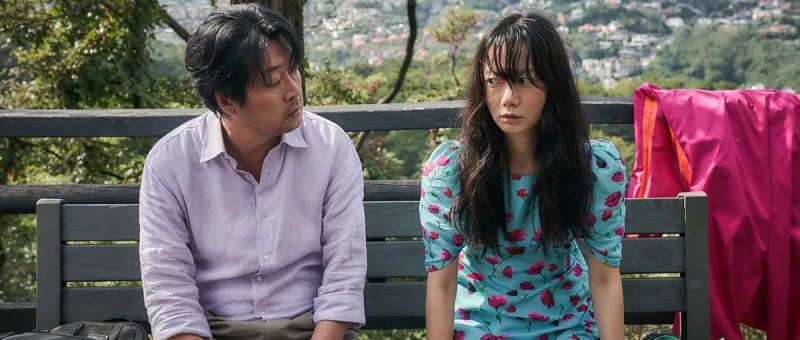
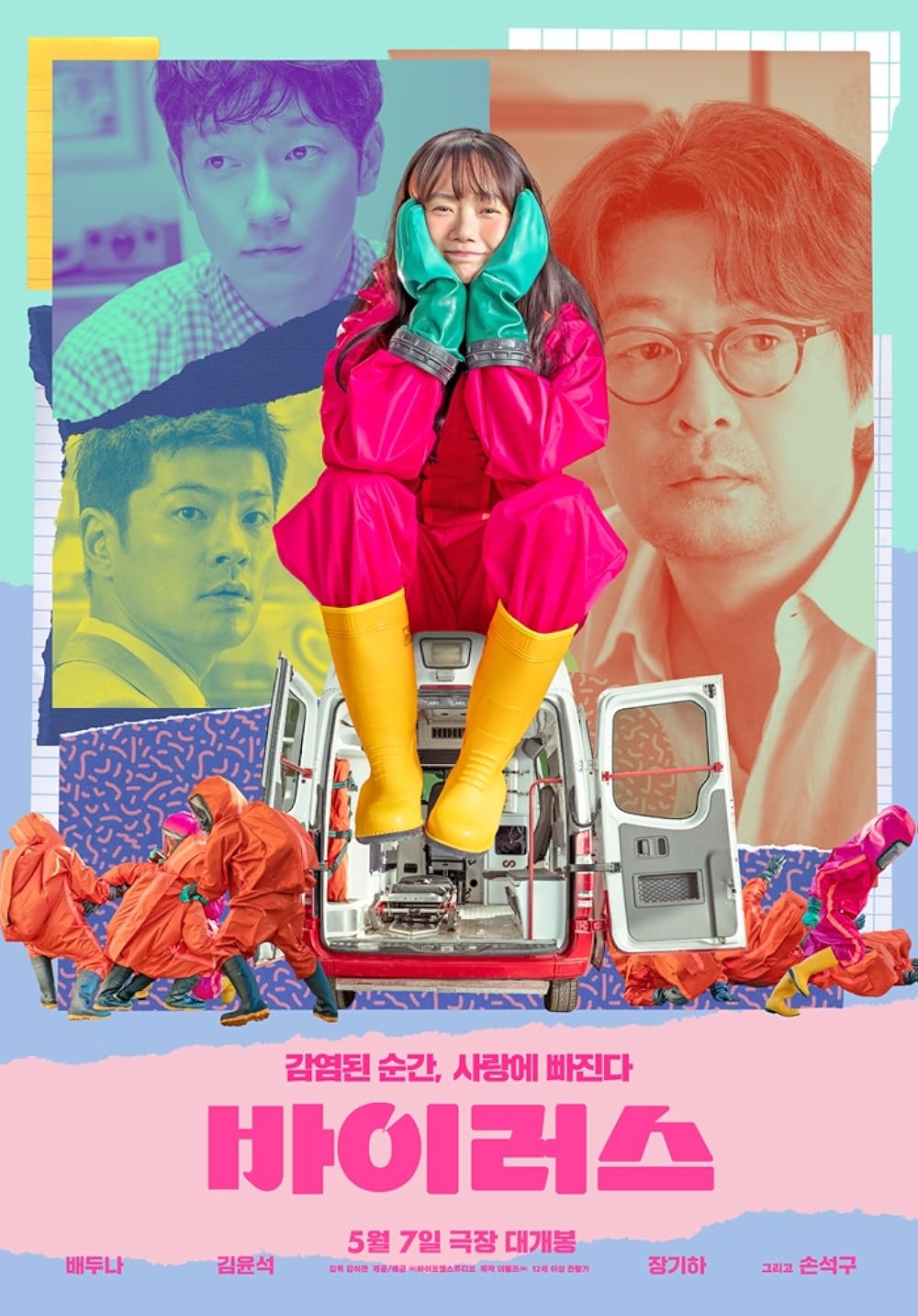
Falling in love is like catching a virus, according to lonely scientist Gyun (Kim Yoon-seok), but how can you know if your feelings are “real” or just part of a crazy fever dream you won’t even remember as soon as the infection leaves your system? “There are no fake feelings,” lovelorn translator Taek-seon (Bae Doona) counters, which is true, but sometimes people do things they don’t recognise or later understand because they weren’t in their right mind, whether because of the sickness called love or a more literal kind of contagion. 

Anyway, this particular virus makes people incredibly happy for the short period time before they die and was developed as part of a project to create an anti-depressant with no side effects. Taek-Seon gets infected after a disastrous date her sister forces her to go on with socially awkward scientist Su-pil (Son Suk-ku). Su-pil is overly attached to the mice in his lab and is still mourning the death of Masako who appeared to him in a dream and told him to make sure her death wasn’t in vain. In retrospect, perhaps these are symptoms of the infection bubbling away in his body as much as they are of his loneliness, but it’s understandable that Taek-seon wasn’t really considering seeing him again only she’s forced into it when her mother and sister invite Taek-seon over to her apartment as a kind of enforced date. The mother and sister’s insistence on Taek-seon meeting someone and getting married is itself a reflection of a patriarchal society in which being unattached is taboo, while Taek-seon’s sister snaps back that translators won’t be needed soon because of AI implying she should find a husband to support her financially.

But then again, though she might claim to be, it does seem that Taek-Seon isn’t all that happy with her life and later confesses to being “always depressed”. She rarely leaves her apartment and lives a dull and unstimulating existence. Infected with the virus, she suddenly becomes sunnier, more confident, and independent, while chasing romance by approaching a childhood crush she seemingly never had the courage to pursue before. Yeon-u (Chang Kiha) is now a car salesman, and Taek-seon now suddenly has the urge to buy a Mini though she’s never actually driven outside the test centre despite having a license. In one sense, yes, it’s Yeon-u she’s after but the car also represents her latent desires for freedom and a more active life. 

Nevertheless, the corrupting aspects of the virus are all too present as Taek-seon begins to act in ways she may be embarrassed by if she could remember them once she’s better. Her memories seem to have remade themselves more to her liking. She’s forgotten that Yeon-u wasn’t quite the hero she thought he was in her overly idealised vision of the innocent childhood sweetheart that she never had the courage to pursue. On the run from “evil” scientists from the lab where Su-pil worked, she starts to fall for Gyun, the expert that’s helping her, but who’s to say whether her feelings are just a product of the virus, an attachment born of their relationship as doctor and patient, or something deeper. 

For his part, Gyun starts to fall in love with her seemingly before he himself is infected while knowing that she likely won’t remember any of this once she’s been cured. He too is still dealing with the romantic fallout of an improperly ended relationship in which he apparently stepped back because one of his friends liked his girlfriend more. The now-divorced girlfriend seems resentful that he didn’t put up more of a fight for her, and perhaps it’s true that he’s just a romantic coward and it’s a combination of the virus, a sense of responsibility, and the fact that Taek-seon’s natural immunity could hold the key to unlocking his own research that pushes him to try so hard to find a cure for her.

But his research goals are at least altruistic in his desire to find a depression cure without side effects to help people like his brother who took his own life. Dr Seong’s (Moon Sung-keun) lab, however, is entirely focussed on profit and protecting its own reputation. They’re mostly interested in Taek-seon because of her usefulness to them and are prepared to endanger her life if necessary. Even Gyun admits he acted unethically in agreeing to bypass animal testing but otherwise draws the line at anything that puts lives additionally at risk. Taek-seon, meanwhile, later signs over her antibodies so they can be used for free worldwide for the good of all. Even after the fever has cooled, the virus does seem to have made her a happier, more outgoing person who has the courage to pursue her dreams rather than living in lonely defeat. Whether her feelings were ”real” or merely part of her “sickness” and if the distinction really matters either way is up for debate, but that’s not to say she might not catch the love bug again from a less compromised position and actively in the driving seat of her own life.


Trailer (Korean subtitles only)
Project Silence (탈출: 프로젝트 사일런스, Kim Tae-gon, 2023)

“It’s a nation’s duty to protect its citizens wherever they are,” according to a more earnest politician, though Blue House security advisor Jung-won (Lee Sun-kyun) counters him that actually their duty only extends to those who voted for them, and they expect wise political judgment. Jung-won is a classic political lackey in that he’s intensely cynical and his every living thought is about how best to spin any given circumstances so that his boss, Hyun-baek (Kim Tae-woo), will become Korea’s next president.

There’s something quite remarkable about the extent to which Jung-won has erased himself from this equation and dedicated his life to making Hyun-baek’s a success while otherwise leaving conventional human morality at the door and pursuing a doctrine of doing only that which is most politically expedient. Some of his detachment might be explained by the fact he lost his wife some time ago to a lengthy illness and is about to send his daughter, who views him with contempt, to study abroad in Australia thanks to a few strings pulled by Hyun-baek. 

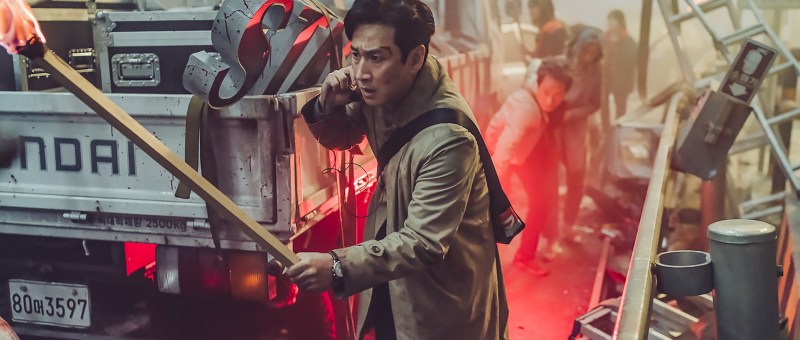
But as he later says, if Hyun-baek were actually there and seeing this for himself, he would make a different decision. Despite his cynicism, Jung-won eventually becomes a voice of authority during a moment of crisis and determines to set about rescuing the survivors rather than communicating with Hyun-baek about how best to turn this situation to their advantage. Paradoxically, he redeems the government in the eyes of those stranded on a bridge after a multi-car pileup in the middle of a particularly thick fog who come to realise that the authorities are not all that invested in rescuing them and may even be partly responsible for putting them in danger.

The Project Silence of the film’s title turns out to be one of creating genetically enhanced attack dogs who can chase a target with a specific voice. Apparently developed originally by the US and EU, the project is being researched in Korea but rendered a failure with the current batch of dogs set for “disposal”. That is, if they hadn’t been set loose by the accident and the possibly malicious actions of their handler who claims he was researching rescue dogs but was forced to reprogramme them to kill on the orders of the military. As he points out, the leader of the dogs, who has a head injury suggesting their programming has been disrupted, is only taking their revenge for their constant mistreatment at the hands of humans.

Then again, one of the ironies of Project Silence is that there is quite a lot going on from the unusually thick fog, the multi-car pileup caused by a live streamer driving recklessly for views, the toxic gas flowing from a crashed lorry, to the fact the bridge itself may collapse after the military helicopter sent to retrieve the dogs crashes and damages the support cables. All things considered, it is too much all at once considering the outlandishness of the evil dog plot. Though there are an assortment of survivors to become invested in as is usual in these kinds of films, we don’t always get to know them well enough with a series of subplots left unresolved such as the creepy behaviour of a Buffalo Bill-esque trucker who nevertheless becomes a kind of comic relief figure and eventual saviour of the group while becoming a reluctant buddy to Jung-won. Similarly, the dementia of an elderly woman (Ye Soo-jung) is intermittently brought up but never for any real reason nor is it ever fully explored, not even in her relationship with her husband who is responsible for her care. The younger of two bickering sister’s golf career does however turn out to have a practical application.

The conflict between Jung-won and his daughter, meanwhile, is largely mediated through her contempt for his callousness and resentment towards him for failing to address her mother’s death. Of course, saving the passengers is also a way to redeem himself in Kyoung-min’s (Kim Su-an) eyes much like the father in the similarly themed Train to Busan, though the awakening that Jung-won undergoes is more like the fog gradually lifting as he realises he is also being played by political manipulators while it is as he said different if you’re actually there and much harder to make the “sensible” decision to let the bridge collapse and take the potentially embarrassing evidence of their rogue science experiment with it. Perhaps that’s the real meaning of “project silence,” making sure there’s no one left to speak. But Jung-won is used to playing this game from the other side so he’s a few steps ahead and knows his best weapon is noise, tell everyone and do it right away so they don’t have time to shut you down nor can they deny it later. He may have been party to lingering authoritarianism, but has now realised that a nation’s primary duty is to protect its citizens after all, even if they voted for the other guy. 


Project Silence is available in the UK on 4K UHD courtesy of Altitude.

Trailer (English subtitles)

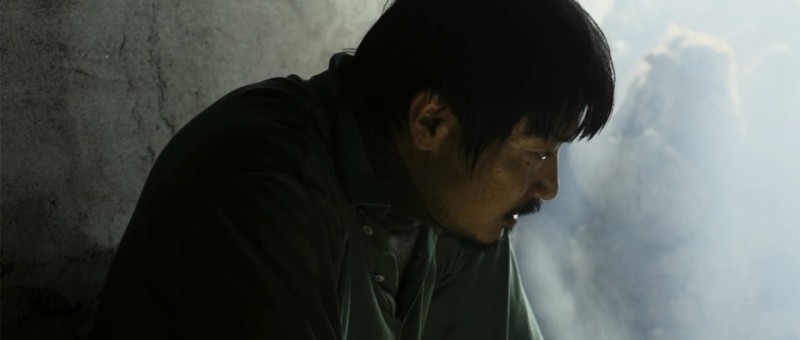
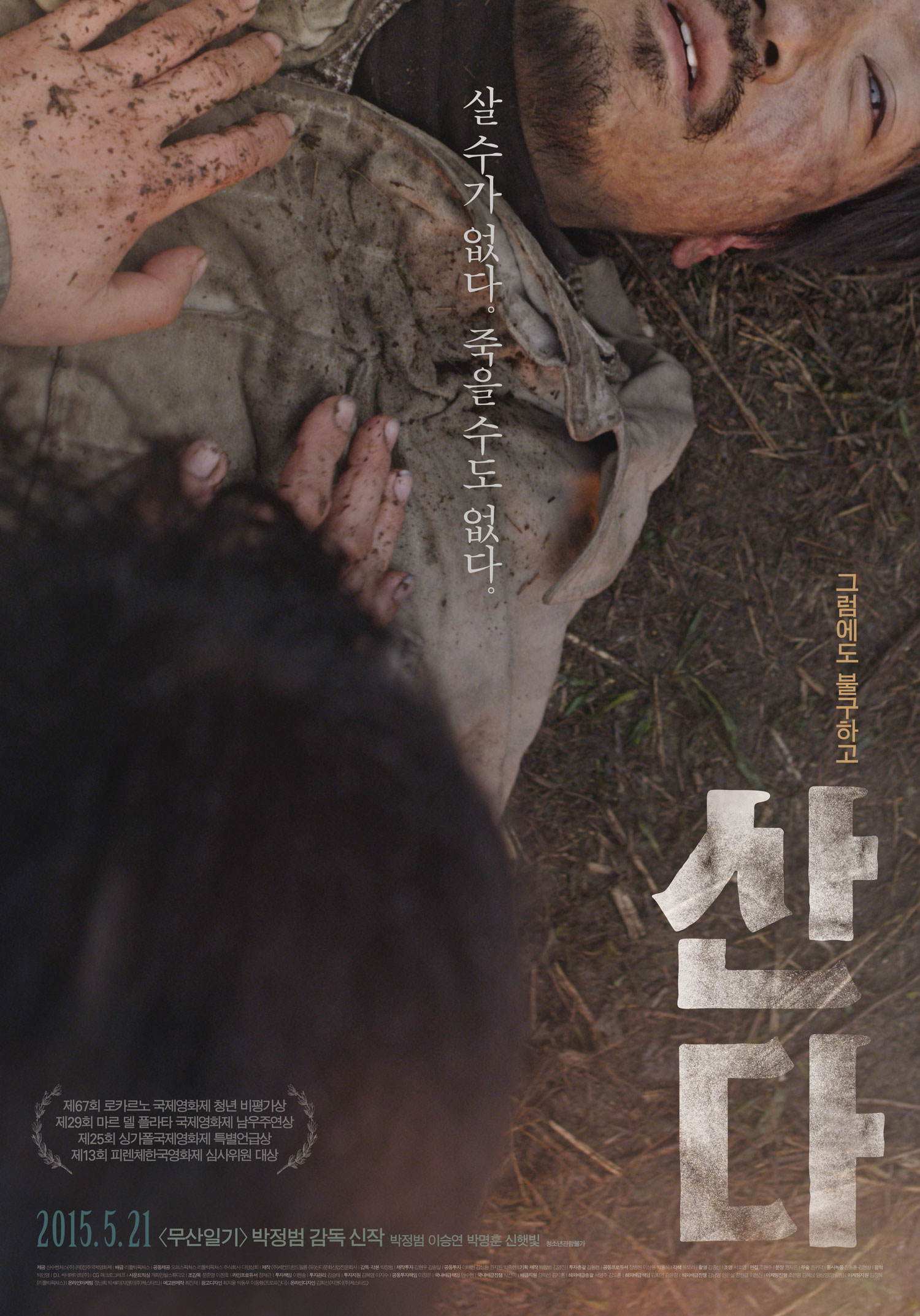
Alive (산다, Park Jung-bum, 2014)

alive-poster“There’s no safe place in this world” intones a pure hearted soul partway through Park Jung-bum’s relentlessly bleak exploration of the human condition, Alive (산다, Sanda). When your existence is defined by impossibility, it may be hard to see the light but to stop looking for it altogether doesn’t bear thinking about. A fierce condemnation of the hypocrisies of a capitalistic society, Alive wants to ask if simply breathing is enough when every breath is unending pain and the faint hope of a better life a cruel irony in an otherwise desperate existence.

Labourer Jung-chul (Park Jung-bum) lives in the ruins of his former family home destroyed in a landslide which also killed his parents. He is responsible both for his sister, Soo-yun (Lee Seung-yeon), who has extreme mental health issues, and her young daughter Hana (Shin Haet-bit). When the construction job ends for the winter, Jung-chul turns a crisis into an opportunity by volunteering to fill-in at the soy bean paste factory owned by the man for whom Soo-yun has been working as a cook to stop him firing her after she had an episode and did not show up for work. Things are going well, but the impending marriage of his haughty daughter to a middle-class salaryman is beginning to weigh on the factory owner’s mind. Worrying about the dowry, he summarily fires a number of longterm employees. Jung-chul, ever the opportunist, seizes the chance to get his construction site buddies over to the factory but his constant attempts to profit from the misfortune of others are destined to end only in disaster.

Trapped in the snowbound mountains, Jung-chul has little realistic chance of escape. His life is hard and marked only by physical exertion while stretched to emotional breaking point thanks to the complicated situation surrounding his sister. Despite himself, Jung-chul resents Soo-yun who has retreated into a near catatonic state in order to escape the misery of her life. She is often to be found at the local bus terminal where she picks up strangers and then returns to her ruined village for acts of self harm in an attempt to embrace vitality through suffering. Jung-chul is suffering too and he can’t forgive his sister for her attempts at mental absence, condemning her for her “shamelessness” rather than attempting to deal with her declining mental health and the physical harm in which it places her.

Jung-chul sees himself as the “pillar” of the family, that without him his sister and niece will be left out in the cold with nothing to sustain them. Yet his desire to protect his own cannot entirely explain his increasing dog eat dog mentality or his willingness to engage in the system of circular exploitations which defines the world in which he lives. “It obeys me better when it’s kept hungry” a woman snaps at Hana when she attempts to feed a performing parrot, somehow encapsulating the insidious logic of rampant capitalism. Jung-chul thinks he can’t afford to think about the employees his boss fired because someone is always going to lose out and it’s enough to make sure it isn’t him, but he doesn’t see that his refusal to stand up for others leaves him vulnerable and alone.

The world of the factory boss is an oddly feudal one in which his major preoccupation is his paternal obligation to provide a dowry for his daughter with the implication that the wedding may not take place at all if he cannot fulfil it. The boss’ daughter, having spent time in the US, objects to her father’s callous treatment of his employees who remain with absolutely no workplace protections and are not even offered severance pay despite being axed deep in the harshness of winter. Nevertheless, when her wedding is threatened she reverts to type. Her dad cut corners and made a mistake, but she’s going to find a scapegoat and cover it up, justifying her decision with the rationale that she’s “protecting” the workers. Obeying feudal obligations, the fired employees all turn up to her meeting at which she tearfully talks about a way to save the factory despite the fact that the factory has just betrayed them and trampled all over a lifetime’s unquestioning loyalty.

Meanwhile, Jung-chul’s simpleminded friend Myung-hoon (Park Myung-hoon) dreams of a new life in the Philippines where the people are kind and you never have to worry about the cold. Unlike Jung-chul, Myung-hoon can’t bring himself to betray his sense of justice even if he eventually succumbs to a kind of poetic recompense in order to save his own dream if only by stopping Jung-chul from ruining himself completely. Nevertheless, as bleak as this world is, it is not devoid of hope as Jung-chul eventually realises through the innocent sound of a child practicing piano. Shining a light for his sister, he finally remembers to close the door on an act of calculated pettiness, accepting that his responsibility extends further than his household and that only by opposing the injustice done to others can he hope to change his hopeless world and begin to feel alive once again.


Alive was screened as part of the 2018 London Korean Film Festival.

Original trailer (Korean subtitles only)

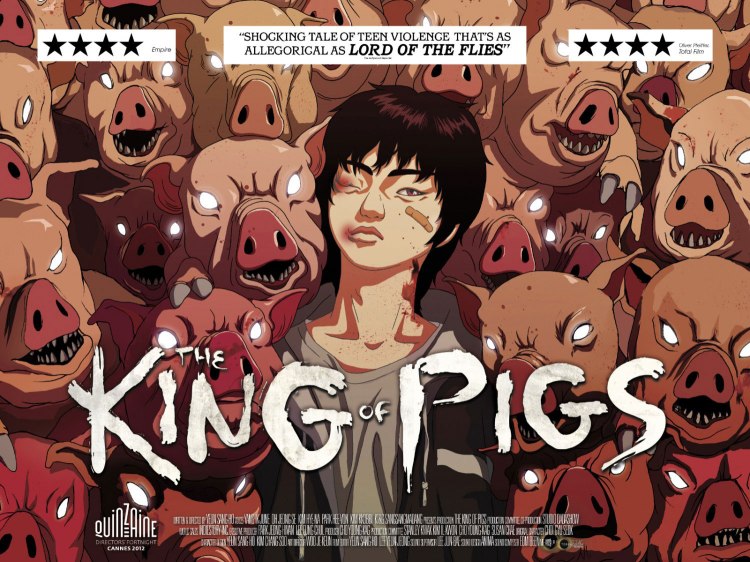
King of Pigs (UK Anime Network Review)

image-8-king-of-pigsFirst Published on UK Anime Network in May 2013


Korea has a long tradition of animation but is perhaps more famous overseas for providing technical services to higher profile productions from other countries. The King of Pigs is the first feature length Korean animation to be shown at Cannes and has been screened at several other film festivals worldwide, picking up a few awards along the way too. Korean live action cinema of recent times has earned itself a reputation for being unafraid of violence and difficult subject matters – an ethos which appears to have directly penetrated into King of Pigs which nothing if not extremely bleak.

As the film begins, failed businessman Kyung-min weeps naked in a shower while the contorted face of a strangled woman lingers hauntingly in the next room. He makes a phone call hoping to track down an old childhood friend – perhaps because he feels he’s the only one who can help him understand what he’s done or because he feels somehow as if this person represents a fracture point in his life where everything started to go wrong. This long lost friend, Jong-suk, seems to be in a similarly dismal situation – an under appreciated ghost writer who’s constantly berated for writing unemotional prose, he returns home to beat his wife after accusing her of having an affair (which turns out to be doubly wrong as she’d been meeting with a publisher about Jong-suk’s own novel). The two men meet and talk over a traumatic period in their childhood when their only protector was another boy, Chul – self titled King of Pigs.

The school system was divided rigidly along lines of economic/social status and academic prowess and neither Kyung-min nor Jong-suk found themselves in the elite camp. Beaten, humiliated and molested the boys appear to have no recourse except to grin and bear it – even the teachers and authorities appear complicit in this unofficial caste system. That is until Chul dares to fight back, violently, on behalf of not only himself but all the other ‘pigs’ too. The three end up becoming a team bound by mutual suffering much more than friendship or human emotion. It takes more than one boy to destroy a system though and circumstances conspire to ruin whatever headway they might have made. These times will affect each boy more than he could ever have guessed and these changes will not be for the better.

The King of Pigs is certainly not an optimistic film. Though it seeks to depict a corrupt system based on arbitrary and unfair principles, perpetuated by the adults in charge and those trapped inside it, it has to be said that by the time we meet the young counterparts none of them is especially sympathetic. It’s an unfortunate part of the film’s message but the fact that both the young boys are so passive and complicit in their own degradation makes it very difficult to build up a sense of sympathy for them. You might think then that Chul would be the natural hero of this piece as the self appointed ‘savior’ of the hopeless cases but his manifesto rapidly turns so repellant that you can’t get behind him either. What you’re left with is a group of misogynistic ‘little men’ who in turn transfer the frustration they feel with their own sense of inferiority on to those they believe to be even weaker than themselves. The film tries to imply that the grown up failures of these men are a direct consequence of a broken school system, yet as we meet them already in the system rather than as totally innocent children, it’s not possible to follow this line of reasoning as the boys appear deeply unpleasant from the offset.

Unfortunately, another thing the film isn’t is subtle. The director really wants to hammer home his message about the socio-economic unfairness that seems to penetrate every area of society and prevent any sort of social mobility, but often it’s akin to being hit over the head with the same idea repeatedly several times over the course of the film. It is extremely violent in a deeply uncomfortable way to the extent that you could call this a ‘nasty’ film – the scene of animal cruelty alone feels both like an underdeveloped cliché and a thinly veiled attempt at shock value. In short, the film constantly undermines itself by shooting straight for the extreme where a more nuanced approach may have made its subject matter all the more powerful.

As it stands, it’s quite difficult to recommend The King of Pigs either as an entertainment piece or as a serious art film seeking to examine Korea’s attitudes to social class. The film was made on an independent basis and some may find its aesthetic a little basic in terms of animation quality yet it does have some interesting directorial ideas and composition. Though it ultimately fails, the film does deserve some praise for tackling such a difficult subject matter – genuinely adult contemporary animation can often be difficult to find. However it’s partly its desire to be ‘adult’ that destroys its ability to be taken seriously – by skewing towards the ‘extreme’ audience who may only be interested in the violence rather the problems that underly it, The King of Pigs risks been seen as a schlocky horror story rather than a parable about some very real social issues.


Available now in the UK from Terracotta Distribution.

Review of Yeon Sang-ho’s second and much improved animated feature The Fake.