Hi-Five (하이파이브, Kang Hyoung-chul, 2025)

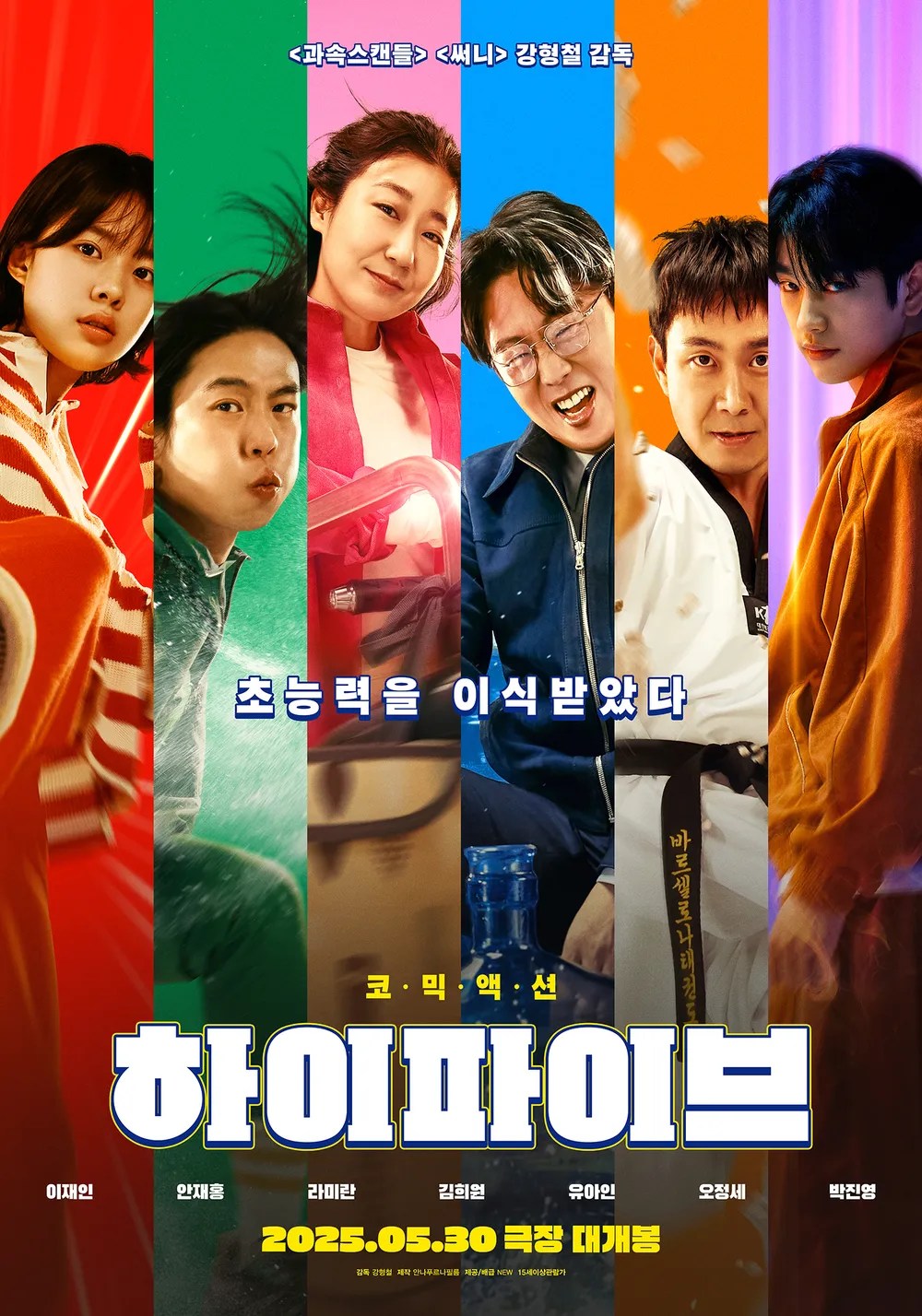
If you suddenly developed super powers, what would you do with them? Would you start using them for good to save the people around you, or would you become obsessed with the power itself and try to amass more of it while your using abilities only for your own ends? Those at the centre of Kang Hyoung-chul’s superhero comedy Hi-Five (하이파이브) are firmly in the helping others camp, but they’ve seen enough movies to know that every hero needs a villain and there’s someone else out there who wants their power for themselves.

That would be ageing cult leader Eternal Young-chun (Shin Goo), New God Resurrected. Young-chun is just ripping his followers off and doesn’t believe in anything he preaches but has, on the other hand, started to believe in his own divinity. He’s been keeping himself in good health through frequent organ donations from less fortunate people to the extent that his body’s a kind of Ship of Theseus. His daughter’s fed up with his longevity and hoping he’ll finally snuff it so she can take over, which is why she’s after the five in the hope of taking them out before Young-chun can steal all of their transplanted organs too. It turns out that the pancreas he was given was taken from a superhero who took his own life and has not only rejuvenated his body but given him the ability to suck the life force out of other people to empower himself in a more literal way than he’s already feeding off his followers by exploiting their devotion to convince them to give up all their money and assets or else work themselves to death for free.

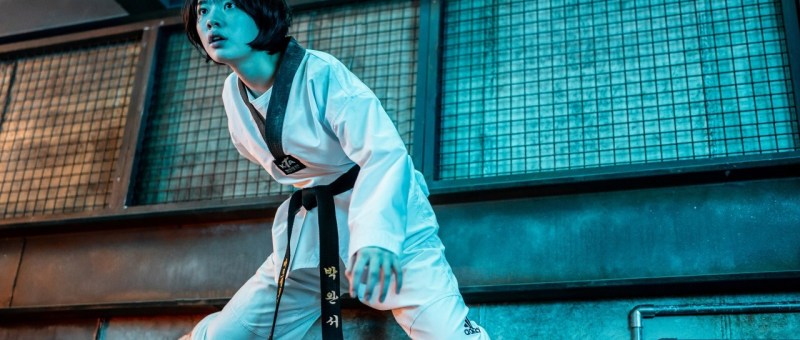
The other five commonly transplanted organs were given other people who are all marked with a tattoo and have been given powers of their own, though one of them hasn’t figured out what hers is yet. In contrast to Young-chun’s soullessness, each of the five seems to have had their own problems that are only impacted by their transplants rather than directly caused by them. Teenager Wan-seo (Lee Jae-in) received the heart and is frustrated by her overprotective father who constantly asks about her friends though she keeps saying she doesn’t have any because she was ill for so long and had to skip school for treatment which is why struggling to make any new ones. He won’t let her do taekwondo either, though that’s what she most wants to do and possibly why she ended up with the all powerful, super speedy fighter skills. Ji-sung (Ahn Jae-hong), meanwhile, is a struggling screenwriter with an interest in the superhero genre. He doesn’t have any friends either, which may be to do with a poor career decision that alienated him from his community. Though he’s the first one to want to get the group together, he’s soon consumed by cynicism. Ji-sung got the lungs and can blow things away, but struggles to convey his emotions with words and gets into an alpha male hissy fit with Ki-dong (Yoo Ah-in), a super-sharp guy who got the corneas and can manipulate electricity but is actually a bit of a loser with gambling issues and similar interpersonal issues to Ji-sung.

Middle-aged yogurt lady Seon-nyeo (Ra Mi-ran) got the kidneys and can’t figure out what her superpower is but becomes the force who holds the group together. Even so, she’s battling mental health issues and some guilt about something that happened in her past and caused unintended harm to another person. Factory foreman Heel-han (Kim Hee-won) is a devotee of the cult, but frustrated and conflicted by the obvious disregard for workers’ safety and wellbeing. He got the liver, and can heal minor wounds caused by recent accidents. The reason he has no friends is that he cut off all of his relationships when he joined the cult, which is one other reason he doesn’t want to make a fuss about the abuse of workers and is originally flattered by Young-chun’s attention.

Nevertheless, it’s becoming part of the group that allows them to save each other and themselves figuratively and literally in combining their strengths to battle Young-chun, who is after all also sort of a part of them and a member of their family as another recipient of organs from the same person. Kang imbues their somewhat clumsy heroism with a quirky humour, even giving the occasional use of CGI a comedic, comic book aesthetic to lean into what might otherwise be a minor liability though production design and values are top-notch. It’s a shame the film was held up for four years by Yoo Ah-in’s drug arrest which has severely hampered his career and led to most of his unreleased work being shelved at the time, otherwise this might have gone on to become a fun movie franchise with deepening lore led by a likeable cast of everypeople using their powers for good in small but important ways. Still, just this episode alone is plenty of warmhearted fun as the gang come together to expose Young-chun’s vain and selfish cult leader for the conman he is, saving themselves and freeing those like them who fell victim to his lies.


Hi-Five screened as part of this year’s London Korean Film Festival.

International trailer (English subtitles)
Yaksha: Ruthless Operations (야차, Na Hyeon, 2022)

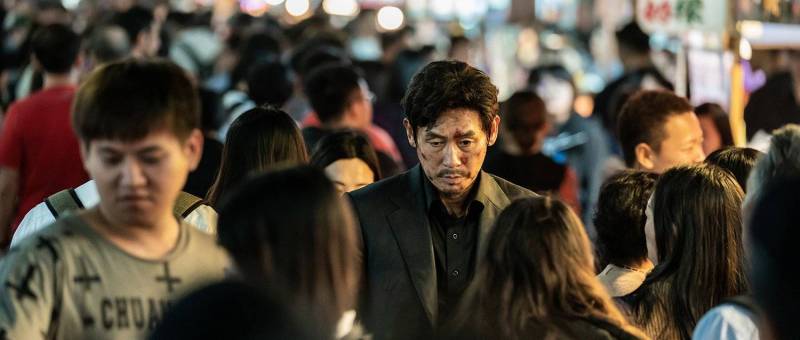
“Justice is preserved by being just” according to the idealistic hero at the centre of Na Hyeon’s Yaksha: Ruthless Operations (야차, Yacha) , though he’ll eventually come round to his sometime mentor’s belief that “Justice must be preserved by any means necessary”. Any means necessary is indeed the motto of the titular hero named for the unpredictable Buddhist deity and regarded by his superiors as a dangerous maverick though as it turns out he does indeed have justice in mind even if his idea of justice might not fully align with those whom he is intended to serve. 

The failure of the regular justice system is signalled in the film’s opening as idealistic prosecutor Ji-hoon (Park Hae-soo) finds his case against a corrupt CEO falling apart because of procedural mistakes by his own rookie team. Humiliated on the courthouse steps, Ji-hoon is given a punitive transfer to the NIS where he is kept out of trouble, told to draw a salary but given very little work. He and his jaded colleague who was once known as the “bulldozer of justice” but has been ruined by this bizarre form of punishment and no longer has the will do to anything much at all mostly spend their time doing jigsaw puzzles stave off boredom. When his colleague admits there’s no more hope for him and turns down an offer of reinstatement, Ji-hoon agrees to travel to Shengyang, a hotbed of international spies in China, to find out what’s going on with a series of false reports from their agents on the ground led by maverick black ops officer Yakska. 

What he soon discovers is that he’s been dragged into some murky geopolitical shenanigans between North Korean spies, his target’s possibly corrupt team, and the Japanese who are once again up to no good trying to prevent a possible alliance between North and South believing such a union would present too much of a threat to their economic position in North East Asia. His problem is that Yaksha’s field craft does not measure up to what he regards as appropriate conduct. He engages in firefights and commits what seem to be summary executions while later threatening to torture a hostage to force her to reveal the location of their missing asset, a North Korean financial kingpin, Moon (Nam Kyung-eup), who had been acting as a double agent for the Japanese but had become disillusioned with their imperialist outlook and decided to defect to the South bringing valuable information with him. 

It has to be said that however uncountable it may be to see a Japanese spy who behaves like a gangster committing acts of torture in a well appointed lab on a Chinese woman in China, Yaksha cannot exactly claim the moral high ground having attempted to do something similar only in his filthy hideout in an abandoned mine. Ji-hoon’s dilemma is that he doesn’t know whose side, if any, Yaksha is on or if he’s after the North Korean trillions Moon had been managing rather than a hugely beneficial national asset. Exposed to this morally grey world, however, Ji-hoon’s idealist edges begin to soften as shifts towards Yaksa’s “by any means possible” philosophy while trying to stop evil Japanese spy turned lobbyist from recovering the valuable data Moon had to sell and going on to do even more nefarious deeds undermining the possibilities for reunification along with the Koreas’ economic potential. 

Somewhat uncomfortably, the film does then more or less condone torture, betrayal, and summary execution if conducted in the pursuit of “justice” even while simultaneously approving of Ji-hoon’s idealistic pursuit of the rich and powerful who continue to misuse their position and cause pain to ordinary people. It comes to something when the safest ally is a gang of human organ traffickers with whom Yaksha seems to be suspiciously familiar. Nevertheless, what Yaksha eventually asks Ji-hoon to do is to “clean things up” hinting at the duo’s complementary qualities as they pursue “justice” in both the legal and more immediate senses. Filled with some quite literally explosive action sequences along with some admittedly broad comic book antics as the guys face off against Hideki Ikeuchi’s Japanese arch villain Yaksha is certainly a good looking film if one with a dark heart beating at its centre. 


Original trailer (English subtitles)

Princess Aya (프린세스 아야, Lee Sung-gang, 2019)

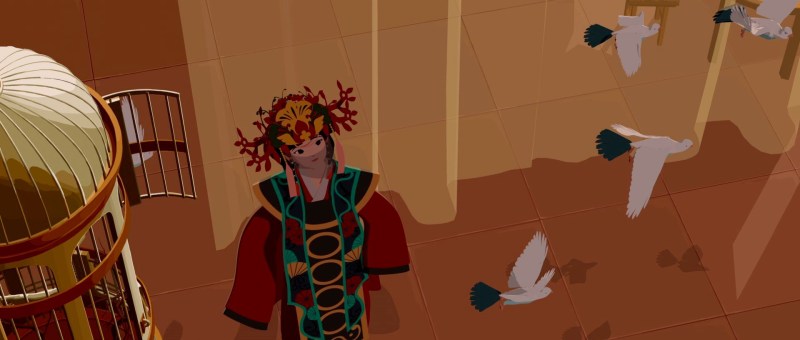
Animation made for children can often be a subversive affair, offering surprisingly progressive messages sometimes at odds with an otherwise conservative industry. Though quite obviously taking its cues from Frozen in terms of aesthetics and atmosphere despite its desert setting while drawing inspiration from classic fairytales, Princess Aya (프린세스 아야) is a sterling example, keen to sell the message that it’s OK to be different while emphasising that it’s prejudice and social exclusion which are the real enemy, creating only pain and resentment while those rejected by an intolerant society may eventually be consumed by their sense of betrayal. 

Long ago in a feudal society, a strange curse begins to affect children born in the small kingdom of Yeonliji which causes them to turn into animals after coming into contact with animal blood. Some believe that the curse is the revenge of animals hunted for sport, while the cursed children are, ironically enough, abandoned to live as beasts in the forest or perish. The Queen, however, cannot bear to part with her child, Princess Aya (Baek A-yeon), and sacrifices some of her own life force in return for a magical bracelet from a tree god that will prevent the curse from manifesting. Years later, Aya grows up into a feisty teenage girl, while the kingdom is threatened by an oncoming incursion from desert nation Vartar who want its water. The Vartan prince, Bari (Park Jin-young), has proposed a dynastic marriage with one of Aya’s younger sisters to broker peace, but Aya has no intention of letting her sisters face such an uncertain fate and insists on going herself. 

Of course, what she discovers, in true Korean period drama fashion, is that there’s intrigue in the court. Bari is not, as she feared, a hideous monster but a kind and handsome young man who is actively trying to prevent a war and protect Yeonliji (which is obviously what she wants too), but his treacherous uncle is ruling as a regent and secretly working against him. Meanwhile, attempts have been made on Aya’s life, and she’s lost the precious bracelet which allows her to keep her true nature hidden. 

The curse appears to be a punishment manifested on mankind for its cruel treatment of animals, forcing Aya to feel the suffering of living creatures in pain and close to death. While Aya does her best to fight the darkness, another creature known as the “Beast” has allowed it to consume him, feeding on sorrow and determined to take revenge on the society which has abandoned and rejected him. It’s rejection that Aya too fears, as perhaps does everyone and most especially young women, but hers is a deeper seated anxiety in that she’s uncertain what will happen if her true nature is discovered. 

Nevertheless, she moves towards an acceptance that her curse could also be a gift while beginning to believe that “no matter who I am I can be loved”. Yet she also feels a sense of guilt in using her amulet, knowing she is deceiving the prince, whom she’s come to admire, while fearing his reaction if she tells him the truth. Bari, meanwhile, is not so much hiding a secret as a lone figure of traditional nobility in a court filled with scheming intrigue. While his uncle plans to subjugate Yeonliji, Bari has been secretly drilling in the desert looking for water, admiring the flowers where they bloom even in adversity. 

Bari refuses to make his men slaves of war, while Aya insists that they need to rebuild their society with a greater sense of compassion. She is afraid of her “difference” and her destiny, longing to be free but afraid of being seen. Eventually she realises that connection can be a strength and not a weakness as can authenticity and mutual understanding. She refuses to abandon the Beast as her society had done despite his wickedness, still hoping to save and bring him into her hopefully kinder world. Princess Aya shows kids that being “different” is nothing to be ashamed of, that no one is unloveable (even evil Beasts), and that the Princess is perfectly capable of saving herself but it’s no weakness to accept help when you need it or to give it when others are in need. A charming musical fairytale, Princess Aya wears its progressive values on its sleeve, always allowing its heroine to chart her own destiny while finding self-acceptance along the way.


Princess Aya screens in Amsterdam on March 7/8 as part of this year’s CinemAsia Film Festival.

International trailer (English subtitles)

Queen of the Night (밤의 여왕, Kim Je-young, 2013)

Queen of the NightThere are only two things which spring to mind on hearing the words “Queen of the Night” – Mozart and…something else. Anyway, Kim Je-yeong’s Queen of the Night (밤의 여왕, Bamui Yeowang) is about neither of these. It’s about a dreadfully self-centred IT guy who finds out something he didn’t previously know about his wife and then decides to go all CIA about it. It’s also about her boss who turns out to have a connection to her hidden past and a taste for date rape. Queen of the Night is a comedy in which in which nothing seems very funny, at least if you don’t happen to be a nerdy IT guy whose dream it is to marry a kind and “frugal” woman who will have just emerged from a nunnery or spent her formative years at a conservatoire where all male contact was expressly prohibited.

Young-soo (Chun Jung-myung) is a lonely, middle-aged computer guy whose continual search for love is often undermined by his money-saving mania which extends to leaving his lunchtime blind date waiting while he runs back to the office to retrieve the discount coupon he’d intend to use to buy her a cheap meal. All he wants is a wife who is “frugal” and kind. One day he ventures into a Subway and lays eyes on the girl of his dreams, Hee-joo (Kim Min-jung), who doesn’t seem to notice him and also seems to be the reason this is store completely packed out with middle-aged salarymen. Finally she sees him, the pair start dating, and eventually get married.

Everything is amazing, Young-soo has never been happier. The pair have bought their own apartment in Seoul and are even about to get rid of Young-soo’s horrible old fridge. Young-soo’s life begins to derail when his good-looking but sleazy boss, Park Chang-joo (Kang Sung-ho), asks him to install a dodgy surveillance app across the office network but it’s a trip to a uni reunion which plants doubts in Young-soo’s mind as to how well he really knows his wife.

Without giving too much away, Queen of the Night’s big secret is not what you think it is. In fact it’s nothing at all. All it amounts to is that Hee-joo was once young and a bit mixed up. She spent some time abroad, didn’t feel like she fit in, came back to Korea and felt even more out-of-place. So she started going to clubs and hanging out with delinquents – how scandalous! Of course, Young-soo wanted a nice, level-headed girl who was careful with money so this information disturbs him. Hee-joo has definitely outgrown her wild years and is exactly the woman he wants her to be, but Young-soo just can’t let it go.

The ironic thing is, spineless Young-soo is conflicted about employing the spy program but does it anyway while planning to write a blocking program to stop it working. Meanwhile he’s basically stalking his wife, googling her on the internet and trying to track down her old friends to find out who she really was before he met her. Simply asking Hee-joo does not occur to him.

The world Hee-joo is forced to live in is extremely misogynistic. Young-soo’s suspicions are first aroused when he is talked into making a rare appearance at a uni reunion after being assured he can take his new wife with him. Young-soo only wants to do this to show off that’s netted himself such a lovely, pretty girl but the reunion itself takes a turn for the strange when the wives (there is only one female computer engineer in the group and she apparently owes her graduation to Young-soo who supposedly ghostwrote her thesis for her, because you know women and computers, right?) are expected to participate in a bizarre talent contest to win white goods by showing off their special skill. Hee-joo ends up winning a kimchi fridge her mother-in-law had been desperate for by showing off her smooth moves on the dance floor, much to Young-soo’s surprise and mild displeasure.

Aside from being thrust into combat with the other wives of engineers, Hee-joo is also forced to contend with the unwanted attentions of Young-soo’s boss, Park. As part of his attempts to defeat the spying app, Young-soo discovers surveillance footage of Park taking women back to his office and spiking their drinks after which he assaults them. Despite seeming outraged, Young-soo does nothing at all about this. When Hee-joo looks set to become his latest victim, Young-soo busts a gut to save her but later descends into a bout of victim blaming, preferring to bring up the small amount of info he’s discovered about Hee-joo’s past to imply this was all her fault. Matters are made worse by Young-soo’s geeky friend (Kim Ki-bang) who spends too much time on the internet and assures him that the reason he and Hee-joo haven’t conceived is because of the anti-sperm antibodies in her system generated by promiscuity. Absolute and total rubbish, but Young-soo falls for it without reservation, largely because he has such low self-worth that he assumes any woman who falls for him must in some way be damaged.

Hee-joo is allowed to get her own back, to a point, by reuniting with some of her delinquent friends to scare the living daylights out of Park before telling Young-soo to get lost. He, of course, tries to win her back but he’ll have to learn to love her past too if he’s to have any chance of regaining his bright and happy future. This is a positive step, in a sense, as Young-soo seems to have acknowledged Hee-joo is a person and not just a personification of his hopes and dreams, but it’s also painted as a kind of forgiveness rather an acknowledgement of his totally inappropriate behaviour. Nothing about this is funny to anyone born after 1780, it is rather profoundly depressing. Queen of the Night may shine a little light on male/female relations in modern-day Korea but the picture it paints is far from inspiring.


Original trailer (English subtitles)

https://www.youtube.com/watch?v=PMPPvhe9ZOU

Take Care of My Cat (고양이를 부탁해, Jeong Jae-eun, 2001)

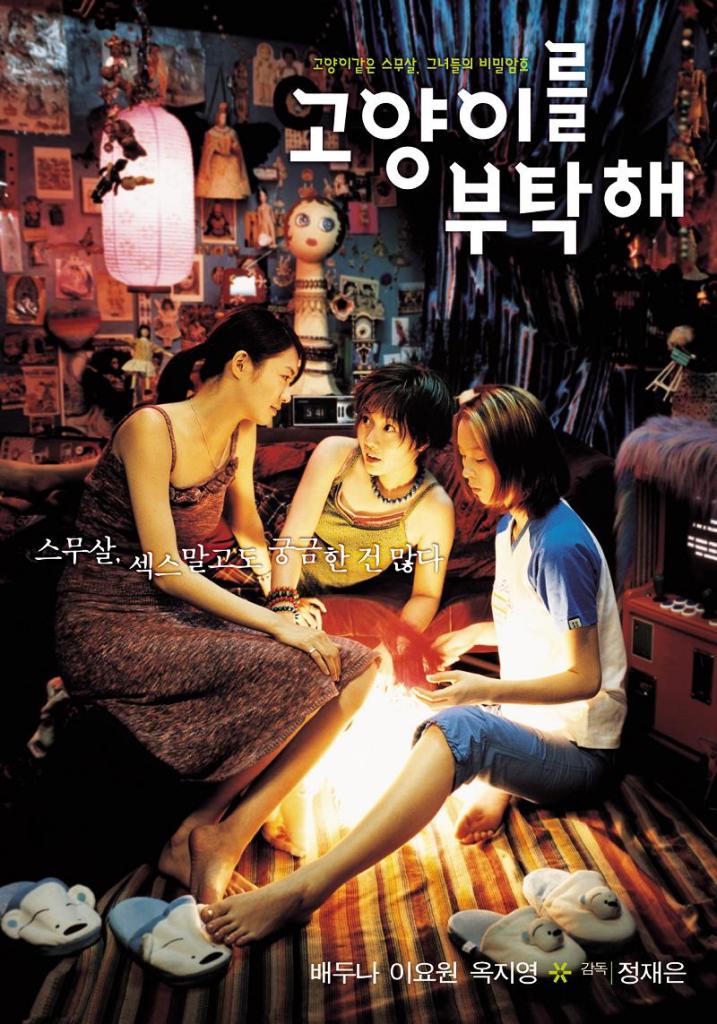
take-care-of-my-catThe time after high school is often destabilising as even once close groups of friends find themselves being pulled in all kinds of different directions. So it is for the group of five young women at the centre of Jeong Jae-eun’s debut feature, Take Care of My Cat (고양이를 부탁해, Goyangileul Butaghae). All at or around 20, the age of majority in Korea, the girls were a tightly banded unit during high school but have all sought different paths on leaving. Lynchpin Tae-hee (Bae Doo-na) is responsible for trying to keep the gang together through organising regular meet ups but it’s getting harder to get everyone in the same place and minor differences which hardly mattered during school grow ever wider as adulthood sets in.

Cheerful scenes of high school mischief give way to the uncertain present as five old friends prepare to celebrate the 20th birthday of the group’s self appointed star, Hye-joo (Lee Yo-won). Hye-joo, however, has moved on to a high level office job in Seoul and is about to blow off her high school friends to hang out with her possibly sleazy boss, only to revert back to plan A when he cancels on her. Too cowardly to ring her friends in person, Hye-joo leaves the business of calling off the party to the chief organiser, Tae-hee, who rings round letting the other three girls – jobless Ji-young (Ok Ji-young), and half Chinese twins Bi-ryu (Lee Eun-sil) and Ohn-jo (Lee Eun-ju), know (and presumably has to then ring them all back to tell them the party’s back on).

Hye-joo moved farthest away from her roots both in terms of location and of her social ambitions through taking a well paid admin job in the city. Increasingly materialistic and status orientated, her friendship with the other girls suffers as she sees herself as transitioning to a higher social class. Ironically, her views are equally deluded as she continues to believe that her dedication and willingness to work hard can make up for her lack of a degree but quickly finds herself displaced when the next batch of newbies arrive.

This growing desire for material status has also contributed to a seemingly unbridgeable rift with Ji-young whose economic status is the most vulnerable. Orphaned and living in a shack with her elderly grandparents, Ji-young has recently lost her job and is having difficulty finding another one precisely because of her circumstances – one firm even point blank refuses her application because both of her parents are dead and they need a direct family member to vouch for her. Hye-joo is insensitive in the extreme and often flashes her money around whilst rubbing salt in Ji-young’s wounds by emphasising her lack of it and pouring cold water over her ideas of saving money to study abroad. Small digs like these and insisting that all the girls leave their home town to visit her in Seoul (leaving aside the additional costs for Ji-young whom she knows is having difficulty making ends meet) point to Hye-joon’s own sense of neediness and insecurity.

As a result, Ji-young distances herself from her friends, ashamed of her desperation and feeling unable to ask them for help. It is she who finds the cat of the title when she hears it mewing whilst trapped behind debris on her way home. The cat becomes almost a mirror of Ji-young – alone and abandoned on the streets with no one to look after her. Originally, Ji-young tries to give the kitten to Hye-joon as a birthday present only to have it immediately returned. The cat is then passed around among each of the friends looking for a more permanent kind of affection, but finding little in the way of stability.

The longest and most devoted guardian turns out to be Tae-hee who is perhaps most affected by the loss of her friends and changing circumstances. Tae-hee is from a moderately well off middle class family and has been helping out in her father’s business since leaving school (apparently without pay). Despite her lack of worry over material comforts, she finds herself feeling restless and increasingly interested in the “foreign” with dreams of taking off alone for adventures overseas. Her desire for freedom is partly down to her domineering father who simply overrules all of her decisions even down to ordering food in a restaurant. Tae-hee is the only one to reach out to Ji-young when she realises she might be in trouble and is the only one still there for her at the end. Their economic and familial circumstances may be different, but in their desire to escape the confines of the rundown Incheon for something outside of what it might have planned for them, the two girls are a perfect match.

Of the group of friends the twins receive the least attention, hovering on the sidelines, separate from the mini dramas erupting between the insensitive and self obsessed Hye-joo and the increasingly desperate Tae-hee and Ji-young. As a unit of two they have their own little world which seems much happier and more solid than that of any of the other girls and arguably have less need for the immediacy of their old friendships. They are therefore the ideal place to deposit them, in the form of a stray cat finally finding a home. The past has its place – in the past, the memories are warm and fluffy and deserve to be taken care of, but there comes a time you have to surrender full custody and be content to visit from time to time.

An extraordinarily well composed debut feature, Take Care of My Cat has a more European feeling than many a Korean coming of age drama but is filled with realistic detail such as the constant ringing of the girls’ ever present mobile phones and the onscreen representation of their straightforward text based conversation. There’s a kind of sadness associated with the transition from carefree adolescence to the difficult journey into adulthood with each of the girls discovering what it is they want out of life, or more aptly what it is they don’t want. Hye-joo emerges as the quasi-villain of the piece as she makes an obvious, superficial choice to follow the consumerist trend over valuing human relationships though it’s hard not to feel sorry for her when it appears she’s being set up for disappointment. Ending on a note of hopeful uncertainty, Jeong’s debut feature is a hymn to the theme of moving on but is careful to admit the bittersweet quality of a new beginning.


International trailer (English subtitles)