Devils Stay (사흘, Hyun Moon-seop, 2024)

Unable to accept his daughter’s death, a father refuses to let her soul rest in Hyun Moon-seop’s possession thriller, Devil’s Stay (사흘, Saheul). The film’s Korean title “the Third Day” hints at its inverted religious overtones as a priest explains that she will indeed rise again like the Lord himself three days after her death, but as a destroyer of worlds in the incarnation of powerful demon. Heart surgeon Seung-do (Park Shin-Yang) isn’t sure that’s such a bad thing if only his daughter survives.

Then again, there’s a sense that Seung-do himself may share that So-mi’s (Lee Re) plight was partly down to his hubristic conviction in his skills as a surgeon that he alone could save her. So-mi evidently had some kind of serious medical condition that could only be cured by a heart transplant, but the obvious implication of that is if So-mi is to survive then another child must die. There is a kind of equivalent exchange in play and a wager that Seung-do is making with the universe. He may not think of it that way, but he is in fact making a deal with the Devil in his willingness to commit a human sacrifice to save his own child at the expense of someone else’s that in turn would colour the rest of So-mi’s life even if she had not become possessed by a demon.

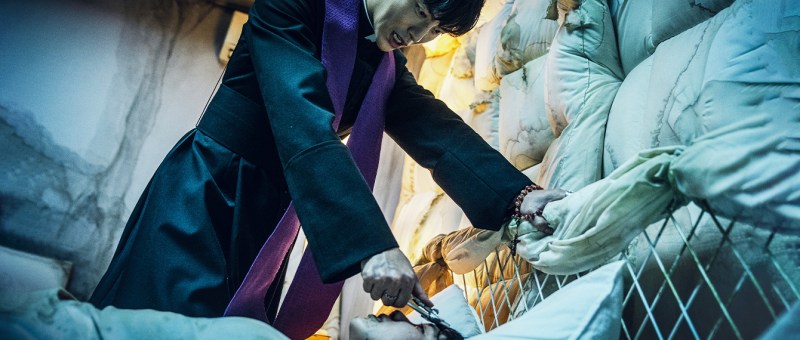
Father Ban (Lee Min-Ki), a young and intense priest very committed to exorcisms and demon hunting, presses Seung-do as to how he came by this heart that he gave to his daughter, already sensing that this is how the demon crept in. Seung-do must in effect wrestle with the decision he made that has both damned and saved his daughter in equal measure along with the reality that whatever has survived is not So-mi, or at least, not So-mi alone. Father Ban tells him that when the demon rises on the third day, it will immediately turn on those closest to its host. He must then place another wager, deciding whether saving So-mi is worth risking the lives of his wife and son in addition to his own rather than letting her go gracefully and attempting to go on with his life while carrying the burden of paternal failure. 

But to all around him, it appears as if Seung-do has lost his mind. He rants and raves, insisting that his daughter isn’t really dead and even at times interfering with the funeral process to take charge of her body. Like him, Father Ban is also considered an outsider by other members of his church who think he’s too invested in demonology and possibly also blame him for the death of another exorcist priest who saved him when he was demonically possessed himself while serving in the army. Perhaps subversively, the film heavily implies that there was more than friendship to Father Ban’s relationship with the other priest and that his desire to vanquish the demon is also one of vengeance. In this, he may be Seung-do’s enemy as he is gradually seduced by the demon and considers appeasing it to save So-mi, encouraged to make another equivalent exchange and in a sense enact his own funeral to take her place.

In this way, the religiosity is undercut by the implication that the “light” that guided So-mi belonged to father rather than to God as he fulfilled his role as a her polestar and his promise that he’d come find her if she made sure to stay where she was. Even so, it amounts to an awkward advocation that father knows best in that So-mi’s salvation lies in her obedience to Seung-do, rejecting her autonomy to place her faith in her earthly father to save her as he promised he would. In many ways, it’s a story of paternal redemption in which Seung-do must reckon with the transgressive choice he made, no longer able to run or hide from it to but forced to accept his weakness and failure along with the morality of what he did. Essentially a character study, Hyun Moon-seop’s conjures a palpable sense of evil and eeriness but also hope as Father Ban’s mentor had reminded him, that demons too can be beaten though the worst of all dwells in the human heart. 


Devils Stay is released in the US on Blu-ray, DVD and Digital March 18 courtesy of Well Go USA.

International trailer (English subtitles)

Motel Cactus (모텔 선인장, Park Ki-yong, 1997)

Motel Cactus posterAs a pair of its patrons eventually begin to muse in a moment of easy reflection, Motel Cactus is an odd name for a love hotel. Then again, a prickly flower blooming in the desert perhaps captures the uniquely melancholy qualities of these illicit, temporary meetings filled with defeated hope and existential malaise. A breakthrough feature for Park Ki-yong, Motel Cactus (모텔 선인장, Motel Seoninjang) owes a significant debt to the world of Wong Kar-wai with which it shares a mild visual similarity thanks to cinematographer Christopher Doyle making his only (to date) foray into Korean cinema. Park’s explorations of romantic emptiness might not be particularly original but it’s hard to argue with the beauty in his sadness.

Each of our joyless encounters takes place in room 407 of the titular Motel Cactus stretching across ten years of turbulent Korean history. Park begins with politics as a young woman attempts to wash tear gas out of her eyes after wandering into a democracy demonstration by mistake. Time moves on and the room becomes home to a pair of students intent on shooting a film but trapped in a Godot-esque limbo waiting for a friend who has been unavoidably detained. The first woman suddenly reappears but with a different man, followed by the man again but now with an old flame whose life after love has proved disappointing.

Park bookends each of the episodes with a brief piece of to camera monologue taking place outside of the room. Hyun-Joo (Jin Hee-kyung), the woman from the first and third scenes, angrily berates an offscreen friend for being naive and getting her heart broken by another no good, cheating man. Of course, Hyun-Joo’s irritated speech could easily be directed at herself, abandoned and then abandoning in each of her unsuccessful encounters with men. Though her original assignation with the young and handsome Min-koo (Jung Woo-sung) begins with passionate intensity, it quickly turns cool – he calls another woman and lies about being with a client, emerging guilty and conflicted. Min-koo refuses to talk of love and eventually leaves early, offering the olive branch of a Saturday picnic that both of them know will probably never take place.

Suk-tae (Park Shin-yang), Hyun-joo’s second partner, begins with a “funny” story recited in a bar about a woman who may have been intending to commit suicide for love. Drunk out of their minds, Suk-tae and fellow drinker Hyun-joo head on up to room 407 where they have a total blowout, alternating between childish play and animalistic lovemaking. When the air cools and introspective chat takes over, he asks her if it’s true she always comes here when it rains to which she freely admits, reliving the ghost of past love and a rainy birthday with the presumably long gone Min-koo. This time, it’s Hyun-joo who leaves sadly before the sun has risen while Suk-tae is left behind in a blissful, drunken snooze.

When Suk-tae returns to the room, it’s for a less deliberate purpose. Reuniting with college sweetheart Hee-soo (Lee Mi-yun), he makes awkward small talk reminiscing about the old days while she sadly keys him in to her melancholy dissatisfaction with her later life which neatly echoes his own sense of defeated failure. They want to go back to a more innocent time, but they can’t and it’s clear their superficial reconnection is merely an echo of the past which won’t survive the room.

The room has its way of distorting itself, trapping the would be lovers in an imaginary space in which a part of them will always remain. The students attempt to subvert the nature of Motel Cactus through inching towards innocent romance, but they remain at odds with each other, playing childishly at love while attempting to take mastery of the room but repeatedly failing. Miscommunication reigns. Seo-Kyung (Kim Seung-hyun), the young actress in filmmaker Joon-Ki’s (Han Woong-soo) student project, gets waylaid on her way to the hotel by a TV vox popper who wants to ask her opinion about in a change in the law which would reverse a ban on people with the same surname marrying (a fairly big problem given Korea’s relatively small number of surnames even when only applying to a common ancestral branch). Seo-kyung, however, mishears them and launches into a consideration of same sex relationships on which she ultimately comes out in favour.

Hee-soo’s monologue was delivered to a fortune teller who’d previously advised her that her marriage was a bad idea – she didn’t believe him, but he was right. Motel Cactus is a sad place, drenched in neon half light with the greyness of rainy skies worrying at the windows. An old lady reappears to clear up after our careless lovers while the room’s decor undergoes minor changes, an ‘80s-style electric moving picture diorama an eerie fixture on the wall as its bright waterfalls threaten to tumble on for all eternity. Time stands still in here, marked only by the futility of true connection and the inescapable longing that accompanies it. Park’s naturalistic desires are occasionally swamped by Doyle’s characteristically stylish camerawork but it’s difficult to argue with the poetry of his images even whilst singing an old song.


Motel Cactus was screened as part of the 2018 London Korean Film Festival.

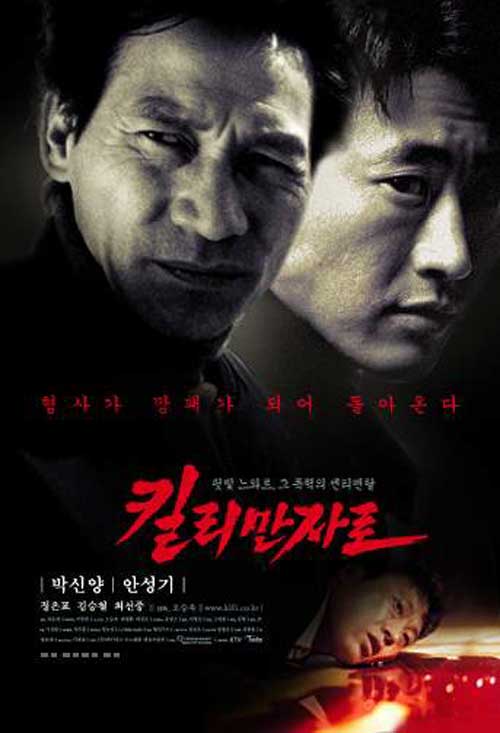
Kilimanjaro (킬리만자로, Oh Seung-uk, 2001)

Kilimanjaro posterMt. Kilimanjaro is the world’s tallest free-standing mountain. Oh Seung-ok’s debut, Kilimanjaro (킬리만자로), is not a climbing story, at least not in that sense, but a story of a man trying to conquer his own mountain without really knowing why. Twin brothers Hae-shik and Hae-chul are mirrors of each other, a perfect mix of light and dark, but when one makes a choice to choose the darkness, it throws the other into despair and confusion. A noir-ish tale of fragmented identities and fatalistic retribution, Oh’s world of tired gangsters and impossible dreams is as icy and unforgiving as the summit of its titular mountain, offering little more than lonely deaths and eternal regrets.

Policeman Hae-shik (Park Shin-Yang) drifts in and out of consciousness, tied up in a room by his twin brother, Hae-chul, with Hae-chul’s children looking on. Hae-chul murders his family and then shoots himself all while his brother is tied up and helpless, a policeman without recourse to the law. Taken to task by his colleagues who want to know how he could have allowed any of this to happen, if not as a brother than as a cop, Hae-shik has little to offer them by way of explanation. To add insult to injury, he is also under fire for unethical/incompetent investigation, and is taken off the case. Suspended pending an inquiry, Hae-shik goes back to his hometown but is immediately mistaken for Hae-chul and attacked by gangsters Hae-chul had pissed off before he left town and killed himself. Saved by local petty gangster Thunder (Ahn Sung-Ki), Hae-shik assumes Hae-chul’s identity and slips into the life of hopeless scheming which ultimately led to his brother’s ugly, violent death.

The film’s title is, apparently, slightly ironic in referring to the film’s setting of a small fishing village in the mountainous Gangwon-do Providence, known to some as “Korea’s Kilimanjaro”. Each of the men in this small town is trapped by its ongoing inertia and continual impossibility. They want to make something of themselves but have few outlets to do so – their dream is small, owning a family restaurant, but still it eludes them and they soon turn to desperate measures in opposing a local gangster in the hope of finally improving their circumstances.

Despite the seemingly tight bond of the men in Thunder’s mini gang – a mentally scarred ex-soldier known as “The Sergeant” (Jung Eun-pyo) and nerdy religious enthusiast knows as “The Evangelical” (Choi Seon-jung) rounding out Hae-chul’s goodhearted chancer, none of them has any clue that Hae-shik is not Hae-chul, or that Hae-chul and his family are dead. No one, except perhaps Thunder, is very happy to see him but even so Hae-shik quickly “reassumes” his place at Thunder’s side and takes over Hae-chul’s role in the gang’s scheming.

Hae-shik and Hae-chul had formed a perfect whole of contradictory qualities, each with their own degrees of light and darkness. Hae-chul had been the “good” brother who worked hard at home taking care of his parents while Hae-shik headed to university and a career in the city, never having visited his hometown since (in fact, no one seems to know or has already forgotten that Hae-chul even had a twin brother). Hae-shik’s “goodness” might be observed in his career as a law enforcer, but he’s clearly not among the list of model officers, and his home life also seems to be a failure. Hae-chul’s family might also have failed, and his shift to a life of petty crime provides its own darkness but living in this claustrophobic, impossible environment his crime is one of wanting something more than that his world ever had to offer him.

As might be expected, Thunder’s plans do not unfold as smoothly as hoped. Ineptitude and finally a mental implosion result in a near massacre costing innocent lives taken in a fury of misdirected vengeance. Despite wishing for a quiet life spent with friends on the beach, heroes die all alone, like mountain climbers lost on a snowy slope unsure whether to go up or down. Attempting to integrate his contradictions, become his brother as well as himself, Hae-shik reaches an impasse that is pure noir, finally meeting his end through a case of “mistaken identity”.


Screened at London Korean Film Festival 2017.