Breaking and Re-entering (還錢, Wang Ding-Lin, 2024)

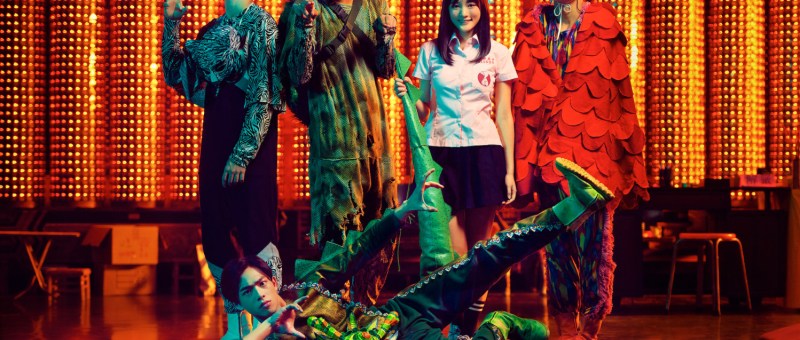
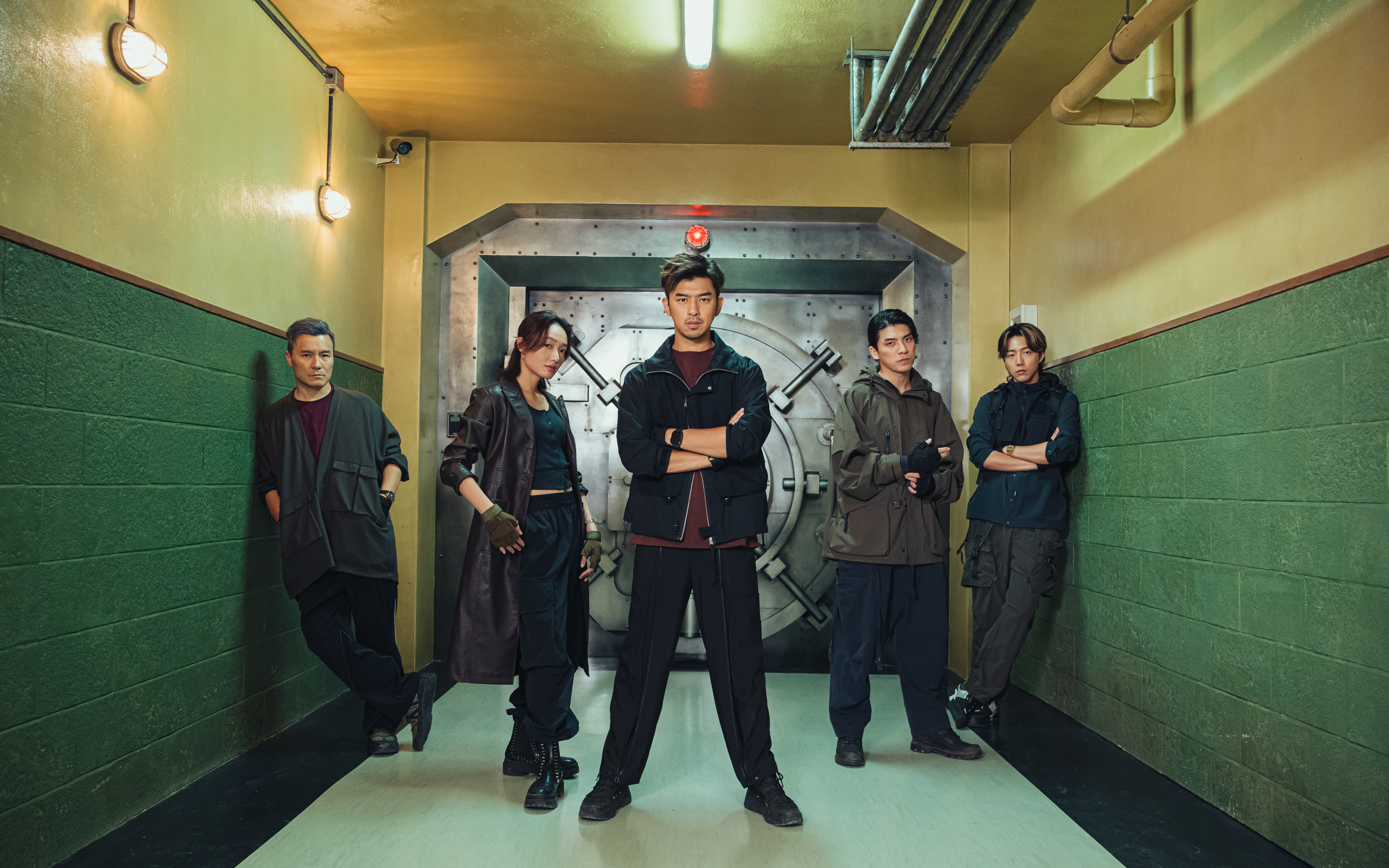
You go to the trouble of planning a massive heist, and then it turns out you have to put it all back again. The gang of theives at the centre of Wang Ding-Lin’s hugely entertaining crime caper Breaking and Re-entering (還錢, huán qián) brand themselves modern day Robin Hoods, pausing for a laugh when they claim to help the poor, “yeah, us”. Yet there is something a little suggestive about this particular gig as they find themselves hired for an inside job by an obnoxious bank chief who claims the most important thing in life is yourself and those around you are merely passengers to be jettisoned at will..

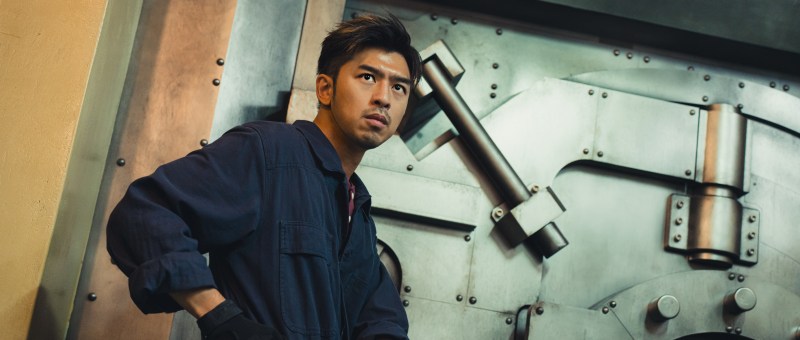
Chen (Wu Kang-ren) is a rich kid who inherited the family bank and thinks he’s hot stuff after studying abroad, speaking Mandarin like foreigner and peppering his speech with English. His big idea is a cryptocurrency called BST and his tagline is “Peace, Love, and Money” while ironically enough he is also claiming to run a charity to help the poor. It’s obvious he’s running some kind of scam and not altogether surprising that he’d plot to rob his own back and then have the thieves bumped off to keep them quiet along with the two employees he’s decided to frame for the crime. Unfortunately for everyone, one of his scapegoats, Shen Shu-wen (Cecilia Choi), is the long lost flame of chief crook Po-chun (Chen Bo-lin) who, having realised Chen plans to bump her off, comes to the conclusion his only option is to mess up Chen’s plan by putting the money back in the vault.  

Of course, Chen is a kind of gang leader too complete with his own chief minion, Hu, though at one point he simply shoots one of his guys in the back of the head after he complains that Chen that doesn’t really value him. By contrast, Po-chun’s gang is a close-knit family, a brotherhood of thieves founded on mutual solidarity and infinite loyalty. Chen’s philosophy maybe that the individual is all, but these men live and die for each other. Nevertheless, Po-chun has a problematic hero complex that sees him, as others put it, aways trying to “take responsibility alone”, sacrificing himself for the group rather than allow his fellow gang members to shoulder some of the burden. That’s presumably one reason he (un)intentionally ghosted Shu-wen after getting arrested and going to prison, convincing himself he was doing the noble thing by avoiding getting Shu-wen mixed up with crime but perhaps also ashamed and insecure unwilling to let her know he met her as part of a heist and his cover personality wasn’t real while never giving much thought to her feelings. Shu-wen spent the last five years looking for him which was apparently a primary motivation for changing her career to work in the bank.

Po-chun’s quest is really one of maturity, to stop being the lone hero and fully integrate into the group by sharing responsibility with the others rather than jump straight to self-sacrifice. As he says through the medium of a montage sequence, their secret weapon is teamwork which is how they’re able to fight back against the well equipped Chen and his minions when the reason Chen flounders is his arrogance and the indifference of his men. That is not to say there isn’t tension in the team, such as the unrequited attraction bruiser Wen-hao has for Po-chun that is quite definitely antagonised by the resurfacing of Shu-wen who seems to have figured out the group dynamics pretty quickly in addition to seeing through Po-chun’s strong man act. 

It’s the warm-hearted, lived-in relationships between the team members that give the film it’s charm along with the quirkiness of the elaborately planned reverse heist and its mild dig at corporate tyranny along with class-based inequality. But most of all what it seems to advocate for is a collective spirit and the triumph of the intellect over the pampered authority of rich kid Chen as Po-chun strategises a way out of his grasp while ending his influence and getting the girl. Wholesome and charming, the film makes the most of its surreal humour along with some hilariously placed reality gags such the infuriating slowness of a “high end automatic door” that ironically prevents a wealthy crook from fleeing the scene.


Breaking and Re-entering screened as part of this year’s New York Asian Film Festival and is also screening as part of the Taiwan Film Festival in Australia

Original trailer (English subtitles)

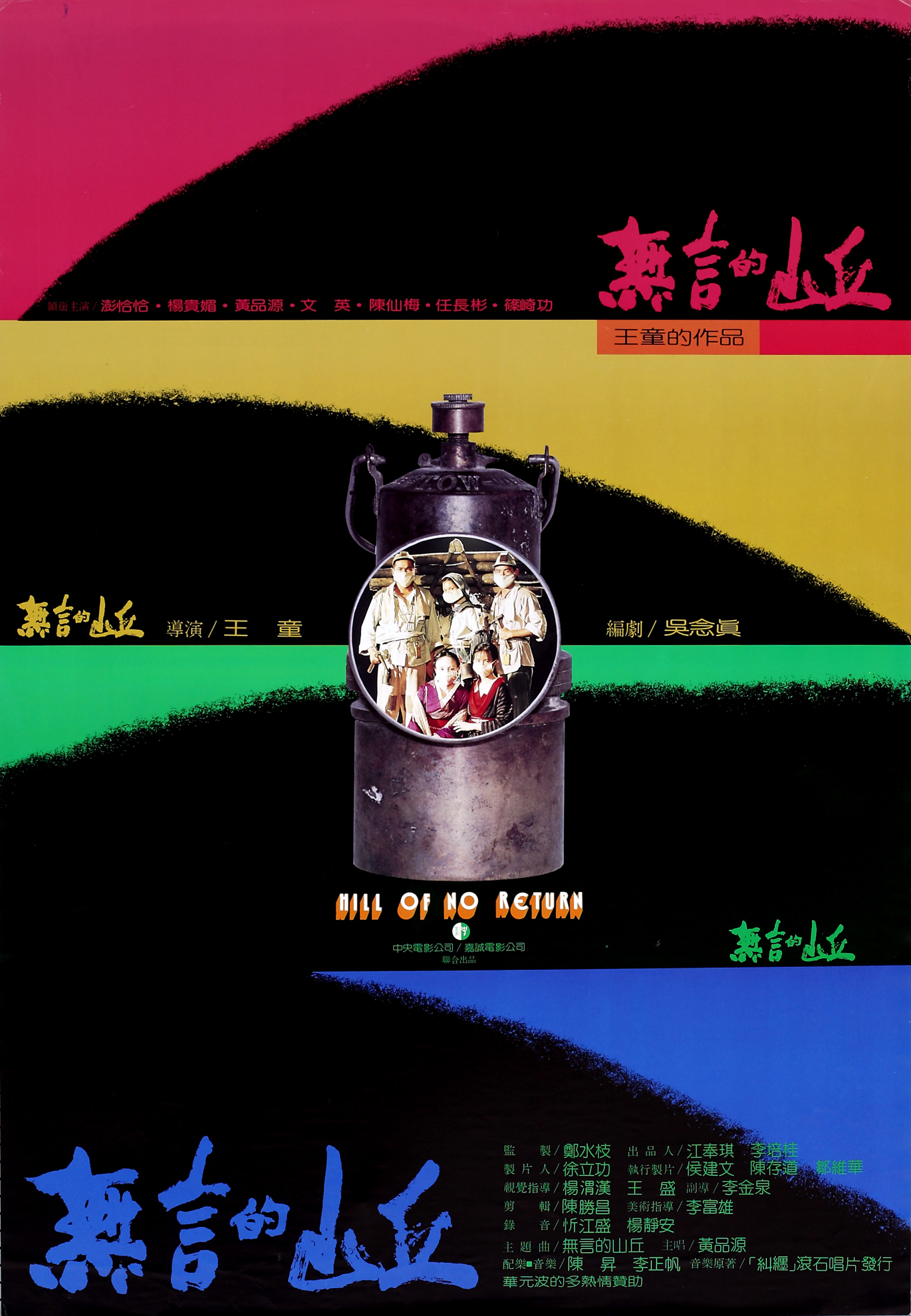
Hill of No Return (無言的山丘, Wang Tung, 1992)

Two orphaned brothers set out to find a literal goldmine, but discover only relentless exploitation and defeat in Wang Tung’s meditation on oppression and colonialism, Hill of No Return (無言的山丘, Wúyán de Shānqiū). The third in a trilogy of films exploring Taiwanese history, Wang’s tragic melodrama finds commonality if not solidarity among a collection of villagers living in a small town sustained entirely by the mine which produces riches only for the Japanese while those who risk their lives underground deprived of the light of the sun delude themselves that if they work hard they too can become rich only to discover each of their attempts to escape the constraints placed against them leading to nothing other than despair. 

As the film opens, brothers Chu (Peng Chia-Chia) and Wei (Huang Pin-Yuan) who have signed long-term five year contracts as farm labourers, are listening to an old man’s story about the grandfather of a local man who followed a frog to a mountain noticing its skin glowing gold and thereafter filling his pockets with gold dust he later used to buy up land and become rich. Chu thinks the man was foolish for not going back and becoming even richer, but the old man explains that he was reminded in a dream that excessive greed would only anger the gods and lead to his downfall. Fed up with their lives as labourers, the brothers take the story to heart and decide to look for their own mountain of gold, their backs too bathed in the light of the sun as they rest while looking for the goldmine town of Jiou-fen, later coming across a grisly and ominous scene shortly before they arrive. 

Both illiterate and speaking only Taiwanese, the brothers are each intent on becoming landowners partly in order to give their late parents, apparently killed by TB, a fitting resting place, but soon find themselves once again exploited, Wei becoming increasingly disillusioned with being trapped underground whereas in the fields at least he’d had the sun. The mine is of course a Japanese concern and its operators care little for the local Taiwanese workforce even if their treatment may not be as deliberately brutal as it might have been elsewhere. The new director is convinced that the miners are pocketing gold before it reaches the surface, instituting several new controls which threaten the local economy and especially that of the Japanese-style brothel which depends entirely on the mine for its survival. 

Like many, Hong-mu (Jen Chang-bin), a young man raised in the brothel by its madam following the death of his mother, looks up to the Japanese colonisers seeing them as innately “better” than the Taiwanese all around him. “People will respect me if I wear Japanese clothes” he tells the madam disappointed on receiving a new outfit in the local fashion. Having been told that his father, whom he has never met and was presumably a client of the brothel, was Japanese he speaks the language fluently and believes himself to be slightly superior by virtue of his birth but only too late learns his mistake in collaborating with the mine owners believing they would help him marry a young Japanese woman working at the brothel as a maid, Fumiko (Mayko Chen Hsien-Mei), and finding himself betrayed. As Fumiko is from the Ryukyu islands (Okinawa), the mine owner doesn’t quite see her as fully “Japanese” either and thinks nothing of using and abusing her in the course of his activities. 

The wily madam quips that you can’t call yourself Taiwanese if you haven’t figured out how to do illegal things legally finding ways of getting around the prohibition on accepting gold from the miners as payment, but that doesn’t stop the military police later raiding the brothel and brutally taking back “their” gold even though it has already changed hands albeit not entirely in good faith. The sex workers too are victims of this same vicious cycle, dependent on the custom of the miners for their livelihood while deprived any real possibility of escaping their desperate circumstances. Meanwhile, the brothers’ grumpy landlady, Ro (Yang Kuei-mei), is a twice-widowed single mother of numerous children left with no choice other than to engage in independent sex work, advertising herself as the more economical, local alternative to the Japanese-style “opulence” of the traditional teahouse. While Wei falls for the melancholy innocence of Fumiko singing Okinawan folksongs in a field of golden flowers, Chu takes a liking to Ro and her many children but though they both dream of the same thing, saving enough money to buy a farm, their tempestuous romance is later frustrated by Chu’s reckless decision to take advantage of chaos at the mine in an attempt to get rich quick by harvesting a mega load of gold while no one’s looking. 

He has perhaps been too greedy, ignoring the lessons from the old man’s story. The brothers are continually forced to pay for their transgressions, Chu cutting off his own fingers when cornered by thugs sent out by his previous employer to satisfy their literal demand for an arm and a leg in satisfaction of the broken contract, while Wei’s foot is later injured in a partial cave in when caught underground during an earthquake. Ro calls Chu foolish in his delusion that hard work will bring him a comfortable life, watching him slaving away to make the Japanese rich but what other choice do either of them really have? Only later does Wei begin to reflect on the possibility that the treasure of the mountain was the bright yellow flowers which covered it, a natural beauty soon destroyed by industrial exploitation. A melancholy chronicle of life in a small mountain town in the colonial era, Hill of No Return finds only despair and impossibility for its orphaned brothers whose eternal quest for ownership of their own land leads to nothing but continual disappointment. 


Hill of No Return streams in the UK until 31st October as part of this year’s Taiwan Film Festival Edinburgh.

Trailer (Traditional Chinese / English Subtitles)

All Because of Love (痴情男子漢, Lien Yi-Chi, 2017)

All Because of Love PosterGrowing up is hard is to do – that is, unless you’re the hero of a teen movie, in which case growing up is merely “difficult” and everything is sure to be alright once the bullies have been vanquished and the last dance danced. Designed to appeal to its target audience, the world of the teen movie is usually black and white, free from the chaos and confusion which most experience during adolescence. All Because of Love (痴情男子漢, Cqíng Nánhàn) is, however, refreshingly honest in its fierce love of a messy situation, forcing its hero into a series of “difficult” circumstances while he plays the noble fool holding fast to an obviously unrequited love in the hope that his niceness will somehow capture his true love’s heart.

When we first meet Erkan (Kent Tsai), he’s a nerd and the member of an oppressed minority at his school, constantly targeted by the tough guys. He is hopelessly in love with popular girl Mandy (Gingle Wang), who is actually dating one of the bullies and doesn’t even really know who Erkan is. Despite his declaration to love her for a thousand years, Erkan’s attempts to woo Mandy end in spectacular and humiliating failure but still he does not give up. Shortly after graduating high school, Mandy abruptly rings him for “a date”. Erkan, still smitten, is excited but Mandy has an ulterior motive – she is pregnant with her jock boyfriend’s child and, abandoned by her own one true love, reckons Erkan might like to try out life as a baby daddy. She is correct in her assumption and Erkan would be buying a ring if he had any money but as it is they’ll have to make do with the gentle guidance of Erkan’s elopement expert grandad (Hsu Hsiao-shun) who takes them back to his seaside home town where they can hide out from Mandy’s overbearing (and very wealthy) family.

As the title implies, the rest of the film becomes a treatise on love – requited or not, familial and romantic, permitted or illicit. Erkan is thrilled, on one level, to have got it together with Mandy but on the other hand Mandy won’t let him near her and it’s clear she is only using him and taking advantage of his noble character to get her out of a fix. Meanwhile, staying at inn, Erkan gets to know another girl, Sing (Dara Hanfman), who is in a permanently gloomy mood thanks to her devastating ability to read minds, and hasn’t left her room in years. Sing, thanks to her ability, has fallen half in love with Erkan’s goofy goodheartedness but also knows he’s still hung up on Mandy, and that Mandy is still hung up on her ex-boyfriend. She is then in a difficult position but manages to strike up enough of a friendship with the lovelorn young man to spur her on to exploring the outside world once again.

Meanwhile, Erkan is also confronted by the eerie similarities between his present predicament and the circumstances of his birth. Having always lived with his granddad, Erkan assumed his parents had passed on but discovers there may be more to the story only he’ll have to go to Japan to find out. Erkan’s granddad kicked off the cycle by eloping with Erkan’s grandmother, leaving their hometown far behind to live a life of love far away, though his son and grandson do not seem to have had so much luck when it comes to romance and Erkan’s romantic answers perhaps lie in exploring his family history rather than re-examining his high school days and refusing to let go of his idealised teenage crush.

A heart to heart with Sing provokes a more grown up meditation of unrequited love even if Erkan is entirely oblivious to Sing’s delicately concealed feelings. Purehearted, Erkan insists that love does not need to be requited, merely loving without being loved is good enough for him (so he says, or perhaps he just doesn’t expect anything more). Sing tells him he’s wrong, that it takes two to love and that a one sided affection is nothing more than intense loneliness. Erkan agrees, missing Sing’s hidden meaning, but maturely admitting that it would be wrong to hold someone’s hand just because you’re lonely when your heart is elsewhere.

Erkan’s idealised love for Mandy is gradually revealed as an adolescent affectation while she is left battling various kinds of familial expectation and manipulation before discovering her former boyfriend is not perhaps the heel that everyone had assumed him to be. Meanwhile, Sing is doing something similar in trying to lay to rest the ghost of a friend who left long ago and Erkan is left trying to reclaim his identity though figuring out who he really is before learning to look at what’s right in front of him rather than indulging in a romantic fantasy. Lien Yi-chi sends Erkan on some very bizarre adventures, swapping genres at a moment’s notice from westerns to classic melodrama and musicals and then settling on something in the middle which feels oddly authentic and lived in despite its strangeness. Often absurd if not quite surreal, Lien’s warmhearted silliness is almost impossible to resist as is the cheerful innocence of the effortlessly romantic conclusion.


Screened at the 20th Udine Far East Film Festival.

Original trailer (English subtitles)