Laugh, Everyone! (みんな笑え, Taichi Suzuki, 2025)

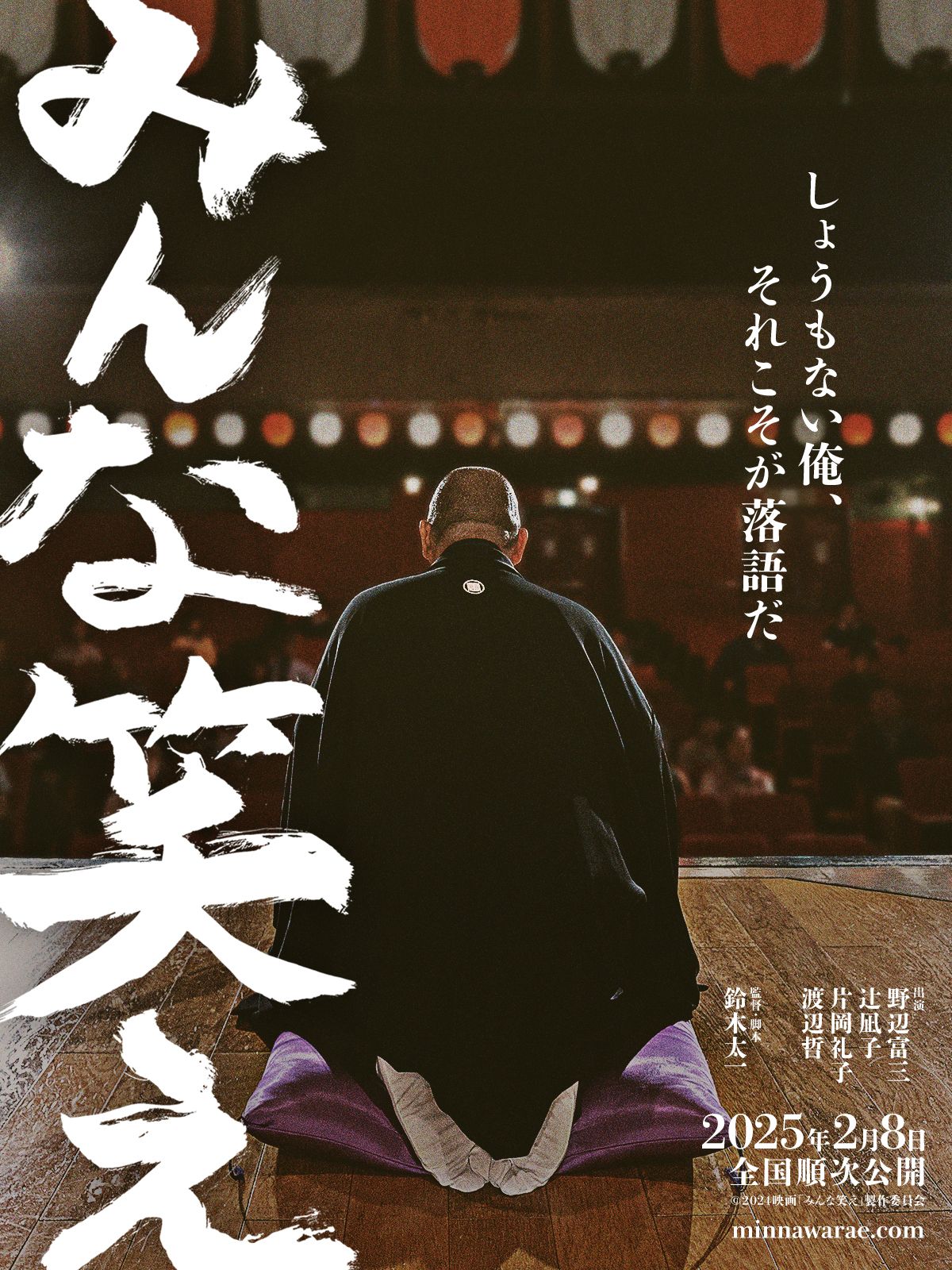
A down of his luck second generation rakugo storyteller begins to discover a new way of life after meeting an aspiring female comedian in Taichi Suzuki’s lighthearted dramedy, Laugh, Everyone! (みんな笑え, Minna Waremashit). The title is taken from a moment of madness in which a resurgent Tamon pleads for everyone to just laugh rather than being at each other’s throats or feeling like they want to die, but that’s something he himself may not be able to do until he’s truly made peace with his demons.

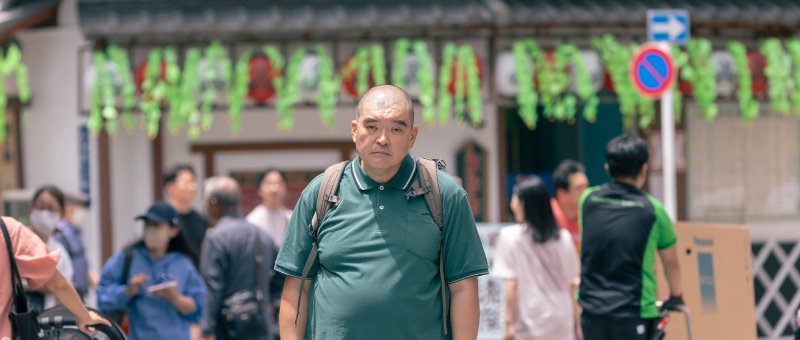
Chief among them would be his father, Kenzo, a rakugo master who’s tormented and bullied him his whole life. In general, rakugo storytellers recite a canon of classical tales that have been passed down since the Edo era, but despite having inherited his father’s stage name, Tamon avoids performing the classical repertoire and sticks to original material. His acts don’t seem to please the audience, and it’s clear that his father’s other disciple, Kannosuke, resents that it was Tamon who became the official heir despite having no talent when he was the rightful successor. Unfortunately, Kanzo failed to plan for his retirement and now has dementia, meaning that he can no longer perform. Unable to make money through rakugo, Tamon has a part-time job in a warehouse to try to make ends meet all while being berated by Kanzo for bing a useless failure.

There are some touching moments later on in which Kanzo bonds with the son of his carer and plays with him as if he were Tamon, hinting that he might have liked to have been a different kind of father and have a different kind of life if it were not for the pressure of passing on his rakugo name. For his part, Tamon has become timid in the extreme and has been running away from anything challenging or unpleasant his whole life. In fear of not living up to his father’s legacy, Tamon avoids the old stories and sticks to telling the same original tale he’s been doing for the last 30 years. 

But if his problem is that he can’t master the classics, Kiko’s is that she can’t innovate and all her original material is pinched from somewhere else. She and her comedy double act partner Chi-chan have been trying to break into television, but can’t catch a break with their largely improvised act. While auditioning, they encounter entrenched sexism as the male panellist tells them that women aren’t funny and don’t take comedy seriously. Kiko’s mother Yoko experiences something similar at her bar where her sleazy backer is all over a younger hostess with whom he eventually hopes to replace her, while Chi-chan has also fallen prey to a predatory man working at a host club. She has been financially supporting Joe to help him achieve his dream while he forces her into sex work to make him more money, pushing her to quit comedy and work for him full-time. This kind of exploitation has regrettably become so common that a specific law was passed in 2025 to prevent young male “hosts”, who work in bars where they charm women into buying drinks and gifts, forcing their patrons into debt and then sexual exploitation. 

Nevertheless, Kiko strikes gold when she hears Tamon’s baseball-themed routine and realises it’s the same one her mother used to listen to on cassette tape. Reworking it as a manzai routine, she sees a way through her creative block even if it’s sort of plagiarism. After getting his permission to use his material, Kiko begins to think of Tamon as a mentor while he almost thinks the same of her as they encourage each other through their comedic failures even while working in opposite directions. A kind of rapport emerges between them as they were actually an accidental manzai double act along with a more positive paternal relationship than that seen between Kanzo and Tamon which is fuelled by a fear of obsolescence, ego, and resentment. Through his friendship with Kiko and rekindling that with her mother, Tamon eventually gains the courage to stop running away and face himself in classic rakugo both making peace with the complicated relationship he had with his father and carving out a new identity for himself in emerging from his father’s shadow. Sparrows fleeing the cage, both he and Kiko rediscover the healing power of laughter and with it the courage to face their troubles head on rather than continuing to run away in fear of failure and miss out on the joy the craft can bring to those around them.


Laugh, Everyone! is available to stream until 14th September 2025 courtesy of Chicago Japan Film Collective.

Trailer (English subtitles)
Something Like, Something Like It (の・ようなもの のようなもの, Taiichi Sugiyama, 2016)

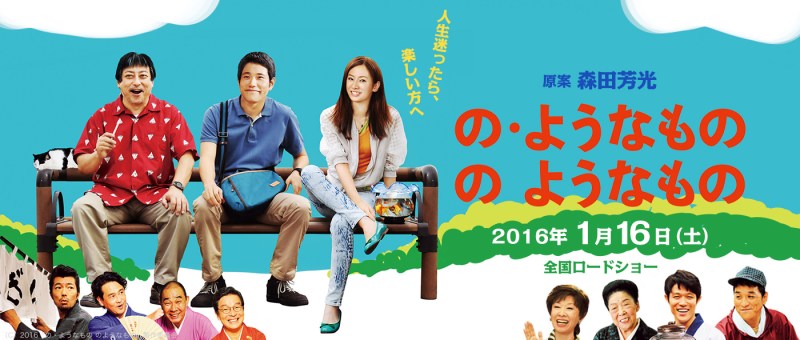
something like, something like it posterSadly passing away at the young age of 61 in 2011, Yoshimitsu Morita had been relatively prolific in his 25-year career, leaving behind him a hugely varied back catalogue that ran from zany idol movies to prestigious literary adaptations. His recurrent concerns, however, were relentlessly populist – he wanted to make films that ordinary people could enjoy which intensely reflected the time in which they were made. Five years after his death, one of his early ADs chose to pay tribute to his mentor by drawing inspiration from Morita’s 1981 feature debut, Something Like It. Something Like, Something Like It (の・ようなもの のようなもの, No Yona Mono no Yona Mono) brings the original cast back together with a few new faces from the late director’s more recent works to recreate yesterday’s pleasures for today’s audiences.

Our hero this time round is young Shinden (Kenichi Matsuyama). Well, he’s not really all that young despite being the lowest ranking rakugoka on the roster. Now 30 and beginning to lose hope, Shinden is a former salaryman well known for taking his time. Meanwhile, the 13th memorial service for the late master is fast approaching and the troupe’s patron has decreed she wants to see the return of an old friend – Shintoto (Katsunobu Ito) who abruptly disappeared right after the funeral. Seeing as Shinden is not so hot at rakugo, the other guys task him with tracking down Shintoto in the hope of convincing him to make a return to the stage so the patroness doesn’t decide to remove her patronage.

Rakugo – the traditional art of comic storytelling, is a rarefied affair. It requires extreme rigour from the performer in order to make often extremely familiar tales funny in all the right places. Shinden isn’t very good at it because he’s too stiff all over. Poor at reading social cues, he has an urge to point out tiny and embarrassing mistakes like a slightly frayed curtain or a wonky sign. He might not be best placed for finding and then convincing a sad old man to take back up the career he’d sworn to lay down. Nevertheless, once Shinden manages to find Shintoto and realises he’s made an extremely circular journey, he makes himself his disciple and commits himself to doing all Shintoho’s odd jobs in the hope he’ll finally finish the “Pop-Eyed Goldfish” routine that the patroness so wants to hear.

Taiichi Sugiyama* was an AD on Something Like It but is only making his own feature debut 25 years later. Reassembling the old cast, Sugiyama remains true to an old formula and his genial retro comedy certainly has an old fashioned quality right down to the cutesy jazz score which feels right out of the ‘80s. More modern additions come in the form of Kenichi Matsuyama (who starred in Morita’s final film, Train Brain Express) back on comedy form with a typically left of centre performance as the archetypal “cannot read the air” aspiring rakugoka whose tendency towards literalism as well as that to be distracted by minor imperfections threatens to ruin his career before it’s even really begun. That’s not to mention his nascent crush on his mentor’s daughter Yumi (Played by Keiko Kitagawa who made her feature debut in Morita’s Mamiya Brothers) and mild jealousy over the other various young and good looking men she seems to take an interest in.

Through getting closer to the now somewhat schlubby but basically good hearted Shintoto, Shinden learns to loosen up a bit and his Rakugo perhaps improves even if he also figures out when it’s best to make a sacrifice on someone else’s behalf. Shintoto too rediscovers his talent for comedy, if not the love. Morita never had much of a “signature” style – his films were in a sense tailor made to suit a particular purpose, but Sugiyama remains firmly within the world of early ‘80s comedy, allowing the everyday to brim with silliness as Shinden pursues his roundabout quest before coming quite literally full circle and then finding his feet again. A man pays tribute to his late mentor, mentors someone else, and then absents himself from the frame to let his pupil grow. One generation retreats and another rises – an age old story, but one that like a rakugo tale shines in the telling.


*IMDB and some other sites list his name as Yasukazu but according to the JFDB and Shochiku the official reading of his name is Taiichi.

Chinese release trailer (English & Traditional Chinese subtitles)

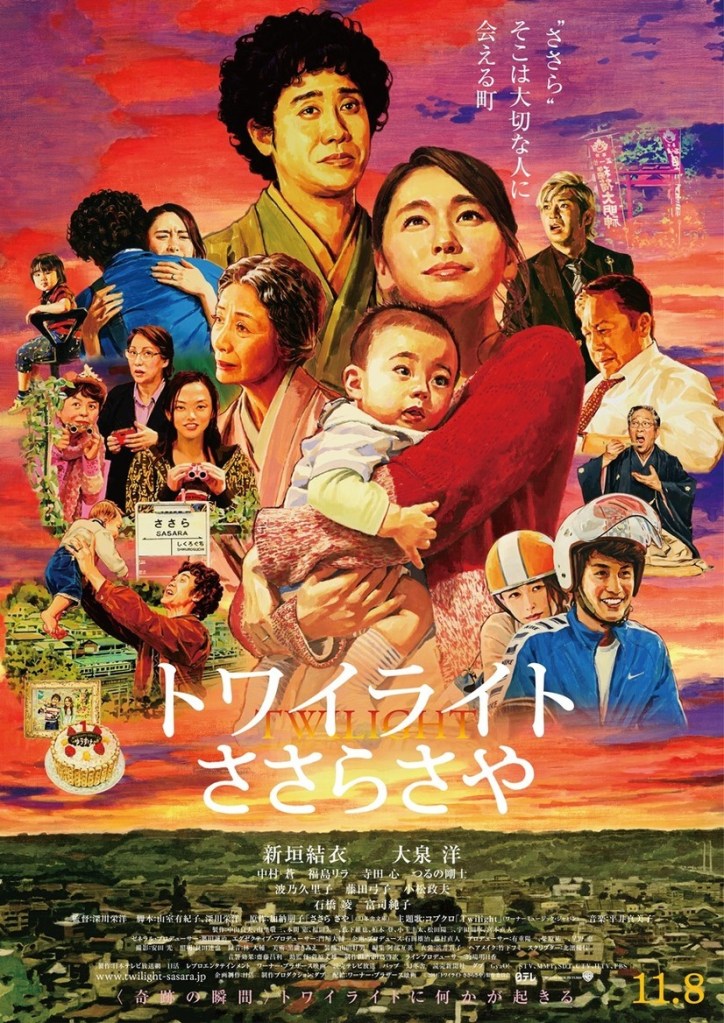
Twilight: Saya in Sasara (トワイライト ささらさや, Yoshihiro Fukagawa, 2014)

Japanese cinema has its fare share of ghosts. From Ugetsu to Ringu, scorned women have emerged from wells and creepy, fog hidden mansions bearing grudges since time immemorial but departed spirits have generally had very little positive to offer in their post-mortal lives. Twilight: Saga in Sasara (トワイライト ささらさや,  Twilight Sasara Saya) is an oddity in more ways than one – firstly in its recently deceased narrator’s comic approach to his sad life story, and secondly in its partial rejection of the tearjerking melodrama usually common to its genre.
Unsuccessful Rakugo performer Yutaro (Yo Oizumi) met the love of his life during one of his sparsely attended recitations. Saya (Yui Aragaki) was the only one laughing but even she didn’t think he was very funny, she just liked him because he was trying so hard. Eventually, he married her and they had a lovely baby boy but before little Yusuke was even a year old, Yutaro got himself killed in a random traffic accident. Such is life. Still, knowing that Saya had no family of her own and having grown up without a father himself Yutaro feels even worse about leaving his wife and son all alone in such a stupid way. Therefore he decides to delay going to heaven so that he can stick around to help Saya in whatever way he can.

A crisis occurs when Yutaro’s estranged father (Ryo Ishibashi) suddenly turns up at the funeral laying claim to little Yusuke with no thought to the additional emotional ramifications of trying to snatch a baby from a grieving mother right over the coffin of her husband. Possessing the body of another guest, Yutaro manages to convince Saya to run leading her to retreat to her late aunt’s house in the peaceful rural village of Sasara.

Though the premise is a familiar one, Fukagawa neatly sidesteps the more maudlin aspects for a broadly comic approach in which Yutaro recounts the story of his death as if it were a rakugo tale. Possessing various people along the way, Yutaro does indeed help Saya adjust to her new life but eventually discovers that perhaps the reason he hasn’t passed over was one of the past rather than one of the future.

Saya’s arrival in Sasara gets off to a bad start – essentially forced out of the city to escape Yutaro’s father Saya causes unexpected trouble when it emerges that the corrupt local estate agent has been letting out her aunt’s house without telling her. If that weren’t enough, some of her valuables are almost stolen by a local delivery boy but, this being an ageing village, children are a rarity and so little Yusuke quickly captures the hearts of the neighbourhood grannies who eventually become Saya’s friends and staunch supporters. Familial problems are the name of the day from childlessness to children (hopefully) writing down possible signs of dementia or just leaving town and not coming back. Yutaro also helps Saya improve the life of another young woman with a son who doesn’t speak by allowing him to finally voice what he really feels, adding to the circle of female help and support which becomes the family Saya had always longed for.

Orphaned at a young age, raised by her grandmother until she died and having lost her only living relative in her aunt a few years previously, Saya had always wondered what it felt like to have a real family of her own. Yutaro had also lost his mother at a young age through illness and was estranged from his father who refused to visit her even on her deathbed. Yutaro’s untimely death adds to Saya’s ongoing sorrows but also ends the beginnings of the happy family they’d begun to build with each other. As it turns out, Yotaro’s limbo is less about his son and more about his father as he gets a last opportunity to bond with his outwardly harsh and cruel dad and come to a kind of understanding about fatherhood in hearing his side of the story. Life is too short for grudges, and even spirits sometimes need to give up the ghost so that the air can rest a little lighter.

Though there are the expected moments of sadness as Yotaro realises the number of people he can possess is dwindling and his time with Saya will be limited, Fukagawa keeps things light and whimsical with a kind of small town quirkiness aided by Oizumi’s spirited delivery. Adding in frequent rakugo references complete with painted backdrops and sound effects as well as a repeated motif which sees the little town remade as a diorama model, Twilight: Saya in Sarasa has a pleasantly old fashioned feeling which only adds to its wholesome emphasis on an extended family of community coupled with the continuing presence of Yutaro watching from somewhere on high. Warm and funny if a little lacking in impact, Twilight: Saya in Sasara is a rare instance of a ghost bringing people together in love and harmony through helping them get closer to their true emotions but one that is also keen to emphasise that we’re all only here for an unspecified time – better not to waste it with silly things like grudges.


Original trailer (no subtitles)

Rakugo Monogatari (落語物語, Shinpei Hayashiya, 2011)

program_rakugoWhen it comes to the classic Japanese art forms, kabuki, noh and maybe even bunraku are not so uncommon overseas. Rakugo, however, has not been as lucky. Famously impenetrable for non-native speakers even if their language skills are otherwise top notch, rakugo is the art of traditional comic story telling in which the “rakugo-ka” recites a standard monologue with the aim of mining it for laughs in their own individual fashion. These stories date back to the Edo-era and rely heavily on classic Japanese puns, stock characters and cultural assumptions, consequently, their appeal has been on the wane in Japan for sometime. That’s not to say the art form is quite dead yet though, as real life rakugo-ka Shinpei Hayashiya’s Rakugo Monogatari attempts to prove.

The film begins as youngster Masato catches a Rakugo act and becomes immediately smitten. Hoping to become the disciple of a top master, he parks himself outside the house of Kozaru but is too shy to actually knock on the door. Luckily, Kozaru’s wife arrives home and spots Masato waiting outside. She’s a sharp woman and immediately guesses what Masato’s after so she invites him inside to meet her husband. Kozaru is a bit of a strange man but with a fantastic sense of humour and eventually agrees to take the young hopeful on as his pupil. There will be laughter and tears along the way but Masato is well on the road to achieving his rakugo dreams.

Created by real life rakugo comedian and occasional actor Shinpei Hayashiya, Rakugo Monogatari certainly has the air of authenticity. For a film that’s about an apprentice, we don’t really see a lot of direct training scenes (though there are some) and, in fact, we don’t spend all of our time on the hopeful Masato. After he starts to make some headway, the canvas widens a little to look at the arcane institution of the rakugo association and in particular its reaction to the decision of one of its female members to pursue a career in television which is taking her away from her rakugo roots. The position of female rakugo performers is briefly touched on as, though there are at least two highly proficient female rakugo-ka active on these stages, one of the other association members proclaims that he feels “uncomfortable” with a woman reciting this material at an important event. He says this right in front of an apparently high ranking female member of the association who looks rightfully non-plussed (and in general she is not a woman to be crossed lightly) before trying to back track. The younger female rakugo-ka eventually gets to perform but then has her profile immediately undermined by a personal scandal that would probably not have much effect on a male star’s career.

Hayashiya does give in to melodrama in the third quarter though he largely even manages to work a few laughs into a tragic situation. The other thread of the film is the warm and solid relationship between Kozaru and his wife Aoi, which is filled with a sort of bickering, reciprocal humour as the two become surrogate parents to the nervous Masato. In an odd sort of way it’s Aoi who lends the heart to the film and though her role is purely supportive, she provides the firm foundations which allow her husband and his new apprentice to flourish in their own careers.

A perfect tribute to the art of rakugo, Rakugo Monogatari is an affectionate comedy celebrating all sides of its famously complicated world. Though it runs a little long and has a tendency to run off the point for a while (perhaps an intentional complication), Rakugo Monogatari nevertheless proves an enjoyable foray into the world of this declining art form and finds plenty left to enjoy while it’s there.