
Caution, Hazardous Wife: The Movie (奥様は、取り扱い注意, Toya Sato, 2021) [Fantasia 2021]

Perhaps in some ways out of step with the times, the 2017 Nippon TV drama Caution, Hazardous Wife (奥様は、取り扱い注意, Okusama wa, Toriatsukai Chui), like the earlier Secret Agent Erika, saw top assassin Nami (Haruka Ayase) fake her own death in order to live a “normal” life as an “ordinary housewife” married to “boring salaryman” Yuki (Hidetoshi Nishijima). Nami could not however resist using her skills for good and bravely took on a local yakuza gang who’d been running a suburban prostitution ring through employing handsome gigolos to seduce emotionally neglected housewives and thereafter blackmailing them into sex work. The series ended on a cliffhanger in which, spoiler alert, Nami was confronted by her husband who turned out to be a Public Security Bureau officer originally tasked with monitoring her before genuinely falling in love.

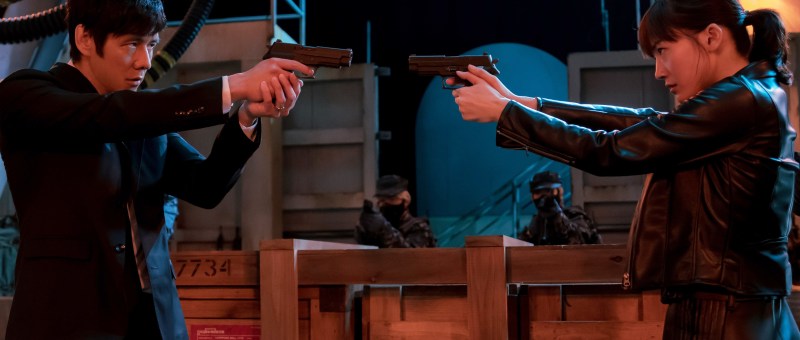
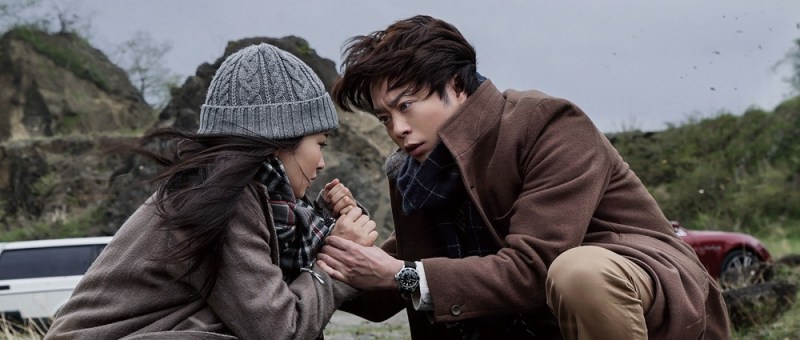
This brief background recap is useful but not strictly necessary in approaching the series’ big screen incarnation, Caution, Hazardous Wife: The Movie, which ironically assumes the audience knows Nami’s secret backstory but also obfuscates it in picking up 18 months after the cliffhanger to find her now living as “Kumi” in a tranquil seaside town having apparently lost her memory. The town will not remain tranquil for long, however, as a mayoral race is about to bring tensions to the fore in the polarising issue of a prospective methane hydrate plant the authorities insist is necessary to revive the area’s moribund economy while others worry about industrial pollution and its effects on the local sea life. Unsurprisingly, the events will turn out to have a connection to Nami’s past while she struggles to regain her lost memories and preserve the peaceful, ordinary life with her husband which is all she’s ever really wanted. 

Though some might find it somewhat conservative that what Nami wants is to become a conventional housewife, what she’s looking for is the stability of the “normal” life she’s never known. As such, she may not actually want to regain her memories, preferring to go on living as Kumi who has perfected the housewife skills which so eluded Nami including becoming a top cook, for as long as possible. Yuki, meanwhile, now living as high school teacher Yuji, feels something similar having been ordered to “deal with” his wife if she remembers who she is but refuses to become a PSB asset. 

Upping production values from the TV drama, Sato keeps Nami in the dark for as long as possible though her sense of social responsibility remains just as strong as she bravely intervenes when coming across a gang of teens taunting a boy with homophobic slurs for having a pink coin curse, later becoming concerned on witnessing the leader of the opposition to the plant being attacked by thugs in an attempt to intimidate him out of his decision to stand as a rival candidate to the incumbent mayor. Nevertheless, he allows space for plenty of dramatic action scenes including flashbacks to Nami’s career as an international assassin while the final set piece also throws in some bickering marital comedy before turning unexpectedly dark.  

Regaining her memories, Nami’s inner conflict is in her complicated relationship with Yuki wondering if he ever really loved the “real” her or if he perhaps preferred Kumi the docile Stepford wife, which is ironically the cover identity she’d longed to construct. Conflicted and suspecting his wife may have remembered who she really is, Yuki tells her to forget about the past but also that his feelings won’t change and she should be free to be herself but as Nami later realises the past won’t let her go and the peaceful life she’d dreamed of might be harder to preserve than she’d previously thought even as she commits herself to embracing the life she has now because her relationship with Yuki is the most important thing to her despite her lingering doubt. 

Touching on a few hot button issues from industrial pollution and environmental concerns to economic decline and rural depopulation, Sato nevertheless returns to the outlandish absurdity of the TV drama as Nami finds herself facing off against Russian gangsters while exposing a plot by shady conglomerates to exploit a small-town desire for better access to jobs and infrastructure, along with judicial corruption and electoral interference. Nevertheless, the hometown spirit eventually wins out even if Nami finds herself on the run once again though having gained a little more emotional clarity. 


Caution, Hazardous Wife: The Movie streamed as part of this year’s Fantasia International Film Festival. The original TV series is also available to stream with English subtitles (along with those in several other languages) in many territories via Viki.

International trailer (English subtitles)
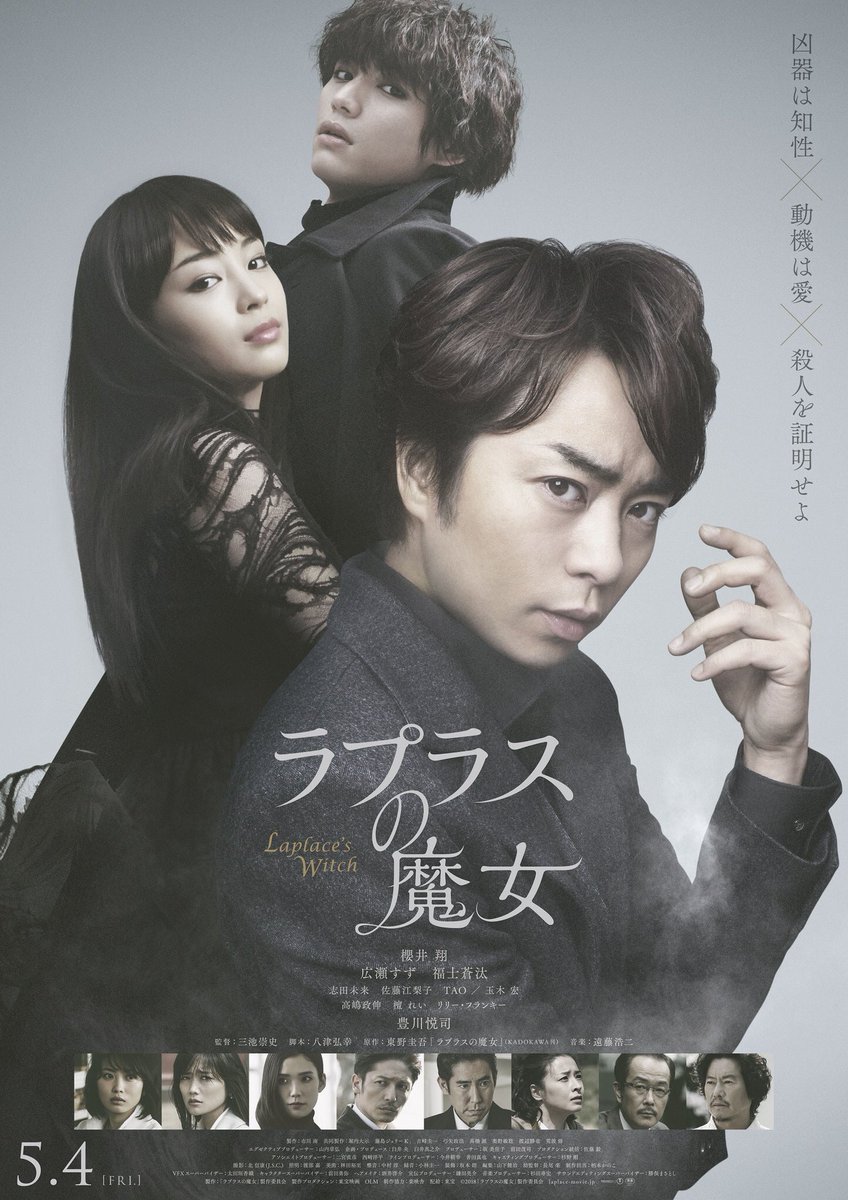
Laplace’s Witch (ラプラスの魔女, Takashi Miike, 2018)

Laplace's Witch poster 2Takashi Miike, among Japan’s most prolific of directors, teams up with one of the nation’s most prolific authors, the often adapted Keigo Higashino, for a dose of scientific mystery in Laplace’s Witch (ラプラスの魔女, Laplace no Majo). Responsible for the international smash hit The Devotion of Suspect X and the Galileo series, Higashino too has worked across several genres ranging from the detective novels for which he is best known to children’s books and fantasy. Perhaps in contrast to the director, however, Higashino’s novels tend towards the socially conservative, occasionally cynical if at times perverse. Nevertheless, there is something a little ironic in Miike choosing to adapt this particular title which revolves around the idea of authenticity in art and meaningful legacy.

The unlikely hero of the tale, climate scientist Shusuke Aoe (Sho Sakurai), is called in to investigate the mysterious deaths of a film producer and an out of work actor who appear to have died of hydrogen sulphide poisoning at separate hot springs resorts. Dying of hydrogen sulphide poisoning outdoors is considered a scientific impossibility and Aoe has no real explanation for how it might have occurred but is stunned by policeman Nakaoka’s (Hiroshi Tamaki) assertions that foul play may have been involved.

Nakaoka is not exactly a bumbling policeman, but his certainties – born of policeman’s instinct, are held up for ridicule as he rapidly switches suspects, knee-jerk accusing the film producer’s widow of conspiracy to murder before deciding there must be more involved than a simple attempt at financial gain. He is however eventually correct, quickly figuring out the surprising connection between the two dead men is a famous film producer, Amakasu (Etsushi Toyokawa), who lost his own family in ironically similar tragic circumstances some years earlier and seems to have dropped off the radar ever since.

All of which means, Aoe’s scientific knowledge is increasingly irrelevant. His major contribution to the case at hand is in his strange friendship with a mysterious teenage girl who is engaged in her own missing persons case which may have some overlap with the murders. Aoe quickly notices that Madoka (Suzu Hirose) appears to have preternatural powers which she later alludes to in branding herself the “Laplace Demon” in honour of a scientific theory which suggests that if someone were to know the exact location of each and every atom in the universe then it would be perfectly possible to calculate their courses and trajectories with mathematical certainty and thereby possess absolute knowledge of the future.

Whether one might want such all encompassing knowledge is a bigger question. As one character later puts it, the ability to discern the future may impede one’s ability to dream and therefore hinder the progress of human society. The central message is, however, somewhat banal in pointing out that we are each of us connected, essential parts of a cosmic machine in which each has a specific role to play. By such logic, murder is then not so much a moral failing as one of over engineering in which attempts to tweak the system may lead to its destruction.

Then again, we hear from the depressed Amakazu that what he fears is that life is essentially meaningless and that many go to their deaths without leaving a mark. His central theory is that objective truth is a matter of record, that whatever is shot is “real” because that is what will be “remembered” long after the fact. Through his films, which are amusingly described in a piece of meta irony as dealing with edgy themes which don’t pander to audiences, he attempts to reorder his world by recreating it, improving on its many disappointments by envisioning it differently. Yet he still yearns for authenticity in his work and may have gone to great lengths to get it in a seemingly pointless piece of behind the scenes theatre.

Perhaps it is this sense of fatalistic ennui that Miike is attempting to capture through Laplace’s continually listless aesthetics but it has to be said that the central mystery, filled with plot holes and contradictions as it is, is particularly unengaging and despite the cheerful we’re all one narrative also carries some decidedly unpleasant undertones. Never quite finding the register to unlock its central philosophy, Laplace’s Witch proves a curiously flat outing for the famously out there director which may very well be the point but then again perhaps it’s a strange point to be making. 


Singapore release trailer (English subtitles)

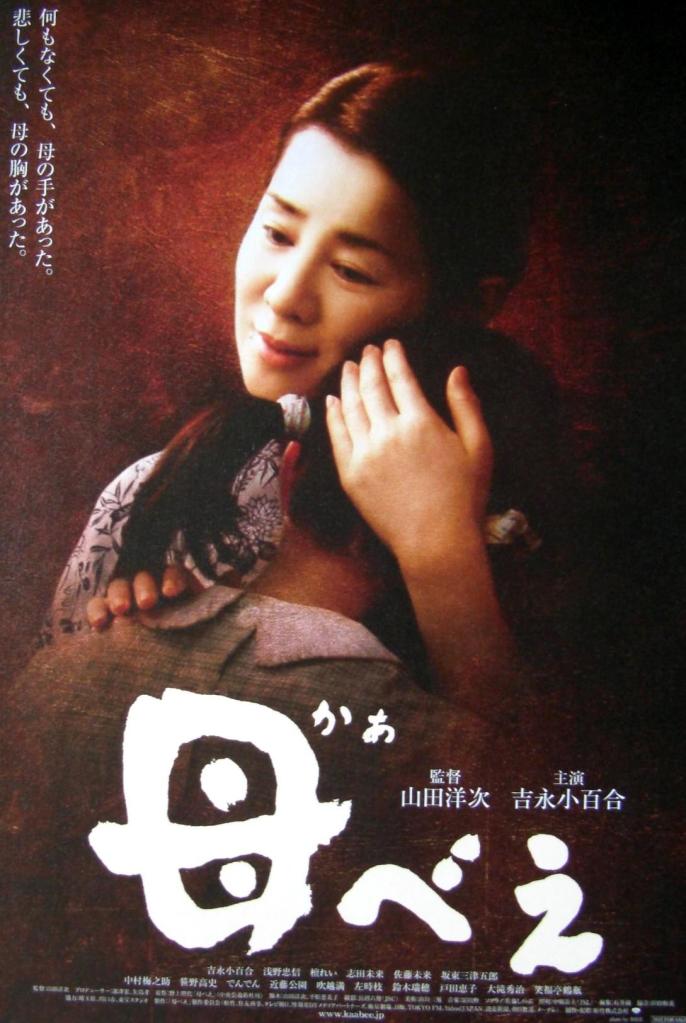
Kabei: Our Mother (母べえ, Yoji Yamada, 2008)

KabeiYoji Yamada’s films have an almost Pavlovian effect in that they send even the most hard hearted of viewers out for tissues even before the title screen has landed. Kabei (母べえ), based on the real life memoirs of script supervisor and frequent Kurosawa collaborator Teruyo Nogami, is a scathing indictment of war, militarism and the madness of nationalist fervour masquerading as a “hahamono”. As such it is engineered to break the hearts of the world, both in its tale of a self sacrificing mother slowly losing everything through no fault of her own but still doing her best for her daughters, and in the crushing inevitably of its ever increasing tragedy.

Summer, 1940. The Nogamis are a happy family who each refer to each other by adding the cute suffix of “bei” to their names. The father, Tobei (Bando Mitsugoro X), is a writer and an intellectual opposed to Japan’s increasing militarism and consequently has found himself in both political and financial difficulties as his writing is continually rejected by the censors. Eventually, the secret police come for him, dragging him away from his home in front of his terrified wife and daughters. After Tobei is thrown into jail for his “thought crimes”, the mother, Kabei (Sayuri Yoshinaga), is left alone with her two young girls Hatsuko and Teruyo (Hatsubei and Terubei in family parlance).

Though devastated, Kabei does not give up and continues to try and visit her husband, urging his release and defending his reputation but all to no avail. Thankfully, she does receive assistance from some of her neighbours who, at this point at least, are sympathetic to her plight and even help her get a teaching job to support herself and the children in the absence of her husband. She also finds an ally in the bumbling former student, Yamazaki (Tadanobu Asano), as well as her husband’s sister Hisako (Rei Dan), and her brother (Tsurube Shofukutei) who joins them for a brief spell but ultimately proves a little too earthy for the two young middle class daughters of a dissident professor.

The time passes and life goes on. The war intensifies as do the attitudes of Kabei’s friends and neighbours though the family continues its individual struggle, sticking to their principles but also keeping their heads down. By the war’s end, Kabei has lost almost everything but managed to survive whilst also ensuring her children are fed and healthy. A voice over from the older Teryuo calmly announces the end of the conflict to us in such a matter of fact way that it’s impossible not wonder what all of this was for? All of this suffering, death and loss and what has it led to – even more suffering, death and loss. A senseless waste of lives young and old, futures ruined and families broken.

Yet for all that, and to return to the hahamono, the Nogami girls turned out OK. Successful lives built in the precarious post-war world with careers, husbands and families. Unlike many of the children in the typical mother centric movie, Hatsuko and Teruyo are perfectly aware of the degree to which their mother suffered on their behalf and they are both humbled and grateful for it. Kabei was careful and she kept moving to protect her children in uncertain times. Seen through the eyes of a child, the wartime years are ones of mounting terror as fanatical nationalism takes hold. Bowler hatted men seem to rule everything from the shadows and former friends and neighbours are primed to denounce each other for such crimes as having the audacity to wear lipstick in such austere times. In one notable scene, the neighbourhood committee begins its meeting by bowing at the Imperial Palace, until someone remembers the paper said the Emperor was in a different palace entirely and they all have to bow the other way just in case.

Though the tale is unabashedly sentimental, Yamada mitigates much of the melodrama with his firmly domestic setting. We see the soldiers massing in the background and feel the inevitable march of history but the sense of tragedies both personal and national, overwhelming as it is, is only background to a testament to the strength of ordinary people in trying times. An intense condemnation of the folly of war and the collective madness that is nationalism, Kabei is the story of three women but it’s also the story of a nation which suffered and survived. Now more than ever, the lessons of the past and the sorrow which can only be voiced on the deathbed are the ones which must be heeded, lest more death and loss and suffering will surely follow.


Original trailer (English subtitles)