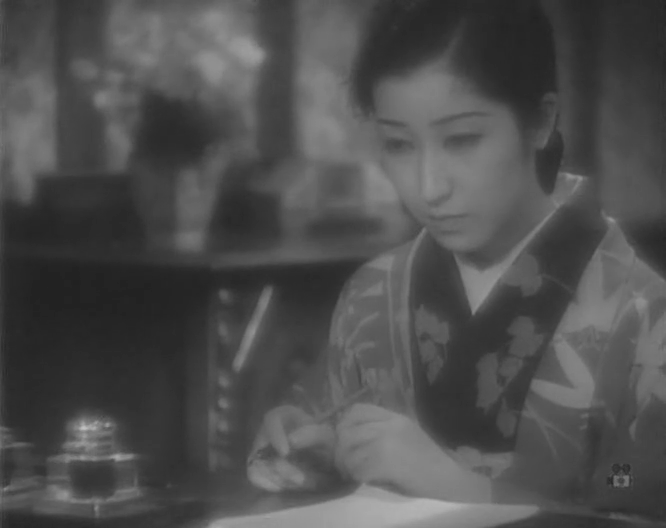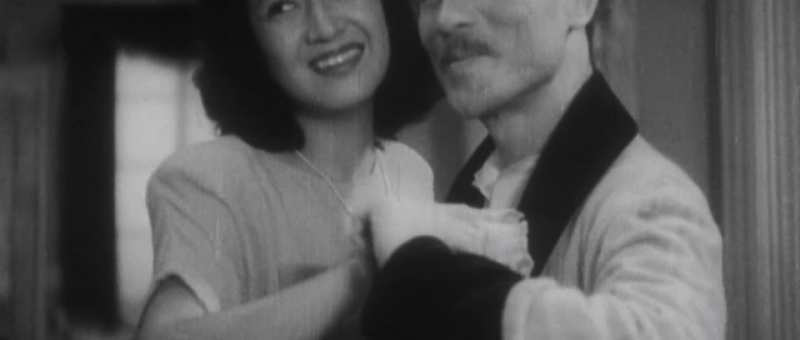
The Ball at the Anjo House (安城家の舞踏会, Kozaburo Yoshimura, 1947)

“Old things die out so new things can be born,” according to the ruined patriarch of a once noble house in Kozaburo Yoshimura’s Chekhovian drama Ball at the Anjo House (安城家の舞踏会, Anjo-ke no butokai), though he might as well be speaking to the post-war society. The Anjos are like the declining aristocracy of the earlier 20th century mourning the disappearance of their world of privilege and gaiety and reflecting that they too must now, as younger daughter Atsuko (Setsuko Hara) says, learn to serve others.

Atsuko is really the only one who accepts the age of the aristocracy has passed and that it is only right and proper that they should join this newly egalitarian, democratic society. Her sister Akiko (Yumeko Aizome) has recently returned home after 12 years having left her husband because of his adultery, but cannot now face it that she no longer has a place here. Approached by their former chauffeur Toyama (Takashi Kanda) who has long carried a torch for her, Akiko snaps that she will always be a noblewoman in heart, unable to let go of outdated customs of class and propriety. She seems to have feelings for the chauffeur too, but won’t let herself embrace them, calling him “dirty” and resenting herself for her attraction to a man who is not her social equal. 

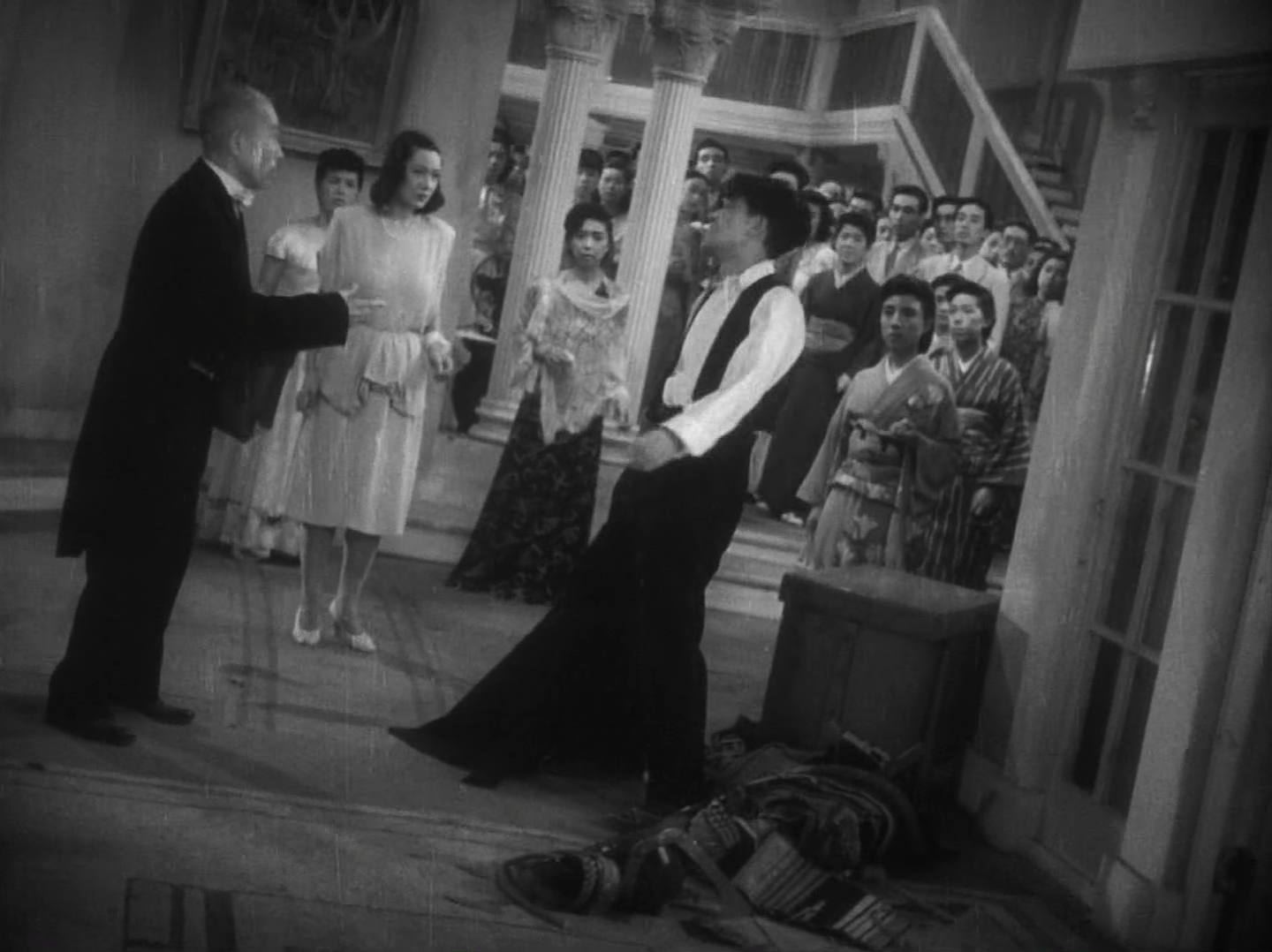
But times are very different now and the aristocracy has been abolished which has in all other senses dissolved the class barrier between them. The tables have turned and Toyama is now a wealthy man having done well for himself in business through honest hard work. Akiko asks him for help as a kind of symbolic gesture as if she were making recompense by handing the house to its rightful owner in their former servant. He insensitively tells patriarch Tadahiko (Osamu Takizawa) that he can easily spare a few thousand to throw away on the house as a sentimental gesture, but does so largely without malice. Only after Akiko has turned him down at the ball and he begins to drink does he start to crow, if a little sadly, that now this base and ugly servant has bought the master’s house. On his way out, he knocks over the suit of armour that had stood in the hall as if literally bringing down the feudalistic military legacy of this once great family and sending it crashing to the floor. The camera suddenly tilts to emphasise that this world is now out of kilter and has been destabilised beyond repair. It’s only this action that frees Akiko from her self-imposed repression as she skips over the armour and chases Toyama out the door. Tumbling down a sand dune she literally descends to his level leaving her pearls and shoes behind. 

The class barrier has been fully dissolved, and Tadahiko too permits himself to marry his long-term mistress, the geisha Chiyo (Chieko Murata), who declares that she doesn’t care about his loss of status and invites him to live with her if he has to sell his house. But it seems as if Tadahiko can’t let go of his ancestral legacy nor his childhood home. In truth, this Western-style country house by the sea can only have been built after the Meiji Restoration which means it’s under a hundred years old and most likely built by Tadahiko’s father, the gentleman in European-style military dress in the portrait. As such, it was likely constructed to look forward to a new era as the samurai class rebranded itself into a European-style aristocracy. Tadahiko’s older sister, married to a lord who’s faring better in this new world, tells an enraptured collection of younger women of the time she danced with a prince a year after the Russo-Japanese war when she was only 19. But this will be the last ball at the Anjo House, in memory of a “beautiful way of life” that has been now been eclipsed.  

Tadahiko had faith that they would be saved essentially through the good chap system in his relationship with a nouveau riche upstart named Shinkawa (Masao Shimizu). Shinkawa holds the mortgage on the house, and there are all sorts of rumours about his shady business. He made most of his money on the black market. Shinkawa had arranged a marriage between his daughter Yoko (Keiko Tsushima) and Tadahiko’s son Masahiko, which gave him even more confidence. But as Atsuko says, Shinkawa was only friendly with him because of his aristocratic title and now it’s gone he has nothing to offer. In marrying Yoko to Masahiko (Masayuki Mori), Shinkawa would have gained the legitimacy of a connection with nobility while Tadahiko would have gained an injection of cash that would save his social status. But none of that matters any more now that the aristocracy has been abolished under the post-war reforms that have also seen Tadahiko’s lands confiscated and estate broken up. It seems that Tadahiko let Shinkawa use his name for a munitions factory during the war, which might not play so well now, just as Akiko’s decision to part with her adulterous husband may also have been influenced by the fact that he was a general who is presumably little in demand in the wake of defeat. Still, Tadahiko prefers Shinkawa to letting the house go to a former servant like Toyama who must himself be enamoured enough with that old world to want to become master of it rather than tear it down.

For Masahiko’s part, he has little interest in marrying Yoko but on learning the engagement has been unilaterally called off and Shinkawa is little more than crook decides to rape Yoko to get back at him. His cruelty is a symptom of post-war nihilism, and we soon discover he’s been sleeping with a maid, Kiku (Akemi Sora), to whom he made promises of marriage he had no intention of keeping. But Like Akiko it seems as if he does care for her after all, only he won’t let himself feel anything in the numbness of his loss of privilege preferring instead to laugh too loudly with his boorish friends. Only on seeing the class barrier dissolve when his father marries Chiyo and his sister Akiko takes off after Toyama does he allow himself to embrace Kiku and express genuine emotion.

Masahiko is played by a young Masayuki Mori who was the son of the novelist Takeo Arishima. Arishima was also a member of the aristocracy but one who became a socialist and dissolved his estate which was something of a fashion in the 1920s. The situation is however complicated by the fact that the Anjos’ servants remain loyal and don’t want to leave them. After all, this is as much their home too and they don’t have anywhere to go either because a world with no masters has no need for servants. We too are encouraged to mourn this world, but its end is also presented as a kind of liberation in which the family are finally permitted to embrace their own desires only after casting off the shackles of the aristocracy and preparing to forge new futures in a changing world leaving the feudal past behind and waltzing into a new and brighter future.
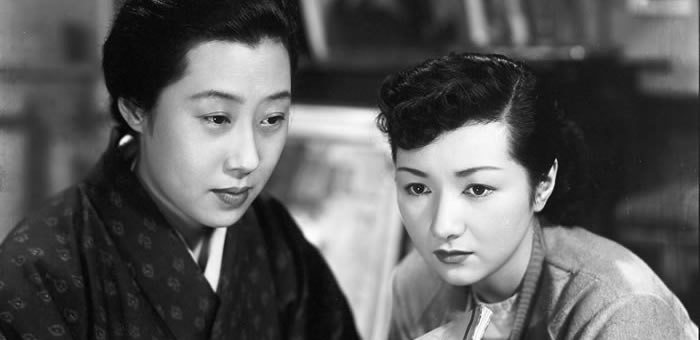
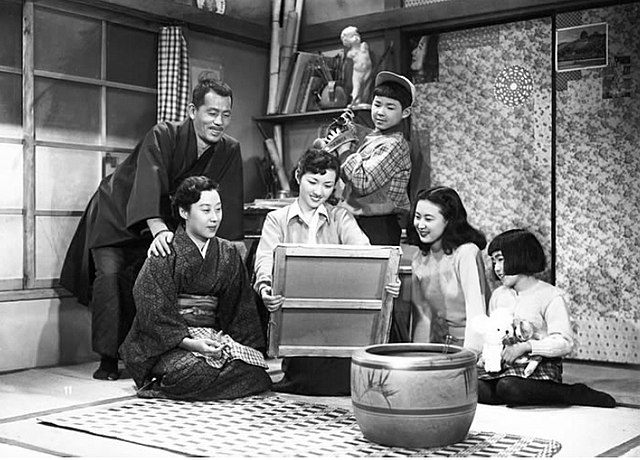
Home Sweet Home (我が家は樂し, Noboru Nakamura, 1951)

There must have been a lot of families like the Uemuras in the Japan of 1951. As film’s title implies, their home is a happy one and though they may not have much they make the most what they have and are cheerful and loving towards each other. Still, the world stores up trouble for them perhaps because they are so very defiant of their circumstances. In many ways a classic shomingeki, Home Sweet Home (我が家は樂し, Waga Ya wa Tanoshi) was the film that put Noboru Nakamura on the map and finds Japan at a kind of crossroads edging past post-war privation towards a broadly consumerist society.

We can get a sense of that in the constant needs of four children in the Uemura family, patriarch Kosaku (Chishu Ryu) picking up his young son Kazuo (Katsumasa Okamoto) after baseball on his way home and noticing that his mitt is almost worn through only to get there and spot his daughter’s boots are getting pretty thin too. It’s clear they struggle for money despite Kosaku’s steady job for which he is about to receive a 25-year good service commendation as wife Namiko (Isuzu Yamada) supplements the family income by taking in sewing at home while we later find out that she’s already sold most of her kimono to help make ends meet and is considering selling her wedding ring to pay for middle daughter Nobuko’s (Keiko Kishi) school trip to Kyoto.

But her hard-nosed sister Kayo (Mutsuko Sakura) tells her that secondhand kimono have lost their value with so many new ones now available. In the immediate post-war era, rice and kimono were the only things that had held their value and so selling one could bring in a lot of money quickly. Conversely, after receiving a sizeable bonus along with his commendation, Kosaku and Namiko visit a department store which has a large range of affordable clothing for sale though the kimono fabric Kosaku picks out for Namiko is still fairly expensive so she instinctively puts it back insisting that they buy the presents they promised the children first. 

That was probably a good move, seeing as the rest of the money is stolen from them on their way home to a congratulations party the children are busy setting up. Kosaku asks why someone would rob people like them, honest, hardworking types who don’t have much to begin with but as Namiko sensibly points out pickpockets don’t really think like that and how would they know anyway. The subtext is that times are still hard for a lot of people even if there are now more exciting, definitely non-essential things appearing on shelves for people with disposable income to buy and a new kimono, though out of fashion, is no longer so out of reach for the ordinary housewife. 

The loss of the money might seem as if it should place a wedge between husband and wife, but bar a moment of disappointment cured by the realisation that oldest daughter Tomoko (Hideko Takamine) has been considerate enough to place hot water bottles in their futons, they resolve to muddle through together and in any case they’re no worse off than they were before. Tomoko herself is conflicted, feeling as if as a young woman in her early 20s she should give up her dreams of becoming a painter and get a job to support the family but Namiko always tells her not to. She encourages each of her children to follow their dreams, perhaps a sign of a new post-war liberation, telling her sister that she’d happily sell all her kimono so that Tomoko could go on painting. Later we discover that she also dreamed of becoming an artist and that though Kosaku had encouraged her to keep it up, a housewife’s day is never done and there was simply no time left for herself. Painting is just another thing she sacrificed for her family and Namiko seems to be determined that Tomoko won’t have to do the same not that she particularly regrets her decision.

Tomoko only really comes to understand her mother’s sacrifices on noticing that the cupboards really are bare, she’s sold everything that could be sold and pawned her ring though the colleague that owned the house they were renting has encountered some financial difficulties of his own and going to to sell to the grumpy old man who bought the house across the way. The Uemuras are such obviously good people that it feels so unfair that so much bad luck has come their way all at once though it is their goodness that eventually saves them when the old man is touched by seeing youngest daughter Mitsuko (Kazuko Fukui) playing with his dog. He later comes to admire Tomoko’s painting of his garden though he’d put a fence up to stop her peering in. The scars of the post-war era are visible in the damage to Uemura’s front wall which would have blocked the way but now perhaps enables them to become good neighbours after all. Though the film may lack some of the visual flair present in Nakamura’s later work, it more than makes up for it with genuine sentiment and the implication that in the end the world is basically good and rewards those who are the same even if it sometimes tests their resilience.


Fallen Blossoms (花ちりぬ, Tamizo Ishida, 1938)

By the late 1930s, film censorship had tightened and it was perhaps all but impossible to rebuke the militarist regime through the silver screen. Nevertheless, as always setting your film in the past can make the impossible possible through thinly veiled allegory. This may not have been its primary intention, but it’s impossible to ignore the subtext of Tamizo Ishida’s Fallen Blossoms (花ちりぬ, Hana Chirinu) which sets itself entirely within the confines of a geisha house on the night of the Kinmon incident or Hamaguri Gate Rebellion in 1864 during which anti-Shogunate forces from Choshu marched on Kyoto with the intention of kidnapping the emperor in order to restore imperial rule. The incident ended in devastating defeat for Choshu with rebel forces setting fire to the city as they bid their retreat. 

There is therefore an uncomfortable anxiety in the context of the Japan of 1938 as the women trapped inside the teahouse remark on the chaos outside with unfamiliar soldiers on the streets and townspeople deciding to remain at home which is of course very bad for their business. Aside from the sense of danger, the major problems inside the house are economic with constant talk of declining revenues and the recent closure of similar establishments while even the guests that have come have done so to drown their sorrows as their own business is also going badly because of the rumours of imminent unrest. The situation is all the more acute for Akira (Ranko Hanai), daughter of the house’s madam, because she’s secretly fallen in love with a young man of Choshu she fears may be marching on the city which is one reason she deflects her mother’s attempts to encourage her to accept an offer of marriage from a wealthy associate. 

As Akira later puts it, her mother was born in the teahouse, became a geisha and then its madam. She sees herself sharing the same fate but wants to experience a different kind of life, curious about what lies outside the pleasure district. Maid Miyako (Kimiko Hayashi) was sold to the geisha house as a child because her family was poor, she doesn’t think the life outside is anything worth seeing. Yet she too wonders what her fate might be, believing herself to be too plain to make it as a geisha and particularly to attract the kind of wealthy patron who could provide an escape route. Matsuba (Ayako Ichinose), a former geisha, did just that but now she’s come back apparently regretting her decision because she’s neither wife not maid in her new home but also occupies a liminal status in the teahouse, her actions deliberate or otherwise reinforcing the idea that she is no longer a geisha in her inability to tie Akira’s obi and claims to have forgotten the words when asked to rehearse a piece of music with another of the women. “Surely it’s OK for a girl to dream, even in the Kuruwa” Akira fires back but perhaps on some level knowing that her mother has a point when she says that samurai don’t marry young women of the pleasure district. 


Even so Akira’s romantic fantasy takes on even greater import when a man begins loudly banging on their door and demanding to be let in, presumably in fear for his life. Akira rushes forward to open it, but is held back by her mother and the other women. After a while the sound of fighting stops and it’s assumed the man has been killed. Akira doesn’t know if the man was her lover or not, but it makes no difference. Someone called for her help and she refused it. Guilt and shame overwhelm her. Her mother’s decision may prove to be a prudent one, though she is in any case later arrested by the pro-shogunate Shinsengumi police presumably suspicious the geisha house may have harboured rebel soldiers. Akira’s double sense of guilt that what’s happened to her mother is partly her own fault prevents her from leaving with the others when it becomes certain that their only choice is to evacuate the city. Her only point of refuge is on the watchtower, apparently unique to her geisha house and said to be haunted by someone murdered by the Shinsengumi, where she sees the smoke of fires glowing on the horizon. Her lover’s poem falls from her hand as if in admission that her dream is ended and there will be no escape for her from the environs of the Kuruwa.

The moment is therefore one of eclipse and endings, a city a falling but not as the invaders are beaten back and defeated. Prophetic and chilling in its import as bells strike ominously in the background while the city burns, the film paints a bleak prognosis for a Japan of mounting imperialist ambitions. Drunken geisha Tanehachi (Reiko Minakami), herself trapped in the Kuruwa apparently because of a bad man she cannot escape, reveals that her father was beheaded in the street for disrespecting a samurai and if this is the beginning of their end then so be it, but even so “Kyoto is finished. No matter who loses it will make no difference.” Adapted from a stage play by Kaoru Morimoto, Ishida’s increasingly anxious drama never leaves the geisha house or repeats a shot and situates itself entirely within a world of women where men are heard but never seen, but finally leaves its heroine all alone watching helplessly as the fires creep closer. 


A Woman’s Sorrows (女人哀愁, Mikio Naruse, 1937)

Arriving perhaps in a moment preceding a major change, Mikio Naruse’s A Woman’s Sorrows (女人哀愁, Nyonin Aishu) finds itself on one side of a divide in which it is, paradoxically, a woman’s conservatism that is thought a barrier to her marriage. As usual slightly ahead of his times, Naruse doesn’t so much attack the idea of marriage either arranged or love, but subtly arcs out the patriarchal cage the bars of which only become visible to his conflicted heroine after she has wilfully allowed herself to be locked inside. 

Opening on location, a thriving Tokyo street scene, Naruse introduces us to the “conservative and indecisive” heroine Hiroko (Takako Irie) at her part-time job at a record store. We learn that Hiroko has recently been to an omiai marriage meeting, and that at least according to her friend she has been harbouring a longterm crush on her sensitive, progressive cousin Ryosuke. Hiroko denies having feelings for her cousin claiming that she thinks of him as a brother and that he dislikes her for being too “conservative”. One might think that a truly conservative woman wouldn’t be working in something as modern as selling records, but Hiroko is indeed a kimono-wearing holdout who has almost fully internalised the properness of the patriarchal order. Her indecisiveness, however, perhaps tells us that she isn’t quite as comfortable with it as she seems and is in a sense forcing herself to accept something she thinks she has no power to resist. 

It is also true that Hiroko’s family is poor. Despite confiding to Ryosuke that her husband gave her trouble, failing in one sense at least by dying and leaving his family with debts, Hiroko’s mother is keen that she marry and marry well. Her prospective match Shinichi is from a well to do family and has also offered to pay for the education of Hiroko’s younger brother Masao, so the marriage is undoubtedly financially advantageous if not immediately essential. “Since I cannot marry someone I love, anyone will do” Hiroko silently sighs, resigning herself to a conservative vision of a woman’s life. For his part, Ryosuke rejects Hiroko because he believes her conservatism runs so deep as to lead her to reject love as improper, that love would in fact be a barrier to her marriage which she would feel duty-bound to refuse. 

Hiroko feels that the match is in a sense too good for her, much better than she had a right to expect. Nevertheless, it’s her seeming conservatism that presents a potential problem in that it is assumed that despite working in a record shop she wouldn’t know how to dance in the modern fashion. Far from censorious, Hiroko’s mother is worried that the young girls these days all go to “dance halls” while Hiroko is quiet and demure. As it happens, Hiroko knows how to dance, though perhaps they should have been thinking about the problem from the other side in that men who like going to dance halls don’t necessarily like to go with their wives, and those looking for “conservative” women often do so because they want to lead “modern” lives outside the home. Having agreed to the marriage, Hiroko finds herself an outsider, treated as unwaged maid by her new in-laws who all exclaim how glad they are to have someone so reliable as their new daughter-in-law especially as they’ve recently disowned oldest daughter Yoko (Ranko Sawa) for running off with her lower class fiancé. 

As so often in Naruse’s cinema, modern girl Yoko acts as a mirror for the outwardly conservative Hiroko. Yoko determines to marry for love, but is actually far more conservative than she seems in that she is entirely unwilling to surrender her comfortable middle class life and continues to resent the man she married, Masuda, because he cannot keep her in the manner to which she had become accustomed. Shinichi had warned Yoko about “frivolous” men, an ironic comment seeing as we’d just heard him dismiss a woman he’d been seeing as “just a girlfriend” laying bare his rather misogynistic view of women as a means of passing time, but Masuda is the very opposite of frivolous, serious in his intentions even while Yoko rejects him solely because of his lack of socioeconomic status. Yet like Hiroko Yoko is perhaps herself also conflicted, forcing herself to reject Masuda whom she loves out of a mistaken pride that tells her it would be wrong to suffer for love when she could have done as Hiroko did and married well for a comfortable but emotionally unfulfilling life. 

Unhappy in her marriage, Hiroko claims that she could have put up with being treated as a maid but can’t stand being treated as a doll, believing herself mere decoration in Shinichi’s life. Nevertheless she continues to believe it’s her duty to “manage” as good wife, bearing her sorrow and loneliness gracefully until pushed into a moment of crisis by Yoko’s rather melodramatic love life. Overhearing the family declining to invite her to join their game of mahjong on the grounds she’s too conservative and is perfectly happy with her life of drudgery, Hiroko is stirred by Yoko’s assertion that she’d never be so “submissive” despite the fact that’s exactly what she’s been in leaving Masuda to return to her upper middle class life with the Hories who are not perhaps as grand as they seem with only the one maid and Mrs. Horie’s constant penny pinching. 

Yet the subversive conclusion isn’t so much that Hiroko begins to realise she has choices and agency after all along with the right to leave a marriage that isn’t working, but that she, temporarily at least, rejects marriage itself in favour of independence while Yoko chooses love in defying her family to return to Masuda who, by then, has done something quite foolish in a mistaken attempt to prove himself worthy of her. Rather than leaving Shinichi for Ryosuke, she tells him that she needs time to figure herself out, to “reconstruct my life by myself”, vowing to find out what is the most beautiful thing in the world so that she can see something more important in herself. It’s a startlingly progressive statement for the Japan of 1937 which is edging closer towards a kind of darkness despite the otherwise cheerfully internationalist atmosphere with its Western jazz music and record shops, dance halls, department stores, trains, and telephones, the contradictions of the age symbolised in the Horie’s awkward home with its mix of Western and Japanese furnishings. It turns out, Hiroko is the most “modern” woman of all, who ever would have thought?  


Our Marriage (私たちの結婚, Masahiro Shinoda, 1962)

Like many directors of his age, Masahiro Shinoda had to serve his apprenticeship at Shochiku contributing to the studio’s particular brand of light and cheerful melodramas though 1962’s Our Marriage (私たちの結婚, Watashitachi no Kekkon) did perhaps allow him to explore some of his persistent themes in its ultimately empathetic exploration of the romantic and existential dilemmas of two sisters who ultimately find themselves taking different paths in the complicated post-war society. Co-scripted by Zenzo Matsuyama, Our Marriage is essentially a chronicle of changing times and the crises of modernity, but it’s also surprisingly even-handed in its refusal to judge or indeed to sugarcoat the “romance” of a working class life. 

Keiko (Noriko Maki) and her younger sister Saeko (Chieko Baisho) both have jobs in the local factory with Keiko working in the accounts department which is where she first meets the brooding and self-righteous Komakura (Shinichiro Mikami) when he marches straight into the office to complain that he’s been shorted on his pay-packet to the tune of 10 yen. The ladies are non-plussed, it’s only 10 yen after all so perhaps there’s no need to be so unpleasant about it, but Komakura insists on having it looked into even after they give him the single coin in an effort to make him go away. Getting so upset about 10 yen is perhaps disproportionate, but then it is Komakura’s 10 yen and he has a point that if a mistake has been made it needs to be acknowledged and corrected especially when you’re dealing with people’s livelihoods to ensure that everyone is being paid fairly. On the other hand, marching in and shouting at people is unlikely to help the situation. 

It just so happens that Komakura is a good friend of Saeko’s who perhaps reads more into the mild embarrassment he and her sister each experience on meeting in another context to assume that they are romantically involved, immediately swinging into action to get them together. Meanwhile, another potential suitor has turned up at home in the form of Matsumoto (Isao Kimura), apparently an old friend dropping in on their parents out of courtesy. Matsumoto is very good looking and apparently now has a well paying job in the textiles trade, but despite their politeness to him the parents later have their doubts because it turns out that he was their blackmarket dealer during the dark days of the immediate post-war era. 

The Hibino family make their living as seaweed farmers and live in a small two-story home in a fishing village. Times are hard because the sea is dying. Increased industrial pollution, land reclamation, and the new airport have reduced the harvest to almost nothing and the girls’ father (Eijiro Tono) can no longer make ends meet. The union hasn’t paid him and he can’t ask about it because he’s still in debt from a previous loan, which is why Keiko’s mother (Sadako Sawamura) is always asking her for extra money to help with household expenses. Keiko intensely resents this, especially as her father’s irresponsible drinking habits continue to adversely affect the family’s finances. They haven’t really been thinking about her marriage perhaps partly because they need her salary but are now forced to because of all the sudden and unexpected interest. On top of Matsumoto and Komakura, it seems that the union leader’s widowed son is also interested which would, admittedly, be quite beneficial to the family. 

Keiko, however, is insistent that her husband must have a decent salary and that her married home must have a refrigerator and a washing machine. Quite the consumerist, Keiko has had enough of poverty and of feckless men like her authoritarian father who waste all their money on drink while relying on female labour to keep them out of trouble. When Matsumoto writes a formal letter proposing marriage, the parents decide to push the union leader’s son instead hoping to avoid embarrassment all round. Keiko immediately assumes the worst, that her father is trying to sell her to the union leader in exchange for the cancelation of his debts. She insists that she will decide her own future, leading Saeko to make a disastrous intervention revealing Keiko’s relationship with Komakura which only has the effect of enraging her father who brands her an ungrateful “whore” while shouting that a mere workman is not good enough for his daughter despite having previously stated that the union leader’s son was really “too good” and they were only in the running because it’s a second marriage. 

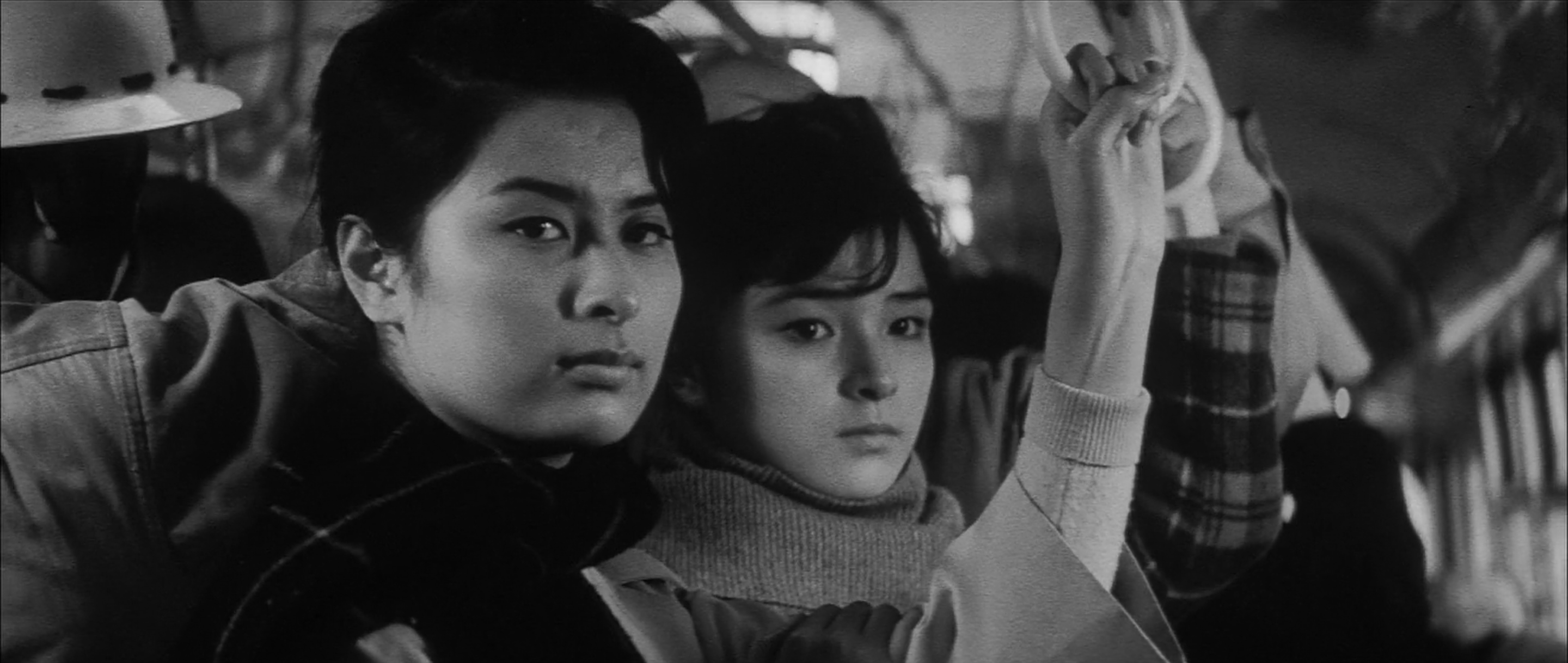
Both women still implicitly feel that marriage will define their futures, they do not have an expectation of living independently. Nevertheless, marriage itself may not be an answer. Everyone keeps talking about how happy Miyoko (Fumiko Hirayama) is with her new husband and she herself is forever extolling the joys of married life even in poverty, insisting to Saeko that “a woman’s happiness lies in marrying and having babies”. It’s a cruel irony then that we later see her arguing with her husband who is trying to force her to have an abortion against her will because they cannot afford to raise a child. Keiko has had enough of poverty, she wants to be more than comfortable, enjoying the new consumerist age. Re-encountering an old schoolfriend who has become a glamorous social butterfly she is mildly scandalised when she tells her that she obtained all her treasures through a complex network of compensated dating arrangements with foreigners, but later decides to check it out for herself when directly faced with the hopelessness of her situation. 

The fact remains, however, that no matter the initial attraction and her sister’s earnest attempts to make it work, Keiko and Komakura are fundamentally unsuited. They have entirely different ways of thinking about the world and want completely different things. Komakura is an angry young man but committed to his working class roots. He isn’t trying to get on, he’s happy with working in the factory for the rest of his life and just wants a quiet, honest existence. Keiko wants more, she thinks that people who say they’re poor but happy have merely given up on life. Revealing himself, Matsumoto says that he was struck by Keiko’s harsh words to him when she was a child, her calling him a blackmarketeer to his face apparently showing him what he was. He claims to have reformed and now fears the various ways that poverty can corrupt, something Keiko feels herself after her brief brush with the shady world of compensated dating. They are very much on the same page, both intent on seizing the benefits of the consumerist age but hoping they won’t have to stoop too low to get them. 

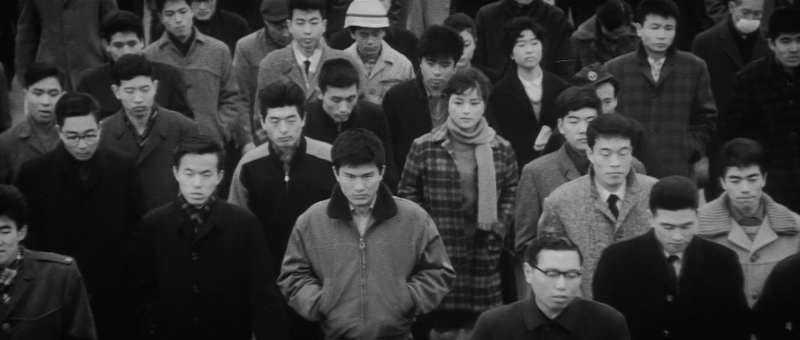
Saeko meanwhile is a little younger, still naive, and unlike her sister completely resistant to the corruptions of consumerism. Part of that might be because Keiko has shielded her from some of the harsh consequences of the way their family lives such as the financial burden of her father’s drinking, leaving her with a rosier view of poor but honest life which has her taking notes from Miyoko on how it’s easy to be happy even when you don’t have enough to eat. She and Komakura are in fact perfectly suited and perhaps she is already in love with him but either afraid of her feelings or unable to recognise them, pushing him towards her “prettier” sister instead. Then again, is there anything to say that Komakura will not turn into another man like her father, embittered and old, trying to drown his disappointment in sake? There’s no guarantee Keiko will be happy with Matsumoto, or perhaps with anyone, but they are at least moving forward in the same direction, as are Saeko and Komakura even as they blend back in with a hundred other cheerful youngsters making their way towards the factory. Our Marriage offers no judgment on its heroines’ choices, merely stating that people make their own paths in life pursuing their particular ideal of happiness and it happens that those paths might necessarily diverge but the people are still the same ones they always were and perhaps you don’t need to reject them for choosing differently than you might have done. Isn’t that what post-war freedom is all about after all?


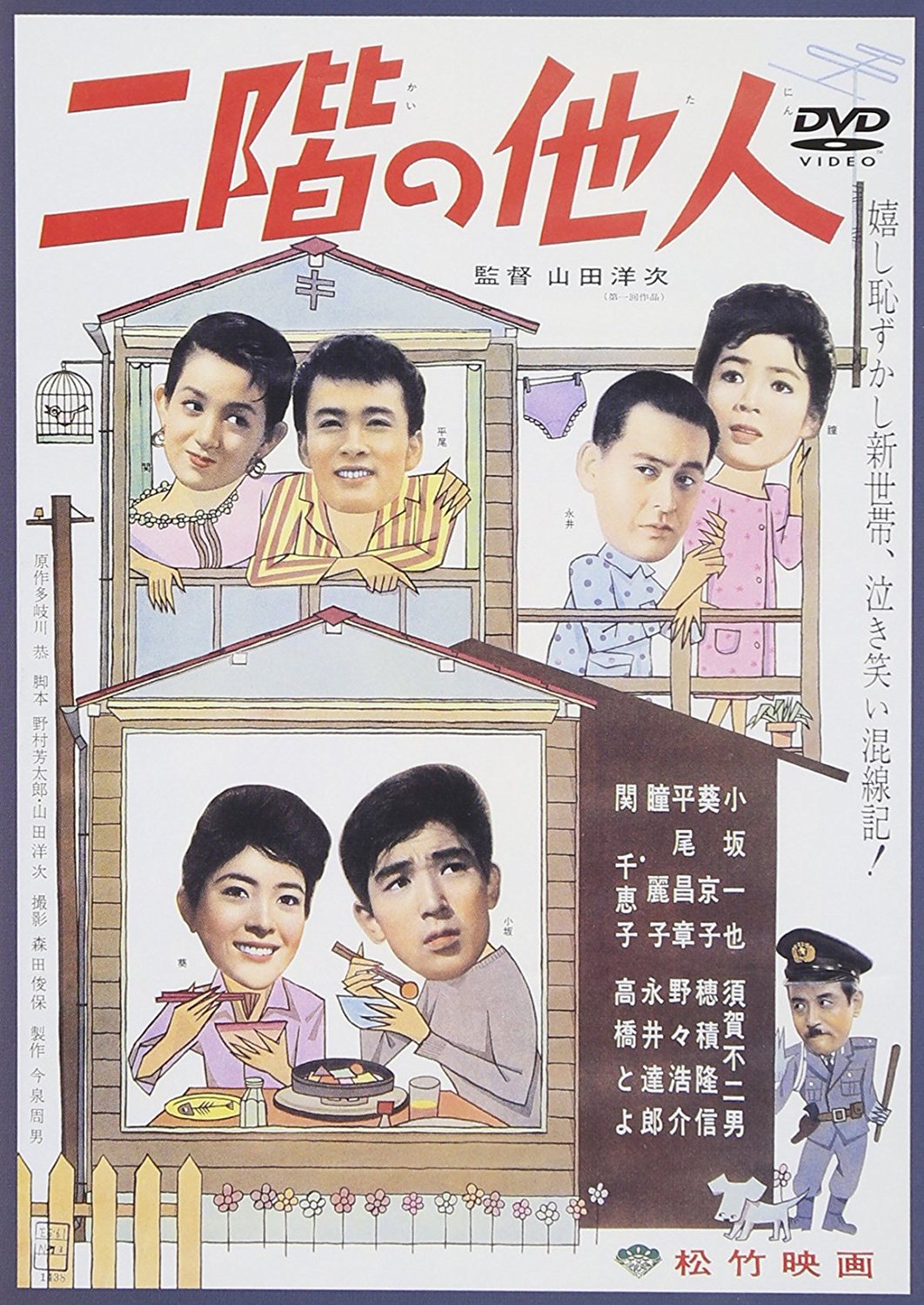
The Strangers Upstairs (二階の他人, Yoji Yamada, 1961)

strangers upstairsLate into his career, veteran Japanese director Yoji Yamada has become synonymous with a particular brand of maudlin comedies and tearjerking dramas often starring veteran actress and long standing collaborator Sayuri Yoshinaga. He is, however, most associated with the iconic long running Tora-san series which revolved around the heartwarming adventures of the titular travelling salesman. Tora-san does indeed epitomise Yamada’s general philosophy which leans towards realistic humanism, finding resolution in kindness and decency yet accepting that oftentimes the rules may need to be bent in order to accommodate them. In this respect his Shochiku debut, featuring a script written by his mentor Yoshitaro Nomura, is a good indicator of Yamada’s future career in its humorous tale of a newlywed couple filled with ambitions of social mobility in the rapidly modernising post-war economy.

Salaryman Masami (Kazuya Kosaka) has taken out a huge loan to build a new house for himself and his new wife, Akiko (Kyoko Aoi), but, to keep costs manageable, they’ve decided to do without a bathroom (there’s a bathhouse across the street) and added an extra floor with the intention of renting it out for a little extra money. So far, married life is going pretty well – Masami and Akiko are a nice, well matched young couple happy in each other’s company and committed towards forging a harmonious future.

The problem is their lodgers are a little, well, difficult. Not having anticipated any “difficulty”, Masami and Akiko are becoming worried that their upstairs neighbours are already a few months behind on the rent and seeing as their contract also includes food, they’ve been eating for free. Not really wanting to broach this difficult subject, Masami and Akiko try gentle prodding to remind their lodgers they need to pay their dues only for the couple to act embarrassed and claim they’d forgotten because they’d always lived with their parents in the past. Finding out that the central concern is that the husband, Hisao (Masaaki Hirao), is currently unemployed, Masami decides to help him find a job but quickly finds out that working is just not Hisao’s thing. Meanwhile, Hisao’s wife, Haruko (Chieko Seki), is picking up extra money working as a hostess in a bar, rolling in roaring drunk in the middle of the night and singing loudly as she does so.

With their patience wearing thin, Masami and Akiko ponder the best way to evict lodgers who refuse to leave but they have another problem on their hands in the form of Masami’s cantankerous mother, Tomi (Toyo Takahashi), who has arrived from the country without warning for an “indefinite” visit after falling out with another of her daughter-in-laws. An unsophisticated country bumpkin with a wicked tongue and serious hanafuda habit, Masami’s mum does not quite fit with the couple’s upwardly mobile aspirations and, annoyingly, immediately sides with Hisao and Haruko whose self-centred laziness is more in keeping with her backstreet ways.

If Masami and Akiko disliked Hisao and Haruko essentially for being too common, their second set of lodgers present the opposite problem. Taizo (Tatsuo Nagai) and Yoko (Reiko Hitomi) seemingly have money to burn, so why are they renting an upstairs room in an “up and coming” area of the city? Akiko is quickly taken with their small luxuries, in awe of her lodgers’ sophistication and upperclass elegance and obviously happy that they won’t be having the same kind of troubles that they had with Hisao and Haruko. When Taizo and Yoko offer to front the money to build a bathroom, Masami and Akiko are surprised but eventually grateful even if taking a “loan” from the people who are renting from you presents a definite shift in power dynamics.

The dynamic shifts even further with another crisis sparking the return of Masami’s mum who has once again been kicked out by a disgruntled relative. Masami’s older brother, who put up some of the money for the house, insists that he honour a vague promise he made that family members in need of refuge would be free to stay with him by kicking out his lodgers and letting his mother live in the upstairs room. Not really wanting to take responsibility for his troublesome mother, and feeling friendly with Taizo and Yoko, Masami refuses and promises to pay his brother back instead – ironically borrowing the money from Taizo.

As predicted Taizo and Yoko are not quite all they seem, but like Masami and Akiko, they are a fairly new couple trying to make a go of it in the often cruel post-war world. On finding out the scandalous secret about their lodgers, Masami and Akiko are torn – they like Taizo and Yoko, plus they’re massively indebted to them thanks to the loan and the money for the bathroom, but they also worry about becoming an accessory or being accused of aiding and abetting. Their first reaction is to feign politeness and carry on as normal pretending not to know whilst asking around to see if they can borrow more money from other friends to pay back Taizo and Yoko before asking them to leave quietly.

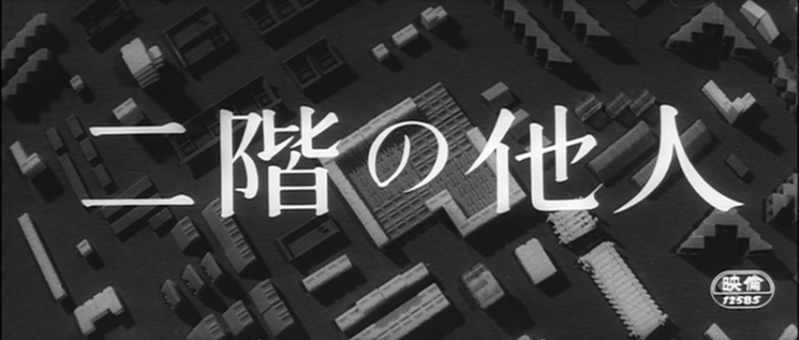
Masami and Akiko, like many of their peers, have aspirations beyond their current pay level and have put themselves at a huge disadvantage trying to live up to the salaryman dream. Yamada opens with an ironic title sequence featuring a series of “Lego” model houses – something which Masami later plays with while lamenting the seemingly small possibility of hanging on to his new home. Homeowning is unexpectedly complicated and becoming a landlord even more so. Masami and Akiko wanted their own mini castle – a status symbol (the policeman’s wife from behind is very jealous), but also a space to call their own which reflects their individual hopes, dreams, and aspirations. They’ve forgone the convenience of a bathroom for the impact of a second floor all while hoping it will pay for itself until they’re ready to use it to expand their family. Until then, they’re content to live in one room and share a kitchen, even providing communal meals if necessary.

The money, however, is a constant worry – the original debt which they accrued to build the house quickly brings its own share of troubles, shifting from one creditor to another as the couple try to invest their fortunes with “nicer” or “worthier” people. Not everyone is nice, as Akiko finds out when she asks Masami’s lecherous boss if he’d mind lending them the money only for him to hint at an extremely indecent proposal. Though Masami seems to be a decent and honest sort who wants to work hard and get on, he is still subject to the salaryman chain of command which means doing his boss’ bidding out side of work hours which turns out to entail further “alibi” duties when he discovers they’re virtually neighbours (though the boss’ house is obviously far more impressive).

Despite all their difficulties, the goodness of Masami and Akiko eventually pays off, their one and only row quickly resolving itself without rancour. Taizo and Yoko, neatly matched in kindness with their former landlords, are grateful for the brief time they spent in the upstairs room and resolved not to bring any trouble into the lives of the nice young couple from downstairs. Masami and Akiko, equally grateful for the consideration, commit themselves to moving forward with a little more temperance, saving the money to pay back Taizo and Yoko and help them in turn when they might need it. Hard work, honesty, and a kind heart, it seems, are what you need to be happy in the burgeoning post-war economy and Masami and Akiko are happy indeed.


Original promo roll (no subtitles)

https://www.youtube.com/watch?v=5NS8TwUdwr0