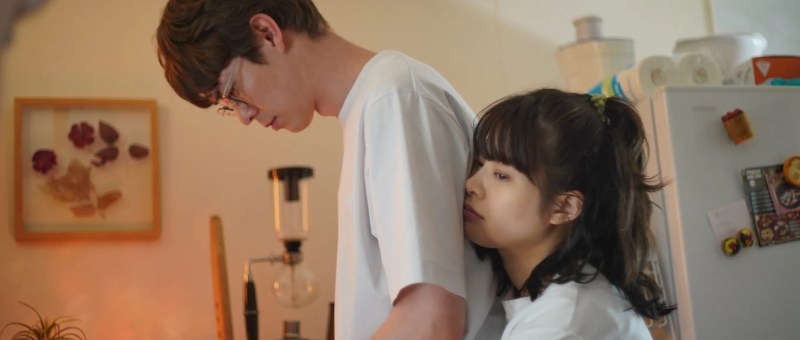
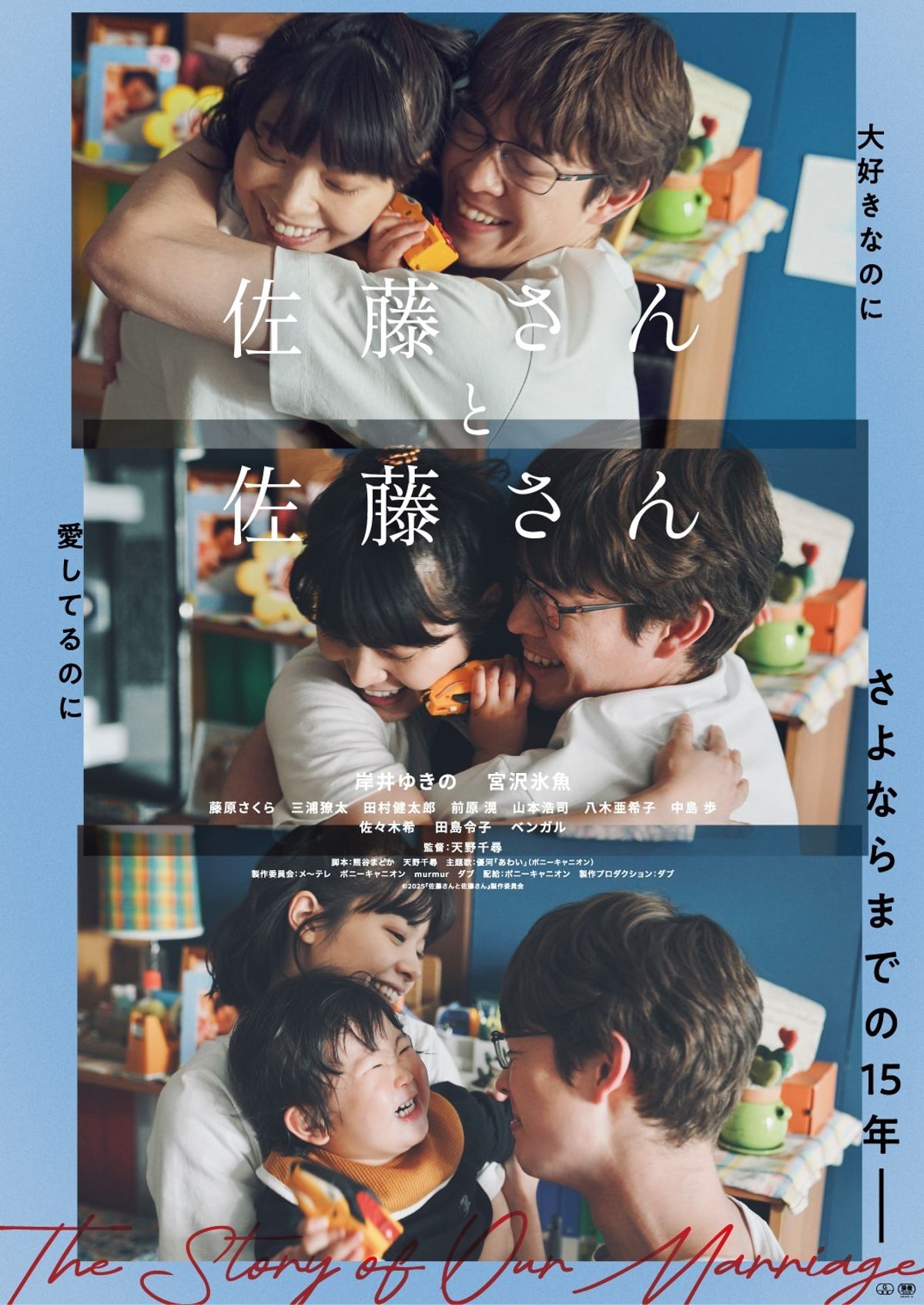
Sato and Sato (佐藤さんと佐藤さん, Chihiro Amano, 2025)

Aged 37 and recently divorced herself, lawyer Sachi (Yukino Kishii) listens to a man whose wife has evidently left him complain that what really soured him on her was that there was a dead bug in their living room that remained in the same spot for months on end, which indicated to him that his wife only ever swept the room as if it were round, literally cutting corners in their married life. He also complains that she only ever fed the children ready meals for dinner and they only ever had toast for breakfast. “I mean, would anyone call that a woman?” he rolls his eyes and sighs, expecting instant support from his legal team. It doesn’t seem to have occurred to him that he could simply have swept up himself or sorted breakfast and dinner, though he now brands his wife an unfit mother and seeks full custody, perhaps only as a means of hurting her or vindicating himself.

It’s this patriarchal take on the division labour that comes under the microscope in Chihiro Amano’s profoundly moving marital drama, Sato and Sato (佐藤さんと佐藤さん, Sato-san to Santo-san). Following the gradual disintegration of a relationship under the pressures of contemporary married life along with changing notions of gender roles, toxic masculinity, and the ways in which men and women navigate the domestic environment, the film seems to ask why it is that there isn’t more equality across the board, with practical and emotional responsibilities for the home still disproportionately falling on one partner.

This is all is more obvious when Tamotsu (Hio Miyazawa) ends up becoming an accidental househusband after repeated failures to pass the bar exam. He and Sachi, who share a surname which is also the most common in Japan making them a pair of everypersons, met as members of the university coffee club and, in truth, seemed somewhat mismatched from the start. She just bought the deal of the day and had the beans ground there. He’s carefully researched the best on offer and had the beans roasted to perfection with the intention of grading them on the day for the best flavour. Depending on how you see it, perhaps they complement each other and round out the corners to become one whole, but, on the other hand, maybe they aspire to different things. Nevertheless, they become a happy young couple full of hope and expectation for the future. But their relationship is soured by Tamotsu’s failures, and only more so when Sachi says she’ll study for the bar with him only to end up passing herself when he again yet fails.

Of course, it’s embarrassing for Tamotsu on a personal level that he can’t pass the exam, especially when he’s so told so many people that he’s going to be a lawyer. He’s been putting everything else on hold, including his relationship with Sachi having put off meeting her parents until he’s passed out of fear he’ll disappoint them. The sense of inadequacy begins to eat away at him, especially after Sachi begins working as a lawyer and is taking care of most of their bills. The other men we meet in the film, especially Sugai who is being divorced by his wife of 50 years, stress their position as a provider, as if that were all they needed to do in order to fulfil their role and buy their wife’s devotion. But Mrs Sugai, who now refuses to see him, states only in a letter that living with him is unbearable and he all he ever did was shout at her so there’s no prospect of communication. Tamotsu too is further driven into despair by the thought that others see him as “unmanly” because he’s being supported by his partner, though in reality masculinity is a performance for other men and not really something most women care about. What begins to bother Sachi is not his failure, but that she feels as if he’s given up and is not really contributing to their relationship or seriously studying to pass the exam. 

On a visit back to his hometown due his grandmother’s health crisis, starts to bond with a local woman and almost forgotten childhood friend who has herself escaped an abusive marriage but lost her children to her in-laws. He sees in her a more idealised kind of traditional wife, but after conplimenting him that his wife must be very lucky as he helps clear up at the bar where she works while all his friends doze off drunkenly, she gives him a rude awakening. He’s just like the others after all. He wants comfort, which is to say emotional labour from her, a woman he doesn’t really know, and the absolution sought by every man who says his wife doesn’t understand him. He wants to be told that he’s right and good, even while he blames Sachi and his domestic responsibilities for his inability to pass the bar. While talking with his old friends and hearing that his ageing father is planning to close their family farm, he starts to think about moving back and starting some sort of non-profit but as Sachi says when he puts it to her rather abruptly, he’s not really serious. Even if this sort of life might really suit him better, it’s not a decision he’s made after coming to the realisation that the bar exam is beyond him, but an attempt to run away not only from his failure but his domestic responsibilities. 

But by the same token, even while the roles are reversed Sachi falls into many of the same traps as an insensitive husband. So busy with her own working life, she doesn’t really see things from Tamotsu’s perspective and is only irritated by what she sees as his failure to commit to one thing or another. He is annoyed when she does things like point out there’s no toilet paper or contemplates buying a washing machine to make his life easier, because really he doesn’t think these things should be his responsibility and suggesting they are makes him feel like less of a man. They can’t orient themselves around the idea of a marriage as a domestic partnership in which they split both domestic and external labour equally and are each responsible for the whole. 

But then again, perhaps society isn’t ready for that either. Though Tamotsu does actually take care of the home environment and is the main caregiver for their son, Fuku, others still look to Sachi where a child is concerned. When they’re called into school because Fuku has apparently seriously injured another child in a squabble over building blocks, Tamotsu wants to ask more questions about how this happened, but Sachi immediately takes over and reassures the teachers she’ll make the necessary apologies to the other family, whispering in private that they’re all too busy to string this out which may not, of course, be very helpful in terms of Fuku’s further development. Conversely, when the pair are picked up by police after a violent argument in the street, the officer insists he has to write down “unemployed” even if Tamotsu says he’s a househusband, while when Sachi replies “lawyer” he assumes she’s trying to assert her right to legal representation and chuckles that she’s not under arrest so it isn’t necessary. She has to show him her lawyer’s pin to explain, and even then he just stares at them dumbfounded by their usual family setup. 

Sachi’s friend Shino who consults her for divorce advice when her husband cheats on her, reflects that Sachi might have had it easy in one sense because she never needed to change her name and accommodate herself with the loss of identity that comes with being called “Mrs Hasegawa” or “Miki’s mum” rather than by her birth name which admittedly was passed down from a father rather than a husband. For Shino taking back her maiden name was more important than a divorce in allowing her to reclaim herself as an individual who has choices and agency and isn’t someone who exists only in relation to a man in her social role as wife and mother. The film suggests the reason the marriage is unsustainable is precisely because society doesn’t accept it as a partnership of equals, so even when Tamotsu finally passes the bar, they end up with what’s perceived as two husbands and no one taking care of the domestic space to which the only solution is two households. With profound empathy for each, the film takes care not to apportion any blame, except perhaps on the parade of useless husbands being sued for divorce while unable to understand why their wives have left them or accept any responsibility for the failure of the marriage, but sees only the sadness of romantic failure and the impossibility of an uncompromised happiness in an otherwise oppressive society.


Sato and Sato screened as part of this year’s Camera Japan.

Trailer (no subtitles)
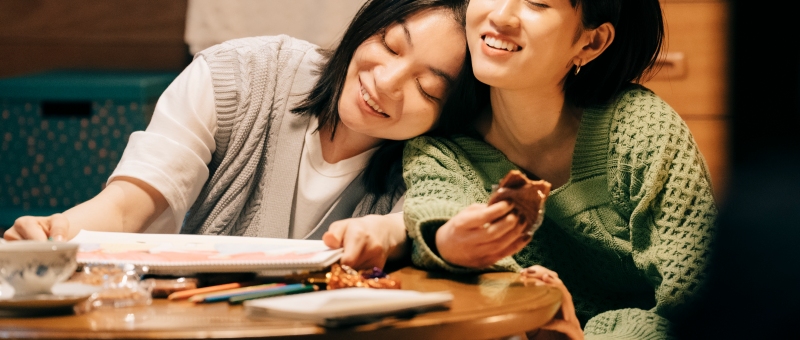
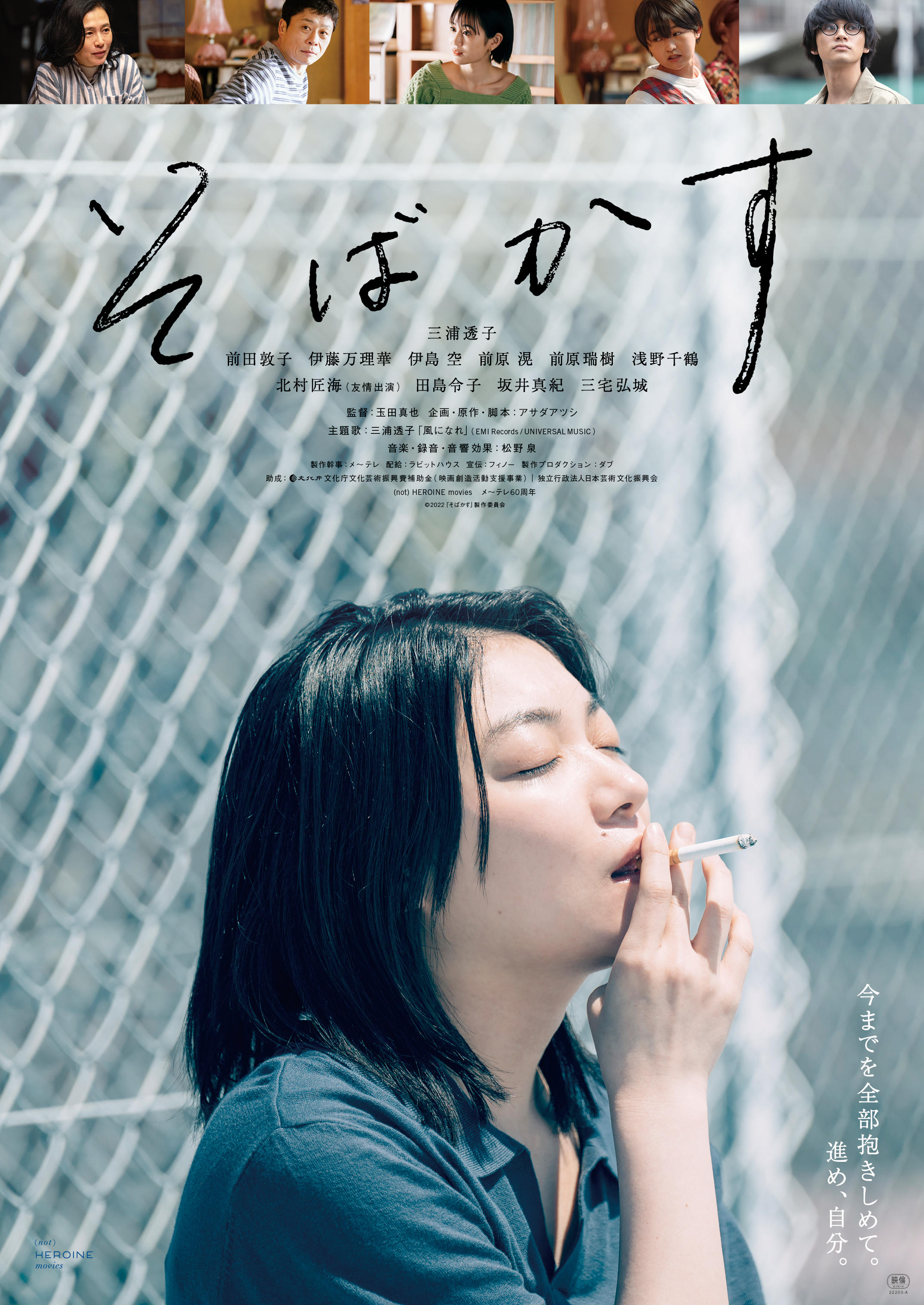
I Am What I Am (そばかす, Shinya Tamada, 2022)

Part way through Shinya Tamada’s empathetic social drama I Am What I Am (そばかす, Sobakasu), the heroine’s sister remarks that she wishes she could live as if the world did not concern her as she assumes her sister does. In many ways, it’s an incredibly ironic statement because Kasumi (Toko Miura) finds herself constantly at the mercy of a world which refuses to acknowledge her, certain that the truth she offers freely of herself must be a lie or at least a cover for some other kind of shame. 

The fact is that Kasumi is asexual and has no interest in love or dating. As the film opens, she appears to be on some kind of awkward double date but seems isolated and aloof, as if deliberately left out of a conversation as she will be several times throughout the course of the film because of the centrality of “romance” in most people’s lives. She’s constantly asked about her “type”, or what she finds attractive in a man with a clear presumption of heteronormativity in also in play. Not wanting to get into it, Kasumi finds herself just nodding along offering some vague, stereotypical comment to smooth things over. When one of the men does strike up a more interesting conversation to which Kasumi can enthusiastically contribute, he doesn’t even listen to her but abruptly gets up to chase her friend. She ends up going to ramen bar on her own to decompress before running the gauntlet at home between mum, sister, and grandma who are all very confused by her lack of interest in marriage. 

Kasumi’s mother tells her that she has to get married someday, unable to accept that not to do so is also valid choice. Whether she does this because she feels embarrassed to have a 30-year-old unmarried daughter fearing that it reflects negatively on her parenting, is genuinely worried that Kasumi is lonely and unable to progress romantically because of shyness, or has a practical concern that she’ll be alone when she’s old, remains unclear though it does seem that her quest to marry Kasumi off is more to do with herself than her daughter. But with grandma apparently having had three divorces of her own, Kasumi’s sister Natsumi (Marika Ito) paranoid her husband’s cheating on her while she’s pregnant, and the parents’ marriage strained by her father’s depression it’s only natural she may wonder what’s so great about marriage anyway. 

In any case, though Kasumi constantly tells people quite directly that the issue is she has never experienced romantic desire and is fine the way she is they refuse to believe her assuming either that she is shy, stubbornly rebellious, or as her sister later suggests, gay. “No one would judge you for that,” she spits out less than sympathetically even while quite clearly judging her for this, as if it denies a basic fact of biology as unthinkable as someone claiming not to breathe the air. Her friend, Yashiro, who introduces her to a new job at a kindergarten, reveals that people did indeed judge him for being gay which is why he’s returned to his hometown. Not even he really believes Kasumi though eventually develops a sense of solidarity with her when her attempt to update Cinderella for a new, more inclusive generation leaves her both exposed and humiliated with a conservative politician visiting the school remarking that he thinks “diversity” is all very well but it only confuses the children and perhaps they should learn about it after developing “solid values”. 

The irony is that Kasumi is remarkably unjudgemental and accepting of all those around her, Yashiro remarking that he just knew she would be a safe person to disclose his sexuality to while she also bats nary an eyelid on reconnecting with a middle school friend (Atsuko Maeda) who turns out to have become a famous porn star in Tokyo only keen to protect her from the unwanted attention of star struck teenage boys and the accusatory eyes of those around them. Each of her attempts to find platonic friendship also fails because sooner or later romance gets in the way. She hits it off with the guy at the omiai marriage meeting her mother tricked her into attending because he also reveals that he has no desire to date or get married, but as much as she thinks she’s found a kindred spirit it turns out that his issue was a more conventional reluctance to enter a serious relationship. When he develops feelings and she has explain again that she meant it when she said she had no interest in romance he takes it personally, insisting that she’s lying and resentful that she doesn’t find him attractive. An attempt to get flat with a female friend also hits the rocks when she decides to get back together with an ex instead. 

When questioned about dating activities and giving the unoriginal answer of the cinema, Kasumi had mentioned a fondness for Hollywood remake of the War of the Worlds starring Tom Cruise. She later elaborates on her statement that she likes the way he runs to explain that in most of his other films, Tom Cruise is usually running towards something but in this one he’s just a regular guy running from trouble which something she can relate to because she’s been running away all of her life too. Yet the unexpected discovery that her mini stand over Cinderella might have done some good after all along with encountering someone who might indeed be a kindred spirit gives her the courage to start moving forward, less concerned by the world and more confident in herself. An empathetic tale of one woman’s attempt to live her life the way she wants frustrated by a conformist society, Tamada’s gentle slice of life drama is a refreshingly empathetic in its fierce defence of its heroine’s right to chase happiness in the way that best suits her.


I Am What I Am screened as part of this year’s Nippon Connection.

Original trailer (English subtitles)

Images: ©2022 “I am what I am” film partners

Thousand and One Nights (千夜、一夜, Nao Kubota, 2022)

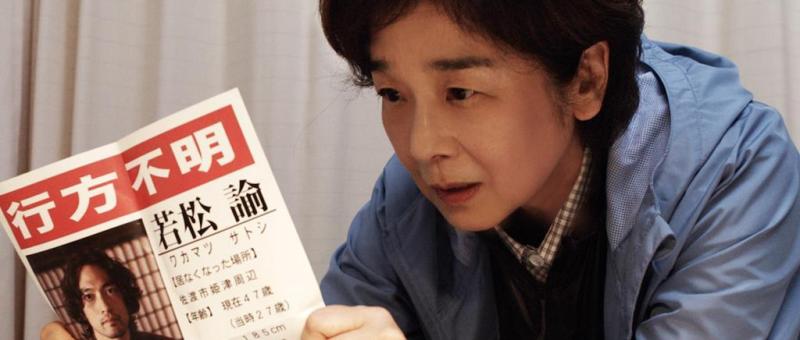
“I can reach the mainland by rowing boat, but why won’t my feelings reach you?” a plaintive song asks in Nao Kubota’s melancholy tale of perpetual longing and continual loss, Thousand and One Nights (千夜、一夜, Senya, Ichiya). A lingering ghost story, Kubota’s contemplative mood piece sees two women, one old and one young, take different paths in the wake of their abandonment but perhaps finding themselves no less unhappy when left with the unanswered questions of a sudden absence. 

On the island of Sado, fishwife Tomiko (Yuko Tanaka) has been waiting for her fisherman husband Satoshi to return home ever since he said he was “just going out for a bit” thirty years previously. Many in the community view her with a mixture of pity of revulsion, seeing her as close to madness in her refusal to accept that her husband will never come back to her. Meanwhile, the former mayor Taisuke now retired to take care of his bedridden wife, puts another young woman, Nami (Machiko Ono), whose husband Yoji (Masanobu Ando) similarly just went out for a bit two years ago and never came back, in touch with Tomiko hoping she can help her investigate what might have happened and if Yoji may be among the small number of presumed abductees taken from the island by the North Koreans. 

Sado does seem to have a large numbers of “missing” people, which in itself is not such an unusual phenomenon given how easy it can be in Japan to simply “evaporate” and start again somewhere else. The island was also the site of a handful of confirmed abductions by North Korea in the late 1970s, dangling another unanswered question in front of the women wondering if their husbands might have been spirited away and prevented from contacting them no matter how much they may have wanted to. Nami is herself third generation Zainichi Korean and wonders if that might have had something to do with Yoji’s disappearance, though in contrast to Tomiko her goal is less reunion than a simple desire to know why. She wants to give herself permission to move on, having drifted into a relationship with a besotted colleague (Takashi Yamanaka) she may not actually quite love but offers her a quiet and conventional life of security she’ll never now know with Yoji. 

Nami does, however, feel a degree of shame in her desire to put the past behind her as if she were betraying a romantic ideal in being unable or unwilling to give up her life in waiting as Tomiko has done. She fears Tomiko may resent her, but she doesn’t, not really only acknowledging that she’s made a different choice. Like Tomiko, Nami is left with unanswerable questions, wondering if Yoji simply walked out on her because he grew tired of the inevitability of their life together, if he was bored, or lonely or depressed. Perhaps he met someone else, had an accident and lost his memory, fell off a cliff or was killed in some other way and someone covered it up. Perhaps he’s dead, perhaps he’s in North Korea. Perhaps it’s all the same. 

While the community pities Tomiko in her martyrdom, they attempt to pressure her to move on by agreeing to marry local fisherman Haruo (Dankan) who has long carried a torch for her even since they were children. Yet in the irrationality of romantic longing, Haruo cannot understand why Tomiko will not give up on Satoshi even as he is unable to give up on her despite her frequent and unambiguous rejections of his overtures. There is a particularly unpleasant quality to his obsessive ardour as his mother (Kayoko Shiraishi) comes round to plead with Tomiko to marry her son and his work colleagues organise a kind of intervention asking her to give in because he’s going out of his mind. He runs her down, says she’s “withering away” and only he can save her while worryingly possessive and controlling even threatening suicide and later going missing at sea just to make her feel guilty and worry about him. 

Even Tomiko’s mother is suffering the pain of lost love, hugging her late husband’s prosthetic leg as she sleeps while excusing the drunken violence that Tomiko says left her with a lasting fear of men by explaining that the war changed him. Tomiko complains that no one ever tells her anything important and that they always leave, but equally refuses to reveal very much important to anyone else keeping her feelings largely to herself remaining something of an enigma, uncertain if her constant waiting is more habit than devotion. In all these tales of frustrated longing from Taisuke and his ailing wife to Satoshi’s parents who rarely talked of their son only for the father to tell the mother on her deathbed that he was still out playing, there is an inescapable loneliness in the essential inability of conveying one’s true feelings that leads some to simply make their exit without saying a word. 


Thousand and One Nights screens at New York’s IFC Center on Feb. 12 & 15 as part of ACA Cinema Project’s New Films From Japan.

Original trailer (no subtitles)

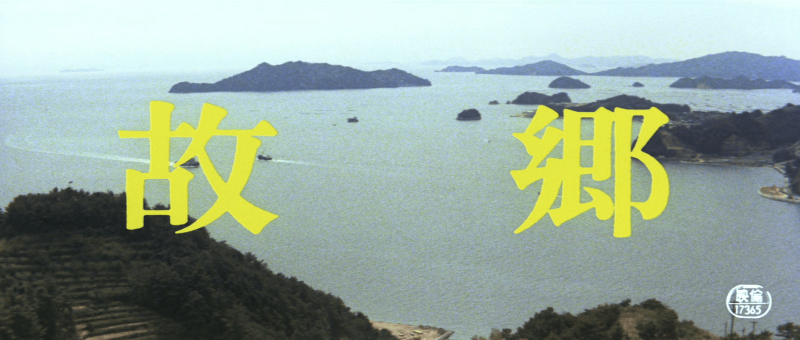
Home from the Sea (故郷, Yoji Yamada, 1972)

Home from the sea still 1By the early 1970s, Japan was well on its way to an economic recovery with memories of post-war privation fading and modern consumerism rapidly taking hold in the national mindset. Contemporary cinema understandably saw this as a good thing, that brighter times were coming and soon enough everyone would be enjoying a comfortable, prosperous life. The future, however, was not always evenly distributed and modernisation brought with it problems as well as solutions. Yoji Yamada’s Home from the Sea (故郷, Kokyo/Furusato*) paints a melancholy picture of a changing Japan as an earnest young couple are forced to consider leaving their beloved hometown to seek their fortunes elsewhere.

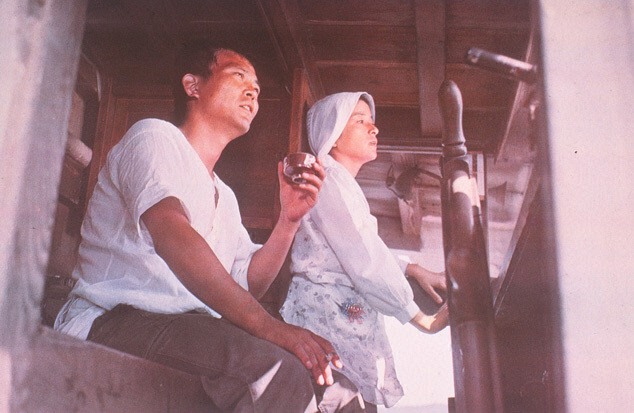
Seiichi Ishizaki (Hisashi Igawa) owns a small transport boat he uses to ferry rocks between construction sites. He is sometimes joined by his wife, Tamiko (Chieko Baisho), who serves as the boat’s engineer. The couple live with Seiichi’s elderly father (Chishu Ryu) and their two daughters on a small island in the Inland Sea. Times are hard. Fuel costs are increasing making Seiichi’s business much less profitable while his boat is old and slow. The maintenance costs alone are difficult to contemplate and the family cannot afford to invest in one of the new steel boats which are currently sucking up most of the available work. Seiichi’s younger brother who used to work on the boat with him has already given up and moved on, taking his wife and children to another town where he works in a factory. Many people seem to think Seiichi would do well to do the same, but he is stubborn. He refuses to be pushed out of his ancestral home and occupation simply because of the unfairness of his times.

A little way into the film, a friendly fishmonger, Matsushita (Kiyoshi Atsumi), who often stops by to have dinner with the family expounds on the beauty of the town. He can’t understand why anyone would want to leave somewhere as lovely as this. Unlike the Ishizakis, Matsushita wasn’t born on the island but in Korea – his parents died during the repatriation after the war and he’s been getting by on his own ever since. He’s done many different jobs and lived in many different places but has chosen to make his home here. A fishmonger’s job is probably always safe (to an extent, at least) in a small harbour town, but Seiichi’s isn’t and he needs money to feed his family. There is no other work on the island, and so there is no way to stay without making the boat pay.

The boat, however, is already 19 years old. Transport ships are only intended to last 10. The engine is faulty and the hull is in desperate need of repair but a visit to the original shipwright reveals that to do so would not be cost effective. The best thing to do would be to buy one of the shiny new steel vessels like their neighbour’s, but that’s far out of Seiichi’s reach. All along the shoreline, you can see the charred remains of boats belonging to those like Seiichi who’ve finally come to the conclusion that their era has passed.

“Can’t beat the Big” is a local mantra. In early ‘70s Japan, counterintuitively enough, size is everything. Not just the boats themselves, but the fleets and the architecture of life. You can’t survive as your own boss anymore because the little guy alone has no power when corporations and conglomerates are extending their reach even into tiny islands. Seiichi goes to have a look at the factory in Onomichi to which he’s been recommended by a friend. It’s not as bad as he thought, but it’s huge and filled with hundreds of identically dressed faceless men. The food is awful, and they’d have no friends. Nevertheless, needs must. If you can’t fight the Big you’ll have to become a part of it or it’ll swallow you whole.

Still the sadness of leaving one’s hometown behind against one’s will with one eye always looking back towards the shoreline is difficult to bear. Seiichi’s father, who had been looking after the children and was therefore extremely close to them, will be staying behind with no one left to look after him save the community itself. Progress might be a good thing, but there are costs too and small town Japan is one of them. It’s sad, but there’s nothing you can do about it. The post-war world might not require so much “gaman” anymore, but bearing the demands of modernity just might.


*According to Shochiku’s website and the narrator in the trailer, the official title is “Kokyo” which is the Sino-Japanese reading of the kanji (故郷) but it’s also often listed under the title “Furusato” – the slightly more emotive native Japanese reading.

Original trailer (no subtitles)