Twilight of the Warriors: Walled In (九龍城寨.圍城, Soi Cheang, 2024)

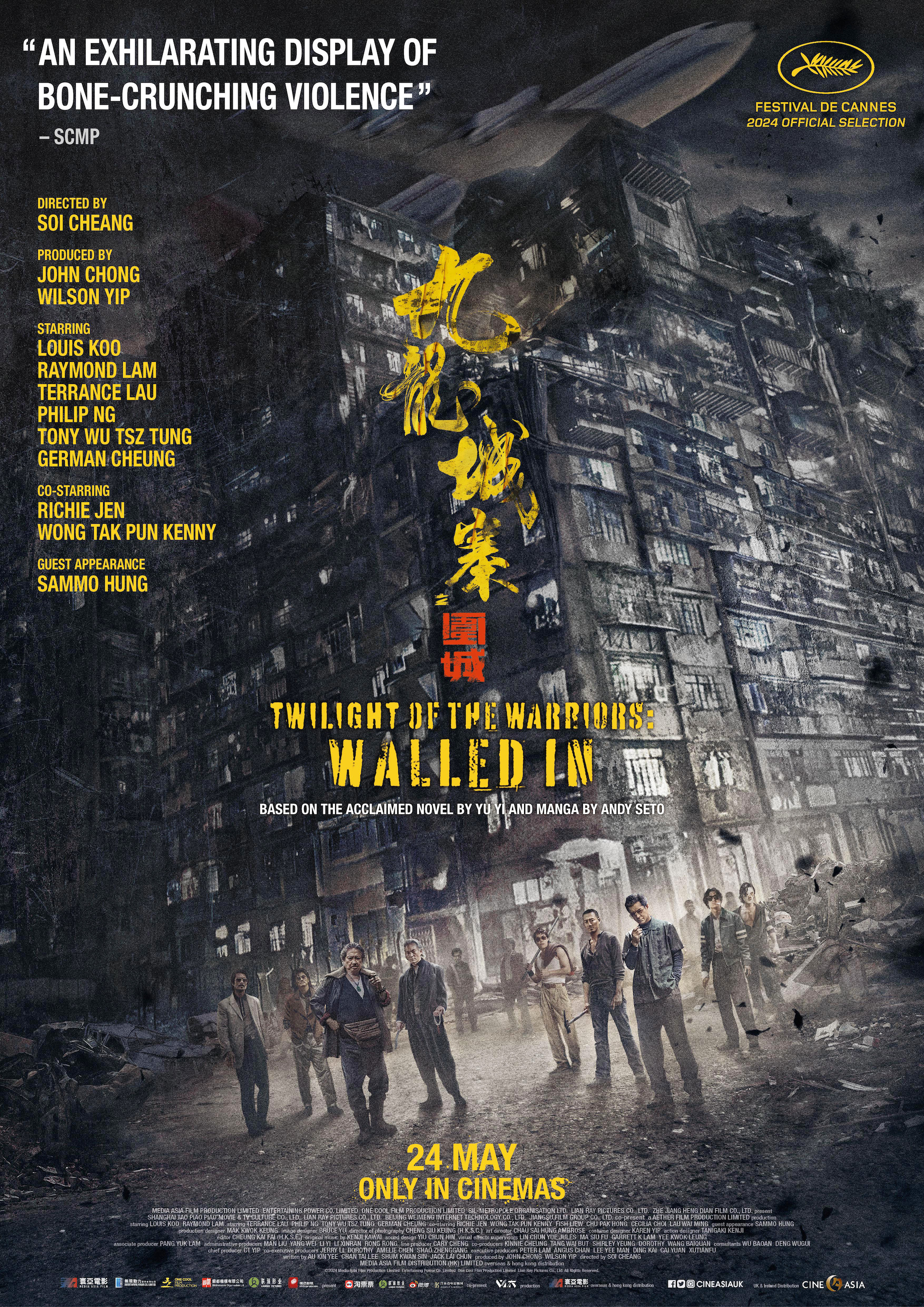
In Kowloon Walled City, you give help, you get help. Sometimes described as a colony within a colony, by the late 1980s the settlement was largely ungovernable and literal law unto itself save for the triads who maintained what little order there was. Yet in Soi Cheang’s Twilight of the Warriors: Walled In (九龍城寨.圍城) it’s a place of comfort and security, a well functioning community that as its leader Cyclone (Louis Koo Tin-lok) points out may be unpalatable for “normal” people but provides a point of refuge for the exiled and hopeless.

It’s difficult not to read it and Cyclone himself as embodiments of Hong Kong that is slowly disappearing. Dying of lung cancer, Cyclone is aligned with the fate of the walled city as someone whose time is running out, tired and world weary but still hanging on. In the opening sequence set 20 or so years before, we see Cyclone stand up to an apparent dictatorship and institute what seems to be a more egalitarian form of government though one obviously defined by violence. Nevertheless, when refugee Lok (Raymond Lam Wui Man) lands up there originally suspicious of Cyclone having been duped by local gangster Mr Big (Sammo Hung Kam-bo), he discovers him to be a stand up guy looking after those in his community and generally keeping the peace. Nevertheless, Lok’s arrival is the fatalistic catalyst for the opening of old wounds amid the free for all of the mid-80s society in which the Walled City, sure to be bulldozed, has just become a lucrative property investment.

Mr Big and his crazed henchman King represent this new order, amoral capitalistic consumerists who care little for the conventional rules of gangsterdom. Their bid to seize the Walled City has its obvious overtones as they seek to replace the (generally) peaceful egalitarian rule of Cyclone with something that appears much more authoritarian and ruthless. Believing himself to be a stateless orphan, Lok tries to keep his head down saving everything he can to buy a fake Hong Kong ID card which is also in its way a quest for identity not to mention a homeland and a sense of belonging. He finds all of these things, along with a surrogate father figure, in the Walled City only to have the new home he’s discovered for himself ripped out from under him because of a twist of fate. When he teams up with a trio of other young men who all owe their lives to Cyclone and the Walled City to attempt to take it back, it’s also an attempt to reclaim an older, more autonomous Hong Kong that exists outside of any kind of colonial control as evidenced by his final statement that no matter what happens some things don’t change.

This sensibility extends to the casting of the film which includes a series of Hong Kong legends including a notable appearance from the legendary Sammo Hung not to mention Louis Koo alongside a generation of younger stars such as Tony Wu and Terrance Lau Chun-him. Adapted from the manhua City of Darkness by Andy Seto, the film opens with a flashback to the original war for control of the Walled City that hints at deeper, extended backstories otherwise unexplored though equally mythologised by those who impart them to them Lok, a prodigal son and eventual inheritor of the City’s legacy. Even so, the comic book elements sometime distract from Soi Cheang’s otherwise evocative if hyperreal recreation of the Walled City slum or the political subtext that can be inferred in the presence of supernatural abilities such as those which seem to grant King near invincibility.

In any case, Soi Cheang looks back equally towards the history of heroic bloodshed in particular in his tale of brotherhood and loyalty in which the secondary antagonist is literally imprisoned by his own futile desire for a pointless vengeance on the descendent of a man who had wronged him but was already long dead himself. As he’d said, the future of the Walled City is in the hands of the younger generation who choose to end the cycle by setting him free rather than imprison themselves along with him while defending their home as well as they can. With some incredibly well designed action sequences including one that make its way onto a double-decker bus, Soi Cheang’s beautifully staged action thriller as its name suggests has a rather elegiac quality but also the spirit of resistance in its gentle advocation for the importance of supportive communities.


Twilight of the Warriors: Walled In is in UK cinemas from 24th May courtesy of CineAsia.

UK trailer (Traditional Chinese & English subtitles)

Tales from the Occult (失衡凶間, Fruit Chan, Fung Chih-Chiang, Wesley Hoi Ip-Sang, 2022)

A collection of Hong Kongers contend with the hidden horrors of the contemporary society in the first instalment in a series of anthology horror films, Tales from the Occult (失衡凶間,). Veterans Fruit Chan and Fung Chih-Chiang are accompanied by Wesley Hoi Ip-Sang making his directorial debut as the three directors each tackle lingering terrors as the protagonists of the three chapters are quite literally haunted by past transgressions from a pop singer on the edge consumed with guilt over a teenage trauma, to a sleazy financial influencer who might inadvertently have killed a hundred people, and the denizens of a rundown tenement who are too afraid to report a possibly dangerous presence to the police lest it damage the property value of their flats. 

In Wesley Hoi Ip-Sang’s opening instalment The Chink, a carefree high school girl chasing a stray cat stumbles on the body of a burglar who apparently fell from the rooftops and was trapped in a tiny cavity between two buildings. Some years later Yoyi (Cherry Ngan) has become a successful pop star but is still haunted by her failure to report the body to the police all those years ago worried that perhaps if she had he might have been saved though he had obviously been dead for some time when she found him. Her kindly psychiatrist uncle Ronald (Lawrence Cheng Tan-shui) tries to assuage her anxiety but fails to consider that there might actually be a dark presence in her new flat. Meanwhile, she’s also under considerable stress given that she’s in an ill-defined relationship with Alan, her married manager, who eventually brands her “mentally unstable”, and she’s somehow oblivious to the fact her high school best friend is clearly in love with her. Even so, as it turns out, perhaps you can also be haunted by the living while there are some threats that even the most well-meaning of psychiatrists is ill-equipped to cure. 

It’s ironic in a sense that Yoyi was provided with her new apartment as a path towards an illusionary freedom which is really only a means for Alan to exert greater control over her life while the heroine of Fung Chih-Chiang’s final sequence The Tenement has in a sense chosen seclusion in installing herself in a moribund tenement block in order to concentrate on her writing. The contrast between the two buildings couldn’t be more stark but even the tenement dwellers are paranoid about house prices while assuming the creepy, water-drenched presence encountered by author of pulpy internet novels Ginny (Sofiee Ng Hoi Yan) is an attempt by developers to scare them out of their homes amid Hong Kong’s horrifyingly competitive housing market. Still, like Yoyi they are each haunted by past transgressions but pinning the blame on former gangster Frankie Ho (Richie Jen) who was once accused of drowning a man. What began as a haunting soon descends into farce as they realise the “water ghost” seems to be a young woman who has passed away in their stairwell and decide to “dispose” of her with Frankie’s help to avoid a scandal destroying the value of their homes. But then, all is not quite as it seems as the sudden appearance of a journalist investigating a scandalous “love crime” makes clear. 

Fruit Chan’s middle chapter Dead Mall also takes aim at internet investigators and dodgy “influencers” as sleazy financial snake oil vlogger Wilson (Jerry Lamb) fetches up at a shopping centre surrounded by shoppers in masks to advertise that the mall is actually doing fine despite the economic downturn produced by the pandemic which he describes as worse than that of SARS. In reality the mall is “dead” with barely any customers and rows of shuttered stores, Wilson is simply doing a paid post in an attempt to raise its fortunes not least because the original mall was destroyed in a fire 14 years previously started by a carelessly discarded cigarette. Wilson is pursued not only by those who claim they lost money because of his terrible financial advice, but by a paranormal live streamer who has a separate grudge against him while he continues to refuse any responsibility for his actions answering only that investment carries risk and there’s no opportunity without crisis. What he discovers is perhaps that you reap what you sow, Chan frequently cutting to hugely entertained netizens baying for his blood while he attempts to outrun his fiery karma. 

In each of the increasingly humorous storylines, Chan’s being a particular highlight of wit and irony, there is a lingering dissatisfaction with the contemporary society from the pressures of the fiercely competitive housing market to the kind of financial desperation and longing for connection that fuels the consumerist emptiness of influencer culture. The jury might be out on whether there’s really any such thing as “ghosts” but the haunting is real enough even if it’s only in your mind. 


Tales from the Occult screens at the Garden Cinema, London on 9th July as part of Focus Hong Kong’s Making Waves – Navigators of Hong Kong Cinema.

Original trailer (English subtitles)

Life Without Principle (奪命金, Johnnie To, 2011)

A financial earthquake destabilises the ordinary lives of a series of Hong Kongers in Johnnie To’s circular thriller, Life Without Principle (奪命金). As one character puts it, greed is human and everyone always seems to want more but even a little is out of the reach of many and so perhaps their desire is understandable in a world in which a loan shark can lord it over the bank who are in essence little better than he is in exploiting their customers by charging them extortionate fees yet failing to protect their investments. 

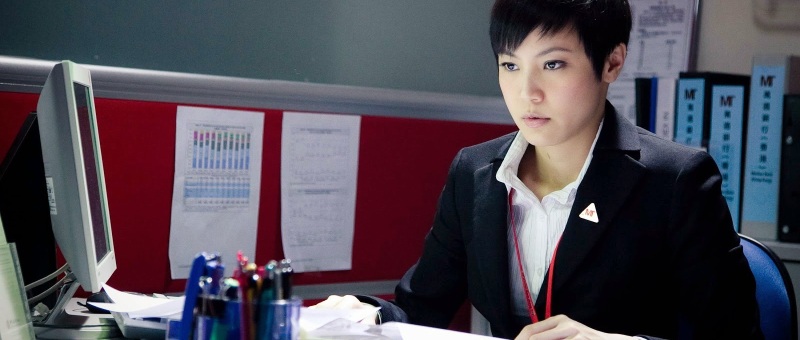
Just before the financial crisis of 2008, bank clerk Teresa (Denise Ho Wan-see) is beginning to fear for her job because she’s stuck at the bottom of the staff sales leader board and her boss doesn’t even bother to tell her off anymore. Under pressure she finds herself misselling a high risk BRIC loan to an older woman seemingly fearful of her declining economic power and hoping to make her savings pay a little more rather than just sitting in the bank doing nothing. Meanwhile Teresa is at the constant beck and call of boorish loanshark Yuen (Lo Hoi-pang) who won’t take out a loan with her because banks just rip you off. “Business is about profit but you have to play fair” he unironically explains handing over a card in case Teresa ever needs a “fair” loan pointing out you’ll pay 35% interest on a credit card but he’ll give you 15% even with bad credit. In any case, he leaves with only half of the 10 million he took out, asking Teresa to deposit the rest and sort the forms out later because he’s in a hurry, only he ends up getting offed in the car park meaning that second five million is in paper limbo. 

Teresa can’t really argue that the bank is morally any better than the loanshark, only that what they’re doing is legally regulated even if she has just broken a series of regulations in talking the old woman into the risky loan because she herself fears a financial crisis in losing her job. Meanwhile in another part of the city, one old man ends up killing another in a property dispute amid the city’s notoriously difficult housing market. The policeman investigating, Cheung (Richie Jen), is ironically called away because his wife, Connie (Myolie Wu Hang-yee), is nagging him about buying a new apartment requiring a one million deposit on a 30-year mortgage. She complains that he’s stubborn and overcautious, but he is at least pretty much the only person showing any kind of prudence in the cutthroat investment world even as he hesitates on learning that his estranged father is at death’s door leaving behind an illegitimate little girl it falls on he and his wife to adopt. 

If Cheung’s caution seems cold, it’s ironically mirrored in the film’s only pure hearted hero, ironic triad parody Panther (Sean Lau Ching-wan) who only cares about old-fashioned ideals like gangster loyalty even if those ideals are often expressed through money. Complimented by a boss for not trying to steal from a wedding collection he nevertheless games the restauranteur but only desires money in order to bail out his gangster friend Wah (Cheung Siu-fai) who is immediately deserted by all his minions who obviously don’t have the same ideas of loyalty as old school Panther. “Loyalty matters most” he insists to an old friend who left the triads to work as a junk collector because you can make more money recycling cardboard than in the contemporary underworld. Even his former sworn brother Lung (Philip Keung Ho-man) has managed to do very well for himself as a legitimate businessman hosting online gambling platforms and playing the stock market. 

Yet as Panther pores over data it becomes obvious that they are all betting on the market remaining the same, blindsided by the advent of the Greek Debt crisis and its devastating destabilisation. They thought they had control, that the decisions they made based on the data they received would remain correct only to realise that they are almost entirely powerless. Teresa fiddles with the jammed lock on her cabinet as she vacillates over whether or not to cash out of the corporate life with the “invisible” money, while Connie reckons with potentially losing her deposit when the already risky mortgage application is turned down, and the old lady is left to face potential financial ruin all alone in the twilight of her life. Then again, fate is fickle. The crisis passes as quickly as it arrived allowing a kind of normality to return but finding the desperate protagonists largely unchanged if perhaps emboldened by the feeling of relief resulting from their accidental lucky escapes from certain ruin. A slick and intricately plotted elliptical thriller, Life Without Principle revels in cosmic ironies but nevertheless holds only scorn for the dubious promises of spiralling consumerism in an increasingly jaded society.


Life Without Principle screens at London’s Prince Charles Cinema on 7th July as part of The Heroic Mission: Johnnie To Retrospective.

Original trailer (English subtitles)