

Ciao UFO (再見UFO, Patrick Leung Pak-Kin, 2019/2026)

“Where will I go in this future?” a young man tearfully asks, unexpectedly cast adrift and handed a future he never expected to have with no one to help him navigate this new reality. Speaking from the perspective of the Handover, his confusion hints at a sense of despair falling over Hong Kong, but also echoes through the contemporary society in a place where, as he later says, nothing stays the same, though that might not necessarily be such a bad thing.

Long delayed for a wider release, Patrick Leung Pak-Kin’s Obayashi-esque drama has a potent sense of nostalgia for a lost Hong Kong of the 80s and 90s, but also a hope that, even if the past cannot be reclaimed and we cannot become who we once were, it is never too late to start again or to choose a new path that leads back to who we were really supposed to be. As children, Heem, Kin, Hoyi, and her unnamed little brother were firm friends living on the Wah Fu estate. The fact that they are no longer in touch reflects a sense of displacement amid the rapid economic growth of that later 20th century in which these kinds of apartment complexes fell out of use leaving communities scattered as the housing market escalated to the extremes of today thanks to rampant property speculation. 

The children see the UFO at moment of extreme emotional despair and it gives them only a temporary respite from the terrors of a more adult world. In the mid-1990s, they have all lost their way. Kin (Chui Tien-you) once said he wanted to be an explorer like his father, but is now working several low-paying jobs such as manning a paper stand, selling vacuum cleaners, and acting as an agent of encroaching modernity by setting up home computers for first-time users. He no longer believes in aliens or the UFO, and though he reconnects with an equally melancholy former schoolmate, keeps her at arms’ length and lacks the courage to fight for what he really wants. Heem (Wong You-nam), whose childhood leukaemia has gone into remission, is working as an extra without much of a plan for the rest of his life, because he never expected to have one. He still believes in the UFO and tries to reconnect with his childhood friends amid the X-Files inspired alien obsessions of the ‘90s.

Hoyi (Charlene Choi), meanwhile, who wanted to be a joker making people laugh has been pushed onto a more conventional path as a professional accountant that appears to be making her unhappy, though she’s unable to escape it. While Kin falls victim to stock market mania and Heem Tamagotchi profiteering before joining his brother’s burgeoning real estate business, Hoyi’s straight and steady path would seem to be the winner, though perhaps there’s not so much need for accountants when everyone’s going bankrupt in the Asian financial crisis just as no has the money to buy apartments, which is something Heem’s brother didn’t seem to consider in thinking himself superior to those who got hooked on the stock market.

Several times the three’s path cross, though they do not meet each other and remain locked on their own melancholy paths. Hoyi’s free spirited “hippie” uncle teaches her a classical song written by an ancient poet that he says is about learning to find beauty in loneliness, perhaps sensing her sense of isolation as she wilfully suppresses herself to be the person that she thinks she’s supposed to be including a potential marriage to a man who’s the polar opposite of her authentic self. Austin (Joey Leung) pulls her back to earth when she’s lost in space, which is another way of saying that he crushes her dreams and desire for happiness by telling her to forget about UFOs and concentrate on being a wife and mother after their wedding.

The UFO then comes to represent a kind of nostalgia and the longing for a lost a past, but within that also finds a sense of hope that what once was can be again. It might not be the same, but it’s still there and it’s not too late to turn around and rediscover that sense of wonder in life. The childhood friends eventually reunite and find new solidarity in their shared experience that makes this new reality a little more bearable, even amid its painfulness and irony. The film ends with Hoyi’s brother (Ng Siu-hin) wearing a mask and telling us that it is April 1, 2003, which is the day that Leslie Cheung died, along with perhaps a certain vision of another Hong Kong, but also hints at the SARS crisis that would strike that year along with the more recent pandemic. Perhaps everything is a cycle, but as they say, the end of one thing is the start of another. They haven’t seen any UFOs for a long time and perhaps won’t ever see one again, but the hope remains, and with it the courage to live in this new future whatever it may hold.


Ciao UFO is in UK cinemas from 15th May courtesy of Central City Media.

Trailer (English subtitles)
Life Without Principle (奪命金, Johnnie To, 2011)

A financial earthquake destabilises the ordinary lives of a series of Hong Kongers in Johnnie To’s circular thriller, Life Without Principle (奪命金). As one character puts it, greed is human and everyone always seems to want more but even a little is out of the reach of many and so perhaps their desire is understandable in a world in which a loan shark can lord it over the bank who are in essence little better than he is in exploiting their customers by charging them extortionate fees yet failing to protect their investments. 

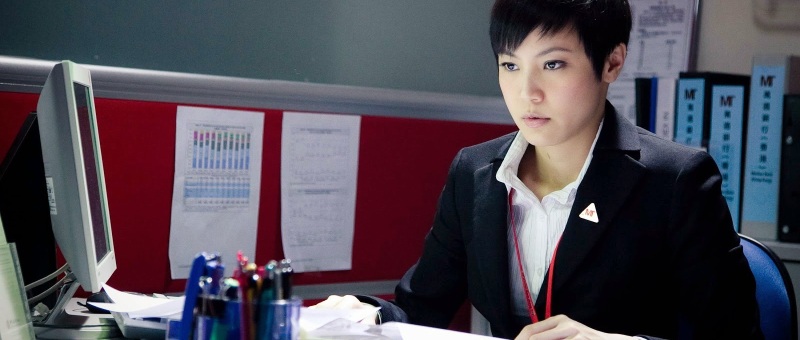
Just before the financial crisis of 2008, bank clerk Teresa (Denise Ho Wan-see) is beginning to fear for her job because she’s stuck at the bottom of the staff sales leader board and her boss doesn’t even bother to tell her off anymore. Under pressure she finds herself misselling a high risk BRIC loan to an older woman seemingly fearful of her declining economic power and hoping to make her savings pay a little more rather than just sitting in the bank doing nothing. Meanwhile Teresa is at the constant beck and call of boorish loanshark Yuen (Lo Hoi-pang) who won’t take out a loan with her because banks just rip you off. “Business is about profit but you have to play fair” he unironically explains handing over a card in case Teresa ever needs a “fair” loan pointing out you’ll pay 35% interest on a credit card but he’ll give you 15% even with bad credit. In any case, he leaves with only half of the 10 million he took out, asking Teresa to deposit the rest and sort the forms out later because he’s in a hurry, only he ends up getting offed in the car park meaning that second five million is in paper limbo. 

Teresa can’t really argue that the bank is morally any better than the loanshark, only that what they’re doing is legally regulated even if she has just broken a series of regulations in talking the old woman into the risky loan because she herself fears a financial crisis in losing her job. Meanwhile in another part of the city, one old man ends up killing another in a property dispute amid the city’s notoriously difficult housing market. The policeman investigating, Cheung (Richie Jen), is ironically called away because his wife, Connie (Myolie Wu Hang-yee), is nagging him about buying a new apartment requiring a one million deposit on a 30-year mortgage. She complains that he’s stubborn and overcautious, but he is at least pretty much the only person showing any kind of prudence in the cutthroat investment world even as he hesitates on learning that his estranged father is at death’s door leaving behind an illegitimate little girl it falls on he and his wife to adopt. 

If Cheung’s caution seems cold, it’s ironically mirrored in the film’s only pure hearted hero, ironic triad parody Panther (Sean Lau Ching-wan) who only cares about old-fashioned ideals like gangster loyalty even if those ideals are often expressed through money. Complimented by a boss for not trying to steal from a wedding collection he nevertheless games the restauranteur but only desires money in order to bail out his gangster friend Wah (Cheung Siu-fai) who is immediately deserted by all his minions who obviously don’t have the same ideas of loyalty as old school Panther. “Loyalty matters most” he insists to an old friend who left the triads to work as a junk collector because you can make more money recycling cardboard than in the contemporary underworld. Even his former sworn brother Lung (Philip Keung Ho-man) has managed to do very well for himself as a legitimate businessman hosting online gambling platforms and playing the stock market. 

Yet as Panther pores over data it becomes obvious that they are all betting on the market remaining the same, blindsided by the advent of the Greek Debt crisis and its devastating destabilisation. They thought they had control, that the decisions they made based on the data they received would remain correct only to realise that they are almost entirely powerless. Teresa fiddles with the jammed lock on her cabinet as she vacillates over whether or not to cash out of the corporate life with the “invisible” money, while Connie reckons with potentially losing her deposit when the already risky mortgage application is turned down, and the old lady is left to face potential financial ruin all alone in the twilight of her life. Then again, fate is fickle. The crisis passes as quickly as it arrived allowing a kind of normality to return but finding the desperate protagonists largely unchanged if perhaps emboldened by the feeling of relief resulting from their accidental lucky escapes from certain ruin. A slick and intricately plotted elliptical thriller, Life Without Principle revels in cosmic ironies but nevertheless holds only scorn for the dubious promises of spiralling consumerism in an increasingly jaded society.


Life Without Principle screens at London’s Prince Charles Cinema on 7th July as part of The Heroic Mission: Johnnie To Retrospective.

Original trailer (English subtitles)

Gallants (打擂台, Derek Kwok & Clement Cheng, 2010)

Gallants PosterLike the master at the centre of Derek Kwok and Clement Cheng’s Gallants (打擂台), old school martial arts movies have been in a deep sleep since their Shaw Brothers heyday. Drawing inspiration from the kung fu films of old, Gallants is a tale of buried heroism suddenly reawakening and the risks of writing off veteran challengers just because of their age. It’s also a tribute to those perhaps more innocent times and, in contrast to a prevailing trend, a true Hong Kong film filled with typically Cantonese (sometimes untranslatable humour) and meta references to the area’s long cinematic history.

For a brief moment in his childhood, Cheung (Wong You-nam) was the unbeatable superhero who never lost a fight. These days, he’s a nerdy loser who sometimes hides under his desk to escape his angry boss. Despatched by the shady real estate company he works for, Cheung is sent back to his rural hometown entrusted with the mission of convincing the local population to surrender their homes so the developers can build a large scale complex. Whilst there he gets attacked by local punks only to be saved by an old guy who has immense kung fu skills.

The old guy turns out to be one of two living in a ramshackle tea house that used to be a martial arts studio. Tiger (Leung Siu-lung) and Dragon (Chen Kuan-tai) turned the Gate of Law into a teahouse to make ends meet while their legendary sifu, Master Law (Teddy Robin), has been in a coma for the last 30 years. When a fight breaks out and the old guys get to strut their stuff against a local kingpin, Cheung decides to petition them to take him on as a pupil. In a classic case of bad timing, Cheung is around when the teahouse is raided again and someone attacks Master Law causing him to wake up and act as if the last 30 years never happened. He thinks Cheung is both of his young pupils, Tiger and Dragon, in one and that the real 30 years older versions of Tiger and Dragon are some random old guys Cheung has agreed to train out of pity.

If you don’t fight, you won’t lose quips Law, but if you fight you have to win. Like any good martial movie, Gallants is more about the journey than the destination. Rather than focussing solely on Cheung who experiences several conflicts of the heart when he realises that his adversary is the childhood friend he used to bully and that he was technically on the wrong side to begin with, Kwok and Cheng broaden the canvas to allow Tiger, Dragon, and Law to take centre stage. Still skilled martial artists, the guys give it their all in the knowledge that they’ll have to work far harder now that they aren’t as agile as they once were. Still, they have the true spirit of kung fu and resolve to keep getting back up each time they’re knocked down.

This oddly defeatist attitude which presupposes humiliation but insists on perseverance gives the film much of its warmhearted, ironic tone as the hapless martial arts heroes repeatedly fail yet refuse to back down. The other source of comedy lies in the hilarious performance of the tiny Teddy Robin as the supposedly all powerful Law. Law, as it turns out, is a wisecracking lecher who sets about flirting with just about every young girl he lays eyes on before decamping to a hostess bar and asking for the ladies from 30 years ago. Former starlet Susan Shaw makes an amusing cameo as the long suffering, lovelorn doctor apparently in love with Law since their youth who has continued to care for him throughout his illness but is entirely forgotten when Law wakes up in full on sleaze mode.

Bizarre gags including one about a missing preserved duck, jostle with impressive action sequences performed by two veterans proving they’ve still got what it takes all these years later. The aesthetic is pure ‘70s Shaw Brothers complete with speedy zooms and whip pans accompanied by an overly dramatic score, lovingly echoing the classic kung fu era rather than trying to attack it through parody. As funny as it all is, and it is, Gallants is also surprisingly warmhearted as it finds space to value the skills of its elderly protagonists as well as the enduring bonds of friendship which connect them.


Screened at Creative Visions: Hong Kong Cinema 1997 – 2017

Original trailer (English subtitles)