Undercurrent (アンダーカレント, Rikiya Imaizumi, 2023)

Part way through Rikiya Imaizumi’s adaptation of the Testuyua Toyoda manga Undercurrent (アンダーカレント) a detective asks his client what she thinks it means to “understand” someone. Of course, she doesn’t really have an answer, and the film seems to suggest there isn’t one because we are forever strangers to ourselves let alone anyone else. We do things without knowing why or that somehow surprise us, while the actions of others can an also be be worryingly opaque. But then perhaps you don’t really need to “know” someone in order to “understand” them and as someone else later says perhaps it’s true enough that most people don’t really want the truth but a comforting illusion. 

But then Kanae’s (Yoko Maki) illusions aren’t exactly comforting. Her husband of four years Satoru (Eita Nagayama) suddenly disappeared during a work trip a year previously and has not been heard from since. She turns the television off when the news announces details of a decomposing body discovered near a set of electrical pylons, but on another level she’s sure that Satoru is alive and chose to leave her for reasons she can’t understand. Kanae tells a friend that what pains her most is thinking that in the end she wasn’t a person Satoru felt he could share his worries with so she was powerless to help him. Then again, there’s something in Kanae that is equally closed off, a little distant and otherworldly as if she were also putting up a front to keep her true self submerged.

The detective (Lily Franky), whose name is “Yamasaki” yet allows people call him “Yamazaki” because it’s easier for them, says of Satoru that his “cheerful,” ever smiling nature may also have been a kind of masking designed to dissuade people from looking any deeper. Someone else admits that they lied mostly to fit in, be what others wanted them to be, only to be caught out by the gulf between their genuine feelings and and the ever expanding web of their lies. Caught in a kind of suspended animation uncertain if Satoru will ever return and if and how she should continue with her life, Kanae ends up taking in a new assistant at her family bathhouse. Hori (Arata Iura) is the polar opposite of the way her husband is described, silent, soulful and somehow sad. We might be suspicious of him, his arrival seems too coincidental and the way he looks at some children running past in the town perhaps worrying. Yet how can we judge based only on his silence knowing nothing else of his history? Nevertheless, he may understand Kanae much better than anyone would suspect and may be the comforting presence from her recurring nightmares.

In her dreams, she’s plunged into water with a pair of hands around her neck. Unknowingly, Hori asks her if she’s ever really wanted to die and she can’t answer him even if it seems to us that the dreams reflect her desire for death, to be submerged in a sea of forgetfulness. Yet we later learn they come to have another meaning reflecting her long buried trauma and the reason for her own listlessness. These are the undercurrents that run silently through her, waves of guilt and grief that obscure all else. Disappearances have happened around her all life and seem only to increase, another bath house owner seemingly disappearing after a fire having promised to sell her his boiler. Yet through her experiences, she comes to fear them less reflecting that anyone could leave at any moment and that’s alright, as Hori had said nothing’s really forever. 

Even so, she regrets that there couldn’t have been more emotional honesty from the beginning then perhaps no one would need to disappear without a word. Confessions are made and the air is cleared. Someone had said that no one wanted the truth, but it seems Kanae has chosen it as perhaps symbolised in her decision to call Yamasaki by his actual name rather than the one he allows people to use because it’s too much trouble to correct them. Aside from his multiple names, Yamasaki is a strange man who holds meetings in karaoke boxes and theme parks though perhaps because he simply thinks Kanae could use a little cheering up. In more ways than one, it’s the ones left behind who are left in the dark, but they may be able to find their way out of it with a little more light and reflection.


Screened as part of this year’s Japan Foundation Touring Film Programme.

Original trailer (English subtitles)
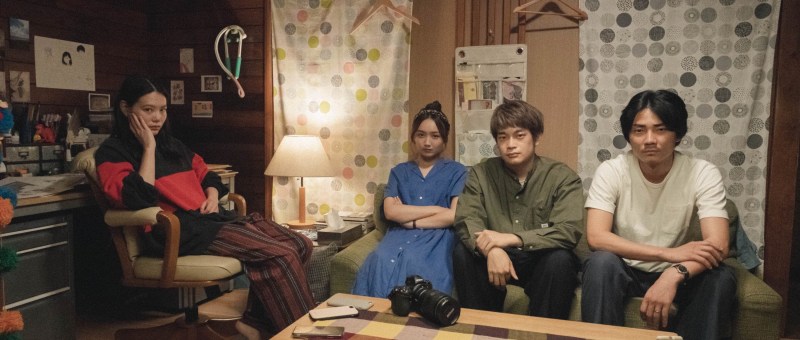
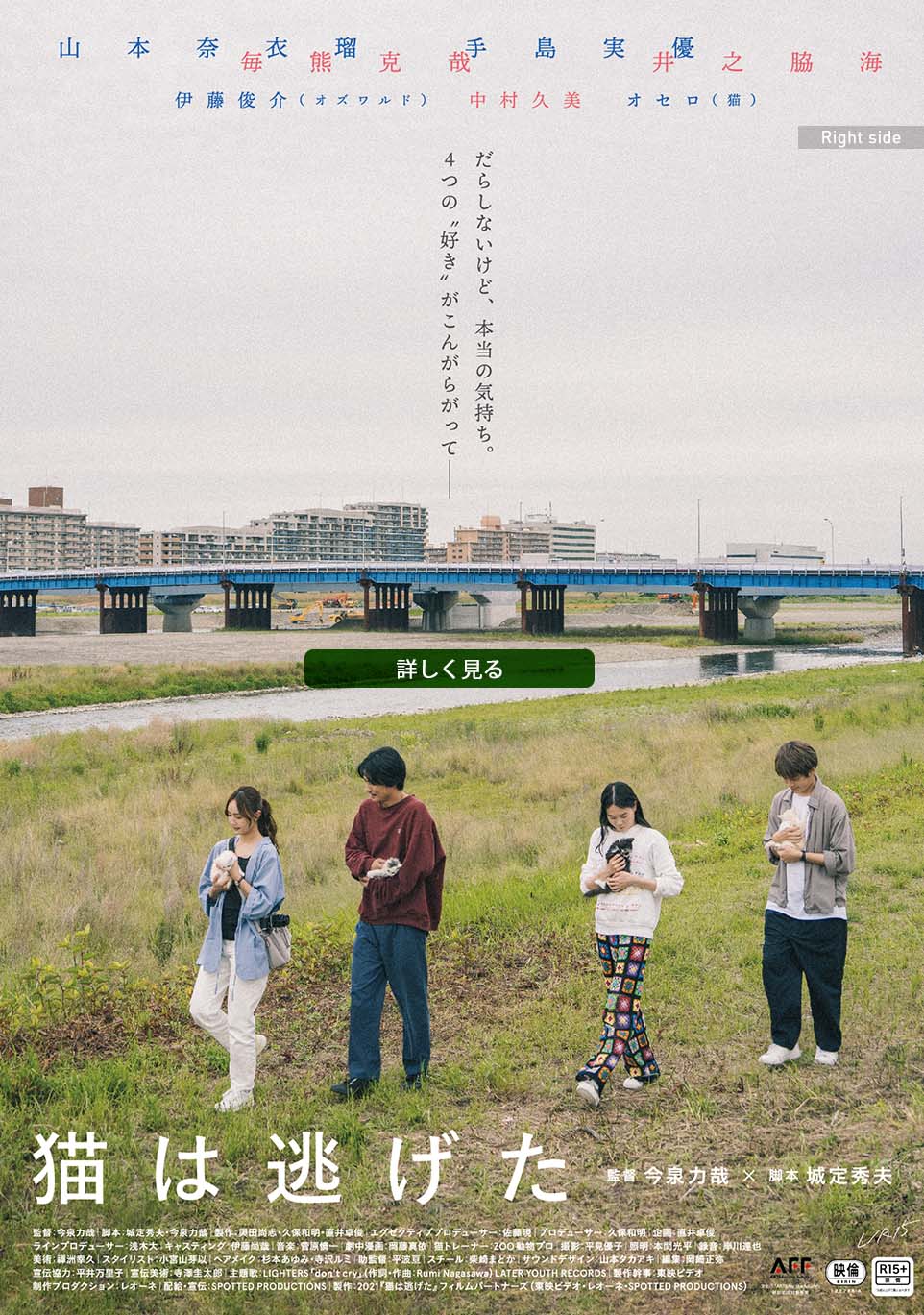
Straying (猫は逃げた, Rikiya Imaizumi, 2021)

Part way through Rikiya Imaizumi’s Straying (猫は逃げた, Neko wa Nigeta), a tabloid reporter and the photographer with whom he’s been having an affair attend a screening of a pretentious film made by a hypocritical director exploring why a once loving relationship between husband and wife broke down. His reasoning may not be all that sound in the end, but does perhaps hint at something of the malaise which has invaded the relationship between Hiro (Katsuya Maiguma) and his wife of five years Ako (Nairu Yamamoto). Now on the brink of divorce, the couple have hit a stumbling block in the inability to agree who gets custody of their beloved cat, Kenta. 

Kenta may not be all that happy about the separation either, peeing all over the divorce papers which only Ako has so far stamped. Hiro suggests that they’re going about it in the wrong order, that the papers should have been the final step once they’d sorted out dividing their property and finding alternative living spaces but he is perhaps a little reluctant as his determination to hang on to Kanta implies. A kitten they found together in the street in the midst of a pregnancy scare, Kanta is a symbol of their love and the hopes they had for it in the beginning. When he suddenly disappears, it sends each of the couple into a tailspin trying to find him which is also an attempt to recapture their lost love. 

Yet we can see that the marriage has failed in part because of dissatisfaction in either on side. As he later admits, Hiro was always insecure in the relationship and had been planning to run out on Ako after hearing about the possible pregnancy while overcome with paternal anxiety. He once dreamed of being a novelist and hates himself for his morally dubious job as a tabloid journalist exposing the sordid secrets of the rich and famous, yet he does the job in part because he feels emasculated by Ako’s success as a manga artist and cannot bear the idea of being supported by his wife. For her part, Ako declares that she’s bored with eroticism while working on an erotic manga for a publishing company specialising in sexually explicit series aimed at a female audience. When she says she’s thinking of writing a cat manga, like the much loved Gugu the Cat, it suggests that what she wants is love rather than sex but she’s also begun a revenge affair with her besotted editor Matsuyama (Kai Inowaki) little realising that she’s toying with his feelings. 

Like Matsuyama, Hiro’s girlfriend Mamiko (Miyuu Teshima) is more emotionally involved in the relationship than Hiro is though he sadly tells her he loves her and has superficially committed to leaving his wife. Mamiko also has a habit of eating Haribo at every opportunity which hints at her childish nature, though as is later revealed she’s surprisingly conservative for her age coldly telling Ako in a final confrontation that wives are responsible for their husband’s affairs while insisting Ako let Hiro go because she wants to become a traditional homemaker cooking and cleaning for him. She was also offended by the film because of its anti-marriage stance all which fuels her desire to unmask the “devoted familyman” director as just another industry sleazeball. Yet evidently the last thing Hiro wants is marriage because if that’s what he wanted he wouldn’t be getting a divorce. It’s no surprise that he put his foot down over getting Kanta neutered, insisting he be free to sow wild oats wherever he sees fit which is apparently with next-door’s cat Mimi who becomes an accidental victim of his sudden disappearance. 

Yet sometimes straying only shows you the way home as the central couple awkwardly discover, brought closer together by the search for Kanta while forced to face the realities of their frustrated desires each emerging on a more authentic note and resolving to chase their individual dreams. The second film in the L/R15 project of contemporary sex comedies, Straying is scripted by Hideo Jojo who directed Imaizumi’s script for Love Nonetheless and in its ironic conclusion is perhaps less cynical than it might seem in hinting at new beginnings founded less on forgiveness than acceptance of life’s imperfections. 


Straying screened as part of this year’s Camera Japan

Original trailer (no subtitles)

Skeleton Flowers (かそけきサンカヨウ, Rikiya Imaizumi, 2021)

The increasingly prolific Rikiya Imaizumi has become most closely associated with zeitgeisty youth romance accurately capturing the fears and anxieties of 20-somethings in contemporary Japan but brings his characteristically mellow touch to the classic coming-of-age tale in adapting Misumi Kubo’s short story Skeleton Flowers (かそけきサンカヨウ, Kasokeki Sankayo). In contrast to the gloominess of the title, teenage angst is never where you’d expect it to be as the variously pre-occupied pair at the film’s centre strive to deal with their problems with maturity and mutual compassion. 

You might for instance expect Yo (Sara Shida) who has been raised by her father, Nao (Arata Iura), since her mother left the family when she was three to feel jealousy or resentment when he sits her down and tells her that he’s fallen in love and wants to get married, especially as the woman he’s fallen in love with, Yoshiko (Akiko Kikuchi), has a small daughter of her own, Hinako. Attempting to be sensitive, Nao frames the new arrangement in a positive light in that Yo will be have more free time to be a regular teen and hang out with her friends rather than skipping out on after school clubs to take care of the household chores, a spin which could backfire in that Yo has obviously been used to being the lady of the house and might feel as if a responsibility she was proud of carrying is being taken away from her or that she’s being displaced by the new maternal presence of Yoshiko. She may in fact feel a little of this, but rather than lashing out or rebelling against the change in her familial circumstances she does her best to accept it with good grace while simultaneously prompted into a reconsideration of the relationships between parent and child meditating on the absence of her birth mother and wondering how and why she could have come to leave her behind. 

Riku (Oji Suzuka), her sometime love interest, had started a discussion in their friendship group about their earliest memories Yo unable to come up with anything on the spot but later remembering her mother carrying her into the forest and showing her the skeleton flowers of the title which appear bright white when dry but gradually become transparent as they absorb water. Later she remembers something else unsure if it’s a memory or a dream, a feeling of being suspended in mid-air as her parents argued as if everyone had forgotten she existed. Riku too frequently states that he’s “nothing at all”, feeling himself lost and directionless after being diagnosed with a heart condition later forced to accept that his life will never be the same as it was and his choices are now limited in ways they might not have been before. His health anxiety ironically leaves him emotionally numb, unable to identify let alone express his feelings as he becomes close not only to Yo but another, much more direct, girl in his class Saki (Tomo Nakai) who later does him the favour of explaining exactly what his problems are hoping to jolt him out of his emotional inertia while taking him to task for having been unintentionally condescending in his innate kindness. 

It’s this innate kindness that eventually sees both the teens through, each approaching their various worries with a mature compassion. Riku had felt uncomfortable in his familial home and jealous of Yo’s “real family” as she comes to accept her new relationships with Yoshiko and Hinako, but himself comes to understand the complicated relationship between his overbearing grandmother and lonely mother as one of mutual support getting another tip from Yoshiko that even if he feels has no particular talents, also jealous of Yo’s artistic prowess, his ability to support those around him is a talent in itself and an important part of the whole. A robust emotional honesty and the willingness to think things through calmly eventually lead stronger bonds between all concerned, Yo forgiving her birth mother while also embracing a new maternal relationship with Yoshiko, while Riku gains a new perspective of his own and even if he still hasn’t quite learned to identify his feelings is more comfortable with expressing them directly. A gentle, empathetic coming-of-age tale Imaizumi’s teenage drama roots itself in a world of fairness and compassion that allows each of the teens the space to figure themselves out while helping others to do the same no longer transparent in the rain but whole and fully visible not least to themselves. 


Skeleton Flowers streams in the US until March 27 as part of the 14th season of Asian Pop-up Cinema

Original trailer (English subtitles)

his (Rikiya Imaizumi, 2020)

Though Japanese society is often regarded as comparatively liberal, that liberality can sometimes reflect a superficial politeness and respect of discretion more than true acceptance. Though several prefectures have now made local provision for same sex unions, Japan lacks a basic anti-discrimination law at the national level protecting the rights of LGBTQ+ people and has often been slow to accommodate social change especially when it comes to the organisation of the family unit. The journey of the two men at the centre of Rikiya Imaizumi’s his, a sequel to the TV drama of the same name set some years earlier, perhaps travels at a rapid pace from internalised homophobia to the acceptance of identity and foundation of a home but mirrors the path of society at large as it edges its way towards the truly liberal in which all are free to live in the way they choose. 

Beginning with an ending, Imaizumi opens in the “past” as Shun (Hio Miyazawa), now an isolated young man living alone in the country, dwells on ancient heartbreak as his first love Nagisa (Kisetsu Fujiwara) abruptly breaks up with him as they prepare to graduate from university. We subsequently discover that Shun got a regular salaryman job but remained in the closet only for rumours to circulate around him at work forcing him to endure the casual homophobia of his co-workers at the compulsory nomikai all the while denying his true identity. This seems to be the reason that he’s taken up the offer of cheap rural housing designed to bring the young back to the depopulated countryside and has been largely keeping himself to himself, growing his own produce and deliberately keeping the locals at arms’ length. All that starts to change, however, when Nagisa suddenly turns up on his doorstep with his six-year-old daughter Sora (Sakura Sotomura) in tow. 

Though not exactly overjoyed, Shun allows the pair to stay but remains conflicted unsure what it is Nagisa wants from him and also fearful of his new life being derailed should the local community discover what it is that he’s so obviously in hiding from. Nagisa, meanwhile, apparently broke up with him for the same reasons, afraid to continue into his adult life as an openly gay man eventually travelling to Australia where he drifted into a relationship with a Japanese woman, Rena (Wakana Matsumoto), working as an interpreter with whom he later conceived a child and formed a conventional family. Struggling with himself he tried to maintain the facade through casual relationships with men, but discovered that he couldn’t make it work and unlike Shun decided the only way out of his predicament was to embrace his sexuality and attempt to live a more authentic life with the man he never stopped loving. 

Having pursued contradictory solutions to the same problem, the two men find themselves still in some senses at odds even as they reunite in their obvious love for each other. Nagisa envisages for them a family life raising Sora together and with the help of his sympathetic, supportive lawyer intends to have his conviction vindicated by a verdict in law but his former wife, while not openly hostile if obviously hurt and feeling humiliated in having been deceived, wishes to retain custody of her daughter even though she was not the primary caregiver. The court battle opens a veritable can of worms in a fiercely patriarchal, conformist society, Nagisa’s lawyer reminding him that he has an uphill battle because society inherently believes that women are better suited to childrearing. Rena’s lawyer throws the homophobic book at them, describing the relationship between the two men as “eccentric”, implying it cannot be other than harmful to Sora not least because of the bullying and social stigma she may face as a daughter raised by two fathers. Even the judge agrees that the situation is “not exactly normal”, though in this he may have a point in the fact that Nagisa had been a househusband and his wife the breadwinner, still an extraordinarily unusual family setup in a society in which women are expected to shoulder the domestic burden sacrificing their careers in the process. 

Indeed, it’s this same paradox that Nagisa’s female lawyer eventually throws back at Rena, that she cannot claim to adequately care for her daughter while working especially as she is a freelancer whose hours are often unpredictable. Rena had been reluctant to involve her family because of the shame of admitting her marriage has failed and for the reason it has but is later forced to ask her mother for childcare assistance only to receive a curt “I told you so” which speaks volumes as to the quality of their relationship. Meeting in a coffeeshop Rena looks at her mother looking askance with mild though unvoiced disgust at two men holding hands, reflecting both on her unforgiving austerity and her relationship with her granddaughter. The two women obviously differ when it comes to childrearing philosophy, Rena not wanting her daughter to suffer in the same way she has suffered because of her mother’s unforgiving conservatism and is extremely worried on being called to the school and told that Sora, who had previously been so cheerful and outgoing, has become sullen and withdrawn. 

Yet Sora is perhaps the force which allows each of her parents to accept themselves for who they are and embrace their true identities. Worried that she might be a burden to her mother who often drinks and appears to resent her for interfering with her work, Sora wonders why everyone can’t just get along and live together happily. She sees nothing “weird” in her father’s new relationship, though perhaps fails to understand why the four of them might not be able to live together as a family. Supported by Sora, Shun begins accept himself for himself, eventually coming out to the community and finding them entirely unbothered by his revelation bearing out the commonly held belief that small rural communities are often far more liberal than the famously conservative capital. Filled with a sense of love and mutual support, his presents a perhaps idealistic view of the modern society but an infinitely hopeful one as the three adults resolve to be kinder to themselves and others as they move forward together into a happier, more authentic existence. 


his streamed as part of the 2021 Japan Foundation Touring Film Programme.

Original trailer (English subtitles)
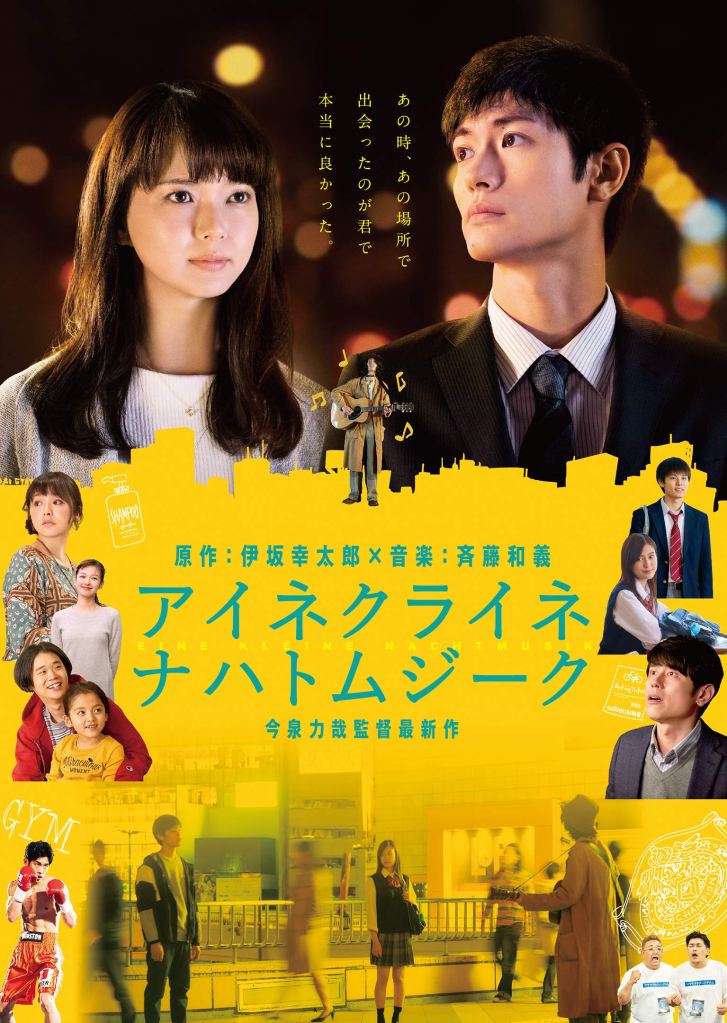
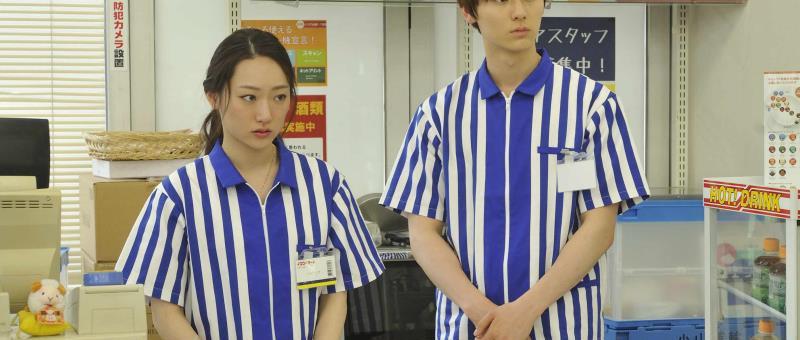
Little Nights, Little Love (アイネクライネナハトムジーク, Rikiya Imaizumi, 2019)

What is love? Is it an accident, cosmic destiny, or something that finally you have to choose? The romantically inclined hero of Little Nights, Little Love (アイネクライネナハトムジーク, Eine Kleine Nachtmusik) is convinced that romance is something that happens to you at an unexpected moment, but his friends worry that he’s letting life pass him by because of his bashful passivity. While the city is gripped by the upcoming world heavyweight boxing championship which might finally result in a Japanese underdog raising the belt, its citizens gain the courage to fight for love, but discover that love is less victory than mutual concession. 

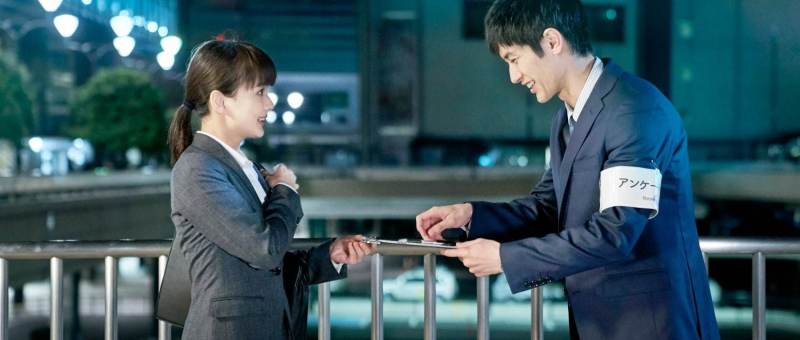
Sato (Haruma Miura), a hopelessly romantic salaryman, is forced to stand outside the station in the centre of Sendai conducting public surveys to make up the data that was lost when he accidentally spilt coffee on his colleague’s computer. Naturally shy, he’s not an ideal fit for the job but serendipitously bonds with a young woman, Saki (Mikako Tabe), when they are both captivated by the soulful song of a street musician. She agrees to fill in his form, and he notices she has “shampoo” written on her hand. He thinks it might be a sign, but she’s gone before he can do much about it. 

Sato’s college buddies Yumi (Erika Mori) and Kazuma (Yuma Yamoto), married young in a shotgun wedding but seemingly blissfully happy and parents to two adorable children, are quick to tell him that his romantic desire for serendipitous love is just thinly veiled cowardice and his essential passivity, refusing to put himself out there, is the reason he’ll end up alone. Meanwhile, Yumi is also trying to support her longterm single sister, Minako (Shihori Kanjiya), who is in a strange “relationship” with the younger brother of a client at her hairdressing salon. Despite talking regularly on the phone, he seems reluctant to meet because his job keeps him very busy which leaves her feeling confused and suspicious. 

Yumi and Kazuma think they ended up together out of necessity, but that necessity was in its own way chance. Secretly, Kazuma might wonder what might have happened if he’d been careless with some other girl, but has come to the conclusion that he’s glad it was Yumi and not someone else. Sato’s colleague Fujima (Taizo Harada), meanwhile, thought he had a cheerily romantic origin story for his relationship – a classic dropped wallet meet cute of the kind Kazuma insisted only happens in the movies, but now nearing 40 his wife has left him and the failure of his marriage has provoked a nervous breakdown. Sato asks him if he’s still glad it was his wife who dropped her wallet and not someone else, and if she’s glad that it was him who picked it up. Not only can he not quite answer, he doesn’t quite want to know. 

Meanwhile, Minako discovers that her diffident lover has decided to stake his romantic future on the championship match, that if the Japanese challenger wins he’ll finally have the courage to speak his heart. Minako is angry and disappointed, infuriated that he has so little courage that he has to vicariously channel the power of someone else to confess his feelings, but is as glued to the match as everyone else. 10 years on, the same thing happens again. Yumi and Kazuma’s daughter, Mio (Yuri Tsunematsu), is now a rebellious teen fed up with her father’s perpetually easygoing attitude and infuriated by a school friend, Kurume (Riku Hagiwara), who also pins his romantic hopes on the boxing match while inwardly resenting his overly spineless father (Yurei Yanagi) for becoming a mere cog in the great machine of capitalism. His refreshingly honest mother (Mari Hamada), however, reminds him that everyone thinks that when they’re 17 but really there’s no life without compromise and cogs at least have their place in keeping the wheels turning. Kurume finds this out by chance when his dad is able to save him from a sticky situation using classically meek, salaryman-style strategy. 

Perhaps what Kurume resents is the sense of impending powerlessness that comes of being a teenager squaring off against the salaryman straightjacket even if he’s still too diffident to put up much resistance. Meanwhile, the reverse is also true. The youngsters bond while staking out a bicycle parking garage to look for a thief who stole Mio’s 60 yen parking sticker and put it on his own bike, leaving her with the fine. They discover it’s an old man who wastes no time in yelling at the young whippersnappers while kicking off against his sense of impotence by gaming the system over a measly 60 yen he could have easily paid. The same thing happens again at Mio’s part-time job where a horrible old man decides to take out his frustrations with his place in the world on an innocent teenage girl. 

10 years earlier, Sato had saved a boy with hearing problems from being beaten up by bullying classmates, giving him new strength by introducing him to Japan’s boxing champ. The inevitable, however, happens, and even champion boxers have feet of clay. Things don’t always go to plan, or perhaps they do but that only makes you wonder if you’re really on the right path or merely settling for that of least resistance. The street singer’s song asks if you’re happy where you’ve ended up or if you still want more than ordinary happiness. Sato, still diffident, has to admit that perhaps he isn’t sure, while Saki does something much the same in wondering if they’re only still together out of habit and a misplaced belief in the narrative destiny of their serendipitous meeting. Another championship match sees them all ready for the fight once again, encouraged by the embattled boxer’s refusal to give-up on his fighting dreams, but perhaps still waiting for a “sign”. What Sato learns, however, is that they don’t always arrive quite as serendipitously as one might might think. “It builds up” Fujima warns him, waking up to the fact that his wife likely left him after years of small microagressions that killed their love through taking it for granted. But love can build up too, if only you build up the courage to fight for it with a willingness to be honest with your feelings, and what’s life if not lots of little nights filled with lots of little love, no grand romance but maybe not so bad after all. 


Screened as part of the Japan Foundation Touring Film Programme 2020.

International trailer (English subtitles)
The song – Chiisana Yoru by Kazuyoshi Saito

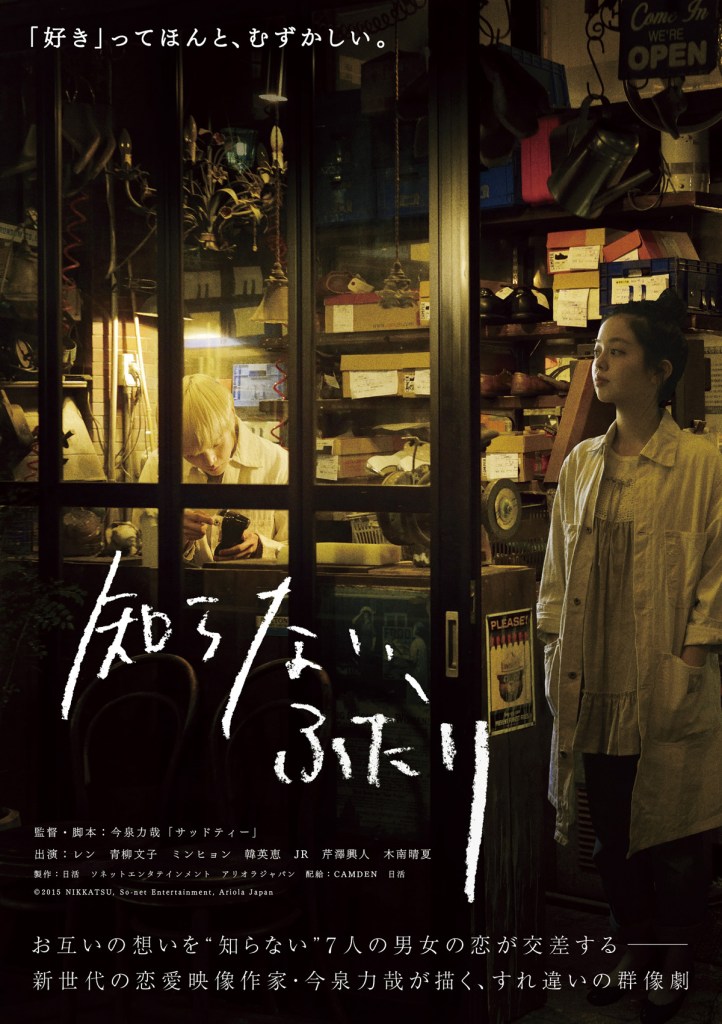
Their Distance (知らない、ふたり, Rikiya Imaizumi, 2015)

Their DistanceAh young love! So beautiful, so complicated, so retrospectively trivial. Intrigue engulfs a group of young Koreans living in Japan, their co-workers, and even their English teacher and her fiancee in Rikiya Imaizumi’s indie youth meets boyband quirky romance movie, Their Distance (知らない、ふたり, Shiranai Futari). The aptly named picture paints a vista of misdirected love, miscommunication and misjudged honesty to show how messy romance can be even when it’s intent on being cute.

The hub of the story is a small shoe repair store where Korean migrant Leon (Ren) is an apprentice. Having been involved in a traumatic incident two years previously which has left him with a huge amount of personal guilt, he’s entirely cut himself off from human interaction of any kind, leaving the store each lunchtime to eat alone and miserably on a solitary bench surrounded by concrete. Despite this, one of his Japanese colleagues, Kokaze (Fumiko Aoyagi) has developed a crush on him and is patiently waiting for him to decide it’s OK to be happy again.

Events are set in motion when he finds fellow Korean Suna (Hanae Kan) asleep on his favourite bench after a night of binge drinking to forget her troubles with boyfriend Ji-woo (JR) who’s developed a thing for his English teacher, Kanako (Haruka Kinami). Kanako, as well as being a little older, has a fiancé already, Awakawa (Tateto Serizawa), who happens to be in a wheelchair following an accident, before which he had also been cheating on her. The two Koreans are also joined by a third who works with Suna at her part-time job at a convenience store, Sangsoo (Min-hyun). Sangsoo ends up in the shoe repair store where he falls for Kokaze, completing our love…heptagon?

This is all very complicated already. Ji-woo decides to unburden himself by revealing his feelings for his teacher to Suna even though he doesn’t actually want to break up with her and the teacher turns him down for a number of very sensible reasons. His case of (probably selfish) extreme honesty sends Suna into a bout of drunken confusion during which she meets Leon and becomes semi-attached to him despite not being able to remember much about him because she was pretty much out of it the whole time.

Flitting between the innocence of a hand written love letter to quasi-stalking, and even a third layer of stalking the stalker, Their Distance has an oddly schizophrenic tone which darts between quirky comedy and serious drama without much consistency. The most interesting plot thread concerns Kanako and her fiance´ who are both a little older and ought to know what they’re doing but only seem to confuse and mislead each other even when they’re making a point of mutual honesty. Neither can be sure of why the other is still in the relationship and if the true love partner is the wheelchair itself – did she stay because she didn’t want to leave a disabled man (even though he’d been cheating on her before the accident), or did he stay with her because now he’s in the wheelchair he thinks he won’t find anyone else? Arawaka gives Kanako an out by offering to separate so she can pursue her dreams of living abroad and travelling the world but refuses to say one way or the other what his true feelings about the marriage are causing more than a little emotional confusion for the put-upon Kanako who is also getting drawn into the maelstrom of her students’ romantic problems.

Ji-woo treats Suna in a similar way by revealing his growing feelings for Kanako yet leaving all the decisions entirely in her hands. He claims he’s doing the right thing by being “honest” but actually he’s being a coward by refusing to choose (and anyway, seeing as the teacher turned him down there’s no real reason to tell her). This kind of childishness is almost forgivable in the younger guys who, after all, are still inexperienced, but in a man of Arakawa’s age, diffidence is far from an attractive quality.

Imaizumi has three members of top Korean boy band NU’EST as his gang of Korean émigrés and has half an eye on cute idol drama with the other half pointed firmly at the indie/arthouse scene. Though the performances are strong across the board, Imaizumi never quite manages to reconcile these two distinct forms and his detached, almost ironic tone may not hit home with an audience primed for pop star drama. Ultimately, Their Distance has relatively little to say, its message is very slight indeed, and it takes an awful long time to deliver. However, Imaizumi’s observations about romance through the ages have a universal and timeless quality which along with the mild humour and generosity of spirit on show make Their Distance worth the journey, though not perhaps the fare.


Their Distance is actually available now in the UK and other regions from Nikkatsu via iTunes either as an enhanced iOS app or as a regular video from the store (where it has subtitles in English, French, Spanish, and Portuguese).  You can apparently rent it on Nikkatsu’s YouTube channel as well as Google Play and Vimeo (click the link to the YouTube page in the video below for a full collection of subtitle/territory specific links for each of the platforms).