Party 7 (Katsuhito Ishii, 2000)

“This shit’s for real.” according to the front desk guy at Hotel New Mexico, an out of the way spot just perfect for those looking to lay low for a little while. Like a lot of Katsuhito Ishii’s work, Party 7 is essentially a series of self-contained vignettes which eventually collide following a series of bizarre coincidences revolving around some money stolen from the mob, a two-way mirror in a regular hotel room, and the receptionist’s tendency to almost literally shoot the shit. 

Following a brief prologue, Ishii opens with striking animated sequence which introduces each of the main players with an arcade game aesthetic and explains that Miki (Masatoshi Nagase) has stolen money from the mob and is currently on the run which is why he’s turned up at the infinitely weird Hotel New Mexico. The running gag is that Miki thinks he’s holed up somewhere no one will find him, but sure enough a series of “friends” soon turn up in part thanks to a loose-lipped travel agent. The fact that people can find it so easily dampens the impression of the Hotel New Mexico as some kind of interstitial space. It’s not so much existing in a weird parallel world as a bit run down and staffed by a series of eccentrics. It does however have a “peep room” hidden behind a two-way mirror where “Captain Banana” (Yoshio Harada) is attempting to pass his knowledge on to the young Okita (Tadanobu Asano), the son of a recently deceased friend who has been repeatedly arrested for voyeurism. 

Captain Banana’s insistence on his surreal superhero suit is in a way ironic, if perhaps hinting at the super empowerment of accepting one’s authentic self. “It’s your soul,” he tells Okita, “it’s screaming ‘I want to peep’.’” Meanwhile, Miki gets into an argument with his ex-girlfriend Kana (Akemi Kobayashi) who has turned up in the hope of reclaiming money that he owes her. Kana too seems to be less than rigorous with the truth if perhaps emotionally authentic. She’s now now engaged to a nerdy guy having somewhat misrepresented herself as the innocent girl next-door type. Her refusal to let her fiancé into her apartment perhaps hints at a more literal barrier to intimacy or at least that she is intent on preventing him from seeing her true self. What she doesn’t know is that her fiancé hasn’t been completely honest either, in part because he thinks she’s out of his league and is insecure in their romance. 

Miki too maybe somewhat insecure, having run off with the gang’s money after hearing them bad mouth his associate Sonoda (Keisuke Horibe) who has now been charged with killing him and getting the money back. But Sonoda too has reasons to doubt the boss’ affection for him after Miki and the others point out that gifts he thought were so valuable are really just cheap knock offs that suggest the boss thinks very little of him at all. Okita’s psychiatrist tells him that there are “no rules in making friends”, and maybe in a strange way that’s what everyone is trying to do. Kana wanted the money to overcome her anxiety about having no friends or family to invite to the wedding, while all Sonoda wanted was the boss’ approval and though Miki had deliberately gone somewhere he thought no one would find him nevertheless attracts a series of followers. 

Even the receptionists seem to be desperate for human contact with their strange stories of poo falling from the sky and bizarre approach to hospitality. “The point is whether you believe it or not,” one tells the other after spinning what sounds like a yarn but then again might not be. Ishii’s zany world has its own surreal logic culminating in a piece of cosmic irony and defined by coincidence as the otherwise unrelated stories begin to come together and slowly find their way to Hotel New Mexico but seems to suggest the point is in the serendipity of the meeting and its concurrent authenticity even if a literal shot in the arm is a less than ideal way of brokering a friendship.


Party 7 is released in the UK on blu-ray on 17th July as part of Third Window Films’ Katsuhito Ishii Collection.

Original trailer (English subtitles)

April Story (四月物語, Shunji Iwai, 1998)

Shunji Iwai’s wistfully nostalgic coming-of-age drama April Story (四月物語, Shigatsu Monogatari) opens with a POV shot as its heroine awkwardly waits for her train to depart while her family, assembled on the platform, look back at her anxiously before the train door closes and the carriage begins to move. The girl says nothing but places a hand on the glass, freezing amid the snows of Hokkaido, as if bidding a silent goodbye now all alone as she makes her way towards her new life in the capital. 

Shot with the breezy soft focus associated with Iwai’s early work, the film positions its heroine’s growth alongside the blossoming of the cherry trees which in contrast to many other nations in Japan mark the beginning and end of a school year. Shy and somewhat reserved, Uzuki (Takako Matsu) does her best to seem grown up, managing the removals men while insisting on helping but mostly just getting in the way of their work until they finally tell her that, like many students, she’s brought far too much stuff and there’s no way it’s all going to fit in her modest two-room flat. She makes sure to introduce herself politely to her new neighbours bearing gifts, but is met with a wary indifference from the woman across the hall perhaps more accustomed to city living and less likely to be instantly trusting of a stranger. 

At the university some of her fellow students treat her like a country bumpkin asking stupid questions like whether it’s cold in Hokkaido and making fun of her snazzy jumper which is a little too heavy for Tokyo at the start of spring. In the cafeteria she takes it off and hangs it around her waist, embarrassed by her early fashion faux pas. One of the other girls, Saeko (Rumi), attempts to befriend her but as it turns out Uzuki has other things on her mind except for study and in fact Saeko may have an ulterior motive too that neatly reflects her own in looking for fresh recruits for the fly fishing club. 

In any case it’s as if the world gradually opens itself up to her, Uzuki riding the wide streets of the city on her bicycle through parks and under cherry trees before making her way to a particular bookshop. She discovers the dangers of city life while stopping in to watch a classic samurai movie, a beautifully realised historical fantasy homage to golden age cinema and old-fashioned serials in which Oda Nobunaga (Yosuke Eguchi) has managed to escape death at Honnoji Temple and is out for ironic revenge. A late arriving salaryman (Ken Mitsuishi) sits himself down a few seats away from her and surreptitiously tries to edge closer until she’s forced to flee the cinema leaving some of her belongings behind. Even so it doesn’t seem to dampen her enthusiasm for life nor for her unofficial mission and the the reason that’s brought her to Tokyo in the first place. 

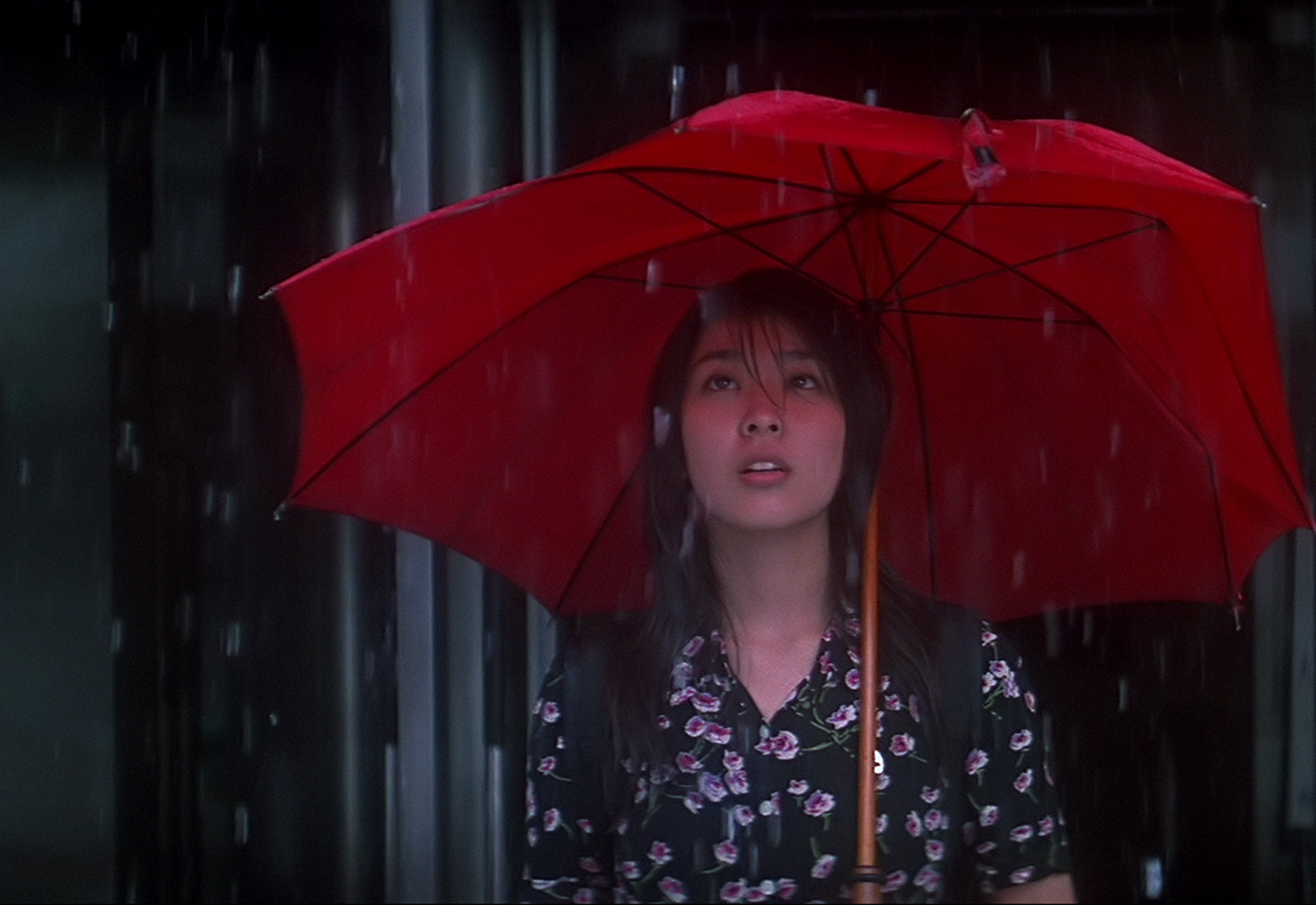
Iwai focusses on the domesticity of her newly independent existence, building a cosy nest in her tiny flat and attempting to cook for herself but finding her invitation to her neighbour for dinner politely rebuffed while uncertain if the fly fishing club is really for her given that the guy who runs it is condescending and incredibly full of himself. But then as she tells her mother on the phone she just wanted to try something new and there is something comfortable in the gentle rhythms of casting the fly especially as no one seems to do any actual fishing only practice in the park. She makes friends with the equally awkward Saeko and even finds her neighbour gradually opening up to the idea of friendship. Her world continues to expand until she’s finally ready to reconnect with the unrequited high school crush she followed to the city if admittedly in another slightly awkward meet cute involving a series of umbrellas, torrential rain, and a very patient gallery director. 

A self-declared “nice film”,  Iwai’s heartwarming drama is an innocent tale of first love and romantic obsession that is nothing other than sweetness and light. “A miracle of love” is how Uzuki chooses to describe her arrival in Tokyo and subsequent reunion with her romantic destiny, but it’s in the pursuit of love that she finally begins to come into herself and embrace the possibilities of life blossoming under the cherry trees of an unseasonably warm Tokyo.


April Story screens at Japan Society New York on Dec. 10 and will be available to stream online in the US from Dec. 9 – 23 as part of Love Letters: Four Films by Shunji Iwai

Original trailer (English subtitles)