Angel Guts: Nami (天使のはらわた 名美, Noboru Tanaka, 1979)

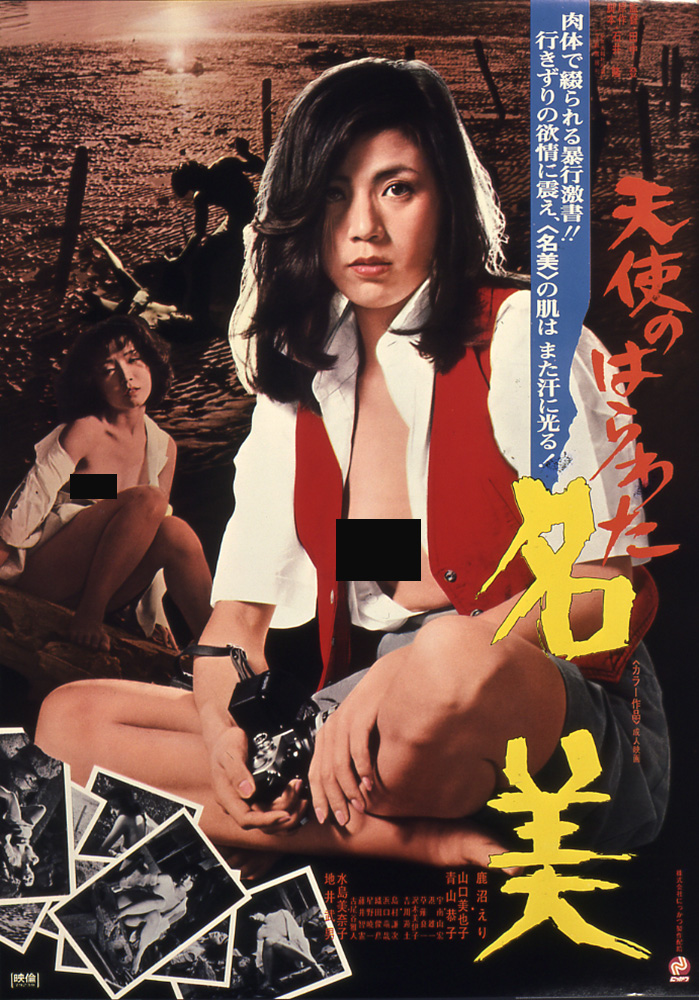
Aspiring journalist Nami Tsuchiya (Eri Kanuma) works for a magazine called “The Woman,” but it soon becomes clear she’s their only female reporter and one of a handful of women in an office otherwise staffed by men. Her editor has her writing a series titled “Rape and its Consequences” in which she attempts to interview women who’ve experienced sexual assault in an attempt to root out the effect it’s had on their lives. At times Nami seems a little conflicted, puffing away on a cigarette with a pensive look on her face, but there’s no denying that she’s sold out other women for a chance to make it in a man’s world by exploiting a suffering she does not herself share.

Muraki (Takeo Chii), formerly a top magazine editor, reminds her that not everyone who reads her magazine is a woman, but there is something perverse about the idea of her article which is otherwise conceived from a perspective that seems very male. The female readership of this magazine would not need to be educated about the prevalence of rape nor its consequences. Nami’s article doesn’t seem to want to find success stories, but to revel in misery. She accosts one of the women she’s hoping to interview and tries to badger her into talking on the record. Yoshiko appears fed up and tells her that recounting what happened would be like being raped all over again, but still Nami doesn’t relent. She tries to guilt her into speaking by suggesting that her testimony would stop other women being assaulted, which is backwards logic seeing as it isn’t the women who are responsible and even if she were advancing a victim blaming narrative that it’s on women to protect themselves, Yoshiko had not done anything that could be seen to be “wrong” nor is there any way she could have prevented what happened to her.

Through her articles, Nami has become complicit in this culture and is effectively an agent of rape herself in her desire to tear into the lives these women have tried to build for themselves and extract even more salacious detail. She describes Yoshiko as “happily married,” but she’s living in a rundown house on the margins of the city. It seems her husband maybe ill and therefore unable to work. Yoshiko may have married him out of a lack of other options and it’s not clear if her husband knows about her past or how he would react if he learned of it now. The fact that Nami’s attempt to interview others about Yoshiko fails bears out the social stigma that can surround those who’ve experienced sexual assault and suggests that Yoshiko has now become an outcast. The photos that they publish only black out Yoshiko’s eyes making it easy for those in her community to identify her which could certainly make her life much more difficult and lead to a loss of employment or social further exclusion.

It’s clear that Nami hasn’t really thought any of this through and is only focussed on impressing her male editors to be given better assignments. This may in part be what she means when she says that she’s been assaulted in her office by the people she works with on gaining more of an insight into the consequences of her writing. Though he threatens to rape her himself, Muraki seems to be a representative of a more compassionate masculinity but at the same time has been emasculated, rendered impotent after his own wife was raped by an intruder and then left him because he couldn’t satisfy her sexually. He connects Nami with a mentally disturbed nurse who was assaulted by a doctor with an autopsy fetish, though the incident was covered up by the hospital. None of these men, except Muraki, is held responsible for their actions. Nami, however, becomes all of these women, envisioning herself abandoned at the scene half-naked and clothes torn, discarded on the rubbish tip of the modern society. At the beginning of the film, a woman smashes the lens of the camera as a man moves towards her, as if she meant to rebuke us for watching, while even Nami finds herself becoming dangerously aroused by watching other women being assaulted or listening to their stories before she too cracks and begins to see herself as nothing more than an anonymous object at the mercy of male society.


Angel Guts: Nami is available as part of The Angel Guts Collection released on blu-ray 23rd February courtesy of Third Window Films.
The Man Who Stole the Sun (太陽を盗んだ男, Kazuhiko Hasegawa, 1979)

(C) Toho 1979

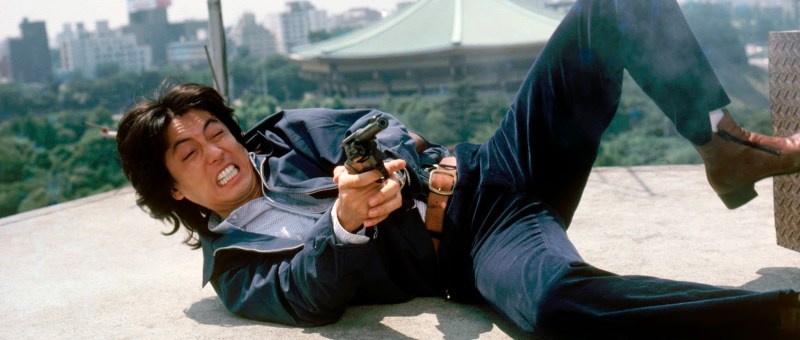
man who stole the sun posterIn the post-Asama-Sanso world, Japanese society had shifted into period of intense calm in which improving economic prosperity was in the process of delivering comfort rather than the creeping acquisitive anxiousness that began to overshadow the bubble era. Nevertheless, in cinematic terms at least anxiety was everywhere and not least among the young who, swept along by this irresistible economic current, were quietly doubtful about their place in a changing society. Co-scripted by an American screenwriter, Leonard Schrader (brother of Taxi Driver’s Paul), The Man Who Stole the Sun (太陽を盗んだ男, Taiyo wo Nusunda Otoko) provides a satirical snapshot of this confusing moment as an oppressed, belittled high school science teacher builds an atomic bomb in his apartment just to show he can but then realises he has absolutely no idea what to do with it.

Technically speaking, the science teacher’s name is Makoto Kido (Kenji Sawada) but no one really calls him that. The kids at school refer to him as “Bubble-gum” because he always seems to be chewing on the rather childish confectionary. Not the most conscientious of teachers, he tailors the curriculum to his own interests, teaching the kids all about atomic energy and the bomb, but the kids aren’t interested. They only want to know what’s going to be on the test. To them Kido’s information is irrelevant and so they ignore him, talking amongst themselves while he carries on, preaching to a seemingly empty room.

Meanwhile, Kido is building the bomb at home, for real. As he tells the kids, anyone can build an atomic bomb – you only need the plutonium which is, admittedly, tightly controlled for just this reason. He acquires his through a daring heist on a nuclear plant. Kido never elaborates on what prompted him to begin his bizarre masterplan, but there is certainly a degree of pent up rage inside him born of resentment with his reduced circumstances. “Just” a high school science teacher, who would really think he’d have the capability to build an atomic bomb, alone, using only household equipment (plus the plutonium and a custom furnace purchased after nearly exploding his oven)?

Kido’s problems are the same as many middle-aged men in ‘70s Japan in that he feels intensely oppressed from above and below. What he’s trying to tell the kids is that they have access to this power already – anyone can build a bomb, if you bother to learn how. The only thing that’s being kept from him is the plutonium (and for good reason), which he manages to acquire anyway. A chance encounter with the madness of the age seems to kickstart his plan into gear when he meets his opposing number in police inspector Yamashita (Bunta Sugawara).

Kido, having halfheartedly escorted a group of students on a school trip, finds himself rendered powerless once again when the bus is hijacked by a distressed older gentleman (Yunosuke Ito) armed with a rifle and grenade and wearing a World War II soldier’s uniform. He demands to be driven to see the emperor from whom he intends to demand the return of his son, presumably killed in the war 30 years earlier. Yamashita, clean cut and authoritative, is the gung-ho cop who masterfully brings the hostage crisis to a close by lying to the man that the emperor has consented to see him. During the evacuation the old man is killed by police snipers (despite Yamashita’s too late cries of “don’t shoot” after having dispatched the grenade and disarmed the suspect).

Like Kido, the old man likely didn’t really know what he intended to do, only that he was lonely and desperate. The emperor couldn’t give him back his son (whose uniform he seems to be wearing) and his gesture is one of futile defiance coupled with a suicide bid that has no real goal save making an elaborate protest against the world in which he lives. Kido makes the bomb, lets the authorities know he has it, but then realises he has no demands. He asks them to fix something minor that annoys him, to stop the TV networks pulling the plug on late running baseball games to make way for the news, and finds himself rewarded. He has taken back the power, they believe he has the bomb and they fear him, but he has no further goals or notion of how his society should change. There is no idealised future he is fighting for, all there is is futility and indifference.

Meanwhile, ironically enough, Kido’s desperation provokes a mini revolution in others. A talkshow radio host (Kimiko Ikegami) named “Zero” (in contrast to Kido’s adoption of the codename “No. 9” as the 9th owner of a nuclear device and the only individual), broadcasts his on-air request for ideas, believing it to be a kind of thought experiment. The ideas she gets from the public are of the usual kind – lonely men who want to bathe with naked women, nationalists who want to start a war with America, dreamers who think it might be better not to want anything and just embrace the dream, while she muses that she wants the Rolling Stones concert that was cancelled a few years ago after a band member’s narcotics conviction to be reinstated. That being as good as anything is what Kido goes for in an overture that passes as an odd kind of romance and a suitably ironic kick back against strait-laced authority.

Kido’s war is, in a sense, a war with the fathers of the world as symbolised by men like Yamashita with their suits and neatly trimmed haircuts. Their button-down existence has never offered anything to men like Kido who feel trapped and angry within it. Yet Yamashita is also reacting against his own generation of fathers as symbolised by the old man on the bus, the last remnant of wartime resistance offering a defeated cry against a world which got away from them. Yamashita let the old man die when he prioritised his own sense of heroism, and that annoyed Kido. He can’t help sympathising with his plight which is in a way also his own in being relentlessly silenced and ignored by austere authority figures.

Turning down Yamashita’s clumsy attempt at a pickup, Zero affirms that Kido has given her a dream, which no small thing and she feels bound to him because of it. It’s an ironic statement because Kido has no dreams and not only that, he has no future either – he is slowly dying of radiation poisoning despite his precautions during the building of the bomb. In their final confrontation, Yamashita, adopting a paternal authority, neatly summarises Kido’s dilemma. The only life he has the right to take is his own, and his own death is the only thing he really wants, but he’s embarked on this elaborate plan to make his presence felt all the while aware that he will remain totally anonymous. No one will ever see him. He will die, like thousands of others, faceless. A lowly high school science teacher, no terrorist mastermind or bomb building genius. His revenge is as absurd as it is futile. Male inferiority complexes threaten to drown us all in a sea of violent resentment, and as the Earth dies screaming all we will have to reflect on is that we ourselves brought this world into being through our own incurable apathy.


Original trailer (no subtitles)