
What Happened to Our Nest Egg!? (老後の資金がありません!, Tetsu Maeda, 2021)

A minor controversy erupted in Japan in 2019 when then finance minister Taso Aso issued a statement recommending that couples should have 20 million yen (£104,620 total at the time of writing) saved for their retirement on top of the state pension in order to live a comfortable life in old age. All things considered, 20 million yen actually sounds like quite a low sum for two people who might live another 30 years post-employment. Nevertheless, Atsuko (Yuki Amami) and her husband Akira (Yutaka Matsushige) are now in their mid-50s and don’t have anywhere near that amount in savings. They’re still paying off their mortgage and though their children are grown-up, neither of them seem to be completely independent financially and both still live at home. 

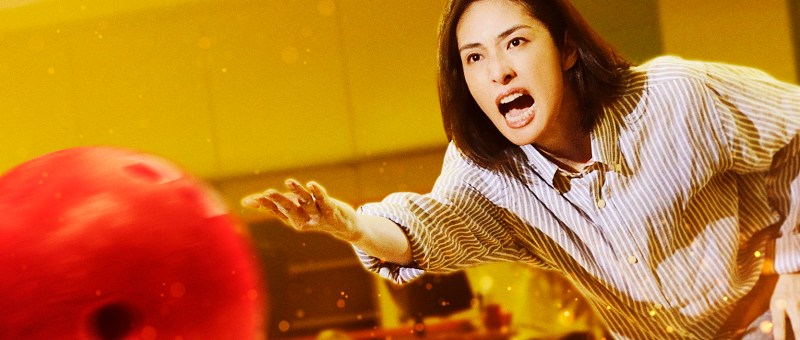
Tetsu Maeda’s familial comedy What Happened to Our Nest Egg!? (老後の資金がありません!, Rogo no shikin ga arimasen!) explores the plight of the sandwich generation which finds itself having to support elderly relatives while themselves approaching retirement and still needing to support their children who otherwise can’t move forward with their lives. Seeing an accusatory ad which seems to remind her personally that even 20 million yen isn’t really enough when you take into consideration the potential costs of medical treatment or a place in a retirement home, Atsuko has a sudden moment of panic over their precarious financial situation. The apparently sudden death of Akira’s 90-year-old father acts as a sharp wake up call especially as Akira’s apparently very wealthy but also selfish and materialistic sister Shizuko (Mayumi Wakamura) bamboozles him into paying for the entirety of the funeral while pointing out that they’ve been footing most of the bill for the parents’ upkeep over the last few years.

There was probably a better time to discuss the financial arrangements than with their father on his deathbed in the next room, but in any case Shizuko doesn’t pay attention to Atsuko’s attempt to point out they’ve been chipping in too. Akira’s mother Yoshino (Mitsuko Kusabue) also reminds them that their family was once of some standing and a lot of people will be attending the funeral so they need to make sure everything is done properly. The funeral arranger is very good at her job and quickly guilts Atsuko into spending large sums of money on pointless funeral pomp to avoid causing offence only to go to waste when hardly anyone comes because, as she later realises, all of the couple’s friends have already passed away, are bedridden, or too ill to travel. 

Yoshino is however in good health. When Shizuko suddenly demands even more money for her upkeep, Atsuko suggests Yoshino come live with them but it appears that she has very expensive tastes that don’t quite gel with their ordinary, lower-middle class lifestyle. Having lived a fairly privileged life and never needing to manage her finances, Yoshino has no idea of the relative value of money and is given to pointless extravagance that threatens to reduce Atsuko’s dwindling savings even more while in a moment of cosmic irony both she and Akira are let go from their jobs. Now they’re in middle age, finding new ones is almost impossible while their daughter suddenly drops the bombshell that she’s pregnant and is marrying her incredibly polite punk rocker boyfriend whose parents run a successful potsticker restaurant and are set on an elaborate wedding.

The film seems to suggest that Atsuko and Akira can’t really win. They aren’t extravagant people and it just wasn’t possible for them to have saved more than they did nor is it possible for them to save more in the future. Instead it seems to imply that what they should do is change their focus and the image they had of themselves in their old age. One of the new colleagues that Akira meets in a construction job has moved into a commune that’s part of the radical new housing solution invented by his old friend Tenma (Sho Aiwaka). Rather than building up a savings pot, the couple decide to reduce their expenses by moving into a share house and living as part of a community in which people can support each other by providing child care and growing their own veg. Yoshino too comes to an appreciation of the value of community and the new exciting life that she’s experienced since moving in with Atsuko. It may all seem a little too utopian, but there is something refreshing in the suggestion that what’s needed isn’t more money but simply a greater willingness to share, not only one’s physical resources but the emotional ones too in a society in which everyone is ready to help each other rather than competing to fill their own pots as quickly as possible. 


What Happened to Our Nest Egg!? screens as part of this year’s Japan Foundation Touring Film Programme.

Trailer (English subtitles)

Volunteering for Villainy (悪人志願, Tsutomu Tamura, 1960)

Tamotsu Tamura is best known as a screenwriter who worked closely with Nagisa Oshima, though he did actually direct a film himself at the beginning of his career. Having originally planned to become a reporter, Tamura was offered a job at Sankei Shimbun but his employment was postponed for medical reasons and he decided to retake the entrance exam for Shochiku joining the studio in 1955. Unfortunately Volunteering for Villainy (悪人志願, Akunin Shigan, AKA The Samurai Vagabonds) was not successful at the box office and Tamura soon left Shochiku along with Oshima and became a screenwriter at his independent production company. 

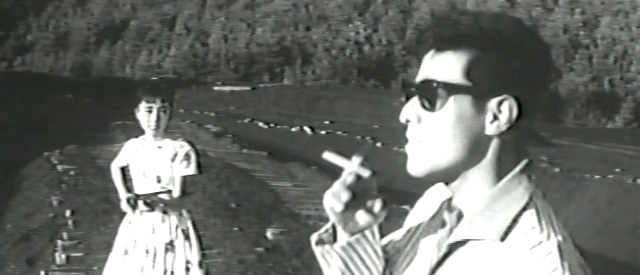
In any case, the film is very reminiscent of New Wave filmmaking both in terms of theme and aesthetic. It repurposes a moribund quarry town as an almost literal purgatorial space casting the protagonists into a deep hole from which they are eternally unable to escape. As the film opens, a collection of children are taunting a young woman, Hide (Kayoko Hono), calling her a murderer and castigating her for failing to die, though it later transpires that they’ve been hired by a henchmen of Tatsuo (Masahiko Tsugawa), the brother of the man she was involved in double suicide with who is determined to become some kind of local dictator.

But even he is in some ways rebelling against his powerlessness as the son of a local politician he brands as phoney and corrupt. Tatsuo claims he hates people who claim to be good but aren’t, in much the same way as Hide claims she can no longer trust anyone. Tatsuo seems to want revenge for the death of his brother for which he holds Hide responsible but insists he doesn’t want to settle it with money nor is he in favour when a shady local man makes vague allusions to having her bumped off.

When a new recruit, Yasuo (Fumio Watanabe), joins the quarry he becomes its latest kicking bag not least because it was Hide who escorted him into town. Yasuo has a stammer and incredibly meek manner that leans towards obsequiousness. “You’re as obedient as a dog,” people often remark with Tatsuo later astutely observing that he’s the sort of person who can’t do anything without someone telling him to do it. Yet it later seems as if his desire to obey, to be liked and accepted by those around him, has led him to commit a terrible crime claiming that he only did what everybody wanted done even if they were too afraid to say so.

Ashamed of himself and his corrupted masculinity Yasuo alternately rebels and overcompensates. He refuses to hit Hide when ordered to by Tatsuo, and to sleep with her when forced by the other men, but later hits and sleeps with her possibly not quite consensually when his masculinity is challenged. The irony is that Tatsuo who claimed he wouldn’t tolerate anyone defying him cannot control Hide’s free spirit and is therefore unable to overcome his powerlessness. He bullies and harasses her insisting that she leave town, but Hide refuses to go and is continually unbothered by the way she’s treated. Hide also eventually rejects Yasuo for his cowardice, severing her ties to him on realising that he informed on one of the other men who was fugitive from justice to curry favour with Tatsuo and take the heat off himself. She tells Tatsuo that though he’s always wanted things his own way, she’s always decided for herself, infuriating him with her free decision to leave having realised how petty and meaningless it was to stay in this petty and meaningless purgatory of broken and hopeless men. 

Tamura shoots with a roving and curious camera that takes on a life of its own swooping through the dorms but lends a degree of mythic eeriness to the final confrontation in the quarry as the workers begin to dot the skyline looking down at Hide below in a scene somehow reminiscent of L’Avventura. The town’s only bright spot is presented by Tatsuo’s younger sister Kiyoko (Chiaki Tsukioka) as the voice of reason even as she  brands everything boring and meaningless but thereby suggesting that it might not have to be this way. Her words, however, fall on largely deaf ears save those of Hide perhaps finally awake to her own agency only to have it immediately crushed by fragile masculinity.

It Was a Faint Dream (あさき夢みし, Akio Jissoji, 1974)

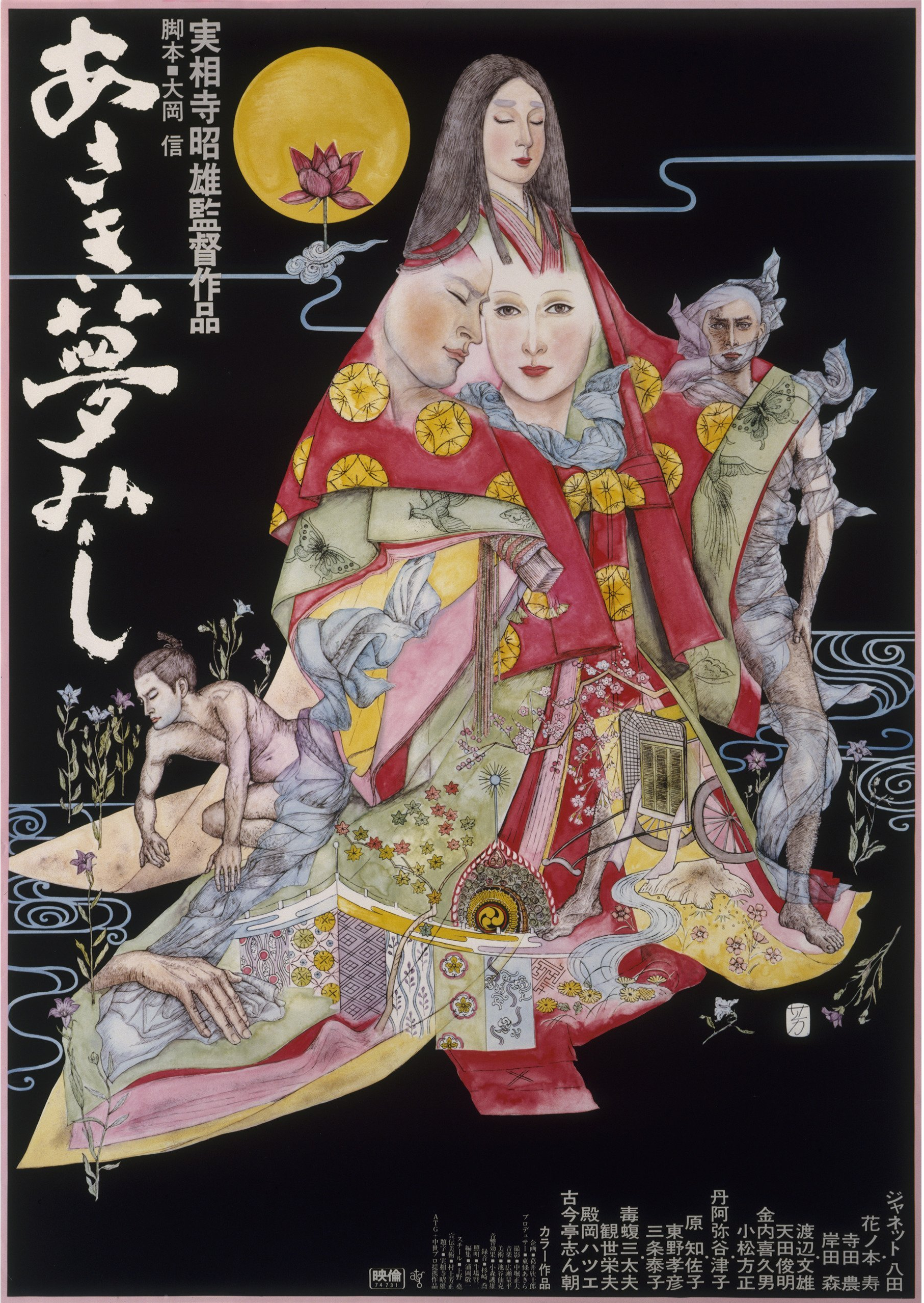
It was a faint dream posterFollowing his ultramodern Buddhist Trilogy, Akio Jissoji casts himself back to the Kamakura era for a tale of desire and misuse in It Was a Faint Dream (あさき夢みし, Asaki Yumemishi, AKA Life of a Court Lady). Taking its name from a Heian era Buddist ode to transience, Faint Dream follows its melancholy heroine on a fleeting path of love, loss, romantic disappointment, and finally spiritual rebirth while the nation faces the external threat of putative invasion by warlike imperialists hellbent on domination and conquest.

Shijo (Janet Hatta), an orphaned young woman taken as a concubine by the lord Tameie (Kotobuki Hananomoto), has returned home to await the birth of her child. The baby she is carrying, however, is not Tameie’s but that of another young noblemen, Saionji (Minori Terada), with whom Shijo had fallen in love before being taken by the lord. Hoping to pass the baby off as merely premature, Shijo has been deceiving Tameie and remains fearful she will be found out. Meanwhile, Saionji’s wife is also pregnant. When Saionji’s legitimate child is stillborn, an obvious solution presents itself and Shijo loses the first of her children.

A young woman without means or protectors, Shijo finds herself forced to indulge the whims of men in order to survive. Yet Tameie, falling ill, apparently thinks only of her when he pushes Shijo towards sleeping with other men in order to keep the peace, so that their resentment doesn’t become an all consuming evil. Thus it is that Tameie’s own brother, the high priest Ajari (Shin Kishida), falls for Shijo with a burning passion which Tameie fears could drag her down to hell with its implacable intensity. Reluctant and half disgusted, Shijo follows her lord’s advice, falling for the priest as she goes, and becoming pregnant with another child she must also lose.

Ajari’s radical Buddhist philosophy insists that chanting sutras is enough for salvation. It doesn’t matter if you’re high born or low or whether you believe or not, simply saying the words gets you into paradise. It’s a philosophy that appeals to Shijo for obvious reasons, but still she finds it near impossible to reconcile herself to her position of powerlessness within the court. A figure of desire, she is “courted” by just about every man she meets but has little right to refuse their attentions, especially as they often hold financial as well as social power over her. Tameie’s warning, ironic as it is in insisting that hell hath no fury like a man scorned, has its merit in bearing out the intensely destabilising properties of romantic love in a highly regimented society.

For all of that, however, Tameie is a romantic man, himself embittered by the disappointments of his life. Born to be a king, he prefers music and poetry to the sword but still laments his “betrayal” at the hands of the older generation who crowned him at three only to depose him at 16 and hand power to his 10-year-old brother with only a promise, apparently now broken, that his son would inherit the throne. Abandoned as a child, he has little sympathy for Shijo’s maternal pain on repeatedly having her children taken from her because of social propriety, merely reminding her that children and parents walk different paths and hers is evidently here, with him, at court.

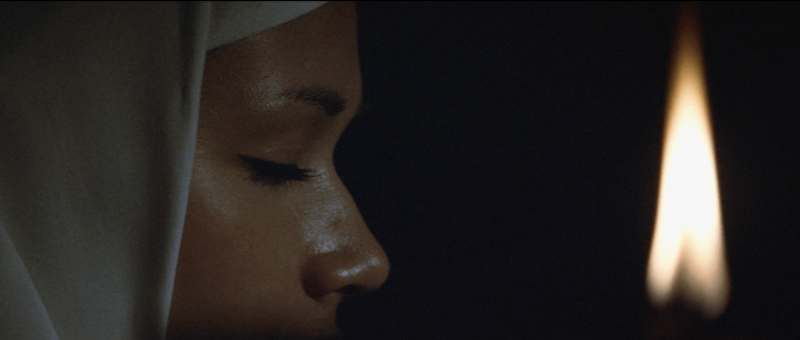
Even so, men are content to have it both ways. Romance is a transient thing, Shijo is told, a flower which blooms in an instant of truth but then scatters. Attachment is the enemy of love, the wise man admires the flower as its falls but does not mourn its loss forever. Shijo finds this hard to understand, but continues to live her life as an object of desire rather than an active participant until she finally stops and makes a firm decision of her own in choosing to reject it. She becomes a nun and wanders the land looking for serenity despite being told that no woman can become a Buddha because of the five obstacles in her way no matter how nobly she might seek it.

Ironically enough, Shijo’s life is in itself a “faint dream”. She chooses to reject her desires, but admires other women for embracing theirs, and remains seemingly ageless while the fleeting loves of her youth grow old and fade. The lords sit around perfecting their poetry while boys are pulled off their farms to combat a Mongol invasion, and a deadly disease ravages the country. Shijo turns to ask her former lover about the child they conceived together, but it’s as if she were asking about someone else in another time. Having received her answer, she walks off into the distance, a nameless nun, free of the cares of the world and no longer burdened by desire.


It Was a Faint Dream is the fourth of four films included in Arrow’s Akio Jissoji: The Buddhist Trilogy box set.

Original trailer (no subtitles)